Hello and welcome everyone to this evening's energy therapy gathering.
Today we're going to go into a meditation about our embodied self.
Before we go into the meditation I just want to tell you a little bit about what the purpose of this is and what made me select this as the focus of what we would meditate on this month.
Oftentimes as we're moving through life we have many different emotional experiences.
For some of us we might even notice our emotions can shift from moment to moment or we might notice that we get uncomfortable with certain emotions and really comfortable with others.
In our emotional experiences it is very common that we are not in our embodied self.
When we think of embodied self you might have heard the term in many different ways.
It's often a term that is used in different maybe spiritual teachings or yoga if you practice yoga in any form,
Even different meditations or works on consciousness or spirituality.
In the focus today of embodied self it's about really being in ourself,
In our body,
In the full experience.
As is in all those different areas I mentioned that you might have heard the word embodied but for this experience it's really about the embodiment of our emotions.
If you have awareness around addiction,
Addiction can be to anything.
It can be to substances,
It can be food,
Gambling,
Shopping,
Thought addictions,
Social media,
Our phones.
It's a huge one right with the phones and people if you ever see how plugged in and tuned in they are to their phone.
But in any type of addiction it's about escape,
It's about disconnect and it's often disconnect from body.
What would make us want to disconnect from our body?
It's about emotion and the experience of it oftentimes for people and they don't want to feel it.
They don't want to experience the emotion in the body or maybe they don't even recognize that's what's going on but they feel a bit of discomfort or fear or hesitation.
Well that same thing runs on autopilot for many of us even if you don't struggle with any type of addictive behavior or choice selection in how you're living or escaping.
The lack of embodiment with our emotions it can really go across many different platforms.
In our everyday even in a conversation we might tap out from our embodied self.
In our own reflection or thought we might kind of tap out and move away from the body.
When we want to regulate our emotions and understand our emotions embodiment is the most pivotal thing in helping us to create regulation,
Comfort and move away from fear and also gain experience and understanding of our emotion.
By slowing down when we do this we get to understand.
We get to open up that window to ourself and know what the body feels like in emotion and that is the regulation.
A lot of times when I'm working with individuals who are trying to gain emotional awareness,
Emotional intelligence,
Emotional embodiment we will talk about this in different ways and how in the experience by letting ourselves experience the emotion that embodiment of the emotion can be such a valuable tool because if we try to think it away we think about it more.
If we are running on a hamster wheel and our mind is going and we're like stop thinking about it or I don't want to feel this we think about it more and we often will feel it more but not in the way that's beneficial.
But when we can sit with our emotions in the realness of what we're experiencing in the now and in the moment in our body it allows us to regulate.
It allows us to understand because every emotion feels different actually in where it even is in the body.
Every single emotion kind of lies a little different,
Reacts a little different in the energy body but also in the physical body.
How we breathe,
Where we hold tension,
Even different sounds you might hear your body make.
So with this evening's meditation we're going to go through where we go a bit into the body first in a connection and following of our breath and then I'm going to guide you into different memories each with four different emotions that will bring into the meditation.
During those periods of time there will be moments of silence and it is so that you can experience the emotion in your body but also have a bit of the memory come in in that experience in the body.
And then I'll guide you back out and we'll talk about it well I'll talk about it a bit with you in terms of how you might include this in everyday life.
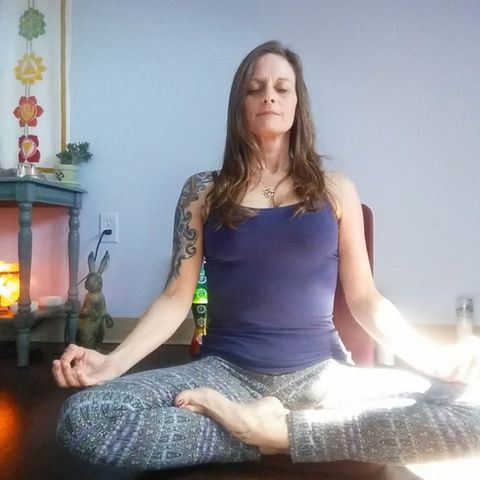
So with that you can start to get comfortable in your space whatever that is for you and I'm gonna grab a sip of my water here as you do that.
Remembering your comfort can be whatever that is for you.
You can be sitting up in something like on a backjack here myself,
Meditation cushion like something like that or whatever works for you.
You can lay down for this it's not something that you have to be sitting up for as long as you are sure that in lying down you're not going to fall asleep if that's not what you would like to have.
Falling asleep is also perfectly fine and you can always begin again when you're feeling ready your body will experience whatever it needs to in that moment.
So getting yourself comfortable you don't have to sit in lotus position if you're sitting and you can also maybe put something under your knees if that's comfortable for you also.
And when you're feeling ready just start to close your eyes and start getting relaxed in your space.
You might find yourself wanting to wiggle around a little and move into feeling settled and that is perfectly fine.
Just letting yourself begin to relax and gain a little comfort in your surroundings.
You might be in these same surroundings many times through your day but when you're sitting in stillness in the space you might notice the settling settles in just a little different.
And you can start with just connecting with your breath in whatever rhythm you find yourself.
Just beginning to follow that gentle ebb and flow as you inhale and exhale.
Still not trying to change the rhythm of your breath and continuing to follow this gentle ebb and flow.
Notice with that ebb and flow how your body moves with it.
As you breathe in you may notice your body expanding,
Filling up with this breath.
And as you exhale letting the breath out you can notice how your body begins to flatten out a bit.
Your shoulders dropping a bit further to the earth or just relaxing against the ground if you're lying down.
This gentle rhythm that automatically happens.
You don't have to make it happen.
Breathing in and breathing out.
Your body's natural support system.
For a few series of breaths here let's work on evening out your breath a little.
So at your own count.
Try to breathe in for a count of four.
Hold for one to two seconds.
And then breathe out for a count of four.
And holding at the top for one to two seconds.
Breathing in.
One,
Two,
Three,
Four.
With a hold.
And breathing out.
One,
Two,
Three,
Four.
With a hold at the top.
And just take a few breath cycles there.
Your own rhythm of count.
Four in.
A hold.
Four out.
And a hold.
And you can start just returning to your natural rhythm.
And maybe noticing any difference.
You might notice your natural rhythm is just a little more steady and relaxed.
You may even notice that your breath is filling your body up more to the base down by that belly button as you inhale.
And that you are releasing more fully on your exhale.
As you're breathing in and out,
Move your attention to the tip of your nose.
And as you inhale through your nose,
Just feel the air flush by the tip of your nose.
And when you exhale,
Again,
Feel that air just passing past the tip of your nose.
One more breath cycle here.
And with your next inhale,
Follow that breath just a little further.
As you inhale through your nose,
Follow it past the tip of your nose and down in through your nostrils.
And see if you can still follow it a little further as it goes maybe towards the top of your throat.
Following it down your spine.
And with the exhale,
Following it up the front of your body,
Keeping the focus inside the body.
Pulling the breath up around the stomach,
The chest,
The heart,
Out the nose,
Past the tip.
And inhaling again in,
Feeling it on the tip of your nose,
Through your nostrils,
Following that breath through the throat,
Down the spine.
You might even try to follow it all the way down the legs to your toes.
And with the inhale and exhale rhythm,
Following that exhale,
And up inside the front of the body,
Around your hips,
Your stomach,
Lungs,
Your heart and your throat,
And out of your nostrils.
At your own pace and your own rhythm,
Follow your breath cycle here a few more rounds.
Focusing this breath cycle in the inside of your body.
And inhale,
Maybe even picturing it surrounding each part of your spine.
As it illuminates the muscles and the bones within.
And each exhale,
You might find it engulfing around and embracing your organs,
Ribcage,
Your heart,
And even your shoulders and collarbone.
Noticing how your breath moves through you to support you at all times with no effort.
But also how your mind can follow this breath through your body.
You can feel it giving oxygen to every part of your being.
With your inhale,
You may also just feel it start to allow yourselves to have more movement,
As it gives them life.
And with each exhale,
You may find that it's releasing and letting go of things those cells no longer want or need.
Breathing in,
Breathing out.
Allow yourself in your mind's eye to pull up a memory.
And in this memory,
Allow it to be one where you experienced a feeling of anxiety or worry.
It might be something recent for you.
Or it might even be something that you repeat often from your past.
Or maybe even one of those illusionary memories that we repeat that's never actually happened.
Whatever it is for you,
Bring this memory into your mind.
Knowing this is a safe space and it will only be for a few moments.
As you think about this memory,
Try to pull in all of your senses that were part of that experience.
Noticing how you felt emotionally.
But trying to remember what your other senses also felt.
As you follow your breath in this memory,
Follow around the inhale and notice where this emotion is also present in your body.
You might notice it in your gut area or maybe in your chest or shoulders.
Sometimes we might even feel it in our heart or lower back.
Just notice for you as you're remembering this memory and as you follow your breath,
Notice the areas that are holding on to this emotion with you.
You may notice in this experience that some of the way the body feels or is holding these emotions can feel a little uncomfortable.
But that you're also okay.
You might notice even a bit of desire to push away the emotion or that body feeling as you experience it.
Just allow yourself for one more moment to experience and sit with this discomfort.
The unease of anxiety in the body.
In any of those areas that you noticed within your body that was maybe holding a bit of tension around this emotion of anxiety,
Follow a few breath cycles there.
With your inhale,
Follow that breath to that area and imagine it's surrounding that muscle of tension.
And with the exhale,
Allowing it to collect any tension and release it.
Following that same path up through the body,
Through the throat and nostrils and past the tip of the nose.
Take a few rounds of breath,
Following the breath into those areas and following it on the exhale.
Now just take a moment or two to simply connect with your breath.
Remembering that you are just in your space,
That all around you in your current moment is safe and secure.
That was simply a choice to bring in the emotion in that moment.
And now we move to the choice to let go of the emotion in this moment.
Feeling ease and comfort in the body as your breath supports you.
And now in your mind,
Bring in a memory that reminds you of a time you felt courageous.
It could be something current in life,
Could be something from the past,
Or maybe even one of those illusionary thoughts that play on repeat.
Bring in a memory.
If it can be an actual memory that has occurred,
That's even better.
But something,
An experience that brought the emotion of courage for you.
And just like we did the last emotion,
Try to bring in all your senses.
What was that experience like for you?
As you're going through this memory and your senses that were there with you,
Notice again what you're experiencing currently in your body.
You might notice that there are sensations or different feelings in your muscles,
In some of even the same areas of your body that you had when you were remembering anxiety.
Like your heart,
For example.
But you might notice here with courage,
It feels different.
Notice the difference.
And maybe even new areas in your body that feel this emotion with you,
That are experiencing this emotion of courage with you.
Take a few moments to notice these areas wherever they are for you.
These areas that you notice within your body.
Going to follow the breath there again.
As you inhale and you follow that breath past the tip of your nose and through your nostrils,
Follow it to whatever areas in your body that you notice hold this courage with you.
And with that inhale,
You're again going to let the breath circle around and embrace these areas.
And imagine at the same time it's watering these areas to continue to have them blossoming and present in every moment.
Noticing how abundant the courage is within you and how you can access it at any time.
And breathe out courage,
Allowing it to be a cycle in and out,
This flow all around you.
Your own rhythm.
Follow this breath cycle for a few breaths here.
And now returning back to just following your natural rhythm.
Reminding yourself you're just in your current space.
If that was just a memory you chose to bring in,
And now you are making a choice to let it go in this moment.
And now we're going to allow ourselves to pull in another memory.
And in this memory,
We are going to bring in a memory that brings a feeling of sadness.
You may choose to have it to be a little bit of a lighter memory of sadness if you desire.
But just letting yourself bring in a memory that brings the emotion of sadness.
And just as you did before,
Trying to bring all your senses into the memory with you.
As you're connecting with this memory and the senses just as before,
Notice where this emotion is experienced in your body and what that experience feels like.
It might be some of those same areas or around the same areas.
But with the heart,
For example,
You might notice it's much different when you're going through the emotion of sadness.
Wherever it is for you,
Just start to notice how this emotion of sadness feels in your body.
Continuing to connect with this memory and the awareness in your body of where the memories lie and the emotion is experienced.
Follow that breath cycle into those areas,
Past the tip of your nose,
Through the nostrils and down the throat.
And then follow it to whatever areas in your body are experiencing this sadness with you.
Embrace those areas like a warm hug.
Offering loving kindness,
Tenderness and care.
And with the exhale,
Allow the release of the heaviness that you're holding around it.
Again,
Following that breath through the inside of the body,
Around the organs,
The ribs,
The heart,
Shoulders,
Collarbone,
Throat,
Nostrils and past the tip of your nose.
At your own pace,
Follow a few breath cycles here.
And now returning to your natural rhythm of breath in the moment you're in right now.
Reminding yourself you are just in the room,
Sitting in the space that you are in.
All is safe and secure around you and that this was just a memory that you chose to bring in.
And in this moment,
You're choosing to let it go.
Just follow your breath right now in the space you're in,
In the rhythm your body feels with the breath.
And now in your mind,
Bring in one last memory.
Bring in a memory for yourself that you experienced great joy.
It could be joy in terms of happiness,
Or it might be joy,
Like laughter and humor,
Where you had a hard time even catching your breath.
You were laughing so hard.
Bring in all your senses in this memory that you're having joy,
Happiness,
Laughter.
As you experience this memory,
Notice again where you find it in your body.
What does it feel like to have this emotion run through you?
As you notice the areas in your body,
Follow that breath again,
Past the tip of your nose,
Your nostrils,
And your throat,
Into the areas of your body where you notice joy lying and being experienced with you.
And allow that breath to circle around and feel it like a cushy cloud,
Something light and airy.
And then with the exhale,
Allow yourself to also let that flow of lightness,
Of joy,
Enter in through the whole body,
Around the organs,
Your ribcage and heart,
Your throat and out your nostrils.
Breathing in and embracing,
Feeling this light cloud of softness around any areas of the body.
And as you do through the exhale,
Keeping that flow going of this light,
Soft airiness of joy,
Going all through the body,
The organs,
The muscles,
The bones,
And following it out of your nostrils.
And following your natural breath rhythm again,
Back in the present moment where you are.
Connecting with that rhythm,
The body and the breath.
And returning again for a few breath cycles.
To the four,
Count the hold,
The four out,
And the hold.
Breathing in,
One,
Two,
Three,
Four,
Hold.
And exhale,
One,
Two,
Three,
Four,
And hold.
And breathing in,
Four,
Four,
Count.
Following that cycle at your own rhythm for a few breaths here.
Taking a nice deep inhale here.
And exhaling out of the mouth.
One more round,
Nice deep inhale through the nose.
And exhaling out of the mouth.
Begin to wiggle your fingers and your toes.
Gently starting to move around in your space.
And maybe stretching a little.
You're welcome to open your eyes to return to your screen,
Or you can keep your eyes closed and stay relaxed as I just share a few things about our meditation experience.
Thank you for joining me for that experience.
Something that you can take from this where you can then integrate it into your daily life.
We noticed in that experience a few things.
First,
Our breath is always there.
We don't have to try,
It's there.
We can use the breath as a way to support ourselves because our breath changes sometimes with emotion.
But as we sit in our body and experience emotion,
We begin to understand how things change and shift a bit.
One of those things being our breath.
And as we notice that change,
We can come back to regulation.
We can use the breath to soothe and ease.
We can follow the breath to release and bring balance.
The other thing we noticed was choice of memory.
And when we choose to bring in memory,
We can really experience the memory and the emotion with it.
We also notice though that it's impermanent.
That when we make an equal choice to let it go and come back to the present moment,
Which is the only moment that the emotion shifts and changes as well.
So all emotions are impermanent.
And so are the body experiences that go with them.
So in the breath and in the body,
And in the awareness,
You may notice you don't have to fear being embodied in your emotion.
Because it's one of your most valuable tools for emotion regulation,
For emotional awareness,
But also for emotion release.
When we don't sit in body and embody ourselves with our experience and our emotion,
The cells hold on tightly to the memory.
It drives our subconscious and our unconscious.
The more we know,
The more we move into conscious living.
I hope you found that meditation helpful to enlighten your own awareness around your emotions,
But also to find an appreciation and love for the body experience of emotion.
It's one of the beauties of our humanness.
Thank you as always for joining me.
And I look forward to seeing you all again very soon.
You can also,
As a side note,
Just incorporate this into your day for 10 minutes,
Or in the now of the experience of an emotion.
How do I feel in this moment?
And how can I best support myself?
See you soon,
My friends.
Namaste.