Good morning.
I'll be talking about Gu Jin,
Or total exertion,
Today.
As you know,
Zen is primarily a practice-oriented discipline.
Zen defines practice,
And practice defines Zen.
Gu Jin,
Or total exertion,
Total manifestation,
Total penetration,
Is a central notion in the Soto Zen tradition and points to this practice orientation.
Gu Jin is short for Ippo Gu Jin,
Or the total exertion of a single thing.
It's the individual or personal complement to the cosmological dimension described in Zenki or total functioning.
Together,
We could say they represent the relative and the absolute,
The one and the many,
Our uniqueness as individuals,
And our oneness as whole being.
The Dogon scholar Hee Jin Kim amplifies the connection between the radical experiential nature of Zen and total exertion as an active process,
And he writes,
And I quote,
The reality of total exertion is thoroughly saturated with the principle of asesis,
Namely practice or discipline,
Privileging the latter,
Practice over vision,
Not in order to deny seeing,
But to explicate a deeper meaning,
One that seeing itself is fundamentally creating and making.
The path to studying Zen and the emphasis on practice is to study the experience of self.
The study of self requires being fully and totally present with one's experience here and now.
That's why we practice without obstruction of what Katagiri Roshi described as decorations,
Meaning techniques such as breath counting,
Visualizations,
Mantra,
All those kinds of things.
From this perspective,
No other time,
Place,
Or vantage point exists except the immediacy of the present situation.
The past is no more than a memory,
Whether it's faded or vivid.
The future is no more than a wish or a fantasy or a concern.
This basic assumption lies behind the intensely experiential,
Personal,
And practice-oriented nature of Zen training and practice.
In Dogen's extensive writing,
The notion of total exertion or gujin is simultaneously pervasive and elusive.
Pervasive because it constitutes a major theme that he implicitly draws on throughout his writings.
Elusive because despite the significance for Dogen's active,
In-the-world,
Non-dualistic religious practice,
He didn't write a specific or detailed fascicle devoted exclusively or exhaustively to total exertion.
Dogen commentators pull on threads throughout his opus to address total exertion.
For example,
As in the title of the pivotal Genjo Koen fascicle of Dogen Shobu Genzo,
Genjo Koen can be translated as immediate or present manifestation,
Manifesting suchness or reality here and now.
When we focus our full energy and attention to the task at hand,
Whatever that activity might be,
Washing dishes,
Sitting in zazen,
Walking or eating or working,
Life becomes fully exerted.
We become totally exerted.
The situation becomes totally exerted.
From this perspective,
In terms of realization,
Dogen writes,
And I quote him,
The known,
Which appears limited,
Is born and practiced simultaneously with the complete penetration of the Buddha Dharma.
This quote from the classical Japanese poet,
Tamakane,
Who actually was born the year after Dogen died.
It's a good example of the application of total exertion to the creative process.
And I quote him here,
In order to express the true nature of the natural scene,
One must focus one's attention and concentrate deeply upon it.
Therefore,
If you try to harmonize your feelings with the sight of cherry blossoms in spring,
Or with the autumnal scene,
And you express them in words,
Without allowing anything to intervene between your feelings and the scene,
Then your work will become one with the very spirit of heaven and earth.
Tamakane points to the interfering impact of abstractions such as concepts,
Definitions,
Ideas,
Dogma,
Religious beliefs,
Theories,
Which can intrude and buffer direct experience.
Without such intrusions,
The poem becomes a matter of lived experience,
No more and no less.
Now,
My intention here is not to devalue concepts and reasoning processes.
I simply want to demonstrate at this point the notion of freedom from obstruction,
Which is crucial to understanding and living in total exertion.
I think this haiku by Isa amplifies this point.
The spring breeze pushes somebody down the slope.
Note there's no speculation,
No inference,
No conceptualization,
Simply the scene itself.
The reader who remains open to the experiential dimensions of the poem will be placed in the scene and will feel its impact.
The objective aspect of the experience presented in the poem evokes the reader's subjective participation in the poem.
The total situation fully involves both poem and reader.
As a result,
The reader has the opportunity to fully participate in the scene.
As reader,
I am on the slope,
Pushed by the breeze.
Isa does not intrude or impose himself on me.
He doesn't have to tell me what to feel.
My psychic space remains open,
Unsaturated,
And I'm free to fully feel whatever emerges for me.
What emerges for you?
We might ask,
What is the true nature of any scene?
What is the true nature of any dharma?
Zazen?
Any encounter?
The marketplace?
The sound of crows at dawn?
What's natural?
Natural.
Spontaneous.
Unnatural.
Contrived.
Can we know these things?
How do we know?
Do we know through cognition of thinking,
Intuition,
Or a combination of both?
Is one mode privileged at the expense of the other?
How do we live in fullness?
In emptiness?
In the fullness of emptiness and or the emptiness of fullness?
Are these questions amenable to answers?
From the Zen perspective,
The question is the answer.
In any case,
Such questions and answers serve as loose threads to pull on.
Here's a definition.
The philosopher John Stombaugh writes in a lovely little book called The Formless Self,
Quoting,
Looked at from the standpoint of the situation itself,
The situation is totally manifested or exerted without obstruction or contamination.
Now,
Stombaugh asserts that,
And I quote her again,
The person experiencing this situation totally becomes it.
He's not thinking about it,
He is it.
When he does this,
The situation is completely revealed and manifested.
Total exertion refers to an opening that calls for a response to every situation.
The intention here is on opening or presencing as fully and as completely as possible.
Total exertion both generates and is the experience of absolute reality,
As that reality manifests in one's moment-to-moment lived experience.
Total exertion requires full participation totally with nothing left out for opening to and fully experiencing this manifestation.
As Stombaugh seems to suggest in her definition,
There is a total lived,
Felt,
In the moment experiential disclosure of ultimate reality.
You notice there are several translations of penetration,
Manifestation,
Exertion.
I use the term total exertion for the sake of consistency.
As I see it,
More importantly,
Because it points to the active involvement of the practitioner that generates the manifestation and realization.
In this way,
From the perspective of practice,
The emphasis centers on your participation in an active ongoing process rather than simply preoccupation with a result,
Which can become rarefied and limiting.
As an active process,
The opportunity for total exertion occurs in each and every moment.
In this regard,
Every ordinary moment,
Every ordinary activity becomes special,
Sacred,
And profound in its ordinariness and simplicity.
Total exertion engenders and is an expression of this manifestation of absolute reality when no aspect or part of the self is left out.
And when one is fully present,
This fully lived moment here and now is it.
However,
The anxieties that might stir up about living fully present interfere with this experiential realization and awareness.
As a result,
Life can become difficult and seemingly more of a challenge than we bargained for.
We leave ourselves out,
Perhaps more or less partially present.
We daydream.
We become preoccupied with results.
We space out.
We strive toward preferred psychological states,
And we imagine alternative realities.
If there is another transcendent state of reality or being other than what is present here and now,
Right before us,
Then what would that state be?
This points to the internal perceptual shifts that enable us to fully realize this reality here and now.
In this moment,
Zazen makes sense through the experience that confirms for each of us that such practice engenders the capacity to totally penetrate or exert the sense of wonder,
Depth,
Specialness,
And spiritual being in ordinary activities of everyday life.
In this way,
Total exertion functions as an activity that facilitates intuition and subjective knowing.
What the Japanese philosopher Hisamatsu,
And we stumble over his name,
Describes as being in complete unity with the flow.
He calls this ordinary mind,
Which some folks have taken from him without giving him credit,
Which annoys the hell out of me.
Anyway,
In the Zen tradition,
Expressions such as chop wood,
Carry water,
Eat plain boiled rice,
Drink plain green tea,
When eating eat,
When drinking drink,
Express the ordinariness of this unity and flow.
Let me talk a little bit about what I would call obstacles to being,
Even though we're being all the time.
It's a paradox.
Anxiety can create and feed aimless rushing around mindlessly and half-heartedly getting through the many tasks of the day that we are faced with.
This rushing unconsciously and unwittingly further increases anxiety.
We can get caught up in a vicious downward spiral until we burn out.
This ongoing mindless recklessness becomes internalized and contributes to an unquestioned way of life and inadvertently further increases anxiety.
Mindlessness replaces living in awareness as the full attention to our activities diminishes and with it the quality of what we produce suffers,
As does the quality of life.
Awareness can be co-opted by this anxiety-driven defensive mindlessness by splitting the person into an observing self,
Watching and operating self,
But safely split off and removed in the distance from the fullness of being.
Over time,
Meeting the pressures of the day in this anxious half-hearted way becomes unfortunately normalized.
Here's another haiku.
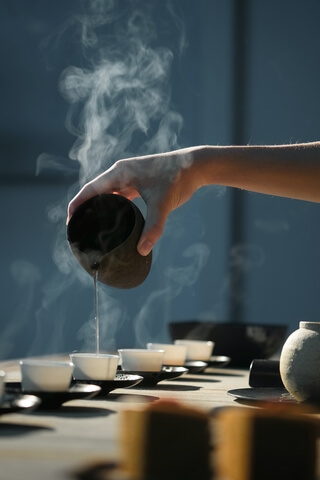
Black coffee,
Steam swirls rising,
Silent morning.
Black coffee,
Steam swirls rising,
Silent morning.
Zazen expands the moment and diminishes the need to rush.
I could sip my morning coffee with full awareness.
In fact,
It's one of my favorite times of day.
I can savor its aroma and flavor,
Feel its warming my chest,
And enjoy a sense of satisfaction when it's brewed well.
Alternatively,
I could gulp it down and quickly run out the door,
Maybe even burning the roof of my mouth.
The choice is mine.
It should be clear from this description that total exertion expands each moment into infinity,
Which spreads out in infinite directions.
This expansion and presencing of each moment can contribute to a feeling of well-being.
The experience itself takes us beyond any cognitive notions dichotomized as mindfulness,
Mindlessness.
I simply sip coffee.
No more,
No less.
In this regard,
Total exertion reflects the fundamentally subjective nature of Zen practice and experience,
Which in turn engenders living a fully unified and subjective life.
Over time,
Zazen practice makes this experientially clear.
It's a basic human habit to follow well-worn streams of thought,
Feelings,
Or moods.
Like a river,
Mind currents forge new channels in the riverbed and create the conditions of flow.
The work of total exertion can alter this flow by creating new channels and altering old ones.
The potential for freedom resides in our capacity for exercising total exertion.
This freedom derives from embracing or being the situation.
In this way,
Total exertion simultaneously becomes an affirmation of the situation itself,
An expression of the situation itself,
Ultimately of life.
Zen practice thus becomes a full expression and affirmation of life,
Being as it is,
As Suzuki Roshi would say.
Practice engenders a radically realistic solution to suffering.
Rather than becoming removed from the seemingly mundane,
Ordinary,
Everyday world and its problems,
The Zen practitioner experiences this shift in perception,
This sudden and radical alteration of perception,
Occurs instantly upon what Dogen describes as body and mind dropping off.
Infinity radiates from the nodal point of the lived moment.
As this moment expands into infinity,
Or rather,
Infinity becomes realized,
Expressive possibilities expand,
New creative expressions evolve into form.
For instance,
For the writer,
The blank page,
So full of blankness,
Blankness totally exerted,
Becomes the fullness of blankness and the point,
Subject,
And matrix of the writer's expression.
The world is viewed differently,
Priorities change,
Relationships change,
And life becomes revitalized.
From this perspective,
Compassion is automatic,
Spontaneous,
And selfless,
And comprises an action or response to that reality.
So you could see total exertion holds profound implications for every area of our life,
How we relate to ourselves,
How we respond to others,
And how we deal with work and with play.
In short,
When the energy of the Zen impulse becomes totally exerted,
We can have an impact,
And life has an impact.
Total exertion as practice encompasses all activity.
It is inclusive,
Not exclusive.
Francis Cook elaborates this crucial point by noting that,
And I quote him,
In this view,
A particular actuality is never devaluated or obliterated.
To the contrary,
The uniqueness,
Freedom,
And purity of a single Dharma emerges unequivocally into the foreground.
And I'll conclude with a bit of repetition of what I already said.
This makes every ordinary situation significant and important.
We can say that each situation is unique in its ordinariness and ordinary in its uniqueness.
Can total exertion be applied to all situations?
Can we exercise the same sense of attention to washing a dish as we do to saying a prayer?
And I don't mean getting spaced out on washing the dish,
Going into some transcendent state.
I just mean washing the dish,
And I just mean saying the prayer.
For me,
This teaching becomes real through this challenge.
Do we really tend to the moment fully and totally?
Here's a simple observation that could be instructive.
When rising from the Zafu or from your chair at the end of a period of Zazen,
Is the mind already rushing ahead to a preoccupation with the next task at hand?
Are we fully present with stretching out the legs and rising to the feet,
Bowing?
Or do we simply go through the motions blindly and absent-mindedly?
If we can't do that when we're alone,
How can we expect to be fully present with the complexities of being with others,
A group,
A friend,
A Sangha?
Then I ask,
Is there something intolerable about the present or about the impact of a friend,
A partner,
That would keep one focused on the future?
Dreaming?
Imagine realities?
What feelings reside beneath this thinking-ahead mind?
What stirs up from within that needs to be defended against?
Anxiety?
Resentment?
Humiliation?
Boredom?
Anger?
I could go on and on.
There's so many different feelings and thoughts that could come up.
How do external factors influence our feelings and behaviors?
This attitude finds expression in this story from the Sufi tradition,
Which I'll use to conclude today's talk.
Mala Nasruddin,
The spiritual fool,
Was sitting in a temple with his feet stretched out and facing the altar.
The high priest,
Upon observing Mala,
Became extremely upset.
He chastised Mala for his sacrilegious behavior of pointing his feet toward the altar,
God's residence.
Mala apologized and made this request,
Please place my feet in the direction where God is not,
And I'll never move again.
Thank you.