I used to live in the western Catskill Mountains of New York State,
Right by the upper Delaware River,
Where one can find beautifully polished river stones in the flowing waters along the banks.
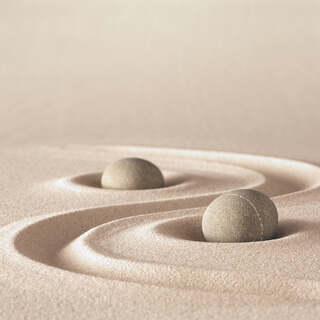
The process of becoming a river stone exemplifies the Zen notion of musho toku,
Or practicing with no gaining mind.
We're all stones in the stream,
Our surfaces slowly being polished and smoothed out as we continue to sit and practice.
This is one of the many paradoxes one encounters in Zen teachings.
That is,
We sit with no gaining mind,
Letting go of expectations,
Goals,
Wishes,
Desires for something special to happen.
And in this simple ordinariness,
Something does shift.
Sometimes the shift is dramatic and feels life-changing.
Sometimes the shifts are extremely subtle and barely perceptible.
Often,
We only realize these shifts in retrospect,
As we spontaneously respond differently to a challenging situation than how we might have habitually reacted to such situations in the past.
These experiences can be quite surprising and life-affirming.
The thing is that the stones didn't go into the river with the intention to become smooth and polished,
And the river did not flow over the stones with the intention of polishing them.
But over time,
They did become polished and smooth,
And then became identified as river stones.
I have three on the altar in my Dokasan room representing the Buddha.
During the persecution of Buddhism in China,
We are told that Zen survived the best because of the absence of ritual and ritual items such as statues.
However,
Practitioners acknowledged their commitment to the Buddha,
The Dharma,
And the Sangha,
The three gems,
By the practice of piling three stones vertically.
Stones in the Stream serves as a good metaphor for Shikantasa practice,
Shikantasa which means just sitting and only sitting.
We are stones just sitting still in the stream of infinite becoming,
Of ongoing constantly changing perceptual experiences,
Without reacting.
We may hear sounds on the busy street outside the temple.
We may notice the rising and falling of feelings and memories and wishes and fantasies or concerns.
Sometimes we become aware of the breath or of the body,
The posture,
And physical sensations.
There is an ongoing mix of internal and external perceptual experiences.
Through all of these experiences,
We simply sit without grasping,
Without pushing away,
And without judging our practice as being either good or bad.
Just like the stones in the river,
We sit still in the river of experience.
The disjunctions of the many melt into the harmony of the one as unit of experiences shift into the perceptual foreground and disjunctions slip into the background as we continue to sit without reacting.
Just like stones that sit on the soft riverbed,
We simply sit on our cushions.
Over time,
We soften.
Each time an old painful memory or present concern emerges in our awareness,
Our response changes slightly.
Initial reactions driven by greed,
Envy,
Lust,
Hate,
Or aggression transform.
They exemplify our sense of separateness,
Distinctions,
And alienation from our fellow human beings and the planet at large.
Through extended and deep practice,
They transform into responses emerging out of wisdom and compassion and express the realization of our commonality,
Our togetherness,
And unity,
Our interdependence,
That we are all connected.
Sometimes the changes are not what we thought of,
But what we might have been looking for,
And they catch us by surprise.
Here is an example.
In my New York City apartment,
Where I once maintained a small zendo for my Realizational Studies group,
Is on one of the busiest streets in New York City.
It is an exit street for the Queens Midtown Tunnel.
The street gets especially busy during the early morning and evening rush hours.
The sounds can be quite jarring,
Engines rubbing,
Radios blaring,
Horns honking,
Expressing the rage and the frustration,
Anxiety,
And impatience of the drivers.
At times,
I react.
My impatience,
Annoyance,
And distraction can turn into rage accompanied by violent fantasies,
Such as dropping a brick from my fifth-floor window and delighting in the view of a smashed windshield.
However,
With continued sitting,
My perceptual orientation shifts into the unitive.
All of the sounds seem to fall into place,
Like a seamless hole,
One harmonic symphony of sound mixed with moments of silence,
As if held by a core background of silence.
In emptiness,
Everything arises and returns to silence,
But this deeper silence of infinite becoming,
The ease and joy that Eihei Dogen,
The founder of the Sōdō Zen tradition in Japan during the 13th century,
The ease and joy that he speaks of,
Only reveals itself when we stop valuing one and devaluing the other,
When we avoid picking and choosing.
In other words,
Maintaining bodhicitta,
The intention to witness the rising,
The coming into form,
And fading away of all experience,
Without judgment,
Without attachment,
Without grasping or aversion and pushing away.
I feel calm and notice that the next horn honk serves as a signal that I have somehow drifted out of the present along with some seductive reverie,
And I return to the basic fact of sitting with a sense of peace and gratitude for the signal.
Thank you.