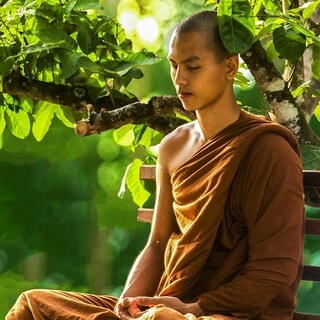
Keys to zazen,
Zen meditation preliminaries.
There are many forms of zazen or Zen meditation.
The form that we'll be practicing now is called shikantaza.
Shikantaza means just sitting or only sitting.
Preparing for the meditation is a very important aspect of practice,
Just as important as the meditation itself.
There is no difference.
In this way,
Everything eventually becomes practice.
So make your preparations with the same mindful and attentive awareness that you give to the meditation itself.
This will help bring your practice into your everyday life more effectively and increase the benefits.
Here are some keys to igniting an effective practice.
First,
Make sure that you are very comfortable.
Whether you're sitting on a zafu,
Meditation cushion,
A chair,
Or on a bench,
It is very important to make yourself comfortable.
If you don't,
You will become preoccupied with the discomfort.
The discomfort will become a source of attention or an object of meditation.
In shikantaza,
We don't fix our attention on anything except what we might call the basic ground of our being.
We remain open to all experience,
Both internally and externally,
As the present moment continuously evolves and changes.
If you're sitting in a chair,
Make sure that your feet are parallel to each other and the back of your heels are in line with the front of your knees.
This will help to reduce pressure on your knee joints.
Now that you're comfortably seated,
Check that the spine is erect but not stiff.
The shoulders are relaxed.
The chin is tucked in slightly so that the back of the neck stretches just a little bit and the jaw is relaxed.
Your mouth is closed and your tongue rests on the roof of your mouth.
Now place your right hand in your lap with your palm facing up.
Gently rest your left hand in your right palm so that the tips of your thumbs are gently touching as if you were holding a very thin piece of paper with your thumb tips.
This position of the hands is called the Cosmic Mudra.
During practice,
If you feel pressure or tension in your thumbs or notice that you are pressing your thumbs together too tightly,
That means that you're working too hard.
You can back off by adjusting your thumbs and your posture and back off mentally and reset yourself.
If your thumbs are drifting apart,
You're probably drifting off into a thought train,
Daydreaming or possibly falling asleep.
Again,
Simply readjust yourself and start all over again.
Next,
Gently rock your body slightly back and forth and from side to side to find your balance point and then simply sit still.
This rocking also helps to ground you in the present moment.
In Zazen,
We sit with our eyes open.
Notice that your eyes are open about halfway.
Relaxed.
Gaze set at about a 45 degree angle to the floor.
Open eyes help to prevent sleep or daydreaming.
Also,
Open eyes represent being fully open to all of reality.
And this way,
In Shikantaza,
We let all reality flow through us without trying to block out anything,
Without judgment and without preferences.
Remember,
We're just sitting.
If you are new to sitting with your eyes open,
You might have some difficulty at first.
Your eyes might close.
If they do,
That's okay.
Simply notice that you are now sitting with eyes closed.
You could even say that to yourself.
Sitting with eyes closed.
When you're ready,
Gently open the eyes again and continue.
No judgment,
No pressure,
No forcefulness.
Just sitting.
Keep in mind that you are centered in the middle.
Relaxed,
But not lazy.
Firm,
But not rigid or forced.
Next you will hear a bell ring three times.
Three rings of the bell is a traditional Zen signal that we are about to start a period of meditation.
When you hear the bell,
Allow yourself to hear it with your whole being.
Feel it with your body.
If your thoughts take over,
Simply come back to the sound and feel of the bell.
This attention to the bell sound is called the samadhi of the bell.
Samadhi means absorption or concentration.
So fully soak up the sound.
Absorb it with your whole being.
As the sound fades,
Become aware of the deep sense of peaceful presence and sense of grounding in the moment that you feel.
Now exhale through the nose completely and take a slow full deep inhalation.
Feeling the tummy,
The abdomen and the chest filling up and expanding without straining,
Without tension.
When you reach your capacity,
Very slowly exhale through the nostrils,
Letting out all of the air until the tummy contracts.
The next inhalation will come by itself as if the breath is breathing you.
You can do this breath practice once or a couple of times.
This will refresh you and help you develop a non grasping attitude toward the meditation.
In Zen we call this non grasping attitude,
Musho toku or no gaining mind.
Now simply allow the breath to rise and fall at its own pace.
During the meditation you will sometimes notice the breath and sometimes you won't.
Some folks count the breath or concentrate on the breathing.
But in this practice of shikantaza we simply notice the breath when we do and we don't notice when we don't.
Traditional teachers would say sometimes notice that there is a short breath and sometimes notice that there is a long breath.
In other words no attachment and no aversion,
Just the breathing,
Awareness of the basic fact of sitting.
It's the same with sounds,
Thoughts or any other sense input.
You will hear another bell that will signal the end of the meditation session.
It will begin in a moment.
Welcome to the world of Jnana mvementouts.
As you rise from your seated position,
Please make sure to move very slowly.
And with full awareness to each movement,
Maybe you'd like to stretch out your legs,
Turn your feet at the ankles,
Press the heels out,
Feeling the stretch,
And moving slowly.
If you are new to this practice and would like to try it out,
I recommend beginning easy and setting the Insight Timer for about 5 or 10 minutes a day,
Preferably around the same time each day,
And adding a minute or two each week,
Until you can sit comfortably for 25 to 30 minutes.
A slow,
Steady practice,
Even just for a few minutes each day,
Is much more effective than a sporadic or impulsive practice of longer sitting periods every once in a while.
Of course,
If you have any questions,
Concerns,
Insights,
Or observations that you would like to share,
Please feel free to contact me.
May your practice go well,
For the benefit of all beings.
Have a beautiful day,
And thank you for your practice.