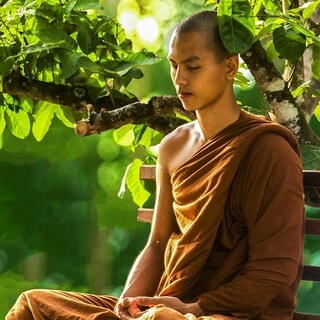
Welcome.
I'm going to speak about hishiyo in terms of defining the term and as active Zen practice.
Here's an encounter dialogue between a nameless monk and the great Chinese Zen teacher Yue Shan,
Or Yaku-san in Japanese,
That describes the role and quality of thinking in the practice of shikantaza,
Or just sitting,
Which is a form of Zen meditation practiced in the Soto Zen tradition,
Which was founded by the 13th century Japanese monk Ehei Dogen.
Once when the great master,
Hongdao of Yue Shan,
Was sitting in meditation,
A monk asked him,
What are you thinking of sitting there so fixedly?
The master answered,
I'm thinking of not thinking.
The monk asked,
How do you think of not thinking?
The master answered,
Non-thinking.
In Zen practice,
The Japanese term hishiyo is often translated as non-thinking,
As it is translated in the final line of the encounter dialogue I just read.
It's also as beyond thinking,
Or as Harada Roshi translates hishiyo in actional terms as leaving the thoughts alone.
Hishiyo can be described as the mind of Zazen in action,
Or the fully balanced activity of just sitting.
Fully balanced in this context refers to the harmonization of body,
Breath,
And mind.
This is accomplished by settling into a firm but relaxed and comfortable posture for Zazen practice.
The spine is erect but not stiff.
The shoulders are relaxed and comfortably in a good posture.
And then breathe naturally and gently from the abdomen.
The mind is settled into a steady awareness of whatever is happening each moment without judgment,
Attachment,
Or aversion.
From this point of view,
Hishiyo describes the unfolding or infinite becoming of realization,
Which is the ongoing flow of basic being as it is.
The immediate moment-to-moment awareness as it happens,
Free from grasping,
Rejecting,
Or evaluating anything.
Just sitting with the harmonized body,
Breath,
And mind,
And just noticing.
Here's an example.
I'm sitting in Zazen on a quiet morning.
A bird starts to chirp outside my window.
It soon becomes quiet again.
However,
The memory of the bird song remains with me.
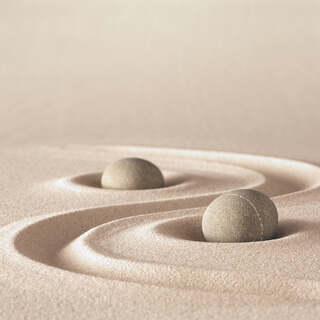
Like a stone tossed into a still pond,
The stone sinks to the bottom of the pond where it now lies still and remains out of awareness but altering the pond forever.
However,
Ripples continue to spread out along the surface toward the pond edges.
The ripples gradually disappear just as the bird song gradually fades and disappears from consciousness or,
For that matter,
Any thought that arises if you just leave it alone,
It will disappear eventually.
In the meantime,
Where does consciousness go?
To the returning silence of the moment or to the fading memory of the bird song?
Both?
Neither?
Did something new emerge into awareness?
Is there feeling associated with the bird sound?
A sense of judgment,
For example.
Does the feeling change as the sound fades?
What's the actual external reality of the present moment?
What's the internal reality?
Attachment to or preoccupation with the internal reality creates a lack of awareness of the external reality and can easily become an internal preoccupation that creates a split between internal and external reality.
What is your relationship to the bird song?
Happiness?
Joy?
Annoyance?
Attachment?
Aversion?
In the fading of the bird song,
Is there a feeling of sadness?
Relief?
Neither?
Or both?
Now suppose it was the sound of a truck with a bad muffler accelerating uphill that you heard.
What is your response?
Your reaction?
Dogen teaches us to investigate all of these states of mind.
In Zanmai Ozanmai,
The samadhi that is the king of samadhis,
Chapter of his Shobogenzo,
The true Dharma eye,
He expresses a vast openness to the rising and fading of all experience.
And he writes,
Just in the moment of sitting,
Investigate whether the universe is vertical and whether it is horizontal.
Just in the moment of sitting,
What is the sitting itself?
Is it a somersault?
Is it a state of vigorous activity?
Is it thinking?
Is it beyond thinking?
Is it doing something?
Is it not doing anything?
Is it sitting inside of sitting?
Is it sitting inside of the body-mind?
Is it sitting that's free of the inside of sitting,
The inside of the body-mind?
And so on.
There should be investigation of thousands and tens of thousands of points like these.
Well,
How does one do this investigation that Dogen is suggesting?
He says by simply sitting in shikantaza,
Which as I mentioned means just sitting without attachment,
Aversion,
Judgment,
Or of any goal and just noticing what is happening in the moment.
In shikantaza,
Which is an all-inclusive,
Non-concentrative and goalless form of zazen,
We just sit.
We do nothing else.
He makes this point clear in Zanmai Ozanmai by asserting that,
And I quote,
Very few people realize that the act of sitting is the Buddhadharma and that the Buddhadharma is the act of sitting.
He continues by observing that even if some physically understand sitting to be the Buddhadharma,
None has realized sitting as sitting.
By this he means that sitting is just sitting.
Nothing else is added on.
Nothing to count,
To visualize,
To follow,
Or to recite.
We just sit.
This is hishiryo,
Thinking of not thinking or leaving the thoughts alone.
This is hishiryo in action.
From the perspective of realizational practice,
It is absolutely crucial that the so-called intrusion of thoughts,
Thinking processes,
And conceptualizations do not serve as a rationale to attempt to eliminate them,
Even if that were possible.
From the non-conceptual perspective,
The non-dualistic perspective that cuts through the duality of thinking and not thinking through the application of hishiryo,
The nearly unrelenting critique aimed at thinking,
Often encountered in contemplative traditions,
Becomes meaningless.
The prioritization of hishiryo could be understood not as a condemnation of thinking,
But as a critique of repetitive and habitual thinking and associated language,
Which stems from unconscious attachments to samskaras,
Or what I like to call habit formations,
And the resulting loss of true,
Effective,
And useful relational patterns that can easily be overlooked,
Like the unseen stone at the bottom of the pond.
These unconscious and repetitive habit formations continue to operate and influence our interactions with others.
Through continued practice,
These habit formations will over time become clarified and can be addressed by continuing to sit with the practice of simply noticing how they rise and dissolve as they occur,
How they seem to suddenly appear as if out of nowhere and then disappear.
In my experience,
Over time,
They do soften,
And have less,
If any,
Hold on our internal life and our relationships with others.
So,
Just keep practicing,
No matter what.
Thank you.