Hello there,
My name is Chris and I will be guiding you through six mindfulness techniques that can help you create an intentional and consistent meditation routine.
At the end,
We will use all of the techniques collectively to complete a gentle meditation flow together.
Alright,
Let's get started.
There are six techniques I primarily use to stay encouraged with keeping a meditation routine going.
We'll go over these in detail,
But for now they are 1.
Finding an intentional space and setting the tone in that environment.
2.
Exploring the best posture for that space.
3.
Using my breath as a focal point to understand how I am truly feeling.
4.
Being aware and present with each moment.
5.
Inviting gratitude to those moments.
6.
Allowing those moments to flow.
I invite you to complete each technique with me fully to understand how they can influence your meditation practice for the better.
So number 1.
Finding an intentional space and setting the tone in that environment.
First and foremost,
I usually like to pick a location and possibly a time if my schedule is limited that would allow me to fully indulge in my practice and invite the energy I want to feel on a daily basis.
Wherever you are right now,
See if you can look around and notice if there is an area or location that instantly calls to you.
It doesn't have to be perfect or Instagram meditation studio goals.
It just has to feel right for you in this moment.
Maybe that's a corner near a window,
The edge of your bed,
Or outside sitting in the grass.
It's really up to you.
Keep in mind,
This location can easily change later.
But for the sake of experiencing this technique,
Let's try to find a space for right now.
So once you've identified that location,
Just take a moment to bring your full awareness to that space completely.
Explore every angle and sight with your eyes,
Every scent with your nose,
And every sound with your ears.
Take your time.
Look left and right,
Up and down.
Maybe even gently open and close your eyes a couple of times to see if you spot anything different.
We don't want to judge the space.
Just breathe naturally and notice it.
Breathe life and intention into the space and let it know that you are here and you are present.
If this is an area you think can suit you for a daily practice,
Maybe try adding personal touches to make it a more welcoming environment.
Sometimes to set the tone,
I light candles or incense,
Set out my crystals,
Lower the lights,
Or play gentle meditation music.
Anything that makes the environment feel familiar each time I revisit it.
Now that we've identified a location,
We can move on to step two,
Exploring the best posture.
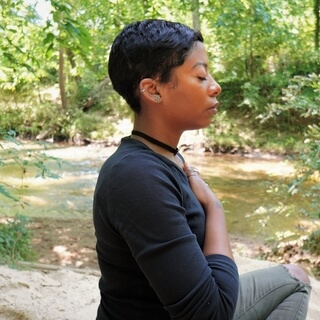
So see if you can position your body in a way that feels easy in this space.
Maybe that's lying down,
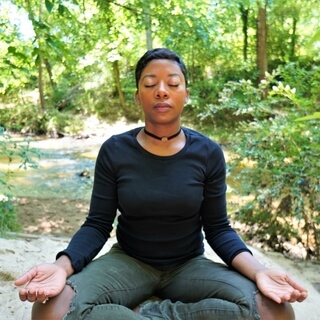
Maybe it's sitting with crossed legs,
Or standing upright in the corner.
Listen to your body and see what it's trying to tell you right now.
Make sure it's a position that allows you to remain alert as well.
So if you are sleepy,
Maybe lying down isn't the best position for you this time.
Try sitting with your spine straight but not too rigid and feel your crown reaching above.
Maybe try placing your hands on your knees,
Thighs,
Or even down by your side if that feels more comfortable.
If sitting in a chair or standing,
Try planting both feet on the ground,
Feeling yourself connect deeper to mother earth.
Whatever position you choose,
See if you can relax a little more into the posture.
Make it feel a little easier to be there.
Maybe relax your eyebrows and eyes.
Release the tongue from the tight grip at the roof of your mouth to relax the jaw.
You can try slightly opening and closing the mouth to see if that's easier.
Now maybe pry the shoulders down away from your ears,
Feeling them melt like vegan butter.
Or release the tensions in your hands and feet as much as possible.
And what about breathing easy,
Gentle,
And effortless breaths in and out,
In and out.
I hope that helps a little.
From there,
We can move on to step 3,
Using the breath as a focal point to get a better understanding of ourselves and where we are mentally.
This is a great assessment to use everyday in any situation,
Not just for mindfulness or meditation practice.
We will also use our breaths to invite further relaxation.
Since breathing is typically an automatic,
Unconscious process,
Taking the time to become aware of what that cycle is can help us further identify how we feel and what we are experiencing in any given moment.
Shorter,
Rapid,
Or shallow breaths may indicate fears and anxiety looming.
While longer,
Slower breaths may indicate a sense of calmness and relaxation.
So let's take a moment to see if we can bring our full awareness to our breaths together.
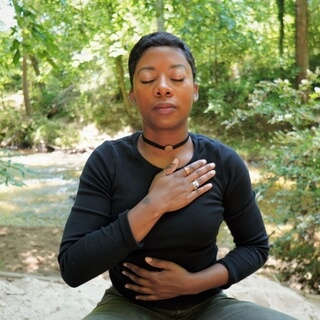
Allow your body to relax further as you take some gentle inhales and exhales.
No need to change or force anything.
Just take notice of the in-breaths and the out-breaths.
Become aware of the sensations of the air as it passes in through your nose and out through your nose or mouth.
Notice if you are breathing from the chest or stomach.
Again,
Try not to overthink or judge it.
We just want to understand what our breath is doing right now,
Here in this moment.
Good.
Notice how fast,
Slow,
Long or short each breath feels.
Great job.
After acknowledging my breathing flow,
I like to bring stillness,
Open awareness,
And presence to my practice,
Which is step four.
By now,
You may have heard of the monkey brain or monkey mind,
The concept that our unsettled thoughts jump around just as easily as monkeys jumping from one tree branch to another.
Our minds seem uncontrollable at times.
However,
With daily practices of techniques such as mindfulness and meditation,
We can learn to tame those thought patterns a little better.
We can become the masters of our minds.
A great start to taming the mind is to begin practicing presence.
One may find it easier to be present in the extraordinary events in life,
Such as a celebration for a new baby or a first-time college graduate.
But what about the activities you do daily,
Such as brushing your teeth,
Driving to work,
Or preparing a meal for your family?
Is that not worth celebrating as well?
Whether you realize it or not,
Those are luxury tasks.
Not everyone is afforded those activities.
So why not fully indulge in those moments and bring your full awareness to the experience of those activities,
Since you can do them?
Being present with the experience means acknowledging every step along the way,
No matter how mundane it may appear.
Driving to work is an inevitable task for many of us,
But what if we enjoyed the process along the way?
Would it make entering the office a little bit easier?
If we noticed the motion of grabbing for the keys,
Hearing the jingling sound they make,
The smell of our car as we open the door,
And feeling our hands touch the steering wheel just as we pull out of the parking space,
Would it feel more like a gift than a nuisance?
Take a moment now and try to think of a task you did just before playing this audio.
See if you can remember each step that got you to the finish line.
Maybe the experience of brushing your teeth really began as you reached for the tooth space.
Or maybe as you turned the bathroom light switch on.
Or maybe even as you took steps towards the bathroom.
Just take a moment now to think about that.
Doing this consistently with different moments in your day will eventually form into routine practices of presence.
From there,
You may unconsciously begin to invite and experience great levels of gratitude.
Step 5.
So what is gratitude?
For me,
Gratitude is the concept of being unconditionally thankful and appreciative.
How does one obtain gratitude?
I think that starts with acknowledging and accepting all there is to be grateful for around you in your everyday life and in your everyday routines.
That's why step 4 was so important.
We have to first learn how to establish what's a gift in our life.
We must recognize what's easily and unconsciously accessible to us that others may not have access to at the moment and some may never get the chance to access.
Once we recognize those micro,
Yet massive,
Moments,
We begin to value what we have more.
We begin to experience gratitude.
And allowing those moments of presence and gratitude to flow help bring insight to your different emotions and moods.
And furthermore,
Insight on what makes you uniquely you.
Step 6.
Embracing a Mindful Flow For me,
Flowing is allowing my whole being to do what feels right to it at any given moment.
Being truthful to myself and vulnerable enough to experience whatever it is my being feels it needs to experience.
Whether that is joy,
Sadness,
Love,
Jealousy,
Hurt,
Or any other emotion,
Flowing means I get an opportunity to learn about myself over and over again.
I get to see what's my love language,
What are my triggers,
What are things I take comfort in or even what makes me smile.
I get to explore myself and confidently stand in my being.
I can recognize and acknowledge both my light and shadow sides and I have a better understanding of what makes me feel whole and what does not.
Let's take the last few minutes here together to combine all of those mindful techniques into a meditation flow.
With your eyes still softly closed,
See if you can bring your awareness to your body and space.
Notice all of your sensations,
How the air feels against your skin,
The different sounds and smells around you.
Your body making contact with the floor or bed beneath you.
See if you can find some stillness and then begin to bring your full awareness to your breathing.
Breathe in through the nose,
Deeply into the lungs,
Feeling the belly rise with the air you are so grateful to be receiving.
And then release a long exhale out through the mouth,
Feeling the belly retract ever so gently.
Do this a few times on your own,
Inviting further relaxation with each breath.
If it helps,
Feel free to breathe into a three count and exhale to a five count.
Breathing in,
This is my in breath.
Breathing out,
This is my out breath.
Good.
Now allow your breath to return to its normal,
Natural effortless state.
Feel your face soften and relax.
Feel your shoulders melt away from your ears.
Feel the tension leave your arms,
Hands,
Chest,
Belly,
Thighs,
Calves and feet.
Good.
Now try to recall a recent situation that made you extremely happy or excited.
It doesn't have to be anything complicated.
It can be something as simple as finding your favorite product at a store after it's been sold out for weeks or getting a freebie at an event that you weren't expecting or maybe finally finding the item you thought was lost long ago.
Whatever it is,
Just bring it to mind for a moment and see if you can play back what emotions you experienced just before the excitement.
Were you nervous,
Scared,
Upset,
Or anxious?
How did those emotions play out in your body?
Did you tense up,
Relax,
Breathe a bit faster or slower?
What happened?
Now fast forward to the excitement.
Become fully aware of everything that happened leading up to the joyous moment.
Maybe it was the way someone looked at you or the way something smelled.
Notice how it feels.
How does your body seem to react now versus what it was before?
Are you a lot calmer and at ease?
Did it make you smile?
What changed?
Now see if you can recall how you felt hours later after that excitement.
Was the feeling still there or did you forget about it and move on?
There is no right or wrong answers here.
I just want you to recognize how easy it is to just let yourself flow.
Let your emotions be what they want to be and you just ride along for the experience.
Take one final deep breath in and out and begin bringing awareness back into your body by wiggling fingers and toes.
Maybe take a little stretch.
And when you feel ready,
Slowly open your eyes.
Thank you for holding space with me today.
I hope to practice with you again.
Best of luck creating your routine meditation flow.
Just remember to be flexible,
Patient,
And consistent.
Know that each meditation experience will vary and you are doing the very best that you can.
So celebrate each one.
Take care.
Bye.