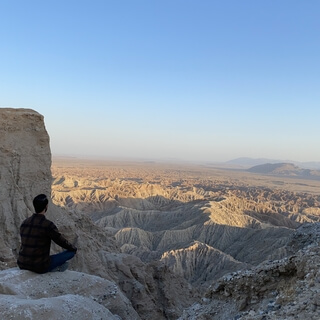
Allow yourself to find a sitting position that allows you to be alert.
So your spine erect but not rigid.
Taking this alert but easeful posture.
Something that's upright but not uptight.
So bringing a sense of relaxation into the body and allowing yourself to take a posture that is comfortable enough for you to sit for an extended period of time.
Stacking your shoulders over your hips and your ears over your shoulders.
You can allow your eyes to close or if that's uncomfortable you can let them rest about six feet in front of you.
Placing your hands in your lap or allowing them to rest on your thighs and your knees.
And just bringing yourself into this present moment.
So this might be the first time of your day where you stopped and really dropped into the body.
So allowing your awareness to scan through your body and wherever possible and soften and release obvious areas of physical tightness or tension.
So relaxing through the forehead and the brow.
Relaxing your cheeks,
Your jaw,
Softening your lips,
Finding space between the lips.
Softening through the throat,
The shoulders,
Softening the chest.
And allowing these breaths to find a softening belly.
Inhaling into a softening belly and exhaling out of a softening belly.
So allowing yourself to take a few full deep breaths in.
Inhaling in through the nose,
Filling the body.
Exhaling out the mouth,
Letting all the breath out of the body.
Again deep inhale through the nose,
Filling the body fully and exhaling out the mouth,
Emptying the body completely.
And one more breath just like that.
Deep inhale in and a full exhale out.
And allowing your breath to be natural.
Finding its own natural rhythm.
And sometimes when we think about natural rhythm there is a slight tendency to try to overthink or control that natural rhythm.
So seeing if you can just open to a sense of softening around the breath.
Bringing attention to where you most easily detect the breath.
So you might notice the sensation of air as it flows in and out of your nose.
Or you might feel the touch of the breath around the nostrils or on the upper lip.
Maybe feel the movement of breath on the chest.
Subtle movements with an inhale or an exhale.
Or you feel the rising and the falling of your abdomen.
Breathing in the belly rises and breathing out the belly falls.
Whatever area you connect with the easiest,
Allow yourself to bring your attention to the sensations of breathing in that area.
And it's possible that you just bring your attention to the full experience of breath in and out of the body.
And there's no need to control the breath or to grasp or fixate on it.
And there's nothing magical or special that you're doing with the breath.
There's nothing that you're trying to make happen here.
There's no right way of breathing and there's no right way of meditating on the breath.
So just allowing yourself to bring this relaxed awareness,
This intention of relaxed awareness and discovering what the breath is really like as a changing experience of sensations.
So maybe you notice the breath intently.
Maybe you can barely notice the breath as it subtly moves in and out through the body.
And after a few moments you will find that the mind naturally drifts off in thoughts.
It's important to remember that thoughts are not the enemy.
You do not need to clear your mind of thoughts.
You not need to try and stop thoughts or repel thoughts.
Thoughts are not the bad guy.
Rather in this moment you are developing the capacity to recognize when thoughts are happening.
And you're recognizing that thoughts are happening without getting lost in the storyline.
So when you become aware of thinking,
I encourage you to use a soft and friendly mental note.
Just labeling it as thinking.
Thinking.
And then without any judgment or bias,
Allow yourself to gently return to the immediacy of the next breath.
So when you notice the attention wanders,
You bring that soft mental noting of thinking.
Thinking.
And then you place your attention back on the breath.
And you let the breath be the home base.
It is a place of full presence.
So while you might know this,
Other experiences,
The sounds of the outside world that surround you,
Maybe passing cars or birds or even other people around you,
You might notice sensations of the body,
Warmth or coolness or dullness or even sensations of hunger in the body.
These can be in the background without drawing away your attention.
And at any point,
If any particular sensation becomes strong and calls your attention away,
Allow those sensations instead of the breath to become your primary subject of mindfulness.
So if a sensation of the body becomes too strong,
Allow yourself to shift your attention from the breath and place it upon that physical sensation.
So you might feel heat or chills,
Tingling,
Aching,
Twisting,
Stabbing,
Vibrating.
Whatever might occur and arise in your experience with a soft and open awareness,
Just feel the sensations just as they are.
There's no need to add a story to them.
There's nothing wrong with them.
Just because they are present doesn't mean that your meditation is bad or ruined or in some way wrong.
Allow yourself to notice them.
So do you experience them as pleasant or unpleasant?
As you fully attend to them,
Do they become more intense or do they dissipate?
And can you just notice how they change?
And as time passes,
When the sensations are no longer a strong experience,
Return your mindfulness back to breathing.
Alternatively,
If the sensations are so unpleasant that they are taking you away from your experience,
If you are unable to regard them with any balance or equanimity,
Then feel free to drop your attention on them and bring your attention again back to the breath.
And again,
If we notice that we've lost our attention from the breath,
We become caught up in thinking,
We allow ourselves to just mentally note thinking,
Thinking,
And bring our attention back to our breath.
And in a similar way of noticing the sensations of the body,
You can also bring mindfulness to strong emotions such as fear or sadness or happiness or excitement or grief.
Whatever arises,
Meet each experience with a kind and clear presence,
So neither clinging to nor resisting what is happening.
Bringing this attitude and intention of openness and spaciousness to your experience,
Allowing yourself to become curious.
So what does this emotion feel like as a sensation in your body?
And where do you feel it most strongly?
Is it static or is it moving?
Does it have a size?
Is it acute or is it quite large?
By chance are your thoughts agitated?
Are they vivid or do you find them repetitive,
Cyclical,
Or maybe dull?
Maybe you notice that your mind feels contracted.
Maybe it feels quite vibrant and open.
Whatever your experience may be,
Know that there is no wrong in your experience.
You're simply allowing yourself to pay attention and notice how the emotion changes.
So does it become more intense or do you notice that it weakens?
Do you notice if they go from one state to another?
Maybe anger turns to grief or happiness turns to peace.
And just like how we interacted with these sensations of the body,
When the emotion is no longer compelling,
When it's lost its charge,
Allow yourself to turn your attention back to the breath as well if at any point the emotion feels overwhelming for you.
Or if you're confused about where to place your attention,
Allow yourself to relax back into the body and then come home back to the inhale and exhale of your breath.
And if you notice that your mind is thinking about all of the different possibilities of the meditation and you're lost in thoughts of how you think the meditation should be or an idea of what you're looking for,
See if you can just soften and let go of those thoughts.
Again,
Just noticing them as thinking,
Mentally labeling them as thinking.
And then bring your attention back to your breath.
And wherever you are in your practice,
You can allow yourself to let go of focusing your attention on your breath.
And allow your attention to expand.
So again,
Bringing in the sensations of the body,
Noticing the space of the body,
The weight of your body.
Maybe again noticing the sensations of the ground beneath you,
Holding you up,
Noticing the space around your body.
Noticing sounds around you.
Maybe sounds closest to you and sounds furthest from you.
If your eyes are closed,
Slowly blinking them open and bringing yourself out of your practice and back into the rest of your day.
Thank you so much for allowing me to lead you in this meditation and I hope to see you again next time.