Hello and welcome to this introduction to yogic breathing.
So you can take any position you'd like.
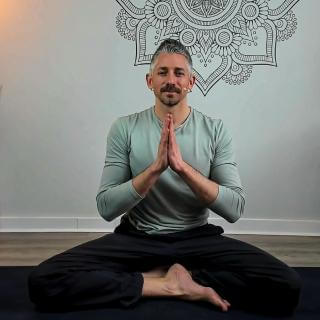
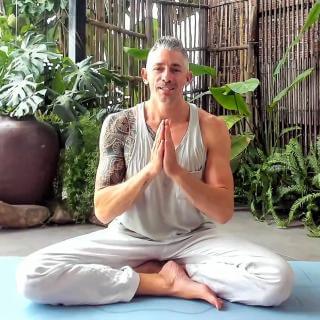
I'm going to stay seated here.
You're welcome to lie on your back in shavasana.
You can take crocodile pose lying on your abdomen.
You can sit up in a chair.
So really any comfortable position.
If you are seated,
You'll just sit up nice and tall.
Relax your shoulders and in either position just bring your awareness inward.
So allow your eyes to close.
And so the first part of healthy breathing or yogic breathing is that we breathe in and out through the nose.
The nose is the instrument given to us by creation or breathing.
Just start to establish a regular breath in and out through your nose.
By breathing in and out through the nose,
We get multiple benefits.
One of them is that the air is filtered.
The nose has a natural filtration system and it also helps to regulate the temperature of the air.
So it optimizes the airflow,
The air temperature for our body.
Then we're gently going to shape the breath into the five qualities of yogic breathing.
Now these won't happen overnight.
So it's really just a gentle invitation to start to incorporate each one of these qualities.
So as you continue breathing in and out through the nose,
Let's introduce the first quality which is deep.
So breathing deeply,
But it's breathing deeply in a way that's effortless.
So generally a lot of our natural response will be to really more forcefully inhale,
More forcefully exhale.
But actually we just stay with a smooth rhythm and the depth really refers to the positioning of the breath in the body.
So in a natural way,
As you inhale,
Inhale down into the space of the abdomen and the pelvis.
Just allow that natural expansion through the abdomen and the ribs as you inhale and a contraction and release as you exhale.
Stay with that and the deepening comes by softening.
So it's by relaxing in the abdomen that you allow your breath to deepen.
The next quality is smooth.
Really stay with the breath for the full length of your inhale and the full length of your exhale.
Begin to notice are there any places of holding.
A little bit of jerkiness in the breath and with each breath you're just naturally beginning to smooth out the breath.
You can assist that process by lengthening the breath.
So as you exhale,
Breathing out just a little bit more slowly and same thing as you inhale,
Breathing in just a little bit more slowly.
The breath is deep and smooth and then the third quality is even.
So there's an evenness in the inhalation and exhalation.
Gradually with each breath begin to sense the length of your inhale,
The length of your exhale and you begin to create some evenness there.
So you're breathing in the same length that you're breathing out.
In the beginning it might even help to mentally count.
Counting the length of your inhale maybe three or four or five seconds and then allowing your exhale to match that same length.
But let go of any striving.
So all of this breathing,
This yogic breathing,
Ultimately we're looking to relax,
Be in a completely relaxed state.
So far the breath is deep and smooth and even.
The fourth quality is continuous.
So each breath flowing seamlessly into the next.
So there's no pause at the top of your inhale.
You just simply relax,
Allow the exhale to follow.
At the bottom of that exhale also relax,
Allow that inhale to follow.
So common for us to hold our breath unconsciously when we're fearful or anxious or the mind becomes busy.
But by keeping the breath smooth and even,
Continuous,
We send signals to the nervous system.
The body responds by relaxing and that leads into the fifth quality which is quiet.
So breathing in a way that's not creating any additional noise.
There very well may be just some natural sound,
The breath moving in and out through the nose.
But in this yogic breathing we're not creating additional noise.
So different than some of the other yogic breathing practices.
By breathing silently we're reducing any kind of constriction anywhere,
Through the nose,
Through the throat.
And we're also helping to bring silence into the mind.
Over time the same qualities that we establish in our breath begin to translate and be experienced in the mind.
So the breath is deep,
Smooth,
Even,
Continuous,
And quiet.
These are the five qualities of yogic breathing and these are the foundation for everything else that we do.
All of our lives,
All of our other practices.
Keep coming back to this practice.
Eventually learn these qualities.
Remember these qualities on your own.
You can do this formal practice anytime,
The morning and the evening,
Both really good times.
And then eventually start to bring this practice into your daily life.
Throughout your day notice your breath.
Notice if you're holding on or if you're breathing more shallow.
Little by little start to incorporate these five qualities into your entire life.
Om Shanti Shanti Shanti.
Namaste.