I'm going to take you through a short Yin Yoga sequence to help support your Wei Chi,
Also known as Defensive Chi.
Wei Chi circulates through the soft tissues while also emanating about an inch around the outside of the body.
Like a force field,
Wei Chi prevents external pathogens from entering the body.
It also protects us against the energy of toxic people.
Wei Chi is a very powerful and powerful system that can help us to improve our lifestyle.
Not unlike the Western perspective on the immune system,
The robustness of our Wei Chi is reflective of how healthy our diet and lifestyle are.
The better we eat,
The more exercise we get,
The more fresh air we breathe,
The healthier our defenses are.
We also want to manage our body's health and our body's health.
The Taoists would say that this drains our kidney chi,
Which is important for vitality.
This practice is designed to use a similar conduit for support of Wei Chi as an acupuncturist might use.
The impostors in this sequence support the kidneys,
Lungs,
And spleen,
The organs that produce Wei Chi.
This practice is not a substitute for medical therapy.
If you feel ill,
Please consult your physician.
For this practice,
You'll need either one yoga block or close substitutes such as a thick book that's no more than three inches thick or firm pillow that can support the weight of your hips.
Start by lying down on your belly,
Propped up on your elbows for Sphinx pose.
This posture creates a bit of compression for the lower back,
The kidneys.
We are looking for gentle sensation in the area of the low back,
Nothing sharp or risky.
If the sensation is too strong,
You can nudge your elbows a little more forward,
Bringing another row or two of ribs down onto the floor.
Some people find that stacking their hands and resting the forehead on the hands is more appropriate.
For those that want a little more sensation in the low back,
Place a pillow or blocks underneath the forearms or chest.
This will create a little bit more backbend without adding much effort.
Some of you may be familiar with seal pose,
A deeper backbend generated by straightening the elbows and supporting the body with the hands,
But since we are working on our defensive chi,
I recommend doing a little less so that you can conserve your kidney chi.
Once you're settled,
Try to relax tension or holding in the body that isn't necessary for maintaining the shape.
It's okay if you lower your head or even put your head in your hands.
Relax your legs and let them roll to the side.
Begin to notice sensations percolating through your body.
Some sensations may be a result of the shape of sphinx pose,
Such as a dull ache in the low back or the effort of the shoulders holding up the torso.
Allow your mind to track all that's going on in the physical body as a doorway into the present moment.
You can ask yourself,
What's happening now in my body?
Notice the sensation of breathing.
In this posture with the belly on the foot,
With the belly on the floor,
You might find it easier to feel the breath along the back of the torso and into your waist.
Let your mind quietly settle on the gentle flow of the breath moving in and out of the body.
See if it's possible to let the mind settle down as you focus on the sensations of the shape and the flow of breath.
Let distracting thoughts or inputs from your environment fade into the background as you stay with the experience that's unfolding within you.
You On your next exhale,
Lower your torso as you turn your head to the side and rest on one cheek.
Stay present with the sensations in your body,
Noticing how they have changed now that you are no longer in sphinx pose.
Maybe there is a sense of relief of coming out of the pose.
Sometimes people feel as if a floodgate of energy that was previously stuck suddenly starts to move through the low back.
Notice what your experience is like in this moment.
Now slowly roll over onto your back.
Bend your knees and bring them into the chest for several deep breaths.
Notice the stretching sensation in the low back where you previously were compressing.
What does that change feel like?
Notice if you have a preference for one or the other.
There's no right pose but it's worth noting what you're drawn to and what you might tend to avoid.
Take a few more breaths here.
Now release your legs and place your feet on the floor.
Your knees are still bent.
Press into your feet so that your hips lift up off the ground and take your block,
Book,
Or firm pillow and slide it underneath your hips.
You want the block on its lowest setting so that the hips are not too high in the air.
Unlike a more dynamic practice where we hold postures for just a few breaths,
When we hold postures for longer like we do in yin yoga,
We want to back away further from the edge so that we can safely stay a while.
And you want this support right underneath your tailbone so make sure it's not behind the curve of the low back.
And then feel the weight of your tailbone and hips settling into the support.
Try to relax your deep abdominal muscles as you let go of tension or holding in the lower torso.
And now extend one leg at a time so that your heels are resting on the floor.
You may feel a tugging sensation across your hips down into the top of your thighs.
If this is too much sensation for your low back,
Try extending just one leg at a time.
I'll tell you when to switch sides.
It's also fine if you want to keep both legs bent.
Now bring your internal gaze to the sensation of breathing,
This time in the lower abdomen.
The Taoists call this region of the torso the lower dantian.
It's your body's home and resting attention here can be very grounding and soothing for the nervous system.
This supported bridge pose,
Sometimes called pontoon,
Is a gentle way of encouraging chi flow to the spleen and its companion organ the stomach.
These two organs are responsible for extracting chi from the food that we eat.
And because we're only able to replenish chi through healthy food and fresh air,
It makes sense that we would want the stomach and spleen to be working well.
Fresh chi is an essential building block for our defensive way chi.
Now go ahead and transition to the other side if you've been doing one leg at a time.
The Taoists are deeply interested in food as medicine,
Even thousands of years ago when these teachings originated.
Taoist healers encourage their people to eat fresh chi-rich foods to maintain optimal health in the body.
In modern times we'd say to eat more fresh produce and avoid eating things from cans and boxes as much as possible.
Food that comes from a box is said to have no chi left in it,
Usually because it's so highly processed.
We are also advised to ingest stimulants like sugar,
Caffeine,
And chocolate in moderation because they can deplete our kidney chi.
Herbal supplements and tinctures have been an essential part of Chinese medicine for thousands of years.
I recommend that you visit a licensed acupuncturist for personalized advice on herbs because some herbs are contraindicated for some constitutions.
Continue to breathe deeply into your belly.
Letting your internal gaze rest on this highly sensitive energetic home in the lower abdomen.
To come out of this shape bend your knees so that your feet are back on the floor.
Raise your hips again and gently slide the support out from under your pelvis.
Slowly lower your hips back down to the floor.
Some people like to bring their knees into the chest after supported bridge.
Others like to stretch out.
Listen to what your body would enjoy right now.
And keep your internal gaze focused on this new set of sensations.
What do you notice first?
And what else is present?
Try to stay curious about this experience and keep asking yourself what else?
If they aren't already there bring your knees into your chest and extend your arms out to the side in the shape of the letter T.
Slowly lower your knees to the right side keeping your upper body connected to the ground as much as possible.
Some people find it helpful to place a block or firm pillow between the floor and the legs.
Other people like a support between the knees.
Experiment to see what kind of prop if any would help you to settle better into this shape.
Now slide your left hand along the floor towards the space above your head.
Your elbow will bend.
You don't have to place the arm very high above your head but find a spot where you feel a little tug along the left arm but that doesn't create discomfort in the shoulder.
You might need to place a soft prop under the arm if it's in the air.
Twists are potent postures because all the energy channels flow through the middle torso.
When we tug and compress this region as we do in a twist we effectively support all the primary organs.
However the position of the arm in this pose stimulates chi flow in the lung channel.
Because the lungs are responsible for extracting chi from the air we breathe they are also important for strengthening wei chi.
See what it's like to emphasize your breath along the left side of your body experiencing an energetic flow along the left side of the torso and arm as the breath flows in and out.
You can imagine that a clear light is flowing down the left side of the body on the inhale and pea green color flows out on the exhale.
The clear light is fresh chi pouring into the body through the air that you breathe and the pea green is stagnant yin chi leaving the body.
Now let go of the visualization and just remain watchful of your inner experience as you rest here a little longer.
Now lower the left arm and lift the top leg first so that it's really easy to come out of the shape and roll back onto your back.
You might find it helpful to set your feet down and lift and lower the hips before going to the other side.
Now when you're ready lower the legs to the left.
You may find that you need different supports on this side which is completely normal.
Once you've settled on a position for the lower body slide the right arm up and over your head.
Again your arm may or may not end up in the same position as the other side.
That's okay.
Take care of your needs on this side using a soft prop if your elbow is in the air.
Once you're settled take a few breaths and notice the difference between the previous shape and this one.
Often we feel really different from side to side even if the shape is similar.
Try to be curious about this observation rather than judgmental.
It's normal for the body to be asymmetrical and experience postures differently on each side.
Now start to emphasize the breath along the right side of your body and along the right arm.
Again the clear light of fresh chi flowing in as you inhale but this time the color on the exhale is rusty red.
This represents stagnant yang chi.
Clear light flowing in rusty red flowing out.
Now like the other side let go of the visualization and any breath control and just rest in your inner experience.
Remain watchful of how you experience sensation and feeling tones while also being aware of thoughts coming and going through the mindscape.
To come out lower the right arm then lift the top leg first followed by the bottom one as you roll back onto your back.
Bring your knees into your chest for a few breaths rocking a little side to side.
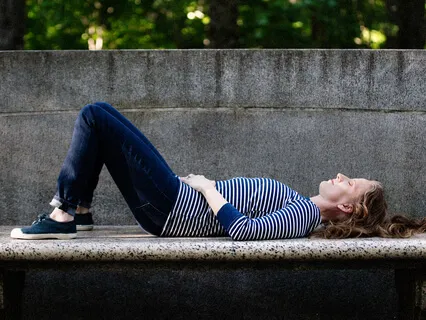
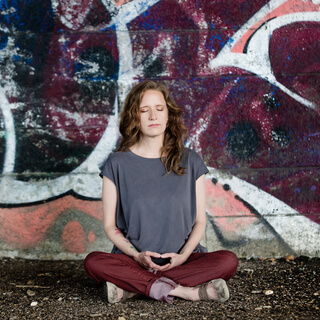
Feel free to take this time to relax for a few minutes in shavasana or you might sit up for a few minutes of seated meditation.
May your body heart and mind be at ease and may you be well now and always.
Thank you.