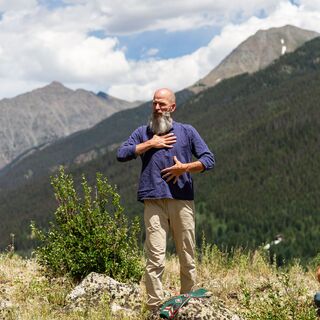
Welcome to your breath work session.
My name is Ryan Bean and today I'm going to talk about the breath wave,
Sometimes called circular breathing.
Today's section is really about learning how to breathe properly.
Now you may say that I've been breathing my whole life,
Ryan,
And why do I need to take this?
Well,
I'll tell you that for the most part,
You probably haven't been breathing correctly.
And when you finally learn the correct breath wave,
You'll find that it's much more efficient.
You'll be getting optimum chemical balance and that you will be able to have longer retentions.
You'll be able to,
In a way,
Biohack the way you feel.
And you'll be able to influence muscles that should be being used in a way to down-regulate or up-regulate as you need to.
The breath wave lets you use muscles that are specific to breathing.
Now you may think that the breath muscles that you use or maybe the organs you use are just your lungs,
But that is not true.
You may have heard the phrase that I need to breathe through my diaphragm,
And perhaps you've been told to breathe into your belly maybe in a class before.
While these instructions are not wrong,
They are not necessarily simplistic and right either.
We're going to learn how to use our breathing muscles in a way to create a tone and presence that will create a positive relationship with ourselves.
This term,
Breath wave,
Describes what functional breathing may look like to you.
It facilitates the fullest and most efficient breath.
So,
To check your breath wave,
We need to either sit down or lie down.
I'll guide you through a short section to find out how you're breathing and how we can maximize that.
So to get the measurement,
You may want to use a camera or maybe you'll just have a mirror in front of you to do this.
What I'd like for you to do is take a nice breath and empty your lungs.
Take a nice big slow inhale and then exhale.
Let's do that three times.
Last one.
Now,
Let's breathe full breaths quickly.
Three seconds in and three seconds out.
In,
Two,
Three.
Out,
Two,
Three.
In,
Two,
Three.
Out,
Two,
Three.
Last one.
And out,
Two,
Three.
Take a giant breath in all the way to the top.
And out all the way.
Now we're going to do this for two counts in.
Breathe in,
Two.
Out,
Two.
In,
Two.
Out,
Two.
In,
Two.
Out,
Two.
Take a giant breath in all the way to the top.
And relax it all the way down.
Now you may be asking,
Why did we do all that?
Why did we go through that?
But did you notice that when we were breathing faster that it affected how you felt?
You may have felt like you were not keeping up or you felt maybe a little bit stressed.
Well,
This is exactly what happens when we're moving around the world and navigating the world.
It's sometimes hard,
But if you're using a proper breath wave,
You can maximize and optimize any breath to have an efficient gas exchange that will allow there to be oxygen in the lungs and releasing the right amount of CO2.
To do this,
We need to get the breath wave down.
Now,
I'd like for you to find about two fingers right below your belly button.
Now,
It doesn't mean that every breath is going to fill the belly completely,
But we're going to try to work belly,
Ribs,
And chest,
And then exhaling chest,
Ribs,
And belly.
What I'd like you to do is just bring those two fingers,
And imagine maybe you were going three fingers in if you could.
Your diaphragm is one of the primary breathing muscles,
And it should be used first when you activate on an inhale.
This is the way babies do it,
And this is the way that you can.
This will allow the lower lobes of your lungs to invite more air in and have the optimum gas exchange in the alveoli and really prepare you for times when you need more oxygen.
We typically call this part of the breath wave the belly.
I'm just going to call it that.
Every breath you should take should begin in the belly and then end in the chest.
Find that point where the belly button is.
Go your two fingers down,
And then from this location,
Imagine placing a marble like in your torso.
This is called the Dian Tian.
With your next inhale,
Imagine that you can breathe into that marble,
Blowing it up like a balloon,
And then exhaling,
Imagine the softball returning to the size of a marble.
Let's do this a few more times.
Breathing into the Dian Tian,
The marble inflates to a softball size,
And then release it down back to the marble size.
Breathing in,
And releasing all the way down.
Continue to breathe that marble into the softball size,
But now place your hands on the abdomen,
And you should be able to feel some expansion here with every inhale.
Every expansion should coincide with the expansion of this space below the belly button.
You can also bring your hands to your ribs,
And begin to breathe in,
Continuing to inflate that marble into a softball,
And feel your ribs expand.
And then as you let go,
Feel the ribs contract.
Breathing in through your nose and out through your mouth,
And then out through your mouth.
Let's do two more like that.
Breathing in,
Feel your ribs expand as though you're making little L's and 7's around your ribs.
Breathe in,
And then exhale.
Still focusing on the belly expanding,
The diaphragm dropping as you open,
And then exhale.
One more,
All the way up,
And then out through the mouth.
Now you can bring your hands to your lower back,
Just so your fingers are pointed down towards your tailbone.
And do the same thing.
We want to feel the belly rising,
The ribs expanding,
And feel that expansion in your back.
Practice this breath.
Same thing,
Marble turning into a softball.
Every inhale,
You should feel some expansion in now your lower back.
Breathe in.
Can you feel it?
Breathe in again.
Breathe in,
Expanding the belly,
The ribs,
Tummy's lifting,
And the ribs and the lower back,
All moving.
Now exhale.
All the way down.
Breathing in.
And all the way down.
Let's do one more together.
All the way up.
And all the way down,
Out through the mouth.
Now let's connect all these areas and let them be the first part to activate,
And then bringing the breath into the chest.
So on your next breath in through your nose,
Inflate the D on Tien,
Bend the ribs,
The lower back,
And then let it rise to your heart.
Now releasing from the heart,
The ribs,
The belly,
And the lower back.
Breathing in.
Do you feel your inhales?
Breathe in.
Expansion and opening.
And then releasing.
You can go back to your normal breath.
Now that we've learned what this breath wave should look like in regards to the functional breathing,
You may want to examine this by watching yourself in a video or in a mirror or having someone else record you.
So you can feel the belly,
Ribs,
And then chest,
And then the exhales are chest,
Ribs,
And belly.
When you do this appraisal of yourself,
You'll find that maybe it's harder to do this as you breathe faster in some of those two-count breaths.
This is why when sometimes people jump into breath work,
They move into hypoxic breath work,
Which is really fast,
But yet the breath wave is not in line for that.
Functional breathing is it depends on your posture.
So you're going to want to sit in the right place.
You're going to either want to lay down or sit nice and straight up,
Cross-legged.
You may find that there's also some paradox breathing happening where you just try the best you can,
But yet your chest rises when you're breathing in,
And this takes time to strengthen those muscles.
Now,
There are lots of techniques that we can offer to strengthen those,
Like the ujjayi breath and others,
That we can use to strengthen the breath wave,
Practice it so that in times when you are feeling stressed or when you're feeling as though you need this breath wave to optimize the gas exchange,
You are prepared.
Thanks for joining me on today's beginner breath work session for the breath wave or circular breathing.
See you soon.