The sounds you just heard are pretty typical meditation bell sounds.
I've been meditating for quite some time and it's interesting because there's this widespread news attraction,
Headlines,
Periodicals on any newsstand now.
I see them mostly in airport bookstores about either mindfulness or meditation or something.
I'm really pretty pleased about this because as a long-term meditator I've experienced many benefits from meditation.
But I want to kind of talk a little bit about what meditation is and of course I can just speak from my experience what meditation is not and some of the things I've observed,
Some of the struggles I've had,
Some of just general ideas as a general primer to meditate.
So the first,
Probably the first question to answer is why meditate?
Well you can easily do a Google search on the benefits of meditation and now there are literally hundreds of studies produced a year showing that the benefits range from increased focus,
Reduced stress,
Reduced stress hormones,
A myriad of health benefits.
I encourage you if you're thinking about starting any kind of meditation practice just do some Google searching and see if the benefits make sense to you,
Whether you're looking for peak performance,
Improved concentration,
Whatever it may be.
What I've found and I work with a lot of high-powered executives and pretty intense people which I very much enjoy and might consider myself one of those people at times is that a lot of Western meditation is being stressed about the ability to not meditate or the inability to meditate or people who are just,
Minds are going a thousand miles an hour.
Well hello that's like most people's minds.
We all have this endless stream of chatter going on,
Things that we like,
Things that we don't like.
We form these judgments instantaneously and then we run away with whatever story our thoughts tell us.
Well one of the benefits early in meditation is you start observing just how crazy this voice in the mind is and if we ever truly listened to it or observed it we'd be like oh my god I would never take advice from that advisor and how much of it is just so critical and so conditioned towards the negative and maybe that changes with meditation,
Maybe it doesn't but really they call meditation a practice or I certainly refer to it as a practice because like anything else that you're going to advance or improve in I just don't see any way around the idea of having to practice.
You just have to practice.
But this doesn't mean that the practice has to be this hard,
Arduous,
Difficult,
Horrendous experience.
In fact I think it can be quite the opposite.
Now sometimes like any practice there's just times when you don't feel like doing it,
You don't feel like you're going to get any benefit out of it,
You may think your meditation was a total waste,
Whatever.
My experience is that consistency is king.
So if you decide you're going to start with five minutes four times a week that's fine.
Five minutes to see if you get any benefit at all.
When I first started meditating I was,
I think I started with like ten minutes and that ten minutes sometimes would be excruciating.
But basically I'm going to just talk to you about some simple classic meditation ideas that you can do regardless of if your mind races through the whole experience,
Whether you have some blissful experience or anything in between.
So in general if you're starting out there's no need to get into some contorted heavy duty lotus or position that you're not comfortable in.
And if we've lost any kind of flexibility,
Like I've had numerous knee surgeries and they've really resulted in a lot of inflexibility in my lower legs,
That probably no amount of stretching because I've done stretches for decades is going to allow me to sit in some full lotus position.
So that's just not happening due to these alterations to the body.
But I recommend you probably start with a seated practice.
And basically the idea is to just have your legs in front of you that are aligned with your hips.
They're not spread out a lot wider than or a lot narrower than your hips,
But really just kind of straight out with your leg straight down on the floor.
And generally you don't want to necessarily lean against the chair.
And this may take a while to sort of develop the back to where you're comfortable with just sitting in an upright position.
But the posture itself is so important because even in getting into a good posture you're starting to pull your attention away from whatever you've been thinking about that may be related to the past or the present,
Things you're excited about in the future,
Things you might be worried about,
Things from the past that may be haunting you or fond memories,
Any of that.
And you're starting to pull your focus,
Your attention to your body and it begins with your posture.
So you just simply sit in an upright position with your back fairly straight.
There's no need to obsess over any of this.
And you just simply place your hands on your lap with an upright position and lift your hands and let them fall on your legs.
They'll probably most comfortably fall an inch or two behind your knees onto your thighs.
And that's fine.
I don't think it really matters at first whether your hands are open,
Your hands are closed or anything.
But basically you can just start with placing your hands on your knees.
So most meditations begin,
And I'll just begin with you on this process,
Just sort of drawing attention to the body.
So see if you can become aware of any feelings on your head,
Any sensations that you may be feeling on the top of your head.
And from there you might notice any feelings,
Perceptions that you might be having in your face.
And you might set a gentle intention.
Again,
We're not forcing meditation,
We're not forcing any of this.
It's really not about that at all.
It's really more about,
As I said before,
Consistency.
But I like to set the gentle intention to the degree you're able in a gentle and relaxed sort of way.
Just set the intention to relax and settle in.
Now you may be able to,
You may not.
Doesn't really matter.
But set the intention.
Intention is an important part of the practice.
So just simply relax,
Be aware of your body.
As you may notice that there's tension in your shoulders.
So sometimes I'll just lift up my shoulders at the beginning of establishing my posture,
So we're still getting into the posture.
I'll just lift my shoulders and then just drop them.
So do that right now if you don't mind.
Just lift your shoulders.
Maybe notice what it feels like to have tension in those muscles in your shoulders.
And then just simply drop them.
So I just kind of call this dropping into position.
I might lean forwards a little bit so that you can notice when your body's leaning forwards.
You might lean back.
Notice when your body's back.
Mess around with leaning to one side.
Lean to the other side a little bit.
And then just slowly lean a little less forward,
A little less back until you find a place that feels pretty centered.
Now most meditation practices,
Or many I should say,
They focus on the breath as the object of meditation.
The object of meditation,
You'll hear that phrase a lot.
It's just simply what you're going to attempt to focus on in the meditation.
And at the very least,
Meditation is a great way to increase concentration and focus and to connect the mind and body.
If you can connect the mind and body through the breath or whatever other object,
You're going to increase your ability to concentrate.
Now sometimes that concentration,
You may be only able to hold your concentration for a half a breath.
And then your mind is wandering all over the place.
Thoughts,
Thoughts,
Thoughts.
Oh,
My back's hurting.
Oh,
My back's hurting.
Oh,
Man,
Did I remember to lock the door?
And as soon as you recognize those thoughts that are happening,
You just simply pull them back to the object of your meditation.
So let me give you kind of an example.
I'll just kind of talk you through this as I'm experiencing it.
So now I'm going to make this attempt to focus on my breath.
So at first I'll just say to myself,
I'm breathing in.
And on the out breath,
I'm breathing out.
In,
Out.
In,
And out.
Breathing in.
Breathing out.
Now see if we can take,
Or you can take,
Five breaths without being distracted.
You don't have to try to make your breath short or long or deep or any of that.
Just see if you can just breathe normally and see if you can focus on five in breaths and out breaths.
So I'm going to be doing it with you.
So let's go ahead and begin.
You can just simply say in on the in breath,
Out on the out breath.
In on the in breath,
Out on the out breath.
All right,
You ready to see if you can handle five in a row and maintain concentration?
Let's do it.
Go.
Okay.
Okay,
So I had several thoughts there.
Was I breathing fast?
Was I breathing slow?
I noticed like some tension in my stomach.
I started thinking,
God,
Man,
Now my back,
I'm noticing my back seat.
Thoughts,
Thoughts,
Thoughts.
They come in.
And now as soon as you catch those thoughts,
This is a critical thing.
You may notice that you're like,
Damn,
I can't do it.
Or man,
Why can't I meditate?
Or anything.
I'm so distracted.
Well,
Hey,
That's a really good sign.
That's a really good sign that you're at least noticing maybe for the first time that you're not able to concentrate on even one or two or three breaths.
That is so normal and so natural.
And at least from my experience,
There are times when I meditate to where I can really concentrate on the breath for many breaths in a row.
And there are times when I can't hold the concentration on that breath for one full breath.
But this gives us an opportunity to just see the things we're saying to ourselves to observe the thoughts.
And over time,
Come with more of an attitude of gentleness.
And just like you're training a puppy or something that you love.
Now,
You may like dogs.
You may not like dogs.
But if you're training something you love,
Maybe it's a child or somebody to do something new,
You want to be really gentle.
And if the voice at first is super hard and judgmental,
You can notice that,
Man,
I'm being really hard and judgmental.
All of that's fine.
Whatever goes on in the chatter of the mind is fine.
But when you catch yourself thinking,
It's so important to just come back.
Like I might just like you would train that dog stay,
You're trying to get them to stay.
Stay,
Stay,
Thinking about this,
Thinking about that,
Thinking about a trip tomorrow,
Thinking about whatever.
Back to the breath,
Breathing in,
Breathing out.
In and out.
In and out.
Now,
Sometimes this may just seem so simple that it's ridiculous.
But I've taught a lot of people to go through meditation process,
And I don't know many exceptions of people who actually gave this a try.
Even if it was for a few minutes a day,
A couple minutes a day,
For a period of a few weeks or even a month,
They're going to start noticing that they can create some space.
That,
Wow,
I was just able to concentrate for six full breaths.
And you start to notice just how crazy all this stuff going on in the mind is and how your mind is all over the place all the time.
That's an important first step.
And then you may notice that that voice is either harsh or critical or judgmental as you just try to come back to stay.
And over time,
Basically what you're doing is you're training your mind,
You're becoming friends with your mind,
You're connecting your mind and your body through your breath,
Which is super important.
So let's go ahead and give it another try.
We're going to do the five breaths in and out.
And you're going to just simply,
Actually this time let's do 10.
And if you get carried away by thoughts,
Notice that and just simply return to the breath.
You don't have to figure it out.
You don't have to understand all your feelings.
You don't have to do any of that.
This is not about that.
It's just coming back to your object,
Which here is our breath.
So we're going to begin just in,
Out,
In,
Out.
So let's do it for 10 breaths starting now.
Ten runs,
10 breaths,
12 breaths.
Okay,
You should be probably close to 10.
Interestingly,
When the mind jumps all around,
It goes all over the place,
All these thoughts come and they go.
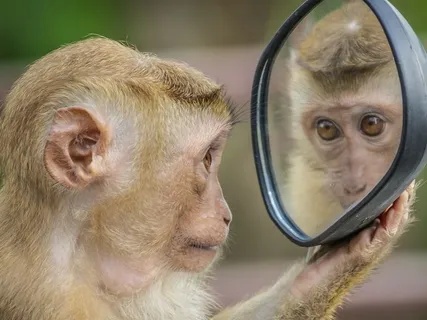
The Buddhists have a great phrase for that.
It's called Monkey Mind.
And I just think of the little gibbon monkey jumping around,
Agitated,
Flying around,
Just not seeming to sit still very often.
That's how the mind is.
If we can teach the mind to be still,
We can teach the mind to stay,
Which we can.
Now,
You may be an amped up,
High performance kind of person,
But you really can,
With consistent practice,
Notice very quickly some of the benefits of this seemingly amazingly simple practice.
And so each time the mind wanders,
Just simply bring it back.
You can bring it back by saying stay or come back.
I like to use my grandmother's voice because she was so good to me and she was such a sweet,
Gentle person in my life as a child.
And I'll just hear her voice now,
Come back sweetie.
Ricky,
We're focusing on the breath.
And she would always smile like that.
So she was just really gentle.
So I use her voice now and I actually see her saying that to me,
Just come back honey.
We're focused on the breath.
That's what we're doing now.
And a sense of humor helps too,
Man.
There's no need to take all this super seriously.
It's just really not.
A good sense of humor is very helpful to practice.
In fact,
The three attitudes I like to share with people is gentleness,
Patience,
Sense of humor.
Gentleness,
Patience,
Sense of humor.
You're probably not going to be good at this right away.
If you are,
Fantastic.
I've shown people,
I was teaching a Tai Chi class and we did a meditation that was kind of evolved.
And it was the first time I did it with this particular student.
And the very first time we did it,
He was able to hold his concentration on the object for 10 full minutes.
And I believe he was able to hold it for 10 full minutes.
I don't think I've,
Well,
A few times,
But not often am I able to hold concentration for 10 minutes.
Many times it's just one thought after another through the entire meditation.
But you know what?
That's okay.
Because I have seen multitudes of benefits in myself and lots and lots of students.
So these practices,
This simple breath meditation has been practiced by cultures for over 2,
500 years.
If something did not provide benefit,
It's difficult to imagine that these cultures would be practicing this for 2,
500 years.
So just the test of time alone gives me some confidence that there's something to this and there is something to this.
But I encourage you to test it.
Test everything I'm saying.
You do not have to believe one word of it.
But if you're willing to give this breath meditation just breathing in,
Breathing out,
Breathing in,
Breathing out,
With the idea of identifying your thoughts and then coming back,
Coming back,
Start again,
Begin anew.
It's okay,
Sweetie.
You're doing fine.
I'm saying you will experience benefit.
You may find yourself not overreacting to situations that you overreacted to.
You may find that there's that little space from you reacting and saying the wrong thing or doing the wrong thing to catching yourself not doing that.
That alone is a massive benefit.
Especially with our colleagues,
With our people we love,
With our mom maybe who pushes our buttons or our dad or our wife or our children or our uncle Vito.
You may notice that little space like hey,
I was able to just go to my breath and then people start saying wow,
You seem more calm or more relaxed and you start noticing these things.
You start noticing your body and how you're feeling and it's just a really amazing unfolding of this richness you may have never even known existed.
But again,
You do not at all have to trust me on this but if you want to practice it,
I'm saying you're going to get a benefit.
But test the teacher,
Test the teachings,
Test the teacher,
Test the teachings.
That's a lot of freedom in that,
Right?
So let's do it again.
We'll do it one more time until the bell sounds and then we'll be done with this primer on meditation.
Ready?
Breathing in.
Breathing out.
Breathing in.