Hello dear friends.
Today we're going to learn a little bit about anxiety and then do a simple three-minute practice to hopefully help you reduce your anxiety.
And even if you don't have anxiety,
Which you probably do and don't realize it,
You certainly know somebody who suffers from anxiety and this will help you or them chill out.
And who doesn't really want to chill out?
Anxiety disorders are the most common mental illness in the United States,
Affecting 40 million adults ages 18 and older,
Which is roughly 18% of the population.
And these numbers are representative of the people diagnosed with anxiety.
In my experience,
The number of undiagnosed anxiety is probably closer to 50%.
This means that almost every family,
If not every family,
Is negatively impacted by this illness.
So that's not very happy news.
So let's transition to some happier news.
Anxiety disorders are highly treatable.
I recently attended a neuroscience class hosted by the University of California,
Berkeley.
The class focused on the role of the vagus nerve in anxiety and also provided an unbelievably simple technique to trigger a relaxation response in the vagus nerve.
And as you know,
Anxiety is the opposite of relaxation.
Relaxation,
The opposite of anxiety.
Let's talk for a minute about the vagus nerve and then I'm going to walk you through the technique.
The vagus nerve represents the main component of the parasympathetic nervous system,
Which oversees many body functions,
Including mood,
Immune response,
Digestion,
Even heart rate.
The vagus nerve plays a huge role in anxiety as it also transmits signals of nervousness or calm,
Anger or relaxation.
Sort of does the yin-yang thing.
Nervousness and calm,
Anger or relaxation.
So obviously we're interested in the calm and relaxation.
So when we're subjected to either real or perceived stressful situations,
The sympathetic nervous system is activated.
The sympathetic nervous system controls the well-known fight or flight response.
Anxiety is all about flight,
Which is fear-based.
I need to get away right now.
At the mild end,
Anxiety may be experienced as a mild nervousness,
Vague fear,
Maybe restlessness.
At the other end of the spectrum is the dreaded panic attack.
The panic attack feels like we're going to die.
We've got to escape.
We want to somehow jump out of our own bodies and we can't.
The situation is terrifying.
As some of you know,
I've shared in another podcast,
I suffer from night terrors,
Which are basically nightmares that result in panic attacks.
I'll have some gnarly dream,
Wake up in a full-blown freakout,
Heart pounding,
Feeling like I'm gonna die and I just die horribly.
Like maybe drowning while being eaten by a shark.
Really scary stuff.
And I've been trying to get these things under control since I was about five years old.
That's 50 years.
And I'm always searching for potential cures.
So here I am,
A practicing psychotherapist,
CEO of a company,
Meditation instructor and educator,
WTF.
Well,
I don't know what the F,
But I'm a lot better at managing these things than I used to be.
And the technique I'm going to show you is a winner.
And it's so simple.
Ridiculously simple.
Ready?
So you basically need to make your out-breath twice as long as your in-breath for about three minutes.
That's it.
Amazing.
Anyone can do this.
And this is a kind of a fun one for me since I'm a drummer who likes rhythm.
So we're gonna start with a simple three in,
Six out count.
I'll do the counting.
This is comfortable for most people.
If for some reason it's not comfortable for you,
You don't have to do it.
But I sure hope you can.
So just experiment with yourself.
If three six is too much,
Maybe try two in-breaths,
Breathing in one two,
Breathing out one two three four.
I've taken it as far as 25 in and 50 out.
Not recommended except for fun and to sometimes amaze small children like my godson.
Just please remember the central idea here is to have your out-breath be about twice as long as your in-breath.
In doing so,
You will activate the wonderful vagus nerve towards relaxation.
You don't have to think about it.
That's beautiful.
It just happens.
Simple.
Thank you Berkeley Neuroscientists.
Thank you so much.
So before we begin,
You might want to rate yourself on how anxious you are right now.
One is relaxed,
Really relaxed,
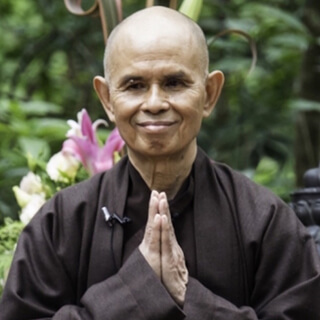
As relaxed as maybe Thich Nhat Hanh.
A ten is the dreaded panic attack.
Well actually you can't really rate yourself as a ten because if you were you're not reading this.
So let's give this a try.
I'm gonna do the counting so you don't have to think about it.
And it's a little tricky for me to do the counting so I may end up screwing it up once or twice but if I do,
No worries.
In the words of Ajahn Achalo,
Never mind.
But I really just want you to get a good feel for how you will do it when you're practicing by yourself.
How you might count it in your own head.
So here we go.
Breathing in,
One,
Two,
Three.
Breathing out,
One,
Two,
Three,
Four,
Five,
Six.
In,
One,
Two,
Three.
Out,
One,
Two,
Three,
Four,
Five,
Six.
In,
One,
Two,
Three.
Out,
One,
Two,
Three,
Four,
Five,
Six.
In,
One,
Two,
Three.
Out,
One,
Two,
Three,
Four,
Five,
Six.
In,
One,
Two,
Three.
Out,
Two,
Three,
Four,
Five,
Six.
In,
One,
Two,
Three.
Out,
One,
Two,
Three four five six in one two three out one two three four five six in one two three out one two three four five six so just keep going like that work out your own rhythm and I hope you find this to be as wonderful an exercise as I do for helping you relax your anxiety thank you