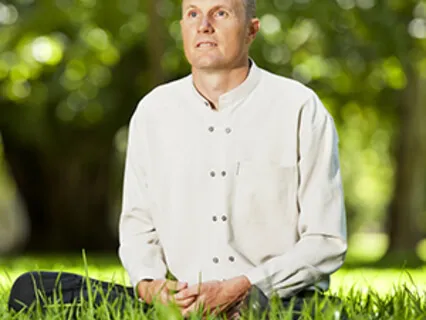
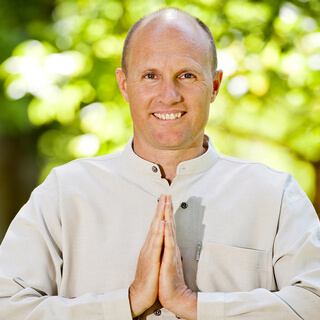
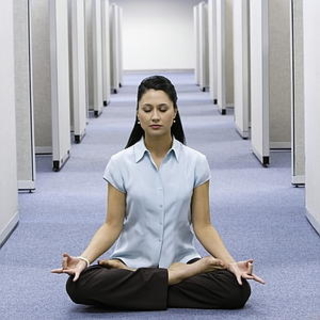
Welcome to this meditation on seven points of meditation posture with Peter Radcliffe.
Just take a few deep breaths.
And as we do in each meditation,
Bring yourself into the present moment and relax your body.
And bring your mind away from problems of the future or stresses of the past.
Into this very moment and in particular into this body.
For this meditation on the body,
We are going to concentrate on the seven points which will assist you in having a good bodily posture for meditation.
Now the first of these points is the legs.
And you might be sitting in meditation in various ways.
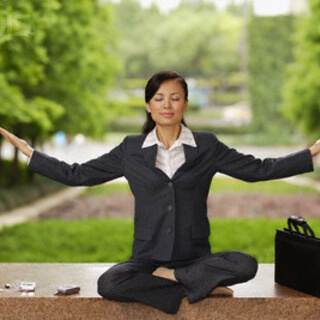
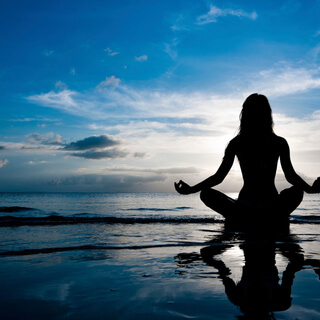
The most perfect way of course is the full lotus posture but this is very difficult for anyone,
Especially westerners who haven't practiced sitting cross-legged when they were young.
The half lotus posture can be achieved by some people by making sure you put your ankle right up on your thigh,
The other one resting on the ground.
The quarter lotus is a much more common posture to take with one leg crossed in front and the other leg resting with the ankle on the calf muscle of the bottom leg.
You can even tuck your toes into the fold of your knee to get a neat cross-legged posture.
If this is difficult,
You can try the perfect posture or Indian posture where your heels are almost in alignment together and your feet are both on the floor immediately in front of you.
Or try to sit in any cross-legged posture which you can feel comfortable for the next ten or so minutes.
Again,
If sitting on the floor is difficult,
You're welcome to try a meditation stool or a chair.
In any case,
Bring your awareness to your legs and check that they are in a good posture for the rest of the meditation.
Now the second point of meditation posture is the back,
Perhaps the most important part of your posture.
By keeping our back nice and straight,
It allows room for all the other organs of our body to work properly and keeps us alert by allowing our body to function fully without any hindrances.
So check there is a natural curve to the spine and relax all the muscles of your back,
Holding only those muscles tight that you need to in order to sit up straight whilst all the other muscles are relaxed.
The third point of meditation posture is that of the hands.
Keeping the hands folded neatly in your lap,
Equanimities about the centreline of your body.
You can either put right hand in left hand with the two thumbs touching or take a posture of the hands either on your knees or in your lap which is comfortable for you.
And then take a moment to bring your mind to the placement of your hands.
Now the fourth point of meditation posture is that of the arms and shoulders.
Allow your shoulders to release down away from your earlobes,
Making sure you're not holding any tension beneath your shoulder blades or in your arms.
Letting them float slightly away from the body so that you have air movement in and around your body.
Moving on to the fifth point,
That of your neck and head.
Making sure your head is a continuation of that straightness of the spine.
A good visualisation which I suggest people do is to imagine they're being pulled up by a thread attached to the crown of your head.
As if you're dangling like a puppet and your head and spine are falling naturally in that straight alignment.
It may help if you just tuck your chin in a little bit to keep that nice straight back and neck.
The sixth point in the seven point meditation posture is that of the jaw because many of us are guilty of holding tension in our jaw.
So make sure you release that tension,
Perhaps bringing the jaw forward a little bit so that your molars are not clenched and placing the tongue behind the front teeth at the top of your mouth.
And finally,
The last point is your eyes.
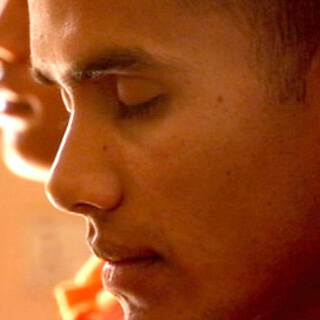
Gazing softly downwards at about 30 or 45 degrees.
Don't necessarily focus on the ground but instead look as if you're looking off into the distance.
So that even though your eyes are open,
The real concentration of your mind or the real attention is inwards to your own thoughts and the own and the seven parts of the body that we've discussed.
Now for the rest of this meditation,
Go through each of those seven points.
Try to commit those seven points to memory so that you can do this in every single meditation from now on because a good body posture will help create a great foundation for the mind.
Continue meditating in this way until you're ready to finish the meditation.