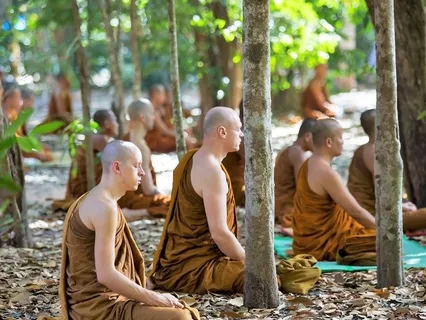
So our nine day retreat,
Eight full days,
Two half days.
We're on the last half day.
What is interesting to notice,
And I notice this each time I teach a retreat,
Is all of this becoming mindful of the characteristic of unsatisfactoriness of Dukkha.
And having a more honest and close up look at the experience of our minds,
The various energies and influences that affect them.
For sure everybody has some experience of bearing with difficulties on the retreat.
Releasing certain types of pain and seeing the way we grasp at things that causes pain.
But one notices as soon as people are allowed to speak a little bit that everybody feels very joyful.
So this is something I wanted to point to people because as I've mentioned before,
Theravada sometimes criticised for the emphasis upon Dukkha,
The Buddha's first of his four noble truths.
But we can see even just in a nine day period of time,
Lord Buddha is a master physician or the best psychologist.
And he knows where we need to focus or what we need to become aware of in order to start undoing the causes of suffering.
So it's in this having an honest look,
Not trying to put band-aids on the experience of suffering,
Not trying to project a pink fluffy cloud of positive affirmation and plaster over this real experience of the fact that we suffer because of ignorance and delusion and grasping.
So in the process of nine days,
Just in this partly in not speaking,
We're not complaining about it and we're not blaming other people,
At least on the level of speech.
Having a good look at it,
Being much more truthful.
Dhamma is sometimes called Satchatamma,
The Dhamma of truthfulness or ultimate truth.
So we do these retreats and we have to be much more truthful than we might habitually be.
We have to be humble because our own key lasers humble us.
We get a good look at the way we grasp,
The way the mind can be very immature and childish,
The way it hangs onto grudges in silly ways.
It's not to judge that,
It's to become aware of it and understand this is what most people do.
But in this process of sitting,
Walking,
Sitting,
Walking,
Trying to be with the breath,
Seeing thoughts as thoughts,
We also start to see the quality of the thoughts,
The texture of the thoughts and we can see very clearly which ones are unwholesome,
Which ones are unskillful,
Which ones are immature.
And it's very humbling.
At the same time,
The fact that we have enough wisdom,
Enough resolution,
Enough determination,
Enough renunciation to get on the bus,
Come up the mountain,
Commit to the retreat in the early mornings,
Cramped accommodations,
More simple food,
Sharing space with people who snore,
All of these sacrifices that we make,
Willing to work with that,
Shows that obviously there's quite a bit of virtue functioning in your minds already as well.
So you have these wholesome skillful habits and our unwholesome,
Unskillful habits.
But this clarity that we develop from being truthful,
Truthful awareness of the way things are now,
Is what leads to eventually understanding the ultimate truth,
Seeing it with perfect clarity.
And this capacity,
The way it works,
The function of mindful awareness in just seeing things as they are,
Seeing when it's due car,
Dropping it,
Learning how to put it down,
Get some space from it.
So I would suggest that's a large factor in the joy that you're feeling now,
Is greed,
Hatred and delusion are dark qualities that oppress the mind.
And the degree to which you feel a sense of lightness,
A sense of joy,
A sense of clarity in space,
Is the degree to which you've cleared out some of those qualities from your mind and so they're not oppressing it as much as they were nine days ago.
So it's a very important thing to notice and it's a good thing to develop confidence about.
Buddha's teaching is not on dukkha,
It's the path that leads to the cessation of dukkha.
And even from just committing for nine days,
You can all experience how much less dukkha there is in your mind now than there was nine or ten days ago.
So I just want to mirror that back to people and I want you to derive great confidence about this path and about your capacity to practice it and experience the results in here and now.
Of course,
For many of us,
We don't get quite the same results as those in the siddhas,
Listening to one discourse,
Attaining Sotapanna in the first paragraph and Arahant by the last paragraph.
But I've also said many times,
And it's true,
It's having intellectual understanding.
Ajahn Anand frequently talks about the three ways that we develop wisdom.
Listening,
Attentively,
Trying to understand and have a sincere interest in understanding the truth,
Just trying to understand.
When it makes sense,
That makes sense.
Accepting that on a deep level,
These teachings on cause and effect,
Karma,
The co-arising factors of experience.
And then we contemplate that deeply,
Recollecting what we've listened to,
Mulling it over.
And then through the practice,
We develop insight,
The three ways that we develop wisdom.
So I'm sure the duration of the nine days,
We've all heard things and it's like,
Oh,
It's like something clicks.
Oh,
That makes sense.
I think that really sounds like the truth.
And then when we apply that understanding,
We're able to let go of deluded,
Incorrect ways of perceiving and grasping things.
And then you have an experience putting down some of the causes of suffering and sufferingness.
And so this process is the practices that you're doing and the processes that you're engaging are precisely the same practices and exactly the same process that will take you to stream into a sakatagami,
Anagami arahant.
Or for those of you who are bodhisattas,
Bodhisattra practitioners,
It'll take you to different levels of evolution until you're able to fulfill your aspiration to help many beings.
But it's the same process.
The only thing that changes is the spiritual powers,
The faith,
The energy,
Mindfulness,
Concentration and wisdom,
They become more and more powerful.
And then they're able to uproot the ignorance and delusion.
It's like this magnifying glass or this microscope and you're able to see more and more clearly what's the cause of suffering,
What here is causing you suffering.
And you're able to see that type of grasping,
That type of delusion.
You're able to drop it.
The more you're able to drop it,
The more refined,
The more powerful,
The samadhi,
The tranquility,
The rapture,
All of these things.
And so the process deepens and the dharma wheel,
The eight factors of the path turning in your heart,
It turns with more and more power and it grinds up the habits of grasping because of ignorance and delusion.
So really acknowledging the value of the practice,
Really having a good look at how much happier you feel,
Having uprooted just a little bit of that attachment and delusion and just imagine what our capacity to realize peace or an absence of suffering really is.
If you can imagine whatever your highest point of the practice in terms of the path factors coming together during the retreat,
When there was a lot of mindfulness,
A significant amount of collectedness and a lot of clarity with regards to seeing things truthfully,
How peaceful your mind felt recollecting that moment.
And then understanding that when your mind is liberated,
It's going to feel much better than that and it'll feel that in a way that doesn't degenerate.
It's an unshakable peace which is no longer subject to the law of dukkha or impermanence.
So just getting confident about the goal,
Feeling confident about your capacity to realize it and then making some serious resolutions and determinations.
So hopefully now seeing how valuable this is compared to the other types of pleasure that we chase after and grasp after,
We see that this is superior.
Our Lord Buddha says,
Peacefulness is the highest happiness.
And I sometimes think happiness isn't really the right word,
But this is the limitations of language.
What we feel when the mind is clear,
Peaceful,
Sane,
It's not really happiness.
It's,
At least in my experience,
Words like tranquility,
Serenity,
Equipoise,
Clarity,
Profound wellness.
You can see that an experience of happiness is actually quite agitated compared to an experience of deep,
Deep serenity.
And so understanding that that's what we're aiming for.
We're not aiming for an unceasing,
Joyful,
Laughing,
Happy experience.
We're aiming for something even better,
A mind which isn't shaken by pleasure or pain,
A mind which isn't shaken by happiness or misery,
Not shaken by gain or loss,
A good reputation or a bad reputation.
Remember the story of Bodhisatta?
Just before he sat under the Bodhi tree,
A Brahmin gave him eight bundles of kusabras.
He made a seat under the Bodhi tree and he sat on those eight bundles.
The symbolic meaning was that Buddha was going to overcome the eight world-leadhamas.
He was going to transcend them.
He was going to get his mind liberated to a state where these things couldn't touch it anymore.
And then there's this story,
According to the legend,
After he was enlightened,
Mara's hordes came in tremendous force and threw all sorts of weapons at him.
And due to the power of the purity,
The metta and compassion and the wisdom,
It's said that those weapons literally changed to lotus flowers and other flowers when they came towards his aura and just floated down around him.
No weapon could touch him.
His mind was above the conditions,
So no condition could harm an unconditioned mind.
So just getting really clear about that,
That's what we aspire for as noble and lofty and sometimes seemingly far away.
It's important to understand that this is our potential and this is our highest aspiration and this is what is most worthy of our commitment.
Lay the causes to experience that because this is your ultimate inheritance.
Having a conscious body and mind,
This is the potential of consciousness.
Consciousness is affected by delusion and ignorance.
Because of that,
It's impure.
But it has,
We have the ability by cultivating the eightfold path,
Applying the four foundations of mindfulness to purify the impurity and what remains is a purified mind,
A liberated mind and unceasing experience of unshakable peace.
So that's our potential and everyone's potential.
It's not the case that there's one or two people in the room who are completely hopeless,
Who are destined to be miserable forever.
That's simply not the truth.
If one person in the room has the potential to purify and liberate their mind,
Then every person in the room has that potential.
This is nature,
Everyone's nature.
So going back to your lives now,
Time to think about what we can do to keep cultivating the mental factors,
Obviously the generosity.
Most people here,
I'm sure everybody here in fact understands the role,
Function,
Importance of generosity,
Grinding away some of the greed that oppresses our minds.
We all have lots of things that we want and when we're able to not fulfill every one of those greedy desires and we're able to give away some of our resources because we aspire to overcome the power of greed,
This is not only putting in place auspicious karmas that will ripen as good opportunities,
Good situations,
Happy feelings in the future.
It's chipping away at the power of greed that oppresses the mind.
And with the five precepts,
Maintaining ethics,
Ethical standards which protects the power of virtue.
So I often say I don't particularly like the word morality,
But I love the word virtue.
And so it's important to understand that it's by being moral which sounds,
Can sound oppressive,
Can sound boring,
Can sound judgmental,
But the word ethics doesn't have that connotation.
We all want to be ethical people.
We all want to be people who have integrity.
Those kind of words.
So we have to re-translate,
Use words that work for you.
Try to be ethical,
Try to have integrity,
Try to be truthful to yourself and to others.
Your love of truth.
Then that's the foundation,
The generosity and the ethics that we all want.
Ethics that allows virtue,
Your innate virtue to fully blossom in your heart.
And that's a power.
People who are virtuous,
When you come in contact with them,
You can feel it.
The Lord Buddha also talks about the offering of fearlessness as a type of generosity.
People who maintain good ethical conduct offer fearlessness to all of the beings around them.
You come in contact with them and you know this is someone who isn't going to try to hurt me.
This is someone who's going to try to help me.
And that's a beautiful offering,
One of the types of generosity Lord Buddha talks about.
Upon this foundation,
So the power of sense restraint is something I think we all need to think about.
The mind flows out through the eyes,
Through the ears,
Through the various touches it wants to experience and through the mind or from modern people who have to be very,
Become very mindful of what nutriment we give the mind,
Not just the body,
Especially with the new technologies,
Information technologies.
One can consume a great deal of information,
Great deal of entertainment,
A lot of it not very conducive to maintaining a sense of balance,
Serenity,
Clarity.
So Lord Buddha also says,
Wise association is the entirety of the holy life.
Kalyanamitta,
The name of the groups that some of you belong to,
The Malaysian Kalyanamitta groups.
Wise spiritual friendship.
So that means in your relationships,
Physical relationships with the people,
But it also means what you engage,
What you relate to on the level of the mind.
When you're alone,
When you have your quiet moments,
What is your mind consuming?
What are you allowing to condition your mind?
Because if you look at entertainment where there's a lot of greed and a lot of hatred and a lot of delusion expressed,
And you're giving attention to that,
It's possible that we actually absorb some of that kilesa,
Or perhaps that the seeds of the kilesa in our own minds are given nourishment and they grow thicker and thicker.
So we don't want to nourish,
Fertilize,
And feed the seeds of the great hatred and delusion.
So make some aspirations,
I strongly recommend,
To be very careful how much news,
How much entertainment,
The type of entertainment and understanding the well-being that you feel now,
Is largely due to sensuous strength and making efforts to meditate and listen to Dhamma.
So if you want more of this goodwill and if you want to continue to lay upon the foundations that you've built,
We have to keep doing these precise activities.
Find time to chant,
Find time to listen to Dhamma talks,
Find time to meditate in your daily life,
Find ways to be circumspect so that this virtue remains strong,
Remains a power,
The power of virtue in your heart,
The foundation for sammasati,
Clarity,
Stillness,
Balance,
Well-being,
The capacity to be okay with the eight worldly dharmas.
I sometimes use the phrase,
Roll with the punches.
That means being able to accept the conditions of life without getting too contentious,
Trying to live as skillfully as you can with compassion for yourself and others.
But sometimes when challenges arise and there's really not much we can do about it,
This capacity as Lompoccha and Ajahn Simedo say repeatedly in the readings that I've been reading,
Which is knowing conditions as conditions,
Not contending with them.
I didn't read that talk in this retreat but I love it.
When Lompoccha uses these wonderful analogies and metaphors,
He says,
So much of our suffering is because we want a cat to be a dog.
And it's like,
Really,
If we can just understand a cat is a cat,
A dog is a dog,
You can't make the cat a dog,
You can't make the dog a cat.
And really,
He also says we suffer because of wrong thinking.
So we need to have enough mindfulness and enough wisdom functioning in our mind to see,
Are you being unnecessarily contentious?
Are you making a problem out of things that don't need to be a problem?
And so it's mindfulness and wisdom that make it possible for us to accept,
Okay,
It's dukkha,
Okay,
There's nothing I can do about it,
Okay,
Fine.
Once we have that,
The Dalai Lama also says some interesting things about what we would call problems or challenges with regards to problem.
If there's something you can do about it,
Then it's not a problem.
If there's something you can do about it,
Then it's not a problem.
Just do that thing.
If there's nothing you can do about it,
Then it's not a problem.
Because there's nothing you can do about it.
Ways to think which help us just accept truth,
Not be contentious,
Not add the suffering of our version and contentiousness to difficult situations.
At the same time,
Really looking at ways that we can,
There's certain type of suffering that we possibly can reduce if we're determined and skillful.
There might be unskillful relationships that we can avoid.
Lord Buddha does say,
If there's a thorny bush in the middle of a path,
He doesn't recommend that you walk through it.
He says,
Walk around it.
So if there are relationships which aren't really helpful,
Then you don't have to,
If you don't have to be in relationship with those people,
Or at least perhaps you can cut down.
Obviously when it comes to family,
It's a bit more tricky.
It is appropriate to try to find generous ways to be generous,
Express one's gratitude to one's parents.
But even with this,
There is such a thing as healthy boundaries,
Skillful assertiveness.
If people are abusive,
One can express one's needs,
One can express one's feelings.
If people are abusive in a way that isn't aggressive or hostile or contentious,
You can just say what your needs are,
What you're willing to offer,
What you're willing to put up with,
And what you're not willing to put up with.
But you don't have to say that with anger.
You just say it with clarity.
This is where the boundary is.
This is what I'm willing to give and be as generous as you can.
And also,
This is what I'm not willing to put up with because I have loving kindness for myself.
So the metta for yourself,
The metta for others,
Keeping it healthy,
Understanding what healthy boundaries are,
Understanding that it's through healthy self-care that you're able to care for others in an ongoing way,
Sustainable way.
But the thing that will help you navigate all of this is good mindfulness and some wisdom.
So that's why your daily practice is vital.
And not to let too much negative energies infiltrate your mind by paying attention in unskillful ways.
And so,
Add a lot of time to experience your mind.
A lot of time to experience what your mind's like with more practice.
And just with regards to worldly dhammas,
As you're going back to the world,
It's interesting I spend some time editing in my quiet kuti talks that I give in these retreats and share them.
But I have a small notebook and I have one of these air cards and it can take a long time to upload one file.
It can take.
.
.
A 30 megabyte file can take about 45 minutes in my remote.
We don't have broadband,
Thank goodness.
And we don't have Wi-Fi,
Thank goodness.
But we have little air cards.
But occasionally I'm uploading something and I want to see that it's successfully uploaded because sometimes the connection cuts out.
And so it's a great way to practice patience.
But as you all know,
There's this little suggested viewing on the side sometimes when you look at some news or something.
So I saw this one.
20 celebrities who have aged monstrously.
And I thought,
Oh that sounds horrible.
But then I thought,
Okay,
Let's contemplate aging.
So I click on it and I had a look and it's very interesting.
It's like.
.
.
So the first one was Goldie Hawn.
And what was interesting about this particular thing I clicked on was.
.
.
And I try not to do this very often but I did because it was related to contemplating aging.
I had a look.
Now Goldie Hawn is a Buddhist actually.
And she's probably about 70 now.
And yeah,
Sure enough,
There's this picture of her and she's very very wrinkled and she's frowning.
And what I noticed was that she hadn't had cosmetic surgery.
And I thought.
.
.
I actually thought,
Isn't that great?
Because about 18 years ago I went to Dalai Lama's teachings in Los Angeles.
When I was staying in the Vaingiri monastery we all went down to his teachings in Los Angeles.
And Goldie Hawn,
Who was probably about 50 at the time,
Actually introduced the Dalai Lama for his public talk.
And so in those days she was still hanging on to some of her youth.
And she came out and she introduced him.
And I remember it was quite funny because she's giving a speech and she got lost in the speech and she went,
Oh,
I'm lost.
And then she said,
This is why we need the Dalai Lama.
Very cute.
Anyway,
So now she's a very wrinkly old lady.
And so what?
For me,
I was just looking at someone who was truthful and honest enough not to have had cosmetic surgery and I was quite happy for her.
But one does have to notice youth,
Beauty,
Fame.
She's not very famous anymore.
She's certainly not useful anymore.
And she's not very beautiful anymore in terms of the external body.
But I suspect she has some.
.
.
I've heard that when Goldie Hawn goes to Dharamsala she can't stand seeing the poverty of the beggars.
So I've heard that she goes into some of these Indian stores and she says,
I'll buy everything in the store.
And she goes out and she tells the beggars,
Just go and get everything you need.
And the beggars run in and they grab everything from the store and Goldie Hawn just hates her.
I don't know how skillful it is,
But it shows that she's very generous and good-hearted and makes efforts to try to help beings.
But of course I clicked on and I saw Russell Crowe.
Russell Crowe is this.
.
.
Many of you are a similar generation to me.
I haven't seen much media in the last 20 years living in forest monasteries like we do.
One of the only times I really watch movies is on flights which are longer than eight or nine hours.
I might watch a movie and get caught up to some degree about what's happening.
But anyway,
Russell Crowe who is this lean athletic,
He's got this big stomach,
Probably.
And it's like,
I need to tell him.
And then a bit of improvement,
A bit of aging.
And then Janet Jackson,
Janet Jackson,
Although as a teenager we were observing Janet Jackson,
Was it the rhythm nation.
So Janet Jackson,
She married some Arab prince or something or other.
I can't remember which country.
And sure enough she's got these really big thighs now.
So what?
It's just the point is youth,
Beauty,
It all changes.
Fame,
It changes.
Wealth,
It changes.
And so the other one that really stood out was Demi Moore.
Because I remember as a young adult,
Demi Moore was doing the Dove soap commercial.
And she came on the TV and she said,
Some people say I have the most beautiful skin in the world.
And she said,
Well I don't know about that,
But I do use Dove.
Yeah,
It was so stupid I still remember it.
Anyway,
So Demi Moore now has really saggy shriveled skin.
20 years later.
So the point is,
And unfortunately some of these celebrities haven't been very virtuous.
And so one wonders,
If you were beautiful,
If you were rich,
If you were successful,
You were not ethical.
You might not have been very generous.
Might have been a lot of unskillful speech,
As there's often a lot of jealousy,
Competition,
Critical comments about each other,
Celebrities.
And then you get to that state,
Upper middle aged,
Entering old age,
And you no longer have the fame and the beauty,
And you also don't have virtue.
Then it really is an ugly situation.
And so I found myself feeling quite sad for most of these celebrities.
But the point is,
If we train ourselves,
Being generous,
Being virtuous,
Then as we age,
It doesn't matter.
We allow your inner goodness and your dignity,
Your self-respect,
Your virtue,
You allow the light of that to shine through the wrinkles,
And not identify with it.
It wasn't a self when it was young and beautiful.
It's not a self as it ages,
And it's not a self as it dies.
But the only thing one can take with one is the good karma,
And the skillful qualities that one has managed to cultivate.
So just as a reminder as you go back to the world,
Even Russell Crowe gets fat,
Even Demi Moore's skin shrivels.
So don't waste too much time investing in youth and beauty and fame,
And if you want to be able to be a shriveled,
Slightly overweight,
Wrinkled person who experiences some well-being and happiness,
And who doesn't care,
Who doesn't care about the fact that they're not useful,
Who doesn't care about the fact that they're not famous,
But respects the fact that they're a good person,
And is able to look in the mirror through this wrinkled,
Shriveled face,
And look in those eyes,
And see a good person who tried really hard to benefit themselves and to benefit others,
And accepting it,
Accepting aging and learning from it.
Don't try to cover it up too much.
Have a good look at those wrinkles.
Have a look at the way the body won't stay the shape that you want it to,
And learn from the pains.
Don't get into this trying to hang on to it to a neurotic degree.
Try to avoid pain to a neurotic degree.
See these people with facelifts,
Especially in America,
Occasionally watch news,
Even the men,
And you can see when eyebrows start here and go that way,
It's like that's two facelifts later,
And it just looks really strange,
And the Botox,
When they can't even smile,
They don't want smile lines,
And for these people,
They think that that's beautiful.
To not have wrinkles,
They think it's beautiful,
But Buddhist monks tend to think being able to smile with wrinkles,
If you're a good person,
Is much more beautiful.
So I encourage you,
In your generosity,
In your ethics,
In your meditation,
Learn from your life,
Be as good a person as you can be,
Be patient and forgiving with yourself,
As well as being determined to do better.
Nobody's perfect,
We all have bad habits,
It is a wrestle.
We do have to wrestle with our negative habits,
And sometimes we fail.
When we fail,
Try to make amends and quickly start again.
A mistake that many people make is after making a mistake,
Then rejecting themselves,
Then neglecting to do the practices that would help them,
Losing self-respect,
Losing self-confidence,
And then sliding back.
So really look out for that.
When you've made a mistake,
It's just a mistake,
Then get back with the program,
And make amends,
Acknowledge it truthfully,
Or just get back to being a good person,
And forgive yourself.
So just a few words,
Encourage you back in your lay lives.
Try to meditate a lot.
Another thing we can feel,
I'm sure,
This is the fifth retreat five years in a row,
And I'm pretty sure people can feel this wholesome field of merit.
It's the little virtuous strings of connection that we have together through helping one another.
I offer explanations and commentary on teaching to the best of my ability.
Many of you have helped us to build our monastery where we live,
And you can feel.
You can feel the goodness of that when a group of human beings cooperate and help each other.
You'll feel our duties.
You can feel the love.
You can feel the goodwill.
You can feel the merit.
Walk into a place that feels safe,
Supportive,
Nourishing,
And we can quickly commit to our work of developing more wisdom,
More mindfulness,
More concentration.
So I did say unfortunately I don't feel that I can come next year.
I'm having a break from certain duties,
But I do hope to come the following year if conditions allow.
And thank you everybody for your support to the monastics at Anandakiri and to the development of our monastery.
Thank you very much.