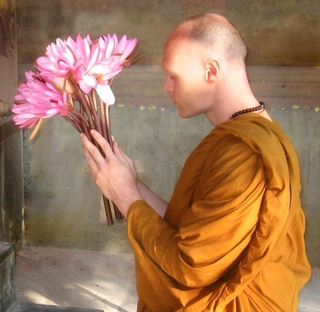
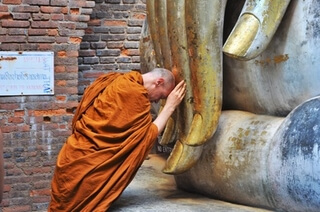
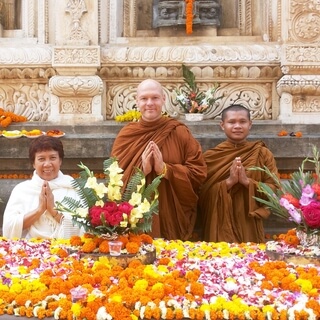
We live on a mountain in a remote rural province.
Our usual day we meditate by ourselves in our kutis.
It's quite a quiet place and we have about 50 acres of the monastery and we're surrounded by farms and some forest reserve.
At about 6.
30 we wander down the hill and we get off with our alms food.
At that time in the village most of the villages getting ready to go off to their farms.
It's an area where people are growing rice,
Corn,
Snow peas.
Every day is very similar,
Day after day.
And then coming back to in a way a more complicated,
More comfortable but also more complicated urban context.
I guess as human beings there's a similar theme with the villages that we know very well.
That we live as friends and rely upon each other.
They see the monastery very much as their monastery as well as us.
It's the monks monastery that it's the villages monastery.
Their theme of struggle is they work very hard but they don't seem to be able to get enough money to get ahead.
They've got some debts paying off their utes.
They pick up trucks,
Their motorbikes,
Paying their phone bills.
Everybody's got a mobile phone,
Even the kids.
Then you come and talk to a few friends this morning.
It's the kind of a different office jobs.
One friend lost his personal assistant,
Has to work a lot harder all of a sudden with less help.
And another person,
Staff reduction and then having to do the same amount of work with less people.
You get the sense here kind of a different kind of stress perhaps.
Shared human experience.
Everybody wants to be happy and yet there's some struggles.
And then I think a large part of our practice is how we relate to those struggles.
What do we do with this human experience?
So that it's ennobling.
So that we learn from our experience.
In rural Thailand I encourage the villagers if they can to come and join the chanting,
The evening meditations of it at least every day.
They're beginning the day with making offerings to monks,
Preparing some food and I encourage them to come do some chanting,
Some meditation.
Not that many people rise on the occasion but on the lunar observance days it's about 30 people.
During the rainy season retreat we probably get people make more of an effort 50-60 people for those three months.
Here you have your hopefully you have your daily practice at home.
It's very important.
I wanted to talk a little bit about refuge because having the refuge of Buddha,
Dharma and Sangha is in a way it makes your entire life meaningful.
And if you recollect that refuge then it gives a context for the way that you live your life and what you're intending to achieve.
So I think a challenge that we all have is the mundane habits that we have and our habits are very deep as opposed to our ideals that we aspire to and even you know the basic practices that we really hope we can do wish we can do.
Even as a monk who has a lot of time to practice I often have that feeling of not quite doing as much as I'd like to.
Feeling a bit frustrated with that and so in this life we have to consistently think of ways to refocus and skillful ways to generate a bit of urgency.
Remember what's important,
Remember why it's important and then try to focus and at the same time then we have to be a little bit patient and a little bit forgiving and a little bit humble in the face of the power of our bad habits.
That doesn't mean that you don't keep trying.
We actually have to try harder and harder but we're just recognizing that if you believe as I do we have thousands of lives before this one with various deep habits quite firmly entrenched in the mind and then we meet these teachings probably meeting these teachings because of having heard them before and having practiced before and so we have a combination of unskillful habits and wholesome habits,
Neutral habits and we have to engage this with our aspiration and then determination to keep increasing the wholesome skillful efforts and it's a bit of a struggle and I think something that we all have to work with is that sense of not quite doing as much as we'd like not quite getting ahead in our spiritual practice as much as we'd like.
So I wanted to talk a little bit about the long-term optimistic view.
The reason I want to talk about a long-term optimistic view well first of all the question is what is there to be optimistic about?
So we know as students of the Buddha we know that the mind is affected by great hatred and delusion.
The power of great hatred and delusion is actually terrifying if you ask me and these energies that can dilute the mind and the things that we can do the unskillful things we can think and say and do under the influence of delusion and then there's the fact of karma and we can create all sorts of terrible karmic obstructions for ourselves.
All of that if you focus on that can be depressing,
Can be frightening but we do have to have a look at it and we do have to become a little bit frightened actually because it's in looking at the truth of the samsaric predicament that we realize it's a dangerous place and we realize that we really ought to be doing things to ensure some kind of relative safety within the samsaric cycle but also to be working quite hard to get liberated from it.
That's where the optimism comes.
So with regards what can we be optimistic about?
The fact of enlightenment,
The fact of the ultimate nature of your mind and your ultimate potential and the fact of deeper truth.
So the deeper truth is that greed,
Hatred and delusion is not the nature of your mind and the deeper truth is that because of this wonderful path of sila samadhi and banya or dana sila and bhavana,
Being generous,
Being virtuous,
Training your mind,
That there's a clear path with which you can weaken greed,
Hatred and delusion and then eventually these things can literally be exploded out of your mind with the power of dharma and that's not the kind of experience that we have in the beginning of our practice.
We don't have this experience of exploding the chilesa,
Exploding greed,
Hatred and delusion and then experiencing an unending ceaseless unshakable peace which is blissful.
But I have great confidence that that's where this practice goes and I have great confidence that that's what our nature and potential is and I think many of you as well as myself have the good fortune of having met beings who have accomplished that,
Who affirm that's the nature of the mind,
That's the potential of the mind.
At the same time these powers of greed,
Hatred and delusion are powerful and so we're in a wrestle,
It's a bit of a struggle and then you understand the strategy explained very skillfully by Lord Buddha.
Be generous to the extent that you can share,
That might be your time,
Your talents,
Can be money,
Whatever it is that you can give and this has several functions.
Sharing,
Giving away a portion of the stuff that you're attached to is weakening your greed.
That's very important,
We weaken the power of greed by giving away stuff that you want actually,
It's not that you don't want it.
Most people feel they want more money,
Very few people,
Even billionaires want to be trillionaires so that never ends.
The whole point is to give it away because you want something better and you can have something better.
You're giving away part of your wealth,
Part of your time so that you can chip away at or starve the energy of greed which oppresses your mind.
So you get into a habit where you think you can have the thing that you want when you want it,
That's happiness.
No,
It's a few moments of pleasure and what happens is when you act on getting the things that you want then you have to want it again and again and again and you want to fulfill it again and again and again and it doesn't end.
Whereas opposed to the path of Dharma practice,
The Lord Buddha explains it as leading onwards to something better than this.
So weakening your greed,
Relinquishing this capacity to relinquish stuff,
Things and go against the power of craving.
When you do that you increase the likelihood of your experiencing your mind when it's not oppressed by greed and you experience your mind when it's not oppressed by greed.
It's very peaceful,
Spacious,
Radiant.
So we have to keep up with these practices long enough that you experience that.
What's it like giving stuff away,
Going against greed,
Patiently enduring the desire.
It's not the case that the desires don't come up.
The more you practice relinquishment the desires can come up very very powerfully in the mind because you're not giving into them.
And then this is where the patient endurance becomes very necessary because you patiently endure this desire until it ceases and you experience a spacious peaceful mind with quality of awareness,
That nature of knowing that knows a peaceful mind not oppressed by greed.
And you notice that it's much more pleasant actually than the pleasure you would have got from the sensual craving if you'd fulfilled it.
But that's something that requires some determination and some courage.
Practicing in the face of the power of your greed,
Going against it and I think it's really important to be confident of this greater potential that you have to experience pleasure that is superior to sensual pleasure,
Mental pleasure,
Pure mental pleasure coming from the nature of your mind when you cultivate it.
And it's similar with the hatred energy,
The aversion energy.
We engage this by consciously developing metta.
So you train yourself to hold loving-kindness in your own body and mind.
And if you do this in a disciplined way,
When the irritated thoughts and the angry thoughts come up in the mind,
Things don't go how you want them to.
You find that you can not say the angry thing you want to say or not have the reaction or you can,
At the very least you know that there's anger in the mind and you know to be careful.
You might go away and be quiet and meditate a bit and if you can sit with this power of aversion and hatred but not give in to it.
And then experience when that,
Those feelings and thoughts,
Mental feelings cease in the mind and you experience the coolness of a mind that isn't angry without having had to say anything,
Without having to express your anger.
It just ceases of its own nature.
But the mind needs to have enough integrity,
Enough clarity that you can do that.
Just go and sit on your cushion or be alone in your bedroom or watch the mind from some distance.
Not keep feeding the story.
See thoughts as thoughts,
Feelings as feelings.
Be really interested.
Will it cease?
And then notice it does.
And just feel what's it like to be aware of the cessation of anger and hatred without having expressed it.
You don't,
Didn't make any more fresh karma.
You feel that something that was oppressing the mind,
Left the mind and the ordinary mind in its natural state when there's some awareness,
Can be very serene and peaceful.
So Lord Buddha says that peace is the highest happiness and one of the ways he describes Nibbana is unshakable peace.
So that's our nature is,
Your ultimate nature is unshakable peace.
But we have these energies,
Great hatred and delusion,
Banging around,
Running around,
Rolling around,
Surging around in the mind.
And we have to wrestle with them.
We have to have a container,
That's your ethical precepts.
You have a container that you try to live within as strictly as possible.
If you make mistakes occasionally,
I just like to encourage people,
What's the result?
You break one of your precepts.
Don't believe the thoughts that justify it.
I'm not asking you to justify breaking precepts.
I'm asking you to have an honest look at what's the consequence when you do.
And if you do,
I think that you'll find that didn't increase your peace or happiness.
I think you'll probably find that it increased your misery to some degree.
And so you have to be honest.
We're kind of Buddha's disciples of the Buddha.
Buddha's practitioners are spiritual warriors,
Engaging these powers in the mind with a different power.
Power of Dhamma,
Power of Sīla,
Power of Metta,
Power of renunciation,
Power of humility,
Power of patient endurance,
Power of virtue.
And with these opposing energies,
Opposing forces,
You can weaken,
Contain,
Uproot,
And eventually experience a mind which is not affected by these things at all anymore.
Wouldn't that be wonderful?
I know some people in Thailand whose minds aren't affected by these things at all anymore.
I was talking with my teacher Ajahn Anand about some of his experience.
So if someone has abandoned greed,
Hatred,
And delusion,
What occurs is that they're experiencing a deeper nature of the mind or the purified mind,
Sometimes called the Nibbāna element.
And then with regards our bodies and minds,
Which are still affected by greed,
Hatred,
And delusion,
That's experienced in the world.
The world is sometimes described the meaning of the word Loka in Pali actually also means darkness.
So our minds are affected by darkness and we grasp at our bodies.
There's some darkness.
But the ultimate nature is light.
We talk about enlightenment.
And so when somebody,
What will happen in your practice is you glimpse your mind without greed,
Hatred,
And delusion in moments.
And you experience it without greed,
Hatred,
And delusion in moments.
And you should derive a great deal of confidence from that.
This is something that people forget to do.
What I wanted to talk about,
Affirming your deeper nature,
Affirming ultimate truth,
And affirming your capacity,
No matter how slowly it might seem to you that you're progressing,
Or no matter how powerful these habits might seem,
They're not there all the time.
And one of the tricky parts in practice is to notice the ordinary mind.
Ajahn Chah says a large part of practice is keeping the mind in the middle.
Because the mind is flying off into cravings for things and fantasies and infatuations and then flying off in the other direction towards irritations and aversions and it doesn't,
We don't notice when the mind's in a neutral state.
But that neutral state is much closer to your nature,
Ultimate nature.
And if you can keep the mind in the middle,
As Ajahn Chah says,
And this is where our training and meditation is so important,
Come and you'll see it,
Come back to the moment,
Come back to the moment.
Don't fly off into the infatuation,
The fantasy,
The craving,
Don't fly off into the aversion.
Come back,
Start again,
One breath.
Keep the mind in the middle.
And if you can do that,
The quality of clarity,
Of awareness,
The mind has a nature to be aware,
The awareness is defiled,
Can be diluted,
You get carried away in a delusion.
But if you train in,
Be aware,
Be aware.
Just aware of the physical feeling of the breath.
And then aware of mental feelings,
That's your emotions in your mind,
Just as a feeling,
Not believing the story.
And you train in,
Just be aware of the feeling,
Just be aware of the feeling,
Step back a little,
Don't believe the story.
The sense of clarity,
Presence of mind,
Gets more palpable,
More established.
And then you realize,
What I want to affirm is that's what I would like you to affirm as being your nature.
Don't believe the delusion.
That's not you.
And the thing about a spacious,
Clear,
Peaceful mind,
There's not much to identify with,
Which is good.
It's actually good that there's not much to identify with,
But you have to train the mind to recognize,
That's it,
That's the nature of the mind.
And then the sense of self bobbing around in some sorrow,
Will keep coming back.
But that's not you.
And so this is where the daily meditation discipline is so important,
Because you have these moments,
And hope,
And what will happen is those moments get longer,
And as you get skilled in meditation,
You have periods of time in the mind where there isn't greed,
And there isn't powerful forms of aversion or delusion.
And you've been to trust that,
That which knows.
And that becomes a refuge.
So the refuge of Dharma,
Practicing dhāna,
Sīla and pavana,
That's the path,
That's a description of what we need to do.
The refuge of Dharma is your nature,
That you experience,
And the path is leading to the realization of your deeper nature.
And then when you experience that,
Moment by moment,
Deeper moments,
Longer periods of time,
That becomes a refuge of Dharma in your heart,
Your nature,
Your capacity to be mindful and peaceful.
That's your refuge.
And it's a real refuge.
But it's a refuge that needs to be cultivated,
Deepened,
Affirmed.
So you need to experience that refuge again and again and again until you get it.
That's my nature.
That's the real refuge.
The other stuff that we chase after is not a real refuge.
So the difficult thing is you come to your cushion and you've got sleepiness,
You've got restlessness,
You've got tiredness,
And it just oftentimes doesn't seem very inspiring and it doesn't seem very,
What's the point?
You might have that experience.
What's the point?
And this is a thing because the refuge is a subtle thing and it doesn't announce itself as being incredibly wonderful and of having,
You know,
What's the point?
What's the point?
It doesn't announce itself as being the point.
But every moment where there's more clarity,
More spaciousness,
More awareness,
It's strengthening the practice of mindfulness.
Mindfulness is a sankhara.
It's a karmic formation.
It's something that has to be generated in the mind.
It's an enormously important part of the practice because it's one of the conditions that leads to the unconditioned.
And it doesn't announce itself as that.
This little bit of mindfulness that you have when you,
At the end of a,
After 15 minutes there's a little bit more clarity.
After 20 minutes there might be,
Have been five minutes of peace.
That's not going to announce itself as this is the condition that's going to liberate you.
What's going to happen is the thoughts are going to come back and you're going to think,
Oh,
What's the point?
And the point is every moment of mindfulness,
Every time that you consciously cultivate mindfulness and every time that you give yourself to the practice,
You're investing in a deeper quality of mindfulness in the future.
So if you do keep it up,
The five minutes of peacefulness with greater clarity and better mindfulness becomes 10,
15,
20,
Half an hour of mindful clarity.
And that clarity is what you can bring into your life where the same delusions come up.
Powerful greed or powerful hatred.
But there's something else in the mind that notices.
You know,
Oh,
The mind's affected by greed.
Oh,
The mind's affected by irritation,
Aversion.
And then that gives you choices.
You can begin to choose you act on it or not act on it.
That becomes more and more powerful but it's a subtle thing.
And so in a way we have to affirm it ourselves because it's not going to affirm itself but look at the suttas.
The Eightfold Path.
Sammasati.
Right mindfulness.
Practicing with right mindfulness is the focus of how I understand Ajahn Chah's approach because right mindfulness conditions right collectedness or right concentration.
So consistency of the mindfulness.
And so then he says,
And this is very instructive.
And he was an Arahant,
I have no doubt.
His closest disciples have no doubt.
You read his teachings,
They're very wise.
With regards to the attitude we have to have when we practice,
He says,
When you're lazy you practice and when you're diligent you practice.
When you want to practice you practice and when you don't want to practice you practice.
When you're peaceful you practice.
When you're not peaceful you practice.
So that's what I was talking about,
The spiritual warrior.
It's not that you're going to want to do it all the time and it's not that it's going to be great every time.
It's that you don't want to do it and you do it.
The mind isn't peaceful and you do it.
And what happens is when it is peaceful it's more peaceful and it's peaceful for longer.
And you begin to trust that,
Keep the mind in the middle and you have that capacity to keep the mind in the middle and see the way it gets swayed to the left or to the right.
And don't do it or don't get swayed as much or wake up more quickly.
And this is this sammasati,
Sammasamati.
I often talk about the five spiritual powers.
Faith,
Satta,
Virya,
Effort.
And then sati,
Mindfulness,
Samadhi,
Right collectedness,
Banyā,
Wisdom.
So your faith is something to,
We need to lift,
Remind ourselves.
The Buddha said we have an extraordinary nature,
An incredible potential.
We can experience unceasing bliss,
Unshakable peace,
Complete liberation from all great hatred and delusion.
You can experience the nirvana element.
And I was talking a little bit before about Ajahn Ananda says that he can come out of a high samadhi state,
A jhanic state,
Or he can decide to spread loving-kindness into the world element.
That's interesting isn't it?
The loka dhatu.
So when you're still swimming in the loka dhatu and you don't yet know the nirvana dhatu,
The mind which is established in its own liberation constantly,
You don't know that that's your nature yet.
But if you realize that as some of the disciples of Ajahn Chah had,
Then they know that.
They're experiencing the nirvana element which is something else.
Unshakable peace,
Clarity,
Awareness,
Constant mindfulness.
And then from that space of the liberated mind they can spread loving-kindness into the world element.
That means the entire samsara.
So when you struggle with your ordinary mundane boring challenges,
We have no inkling that that's possible.
It's possible to establish your mind in liberation and then from that liberated state radiate loving-kindness into the whole of samsara which is where all these other beings are still rolling around affected by greed hatred and delusion.
But that's your nature as well.
That's what I want to talk about the long-term optimistic view.
Every moment of peacefulness,
Every period where there's good clarity,
That's weakening greed hatred and delusion and strengthening your capacity to experience in moments and then for longer periods and then actually experience to the point of it being an unceasing experience where the old stuff that used to be a struggle,
The greed hatred and delusion isn't a struggle anymore at all.
It's something that the mind saw clearly and let go of and then the liberated mind can have compassion for all the billions of beings that haven't done that yet.
But that's where the practice goes which is really wonderful thing.
So I just wanted to affirm where it all goes and what the point is.
I mean that's something really worth giving energy to and time to and investing in so you can experience unceasing unshakable bliss,
Unceasing peace,
Complete freedom from oppressive energies that darken the mind.
The mind can literally be enlightened to the point where that darkness cannot come in at all anymore.
The mind transcended it let it go,
Saw it clearly for what it was,
Recognized that that's not me.
For thousands of lives I've been thinking my greedy thoughts for me,
For thousands of lives I've been thinking if I give in to that desire I'll be happy and now I see that the desire itself is a dark quality and I don't have to pick up the desire let it go,
It's suffering,
It has a nature of suffering and then you experience something that isn't suffering.
So that's worth giving attention to and it's worth putting effort towards and it's worth affirming.
So faith,
How are you gonna lift your faith?
Obviously coming to listen to Dhamma reflection is a very good thing to do.
In Thailand people chant daily I think many of the Sri Lankans in the room probably have a daily chanting practice.
Doesn't work for everybody but it's a very good thing to do because if you do the chanting you recollect the Buddha,
The Dharma and the Sangha the mind's already forgetting about the challenges at work,
Forgetting about the depressing thing you heard on the news,
It's thinking about the refuge and your ultimate aspirations just because just doing it as Ajahn Chah says,
You don't want to do it you do it,
You want to do it you do it,
You can see the point you do it,
You can't see the point you do it and what happens is it becomes a refuge,
It becomes a skillful means,
It becomes a powerful practice because of the consistency but if you do it sometimes you don't but other times you do it when you want to you don't do it when you don't want to then there's that sense of not really getting ahead and not getting powerful and you have to be patient with that,
You have to be forgiving,
You have to have compassion,
The power of greed,
Hatred and delusion is awesome and the power of our habits is very powerful and so lifting the faith so that you have the energy to do something about it,
See faith is energy,
It gives rise to energy in the mind,
Okay you've got faith you remember you have faith in this,
This is worth doing,
Okay now there's energy,
Apply the energy into the mindfulness,
Maintain the mindfulness consistently,
Collectedness,
The right collectedness with good mindfulness and the collected mind you see things according to their nature that's what wisdom is,
The suttas that's a description of truth from certain angles but in terms of how you will experience wisdom that's when you just see things clearly that's impermanent it arises and ceases that's not me it's not a self that's what wisdom is you see that clearly that's wisdom in your mind that's that's what the mindfulness and the samadhi leads to you just see clearly it's not me and when you see it's not you you don't grasp at it you let it go and then you can experience something better so those five spiritual powers the Buddha says lead to the deathless merge in the deathless and deathless is another word for nibbana or that state where there's no great hatred or delusion so I hope I've been able to say something that might have stimulated some faith and to help you increase and commit to your efforts understanding that there is tremendous value and a tremendous point to it all and that it's through consistency and maintaining a momentum that it gets a real power and at the same time to be patient it's tricky isn't it to be patient with your limitations without being really lazy so this is the area where we all need to do quite a bit of wrestling I I was in both Gaia in February for most of February and I did I'm gonna say something impressive followed by something unimpressive just to keep it balanced I did 300 hours of meditation in 33 days and one of the reasons I do that is to establish a habit of doing more and to prove to myself that I can do more but I do it in a place where there's it's easier to have faith and recollect you open your eyes and you see the Bodhi tree the Buddha was enlightened there okay sit in the longer it's possible to do a lot more if you have a strong faith faculty in those places and it doesn't work for everybody other people go they get very irritated it's very noisy it's very dirty people sometimes quite rude so it doesn't work for everybody it works for me but a lot of what I was doing was okay when I go back see actually you can do so much more than you think you can so when you go back be more diligent and you come back and didn't change that much actually and that's frustrating you know not not it okay so do do it again I think I've done that five or six times now 300 hours in book I understand it's gonna take a few lifetimes and but it's just that okay pick it up again do it again start again part of it is you come back from that and you are tired because I actually don't sleep enough you meditate nine and a half hours a day for weeks mine's very awake late at night doesn't want to go to sleep then you've got to get up at four and so you come back and sleep for a week and that's I know that wasn't what I was hoping would happen and then Thailand's having one of the hottest hot seasons it's had so it's not easy to meditate a lot when it's 36 degrees but you try I just keep trying humbled by the power of our habits and keeping on trying anyway so give people the opportunity to make some comments or ask any questions if you'd like to we could also meditate for 25 minutes that would be nice let's do that we've been affirming the value of mindfulness and collectedness we can incline the minds to that