In the bodhisattvas striving,
Siddhartha Gautama,
Once he left the palace,
He was looking for what he called the deathless.
In the life of the Buddha you can read that once the prince left the palace,
He headed off to Rajgir and then King Bimbisara saw him in the distance.
The bodhisattva had left the palace.
Sometimes the prince is criticized in hindsight,
How could the bodhisattva leave his wife and his child?
The way I see it is I imagine Prince Siddhartha looking at his wife,
Beautiful wife and his beautiful child and being very aware that they were subject to old age,
Subject to sickness,
Subject to death and more importantly subject to rebirth.
So death isn't the end of the story,
It keeps going on.
Another childhood,
Another experience of having to associate with that which is frustrating,
Chafing,
Irritating,
Being separated from the loved.
There is joy,
There is love,
There is happiness but there is also so much more,
Challenges,
Frustrations and inevitably sickness and finally death.
The bodhisattva had been thinking since there is the conditioned,
These conditions which arise and stay and cease,
And since there is death,
There must be the unconditioned,
There must be the deathless.
He had this deep intuitive wisdom,
Wisdom,
Barami,
That he cultivated in many past lives,
No doubt.
And so out of compassion for his wife and for his child but also for all of us,
Lord Buddha left the palace and he was very determined so as he was walking towards Rajgir,
He went for alms in the town and the king,
King Bimbisara noticed him and he could see that he was from noble warrior class.
The prince of course had excelled in martial arts,
Various sports so he would have looked very stately,
Very dignified.
And when the king saw him he was very circumspect,
He went for alms looking two meters ahead of him,
Looking very restrained and the king was so inspired that he had his messengers follow the new monk and ask where he was from.
The king actually went up to the cave where the bodhisattva was staying and he said,
I am so inspired by your presence that I want to offer you joint rulership of my kingdom.
And Siddhartha Gautama said,
I don't want wealth,
I don't want sensual pleasures,
I see danger in them.
The king said,
Okay you can have the whole kingdom,
I give it all to you.
And then the bodhisattva said,
No I mean it.
I am looking for the deathless,
I am looking for the unconditioned,
I see danger in attachment to sensuality,
I am looking for something better,
More dependable.
So then the king said,
Okay,
Well when you discover it,
Please come back and teach me.
The Buddha realized that he needed teachers and so he went and studied with one famous teacher and he practiced samadhi to a very refined degree.
The base of nothingness which is one of the Arupa Jhanas,
Seventh jhana.
Now it is interesting to consider the extent to which the bodhisattva was already very well developed because once he attained that state which is incredibly blissful,
Incredibly peaceful,
It suppresses kilesa,
He already had enough mindfulness and wisdom to know that this isn't it.
And actually most people if they were to attain such a peaceful mind state would be deluded by it,
They would be attached to it and they would think just as his teacher did that that was it.
They had attained enlightenment.
But the bodhisattva knew this isn't it,
This state also degenerates and when it degenerates the root defilements of greed,
Hatred and delusion are still there.
So he went and he found another teacher and his next teacher taught him an even higher state,
The eighth jhana,
The samadhi based on neither perception or non-perception.
So we are talking about the most subtle and profound state of samadhi.
Once he attained this his teacher offered him co-leadership,
Co-leadership of his order.
His teacher was so impressed and once again the bodhisattva knew no,
It's not it,
This isn't quite it,
It's not the deathless,
The samadhi as profound,
As refined,
As subtle as it is,
It's still a condition.
It degenerates.
So he thought then to go on and strive with the extreme of asceticism.
He went off to the cave and he was practicing eating extremely small amount and he became very emaciated.
Now during this time the bodhisattva did not allow himself to enter any of the jhanas.
So when we recollect this it gives rise in me a feeling of awe that as the bodhisattva was almost starving it said that his skin at the front of his body touched his backbone and the skin at the back of the body touched his backbone,
His hair was fallen out,
His eyes were sunken,
When he had to get up to urinate he would fall over,
He was so weak.
But during this time although he could have entered any state of samadhi he didn't.
He was practicing patient endurance with painful feelings and he said about this period in his practice that whatever ascetic in the past had experienced pain and difficulty in their striving,
It's possible that they may have experienced that much but it's impossible that anybody would have experienced more.
So that's how determined the Buddha was in his seeking of this deathless.
After trying that I think for a year or so he had the insight that it wasn't really going anywhere.
Although it required incredible determination,
Incredible patience,
Inspired no doubt by incredible compassion,
At the end of that year he still wasn't enlightened.
So he decided to take more food and he had a memory of a time when he was a child sitting under a rose apple tree when he entered the first jhana for the first time.
And the first jhana can be accompanied by focused thought and gladness and happiness and he realized that that kind of pleasure isn't harmful and he had an insight.
Perhaps the middle way is allowing a certain amount of samadhi and then combining that samadhi with contemplation.
So he allowed himself to eat some food and Sujata offered some milk rice,
Dessert,
He bathed and he headed towards what we now call the Bodhi tree.
He sat under that tree and he made a vow,
I'm not getting up until I realize this unconditioned deathless,
Until I'm enlightened.
So on that night the Bodhisattva recollected 10,
100,
1000 past lives with samadhi and then coming out of the samadhi focusing and recollecting with a very focused in a clear track.
He was looking at the past lives and in seeing births,
Aging,
Death,
Karma,
Another birth depending on the kind of karma that had been produced,
Births in heaven,
Births as a human,
Births in hell,
Births as animals,
Births,
Life,
Aging,
Death,
Rebirth,
Life,
Aging and death.
Lord Buddha had a very profound insight into impermanence.
Sometimes it's said that he was contemplating Paticca Samuppada,
The 12 links of dependent co-arising.
Sometimes it's said that he was recollecting the past lives of other beings as well.
It's probably the case that he was doing all of these things as he investigated birth,
Aging and death.
He was also investigating the cause of birth and he had the insight that ignorance as to the way things are fueled by craving is what thrusts consciousness into a new birth.
And in seeing impermanence very clearly,
Ignorance disappears.
There is a seeing of things as they are.
All that is of the nature to arise is of the nature to cease.
You see this in a very clear,
Deep,
Direct way in meditation.
Then delusion drops away.
With the delusion dropping away the bodhisattva was able to look closer and closer and he was able to investigate all of those links.
He was thinking birth must have a cause.
There must be a cause in this realm of karma.
There must be a cause,
The cause of death.
He wanted to go beyond death so he thought well the cause of death is birth.
So then he was investigating what's the cause of birth and he had the insight that it's ignorance fed by craving and attachment.
And seeing this clearly he was able to let go of the craving and the attachment.
In letting go of the craving and attachment and seeing anicca,
Impermanence,
Dukkha,
Unsatisfactoriness and seeing clearly that it's not a self,
The mind was purified and the mind was liberated.
That experience was occurring within the body of the bodhisattva.
In other teachings the Buddha explains in the space where the body is,
I should say that,
Buddha explains that within this fathom long body is the place where the enlightenment occurs.
So enlightenment,
When the Buddha was enlightened he wasn't enlightened somewhere else.
His mind didn't go off to a heaven realm and get enlightened in a pure land.
His mind got enlightened right where he was,
Under the Bodhi tree.
So he said within this fathom long body.
So it's the mind that is purified.
Purified of greed,
Purified of hatred,
Purified of delusion.
And it's the mind that experiences nibbana.
So nibbana isn't somewhere else.
Nibbana is in the mind.
It's a latent potential.
It's a realization.
It's a culmination of insight.
It's when sila,
Samadhi and panya become powerful,
They ripen as insight,
Delusion drops away and what remains is the purified mind.
And that's right where we are.
At the moment we have an unpurified mind.
But the nature of the mind is that it has a nature that it can be purified.
Which is very good news for all of us.
So I believe that all of you here have practiced dana and sila in your past lives.
And you've also listened to teachings and you've also meditated and so now you find yourself with this kind of opportunity.
You're in a Buddhist monastery in the mountains.
Fresh air,
Clean food,
Listening to wisdom,
Contemplations.
So this is born of karma as well.
And the more we do this,
The more we train in this path of sila,
Samadhi and panya on its foundation of dana,
Then we're heading in the direction of the deathless.
And that's something that you will glimpse in your own mind when you see impermanence very clearly.
When you have an insight,
A sense of space and clarity,
The mind might glimpse for a moment at that which isn't conditioned.
Awareness itself,
Awareness without delusion.
And the more experience you have of that quality of awareness,
The more you recognize that awareness as being a refuge.
Refuge in dhamma,
Refuge in truth,
Refuge in your own capacity to be mindful and aware and awake and not deluded.
Now after the Buddha's enlightenment he realized that what he had experienced was subtle.
He saw when he recollected the past lives of other beings,
Hundreds of beings,
Thousands of beings,
He saw that everyone was running up and down one shore between the heaven realms,
The hell realms and everything in between,
In the subtle Brahma realms and formless realms.
But very few people knew about the other shore.
And he was thinking this is difficult to understand and difficult to teach.
And he thought,
I'm not going to teach it,
It's too hard.
I'm going to just enjoy my liberation.
And then the legend tells us that Brahma Sahampati,
A Brahma god,
Heard that thought and out of compassion came down and pleaded with the newly awakened Buddha,
Please teach beings because some will understand.
Those of us who have been practicing Sīlasamārī and Pānyā,
Brahma Sahampati said,
There are beings who are wasting through not hearing the dhamma,
Please teach the dhamma.
So the Buddha surveyed the world and he saw that it was true.
And the symbol given is at its height,
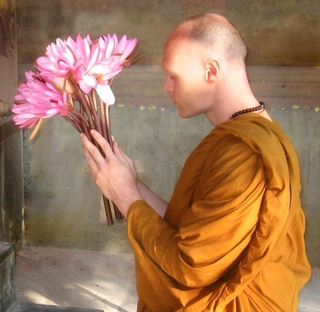
Lotuses.
Although many lotuses are down near the mud,
Little buds and others in murky water,
There were beings whose minds were like lotuses in clear water,
Some were above the water,
Ready to blossom.
And he saw it's true,
There are those with little dust in their eyes who have been training,
Building the Barami who will understand this.
And so then he started to contemplate how do I teach it.
And he was reviewing dependent co-arising from ignorance to death and then back again to twelve links.
But one list I like to mention often because it's simple and it's beautiful and it's practical is the list of the five faculties or the five powers.
It's told that the Buddha after his enlightenment enjoyed the liberation and contemplated what he had experienced and how he had experienced it for seven weeks.
The first week he just enjoyed the liberation and then he reviewed Paticca Samuppada.
One of those weeks he wandered over to what was called the Nighroda Banyan tree and he sat under that tree and he had the insight.
There are five faculties which when cultivated become five powers and these five powers when cultivated made much of lead to the deathless and merge in the deathless.
So this is really wonderful that the Buddha could identify five faculties that we have as human beings which we can train ourselves to make those faculties powers and in training these powers to be truly powerful the mind is headed in a one way direction towards the deathless towards that other shore.
So in any meditation retreat in this practice tradition you'll hear a lot about Sati,
Mindful awareness,
Samati,
Right collectedness and Panya,
Wisdom.
So that's three of the five powers.
The other two are faith and virya.
It's interesting that faith comes first,
Sata.
In order to be able to train in mindfulness consistently like we have to,
We need energy and we need to feel motivated.
So that's where faith plays an important role.
So we recollect the example of Lord Buddha.
We recollect his compassion,
His extraordinary efforts over eons,
Thousands of eons,
Hundreds of thousands of eons.
We recollect that his motivation was compassion.
He cared for each of you,
He cared for all of us.
He cared actually in an impartial way for all beings.
And that's amazing when you think of it.
We look at our lives and we care for our family and our friends and we care for some people but there's a lot of people that we feel indifferent towards and there's some people that we really don't like.
The Bodhisattva as he trained developed an impartial loving kindness and impartial compassion for all beings filling space with our remainder.
It's amazing.
So we can contemplate the qualities of the Buddha.
What a beautiful being.
What a profound being.
It's said that his heart quivered with compassion for all beings.
So after his enlightenment he spent 45 years wandering around India and training.
And I believe that the humans were only part of the beings that he trained.
He was also teaching devas in one watch of the night each night for 45 years.
So it's probably the case that as well as millions of human beings,
Millions of devas,
Possibly tens of millions of devas were also established in the devas.
Gone beyond rebirth,
Gone beyond unsatisfactoriness,
Never again to experience any kind of suffering.
Which is amazing.
So we recollect this and it gives rise to a feeling of faith.
And this is right faith,
Skillful faith.
Faith in the Buddha is correct and skillful.
That won't cause you any harm.
So faith is an amazing quality because it engenders a lot of energy.
Just thinking of the qualities of Buddha you can feel very rapturous,
Very happy.
But if you have faith in the wrong thing,
This is why these five spiritual powers go together as a group.
You've got wisdom there at the end.
So we need our right view.
We have to have faith in skillful things.
Otherwise faith also inspires people to blow themselves up,
Tie bombs to themselves and go and blow up innocent people.
And some of these people believe they'll be reborn in heaven.
They have a wrong view and they really believe it and maybe they die with a rapturous feeling of faith.
Surrendering themselves for the cause.
But because of karma,
They don't go to heaven,
They fall to hell.
So it's very important that we understand karma as an extremely powerful force and samsara.
Nobody can escape it.
So it's the first precept,
Don't kill beings.
Beings cherish life.
No being wants to die.
So don't kill them.
Faith gives rise to energy and then we apply that energy into the mindfulness.
When we're consistently mindful,
Right samadhi arises,
Right collectedness.
The mind settles.
In the mind it turns away from the five sense spaces,
The external sense spaces and it turns inwards.
And as some samadhi arises,
More energy comes up.
So you have more of this virya.
And this energy can also give deeper faith.
Once you have some experience.
The Buddha really knew what he was talking about when I practiced in this way.
My mind feels energized,
Calm,
Clear,
Bright,
Happy,
Peaceful.
You get deeper faith.
This path is leading onwards,
This path is leading inwards.
Wonderful.
So we allow the mind to rest in whatever samadhi arises.
And when the mind moves from its samadhi,
We contemplate,
We investigate,
Just like Buddha did under the Bodhi tree.
We don't yet have the capacity to recollect a hundred,
A thousand,
Ten thousand past lives but we can contemplate impermanence.
We can investigate the body,
See where is the self.
I keep projecting a self onto it.
I think it's a self but when I look at it,
There's no self there.
Investigate with the mindfulness that we have and the wisdom that we have and the samadhi that we have to give rise to the insight that we can give rise to.
And as we do this,
The samadhi will deepen.
As ignorance falls away,
As wisdom gets sharper,
Samadhi deepens and that samadhi will then strengthen the wisdom and eventually you will be able to recollect a hundred past lives,
A thousand past lives.
That's what happens at the higher stages of training even in this day and age.
I'm not yet at that level but I know monks who trained in establishing the four jhanas,
The first four jhanas and then they did have the capacity to recollect their past lives.
Entering the stream and then recollecting the past lives,
Seeing impermanence ever more clearly,
Seeing the conditions that give rise to rebirth,
The conditions that give rise to death,
Seeing conditions more clearly,
Becoming more acquainted with the unconditioned.
Those monks and nuns,
Sometimes eight preceptor lay women,
Also in Thailand we have arahants,
Upasikas.
They see the unconditioned,
Their insight deepens,
Training in that way until all delusion falls away and what remains is the purified mind,
The mind experiencing nibbana,
The deathless,
The unconditioned.
So faith is a wonderful thing,
An amazing thing.
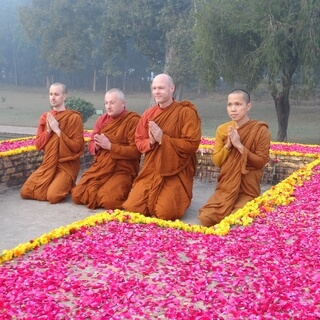
I recently had the opportunity to go to India,
February and March and I was making an experiment about faith.
In the past,
In a period of a month,
I had made a vow to meditate for a hundred hours under the Bodhi tree.
And meditating under the Bodhi tree in India takes certain skills,
It takes a lot of patience,
It takes a lot of determination because there is a lot of noise and one often has to practice with a certain amount of sickness,
Some cold,
Some flu.
On another visit,
A few years later,
I was able to meditate for two hundred hours under the Bodhi tree.
This time when I went,
I made the vow that I was going to try to meditate for three hundred hours under the Bodhi tree.
And to be honest,
I didn't actually think that I was going to be able to do it,
But I felt that I understand that going to India requires visas,
Tickets,
Somebody pays for accommodation,
Many people help.
But by the time everything has been paid for,
It does cost quite a bit of money.
And so I felt that if I'm going to go again,
I had the support to go,
But I felt that I had better practice to the best of my ability.
Otherwise I might be incurring a debt to the people who pay.
So I felt like,
Okay,
You can go,
But only if you practice to the utmost of your ability.
And so I made the vow,
I was going to try to meditate under the Bodhi tree for three hundred hours.
And I secretly thought,
I don't think I'm going to be able to do it,
But I'm going to really try.
And I knew that around the middle of that time,
Six weeks I planned to spend in Bodhgaya,
I knew that we were going to go to Varanasi for a few days,
But I knew that basically I was going to have to meditate between eight and a half and nine hours a day,
Every day,
Without any breaks.
And it was an experiment,
Because in my experience in the past,
One has deeper faith practicing in Bodhgaya,
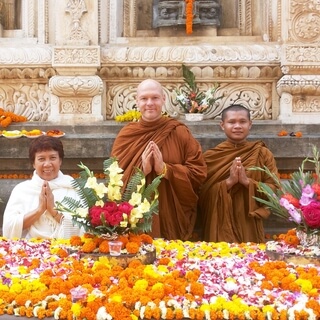
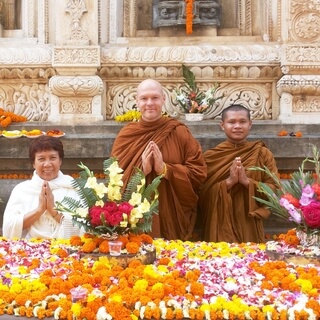
Because if you're at the Mahabodhi temple,
You open your eyes and you can look at the Bodhi tree and you remember Lord Buddha was enlightened here.
Wow,
Amazing.
Lord Buddha contemplated dependent origination in forward and reverse here.
Brahma Sahamphati came down and asked,
Please teach those who can be taught right here.
And then you contemplate that Buddhists with a mind of faith have been going and paying respects for over two thousand five hundred and fifty years.
Wow.
And sometimes there's up to ten thousand people in the Mahabodhi temple doing poojas,
Prostrations,
Chanting,
Group after group coming from many countries,
Taiwan,
Korea,
Singapore,
Burma,
Cambodia,
Laos,
Thailand,
Malaysia,
Groups of westerners as well.
And so there's this wonderful acts of devotion going on all the time.
And so sitting nine hours a day required sometimes four sessions,
But usually three sessions of three hours.
And that means sitting with quite a bit of pain,
It means sitting with some dullness early in the morning,
Sitting with a cold.
And I found that I was able to sit nine hours a day until I reached the two hundred hours point.
It took about a month.
And then I remember thinking,
I don't know if I can keep doing this.
And so we went off to Varanasi and we went and paid respect at Saanath,
Just changing the atmosphere,
Changing the rhythm.
Stayed for a couple of days in Varanasi,
Went and had a look at the corpses burning on the Ganges River.
And then went back to continue for another hundred hours.
Now what's interesting is eventually I was able to do three hundred and thirty seven hours under the Bodhi tree in that six weeks period.
And the only reason that I was able to do that is because of the power of faith.
And I don't think I'd be able to do it anywhere else.
So it was an experiment.
What is possible when one really opens the heart to faith and then taps into that energy and then applies that energy.
And it just means that you can sit for a bit longer through the pain.
You can sit for a bit longer through the tiredness.
You can sit for a bit longer through the noise.
And when you do that,
When you can go beyond the hindrances to some degree and then rest in the peace and the serenity and then that deepens the faith.
It's true when we practice correctly in this way,
Cultivating mindfulness with the four foundations of mindfulness.
When concentration arises it's very peaceful.
It's very rapturous.
It's very nourishing.
The Buddha explains that peace is the highest happiness,
The absence of suffering.
When the suffering falls away,
Peace remains.
So that's very good to,
When we do the chanting,
As we're doing every morning and every evening,
Try to give rise to faith when we chant the qualities of Buddha,
Absolutely pure,
With ocean-like compassion.
And include yourself in the picture.
Lord Buddha had compassion for you.
He went to all of that effort so that people like us could take out the dust that remains from our eyes and realize the peace and serenity that he realized.
So we use the power of faith to apply the mindfulness consistently.
Applying the mindfulness consistently,
Some samadhi arises,
Can rest in the samadhi.
When the mind moves from its samadhi contemplate,
Just see each breath,
It does arise,
It does stay,
It does cease impermanence.
Each thought,
Sometimes a thought seems like they will never go away.
It might be the same old grudge or a very similar fantasy,
The thing that that person shouldn't have done,
You have to go and tell them what you're going to say,
I'm going to tell them this,
Blah,
Blah,
Blah.
But it does cease.
And when it ceases,
You realize it's much more gratifying to let go of the grudge,
It's much more gratifying just to drop the thought.
You don't need anybody to say sorry,
You don't need to go and tell people that they should be sorry.
What you need to do is let go of the grudge,
Let go of the past and then rest in your potential to be truly peaceful right now with everything that you have now,
Your body and mind now can experience deep peace if you just allow it to.
But it takes a bit of work and it's the same with the more sensual stuff,
The stuff coming from greed.
If I can just get that person to love me and have that affair,
Then I'll really be happy.
No you won't.
You'll just have a completely different set of suffering,
Different things to irritate you and then the disappointment,
I really thought that when I just got this sensual experience,
I'd be happy.
It turns out that when I got it,
I still had suffering,
Maybe even more suffering.
So peace doesn't come from getting what you think you want,
It comes from letting go of desires,
Understanding that mental peace,
Peace arising in the mind is superior to transient sensual pleasure that comes from touch,
Taste,
Sounds.
So we're practicing letting them go.
And as I said yesterday,
Breath meditation,
Lord Buddha said the crown jewel in the crown of all meditations.
You can go a long way with just this meditation.
It leads you inwards,
It leads onwards.
So also we have faith in Lord Buddha,
We have faith in his teachings,
We have faith in the meditation practice.
So we energize the practice with confidence.
Faith is sometimes translated as confidence.
Be confident this meditation method is awesome.
It leads to the deathless.
Wow.
If you get interested in it,
What happens when you're really with the breath?
What happens when you're really with the spaces between the breath and what happens when you notice the ceasing,
Notice the ceasing,
Notice the ceasing?
Peace arises in the mind as the things which conceal it fall away.
So I offer that for your contemplation.
I hope that you can practice with faith.
Keep applying the mindfulness at the breath.