I remember yesterday when we were travelling from Rajkia to Vaishali,
We had to stop for a few minutes.
One of the things that we passed was a long procession of Indian people.
All of the women were wearing yellow and orange,
If you recall.
I asked Manit,
Our Indian guide,
What they were doing,
And then he also pointed out the fact that at the very front of that procession was an elephant followed by a camel.
And he said this is a traditional puja in India.
They have gone to some sacred pond or lake or river,
And he said they would have been chanting probably for 24 hours,
And then they take the water from the lake or the pond or the river back to their home,
And then they sprinkle the home.
So it's a tradition of holy water,
But what they're doing is they're asking for blessings from a deity or a god or a goddess from heaven to bless that water by invoking,
Chanting,
Recollecting the deity,
And then they believe that some blessing is coming into the water,
And then they're able to then spread that blessing,
Share that blessing around their homes for safety and protection.
So it was very interesting that we saw that just yesterday because what happened around the teaching of the Ratana Sutta is a little bit similar,
And you can see this ancient traditional practices of puja asking for blessing,
A very,
Very deep and ancient practice in India.
We've been chanting every day the Ratana Sutta,
Starting with Yankinchi,
Yankinchi Vittam Idawahodurangwa.
We've been chanting that every day.
I'll give a little bit of background for how this sutta came to be taught,
Taught here in Vaisali.
So the city of Vaisali was afflicted by a famine,
And then many people were dying,
Especially the poor people,
And due to the decaying corpses,
They say,
Evil spirits began to haunt the city.
This was followed by pestilence,
So that's a lot of other diseases coming from the rotting corpses.
Plagued by these three fears of famine,
Non-human beings,
And pestilence,
The citizens sought the help of the Buddha,
Who was then living in Rajagaha.
So the compassionate Buddha,
Followed by a large number of monks,
Including the Venerable Ananda,
His attendant,
Came to the city of Vaisali.
With the arrival of the master,
There was torrential rains which swept away the putrefying corpses.
The atmosphere became purified,
And the city was clean.
Thereupon the Buddha delivered this dual discourse,
Ratana Sutta,
To Venerable Ananda,
And he gave him instructions as to how he should tour the city with the leech of his citizens,
Reciting the discourse as a mark of protection to the people of Vaisali.
Venerable Ananda followed the instructions.
He also sprinkled sanctified water from the Buddha's own arm's bowl.
As a consequence,
The evil spirits were exorcised,
The pestilence subsided.
Thereafter,
The Venerable Ananda returned with the citizens of Vaisali to the public hall where the Buddha and his disciples had assembled,
Awaiting his arrival.
There the Buddha recited the same dual discourse to the gathering.
So in Thailand,
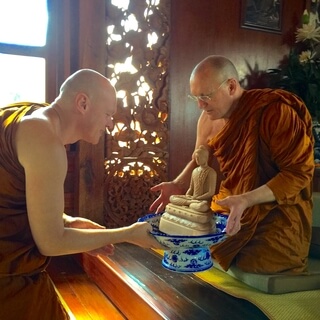
Two monks get invited to chant the protective chants,
Of which the Ratana Sutta is one of them,
And then they traditionally tie some string around the Buddha statue and then wrap that string around a bowl where there's some water,
And then the monks hold that string.
And this is coming from this tradition where the Buddha's bowl had water in it,
And Ananda was sprinkling holy water from the Buddha's own bowl.
So we have the beginning of that tradition right here in Vaisali.
The Sutta goes this way.
There's two verses that we haven't been chanting,
Introductory verses.
Whatever beings,
Non-humans,
Are assembled here,
Terrestrial or celestial,
May they all have peace of mind and may they listen attentively to these words.
Also,
When we chant the protective chants in Thailand,
There's always an introduction for the devas to come and listen also.
Terrestrial and celestial devas.
O beings,
Listen closely.
May you all radiate loving kindness to those human beings who,
By day and night,
Bring offerings to you or offer merit to you.
Protect them with diligence.
So this is an instruction from the Lord Buddha to the devas,
Not to forget the human beings.
Apparently devas can get very attached to their comfort and become a little bit complacent.
They can also be aware of or not be aware of the human realm if they don't want to.
So the Lord Buddha is requesting them.
People have been dedicating merit to you,
So please do your duty.
This is where the Sutta,
As we've been chanting it,
Begins.
Whatever treasure there be,
Either here or in the world beyond.
Whatever precious jewel there be in the heavenly worlds,
There is not comparable to the Tathagata.
This precious jewel is the Buddha.
By this assertion of truth,
May there be happiness.
So that's a very profound statement.
And as Buddhists,
If it's true,
And I think it is,
Obviously we're extremely fortunate.
Basically in terms of things,
Whatever treasure there be in this world or the other world,
Nothing can be compared to the fully enlightened Buddha.
So I see this chant as an affirmation of truth.
And this is where I think Buddhist practice is different to theistic practice or deity practice.
We're basically invoking the power of truth as a protection.
So you just recollect something that is a fact.
And then when we recollect that,
The mind becomes gladdened.
And it's backed up by the power of truth.
The Buddha is the supreme treasure in this and other worlds.
The next verse,
That cessation,
That detachment,
That deathlessness,
Nibbana.
The calm and collected Sakyan sage,
The Buddha realized,
There is not comparable to this nibbana-dhamma.
This precious jewel is the dhamma.
By this assertion of truth,
May there be happiness.
So once again,
Just stating a fact as the Buddha knows for himself,
Having realized it himself,
Nibbana is supreme.
The calm and collected sage that he is realized nibbana.
There is nothing comparable to this.
So you can see when the mind gets affected by fear,
It's not thinking of something which is secure,
Dependable.
And so when you think about something which is secure and dependable,
The Buddha's realization,
It has a wholesome effect on the mind,
Doesn't it?
Once again,
It's an affirmation and an assertion of truth and then it asks that very truth to be a protection.
The supreme Buddha extolled the path of purity,
The eightfold path,
Calling it the path which unfailingly brings concentration.
There is not comparable to this concentration.
This precious jewel is the dhamma.
By this assertion of truth,
May there be happiness.
So you think about the Krupa Ajahn who go into charnal grounds in Thailand,
The tradition of going to the places where the ghosts are,
Of going to the places where the tigers are,
With confidence in the eightfold path.
So the Buddha is saying this eightfold path will definitely bring about a concentrated mind.
So when there is fear the mind isn't concentrated,
It's running outside,
Not collecting,
Being concerned about things outside.
But when you really have confidence in right mindfulness,
A right concentration on that foundation of virtue,
The mind will collect.
And so many,
Many Krupa Ajahn have demonstrated that.
They go precisely to the place where their fears come up and that is often the place where they stabilize their samadhi.
And the mind which is unified and has that one pointedness,
Collectedness,
The fear can't affect it anymore.
And then they develop this tremendous confidence in and courage.
They develop a tremendous confidence in the power of the dhamma which the Buddha here is saying,
This eightfold path definitely leads to this special concentration which nothing is comparable to.
It's basically something you can depend on but it does require practice and this quality of faith as well.
And so once again it's an assertion of truth.
Practicing the eightfold path will bring about this kind of unshakable quality of samadhi and confidence.
By this assertion of truth may there be happiness.
The next verse,
Eight persons extolled by virtuous men constitute four pairs.
Men can also mean women.
They eight kinds of noble beings who are chanting and out chanting.
So that's beings who have attained to paths and fruit on the levels of enlightenment.
So that means someone who has attained a stream of sotapanna,
A fruit,
And then the path of the sotapanna.
So it's often,
We read in the suttas people become arahants quite quickly or become sotapanna and then become arahants.
But apparently I've talked to Tanajana Nan about it.
Most people will have to move through stages.
So there's a first glimpse of nibbana and the mind will change significantly and develop a quality of unshakable faith but it doesn't mean that the fruit of stream entry is completely stabilized yet.
So people often have the path of stream entry and at a later point it gets stabilized as being having the fruit of stream entry.
Similar with sakkha-takami,
The path,
One attains the path of sakkha-takami with the weakening of greed and hatred but it's not completely stabilized but it's a deeper insight,
Seen nibbana more clearly,
Seen through the self view more clearly and weakened greed and hatred because the greed and the hatred is based upon perceiving oneself as a self,
Perceiving others as a self as well.
If that isn't there,
There's nothing to be greedy about.
There's no one to want anything or to not want anything.
Similarly with anagami,
The path,
One attains the path of anagami and the fruit of anagami and in the path of arahant and the fruit of arahant.
So these eight persons constitute four pairs,
They are the disciples of the Buddha,
Worthy of offerings,
Gifts given to them yield rich results.
This precious jewel is the sangha,
By the assertion of this truth may there be happiness.
So once again it's bringing to mind the fact of the noble enlightened lineage,
That is the sangha.
So see,
Other than praying,
It's different isn't it?
It's not like praying to a god,
It's not like praying for a blessing,
It's recollecting the blessings inherent in the human potential,
The blessings inherent in your own potential and the fact of tens of thousands,
Hundreds of thousands,
Millions of enlightened beings that have become enlightened since this Buddha and also previous Buddhas,
So I think it's very affirming for one's own potential and also trust,
I think it's related also to trust,
Trusting ultimate truth and trusting that your commitment to realising truth is a protection.
This is what the Kripa Rajans have when they go off into the jungles,
When they go off into the charnel grounds with all these ghosts.
They don't have much,
What they have is their virtue and their faith and their commitment to realising truth and also their trust that their own ultimate nature is good.
So this is something,
If you fear that your own ultimate nature is somehow weak or flawed then there's something to be frightened about isn't there?
But if you have deep confidence that by the very nature of your mind you can realise the deathless,
You can become enlightened if you cultivate the overfull path,
Well there's not that much to be frightened of,
There's just a matter of surrendering to it with great confidence and then I think this is what evil spirits and tigers and the like sense,
They sense,
Oh this person is confident and there's a radiance to the mind as well,
For people who have strong faith and conviction and are based on virtue,
Their mind is radiant.
A lot of dark beings don't like that,
They might come and challenge it but if you then increase your radiance by recollecting the jewels that you're confident in,
Usually they'll back down.
The tigers,
I don't think they're frightened,
They're just interested,
What is this?
It doesn't look like food,
They're king of the jungle,
Just coming around and they're curious.
You have stories of tigers sitting at the mouths of caves where the monks are walking meditation,
They're jomkrom walking backwards and forth,
Walking backwards and forth and the tigers will just look at them,
It's very interesting,
But they're not trying to eat them.
So they work it out,
They work out that this human being has zeal and has some samadhi,
Has some confidence and it's not food,
They wouldn't dare eat such a being.
The way I think a tiger or a carnivorous being works out whether or not something is food is because it quivers before them and shakes with fear and that means,
Oh food.
So if you can stay still and calm and really have a refuge in your mind then very unlikely anything is going to eat you.
But this is something that when you get to that point in your practice you can experiment.
Of course when we go to Varanasi I am going to be taking you to the places where they burn corpses so we will have some chance to go to some place that some people find frightening.
But most people don't find it that frightening,
Anybody frightened of ghosts?
About half the group.
So we have to chant this sutta don't we?
When Ananda told the people of Vaisalita to chant this sutta they went away,
You see.
With a steadfast mind,
This is an exverse,
Applying themselves well in the dispensation of the Buddha Gautama,
Free from defilements they have attained to that which should be attained,
Arahantship.
Encountering the deathless they enjoy the peace of Nibbana freely obtained.
This precious jewel is the Sangha.
By this assertion of truth may there be happiness.
Those who practice correctly,
Who realize the deathless,
Become the Sangha,
Assertion of truth.
As a post deep planted in the earth stands unshaken by the winds from the four quarters so too I declare is the righteous man who comprehends with wisdom the noble truths.
This precious jewel is the Sangha.
By this assertion of truth may there be happiness.
So there are a few more verses similar,
I am going to stop there because I just wanted to read the ones that we read or chant daily but after Ananda taught the people of Vaishali how to chant this they all gathered in the hall and the Buddha taught it again and he said this is a protection chant.
So it is not asking for God to help you,
It does ask for the devas to spread method to you,
The very devas that we have been dedicating merits to the first two verses which are in the introduction,
It does ask those devas to pay attention to the human realm,
Do their duty and spread method to us,
That is fine.
But mostly what it appears to be is an assertion of the power of the three jewels.
So we are all Buddhists,
We have all taken refuge but sometimes we can forget that this is incredibly powerful and we can still be looking for something else,
Overlooking the thing that we already found or the thing that we already discovered,
We are underestimating its value in a way.
So a lot of our practice is I think really recognising and appreciating the value and then learning how to use these things as tools.
So I am often saying your Buddha potential,
Your Buddha nature or your capacity to realise ultimate truth,
That is already,
That is your noble wealth having been born as a human being,
That is your Arya Sap as they say in Thai,
That is the noble wealth that you have,
That you have accumulated,
That you have the human form that can comprehend these teachings,
That you are capable of meditation,
That you can develop and purify your mind,
That is already an incredible jewel that you have right there and something to be confident about.
And then recollecting the Buddha,
Boundlessly compassionate,
Seeing everything is ultimately empty and yet taught beings out of compassion,
Pure,
Impeccably pure.
So there is nothing,
There is no blemish,
There is no weak point there so when you recollect the Buddha that gives rise to a feeling of confidence,
This is something dependable,
This is something impeccable,
There was no corruption,
There was no selling out,
There was no blemishes,
This is an impeccable being.
As we say in the Ittipi Saut chanting,
Vidya,
Charana,
Sampanno,
Impeccable in conduct and in understanding.
So when you just think about that and gladden the mind,
This is buddhanusati,
Then the various hindrances that can affect the mind will go away.
Sometimes you might doubt your own ability so sometimes what you can do is you use these samatha techniques,
You recollect the Buddha and with love and faith and devotion and gratitude and then the mind becomes more concentrated.
You might be sitting there thinking,
I just can't meditate,
I can't concentrate.
When you are thinking about yourself,
When Ajahn Simedha often says,
All he has to do is think about himself and he becomes depressed.
But if he doesn't think about himself and he places his attention on awareness,
His mind becomes bright and peaceful.
So he has trained himself to take the awareness as a meditation object and not identify with the self-construct of the thoughts.
So that is an extremely helpful and important pointer about how to practice.
The sense of self,
If one isn't a sotapanna yet,
The sense of self is never going to feel consistently,
Unshakably optimistic and confident and positive,
It's not.
Doubt is one of those five hindrances which is constantly going to affect the mind which isn't enlightened yet.
So you have to develop skillful means.
Think about the Buddha's wonderful qualities with the quality of unshakable faith and devotion,
Gratitude,
Confidence if you can.
And then in doing that for five,
Ten,
Fifteen minutes then you will find that your own hindrance has naturally just calmed down.
And you probably can be with the feeling of your in-breath and your out-breath.
But don't try to resolve unceasing,
Unending doubts in the mind,
We have to see them as doubts.
You can also challenge them a bit,
If a doubt ever comes up about your own abilities,
Just say that's not in accordance with Dhamma.
Because the nature of a deluded mind is that it can be purified of its delusion through uprooting ignorance by correct knowing according to the four foundations of mindfulness.
So any kind of doubt about I can't do it,
That's just delusion and we have to say that's delusion.
Anyone who practices correctly,
As we just read in that verse,
Anyone who practices the eight-fold path correctly that will give rise eventually to an unshakable quality of concentration.
Anyone who practices the four foundations of mindfulness,
They will realize liberation,
That's a fact.
But we recollect the power of the Dhamma as the raft that can take us to the other shore if we practice.
But you can recollect the Dhamma with great confidence and then you recollect the Sangha and millions of other beings have done this.
And so we gladden the mind thinking about these wonderful examples we have of Ananda,
Sariputta Moggallana.
Visali,
Since we're here,
Visali was the place where the bhikkhuni order began.
So Mahapajapati asked Lord Buddha,
Asked Ananda to ask Lord Buddha if she could become a bhikkhuni.
She had to ask three times but the Lord did consent.
And you have many wonderful bhikkhunis,
Foremost in psychic powers just like Mahamogallana was and foremost in wisdom,
Foremost in recollecting past lives,
All of these wonderful things.
Some people wonder why the Buddha refused the bhikkhunis twice.
I have my own theory about this and everyone is entitled to their own theory.
I've been a monk nearly 20 years and thought about the issue quite a bit.
What is very interesting is in the Mahaparinibbana Sutta the Buddha relays a conversation that he had with Mara under the Bodhi tree before he went anywhere to teach anyone.
Mara came and told him,
You're not enlightened like he does.
And the Buddha says,
Yes I am.
Then Mara said,
Well don't tell anybody.
He said,
No I'm not going to stop until there are enlightened bhikkhunis disciples and laymen practicing correctly as well.
And then he said,
Okay well then stop.
The next thing the Buddha said was,
No I will not stop until there are enlightened bhikkhunis and laywomen disciples practicing correctly.
So here you have the Buddha under the Bodhi tree in the very first period after his enlightenment stating his intention to have bhikkhus and bhikkhunis.
So the way I see him not accepting them at first is being a necessary political mechanism,
Something that he had to do to be able to pull it off in a way.
So we live in a world which has politics.
That's just a fact.
We have politics in the world.
You understand that the status of women in India at that time was not very high.
They were considered property.
And I believe that there had actually been a serious division in,
I think it was the Jain order when they tried to make,
In recent because Mahavira was a contemporary of the Buddha,
They tried to make men and women equal in that order or something like that.
And it had been a big problem,
A big conflict.
So Lord Buddha had to,
I believe,
Appear not to support it.
And I think,
If you think about Venerable Ananda who was reading the other day,
The Buddha describes Ananda as,
I think he had five of the categories of foremost discipleship.
Ananda had five.
The quickest to understand,
The quickest to remember,
The most,
I can't even remember them all,
But basically you have an extremely attentive,
Smart diligent.
And he praised Ananda.
He said Ananda knows the right time for things.
He knows the right time when it's time to meet the royalty.
He knows the right time when it's time to meet the ordinary folk.
The right time for the Buddha to meet the bhikkhus.
The right time for the Buddha to meet the bhikkhunis.
So Ananda was no dimwit.
Ananda was someone who was profoundly intelligent,
Intuitive and had a really good sense of how to do things.
So what I think we have here is Ananda is a bit like the Fall Guy.
He's going to take a bit of flack so that this can happen.
And some people will say,
Yeah,
That was Ananda's fault,
The ones who didn't want them.
But basically,
After you have bhikkhunis,
You have Arahant bhikkhunis in not very long.
And you have monasteries full of well-practicing bhikkhunis.
And I think the Buddha had to then establish those rules so that the bhikkhuni order could last as long as possible given the context that it was in.
But I think very important to remember that right there under the Bodhi Tree from the very beginning that the Buddha intended to have bhikkhus and bhikkhunis.
And apparently,
Every Buddha must have.
It's just a given.
All Buddhas have the fourfold Sangha as part of their dispensation.
So please don't project any sexism onto the Buddha.
It's impossible.
Absolutely impossible that the Buddha could have had any kind of angry or hateful bias against any kind of being not possible.
He's completely pure,
Completely no aversion,
No latent aversions or hatreds at all.
So just feel confident that the way I see it anyway is that the way it happened was the way it had to happen for it to last as long as possible and to help those nuns to have that opportunity.
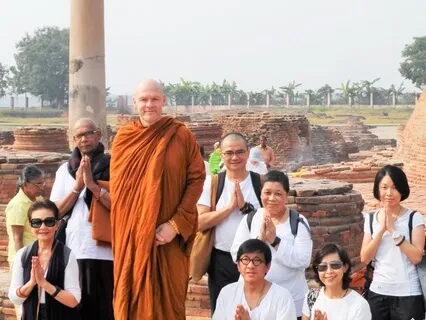
So right behind us,
We have the Asokan Pillar with the lion capital,
The only one intact.
This is pretty amazing,
Isn't it?
And you can see,
I think it's a 2,
200 year old monument still in place 2,
200 years later in quite fine detail.
To this day,
They still don't know how the craftsmen of Asoka managed to polish their sandstone so that it would last so long.
When we go to the museum in Sanas in a few more days,
You will see,
I think it's the four lion capital facing the four cardinal directions.
The directions are very beautiful,
But it's very shiny and no one knows what they used that could make it shiny and stay shiny for more than 2,
000 years.
Still a mystery.
But the obvious thing,
Isn't it?
The fact that this is the only one still standing really suggests something,
Doesn't it?
It suggests the law of impermanence,
Unescapable.
You see the chedi behind isn't in one piece anymore,
Is it?
All that's left is a pile of bricks.
So that chedi would have had a beautiful spire and probably had stucco,
And now what you have is a round pile of bricks.
Still quite beautiful,
Isn't it,
In its gentle,
Serene shape?
I was asking Ajaan Oh,
She says the reason it's called the Ananda stupa isn't because it has Ananda's relics.
It's because Ananda helped to build it.
So apparently Ananda helped the Lichibis to build this stupa when they wanted to enshrine the relics of the Buddha.
So Ananda was very loved by the Lichibis,
And you can see why,
Can't you?
There was Ananda going and splashing the holy water himself in all of their homes,
Chasing away the evil spirits,
And they're asking the Buddha to come.
And so he helped.
Can you imagine?
It's like a bubonic plague kind of scenario where everyone's dying.
It's very scary,
Isn't it?
When your neighbors are dying,
Children are dying,
Relatives are dying,
And then corpses are everywhere,
And there's more corpses than you can get rid of,
And nobody wants to go near them.
So in terms of something horrible that could happen in the human realm,
It doesn't get much worse,
Does it?
It's just awful.
But the Buddha,
With his special powers and his special purity and their strong faith,
Was able to come and rectify the situation in not very long.
So I think in our lives,
In terms of skillful means,
When you're struggling with your faith or when you have some big challenge,
I think just recollecting the refuge is a very powerful practice that we probably underutilize.
I remember Ajahn Simedho,
When he went to England,
He didn't yet have a monastery,
And he was staying in a house in London.
And he didn't know what was going to happen.
He didn't know if he was in the right place.
And Ajahn Chah had said,
Go and start a monastery in the West,
And given his blessing.
And I said,
One of the things he did to just feel confident or just keep going was he didn't know what else to do,
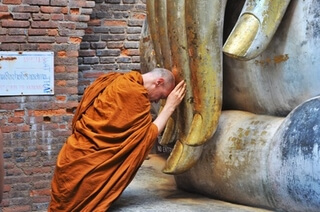
So he'd go and he'd bow.
He'd just go to his shrine and he'd just bow.
Bow to the Buddha,
Bow to the Dhamma,
Bow to the Sangha.
Because that's what he had.
He didn't yet have a monastery.
He had a house in the middle of London.
And his teacher was on the other side of the world.
But you can see that's very powerful,
Isn't it?
Because now there's many monasteries in England and many monasteries in Europe and monasteries all over the world.
Now if Ajahn Simedho had given up at that time,
It wouldn't have happened,
Would it?
So you can see that.
He doesn't know what to do.
He doesn't know what to do.
Well,
Just bow.
And that's not pathetic.
That's powerful.
Because look what it did.
It gave it something to hold onto.
He held onto his refuge with faith and with confidence.
And then the monks went for alms round one day.
Very unlikely that this would happen,
But it really happened.
A man was jogging.
He came up to Ajahn Simedho and said,
I have a forest.
I want to offer it.
Would you be interested to receive a forest?
It's exactly what they needed.
What's the chances?
You see,
But if you hang on to your faith with confidence and you assert the power of truth,
You don't lose your faith and confidence in the power of truth.
That's the kind of thing that can happen.
So I just offer a few words about recollecting our refuge and asserting,
Affirming the power of the truth.
We don't ask in Buddhism for the blessings of the gods.
We practice our dhāna.
We practice our sīla.
And we recollect our nature to be enlightened.
And we recollect the teacher who did that,
His disciples who have also done it,
And the very truth itself that will liberate us.
That's our protection.
That's our blessing.
When you practice correctly,
The devas will protect you.
That's what the devas with rive view do.
The devas with rive view will protect those who practice correctly.
That's one of the ways they accumulate merit.
It's one of the ways they were born as devas.
So just one of the things I'd like to say in terms of praying to heaven for blessings.
It's important to understand that any being in heaven was born there because it practices dhāna and sīla and bhāvanā.
So that's what produces the merit.
If you want to abbreviate the Eightfold Path into those three,
That's how it's often abbreviated.
Generosity,
Virtue,
And mental cultivation.
So the reason they're in heaven is their own practice of dhāna,
Their own practice of virtue,
Their own mental cultivation.
So you can do that.
You can do that here in this realm.
And that makes you deva-like.
Tanajana is often talking about manusa-tewo,
Human beings who have the minds of devas.
She's also talking about manusa-dhelachano,
Which is human beings who have the minds of dogs or pigs.
Or sattelachan is beings who walk on four legs.
So you have both.
You have people with human bodies who have animals' minds.
You have people with human bodies who have devas' minds.
Manusa-tewo.
So yes,
Perhaps devas,
If you have a karmic connection with them,
Maybe they can help you.
Usually high-level devas,
Bodhisattvas or future Buddhas in Tushita heaven.
If there's a karmic connection,
Doing mantras and things might be helpful for a certain type of character.
But basically,
They got where they are by practicing what the Buddha is teaching us.
Be generous.
Keep your free saps.
Do your meditation.
Do your chanting.
And then affirm,
Just affirm,
This will lead to liberation.
The Buddha is the highest treasure.
The sangha is the highest treasure.
The dharma,
The truth,
Is the highest treasure.
And that means your nature is the highest treasure.
So we don't have to look outwards.
The wonderful thing about the Buddha's teachings is leading inwards.
Our liberation will occur in our minds.
So just offer that short reflection.
MayOkayambod promis geçir packeda sar kannst the Dharma.