Tharajanananda has invited me to share some dharma reflection on the occasion of his birthday.
Naan we call in Thailand,
Coming together to practice.
We call Patipati Puja an offering of practice.
It's when Lord Buddha talked about ways that we could honor him after he entered Mahaparinirvana as well as visiting holy sites,
Chanting,
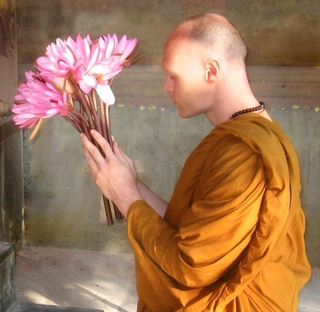
Offering flowers,
Fragrances,
Etc.
He said the highest offering,
The best offering is the offering of practice.
So we come on the occasion of our teacher's birthdays and we make some efforts like training our minds.
I'm happy to contribute,
Offer some encouragement if I can.
What I thought I might talk about today is some of the Anusati meditations,
The other meditations that the Lord Buddha recommended for people that use the thinking mind,
The reflective capacity that we have because many modern people do have a lot of thinking when they come to sit.
We have breath meditation as our primary practice and the Krupajans are often talking about gamatana,
The mindfulness of the body parts,
The investigation of the body parts as elements,
And these practices that lead to deep insights that weaken and uproot the defilements.
But oftentimes when we come to sit,
If we've had a busy day or if practice has slipped somewhat,
The idea of diving straight into these gamatanas to try to uproot the defilements seems like a few steps down the track.
We have to work with the mind as it presents itself and so one of the things that we can do with restless energy or a compulsive thinking mind is to choose a reflective subject and then try to keep the thoughts within the parameters of that theme.
So there are in the chanting every day we have Buddha Nusati,
Nama Nusati,
Sangha Nusati.
So we need to make these practices real for ourselves and the point is to use the thinking mind in a way that gives rise to a glad,
Bright,
Happy mind state and then we'll find that it's much easier to be with the breathing and then when the mind has some collectiveness and peacefulness to pick up a deeper investigative theme.
So with regard to Buddha Nusati,
We put some thought into,
You can ask yourself,
Do you feel gratitude to Lord Buddha?
And sometimes we have to dig a little bit because the mind is very restless or in thinking about all sorts of worldly things.
Maybe there's a lot of work,
Maybe there's deadlines,
Maybe there's staff issues,
Maybe there's family conflicts,
Maybe the content of the mind is mundane or not very inspiring.
That's often what we have to practice within the human situation.
So sometimes it's like,
Am I grateful to the Buddha?
Nothing might come up at first and then you ask yourself,
Should I be grateful to the Buddha?
And then when we consider this further,
At least for myself,
I'm enormously grateful to the Buddha because Lord Buddha explained the path of dana,
Sila and bhavana as being the path that leads away from ignorance,
Delusion,
Greed and hatred.
And if we didn't have his point of view,
If we didn't have his pointer,
If we didn't have his clear instructions,
We probably wouldn't work that out by ourselves.
And so we can ask ourselves,
Sometimes most of us have a gift for feeling a bit sorry for ourselves.
And in some respects that's fair enough.
Life can be difficult.
But one of the things we can ask ourselves is,
How much worse might it be if we didn't have Lord Buddha explaining to us that we should be generous and ethical and make efforts to contain the defilements and try to cultivate wholesome mind states,
Abandon unwholesome ones.
So for myself,
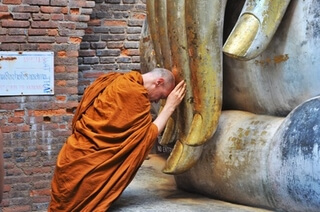
When I went to Bodhgaya after being a bhikkhu for 10 years,
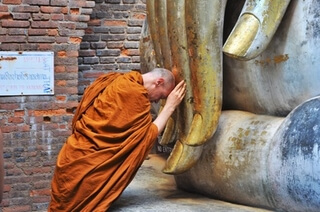
I was doing some full length prostrations in the direction of the Bodhi tree in the Vajra Asana.
And I got quite teary because there was this recognition of 10 years of practice as a bhikkhu,
The mind being in a more wholesome state than it was 10 years previous.
And I was wondering,
Where would I be now,
If it wasn't for the bhikkhu training and if it wasn't for these teachings?
And I was somewhat overcome with feelings of tremendous gratitude.
But people have to engage these practices in ways that makes it real for yourself.
Like which of the sutras,
Which of the teachings really speak to you?
And how did that,
This is coming into the Dhammanusati,
How did that teaching point you in a direction that you found helpful,
That reduced your suffering to some degree?
And so there's obviously a lot of correlation between Buddha Nusati,
Dhammanusati,
Sangha Nusati.
But we recollect the wonderfulness of the Dhamma that speaks to us and helps us reduce our suffering,
And gives us confidence that we're on a path towards the eradication of suffering.
And then naturally we feel grateful to the Buddha for putting these teachings,
Establishing these sutras,
These discourses on many occasions that were handed down to us.
And then we think of the Sangha.
Many people listening to me now consider Thanajan Ananda as their main Dhamma teacher.
And so we can feel gratitude towards Ajahn Anand.
And then naturally we would feel grateful to his teachers.
We kind of trace this lineage.
We kind of do this in a focused way to bring the image of Ajahn Anand to mind.
You think of the fact that he practiced very sincerely,
Got very good results,
Purifying his mind.
You feel happy for him and you rejoice.
Breathing in Sangho,
Breathing out Sangho,
We can continue to use the breath and continue to use the Barikamma practice.
Oftentimes that might be Bhutto,
But when we're doing Sangha Nusati,
We use Sangho.
And then we think of Lampocha,
Thanajan Anand's teacher.
This morning Ajahn Anand was giving a Dhamma talk and he was describing how he would often like to tape Ajahn Anand's Dhamma talks to listen to later and also to preserve for posterity.
But sometimes he was so absorbed in a kind of rapturous appreciation for the Dhamma that Lampocha was speaking that he would forget to bring out the tape recorder and forget to press record.
So we think of how hard Lampocha practiced and what tremendous benefit he brought about.
And then naturally his teacher,
Rumpol Manthap and how incredibly strict,
Disciplined,
And he's almost like the archetype of an utterly pure,
Renunciant,
Forest-dwelling monastic.
We can just bring to mind this lineage of great practitioners that goes all the way back to the Maha Sangha,
The Savakas of the Buddha,
In the time of the Buddha.
Lampo Anand often mentions that Lampocha is in the same lineage as Mahakasipa because of his strict practice with the Dutanga practices.
So we can bring to mind which of the great disciples of the Buddha do you appreciate.
If you don't know much about them yet,
It's good to do a little bit of study.
Read that wonderful book,
The Great Disciples of the Buddha,
And become familiar.
So oftentimes modern people will read something and we'll have that feeling of,
I read that and we'll put it down and we won't think about it and we'll be on to the next thing.
In training in these Anussatis,
Which are oftentimes a Samatha practice,
It's actually about recollecting again and again and again.
It's a process of familiarization.
And we familiarize the mind with these meditation themes so that we can become adept at picking up a wholesome meditation object and brightening the mind,
Gladdening the mind,
And becoming familiar and comfortable with that practice.
So thinking of Lampo Anand,
Thinking of Lampocha,
Thinking of Lampo Man,
Being happy for them,
For their liberation,
Feeling grateful to them for their example of practice.
And then all the way back,
Sariputta,
Who was sometimes referred to as the wet nurse of the Sangha,
Training hundreds and hundreds of young bhikkhus to the point of stream entry.
And then Mahamoggalana,
Who would help those hundreds and hundreds of bhikkhus to finish off their practice,
Attained to Arahantship.
When we go through,
We read a book like The Great Disciples of the Buddha,
There may be one in particular that we really feel a connection with,
That we really appreciate.
And that could be a bhikkhuni also,
It could also be one of the great lay patrons,
Visakha,
Or King Vimvisara.
And we become familiar with our favorite Sanghanusati objects of recollection so that we now have that as a tool.
I can bring this recollection to mind,
I can apply my thinking mind,
Gladden the mind.
And you'll find that if you cultivate practices like this,
After 5-10 minutes,
The mind is happier,
The thinking is within wholesome parameters.
And then you can incline the mind to watching the breath,
The thinking gets less and less,
The mind is happy,
Content to stay with the breath.
So this is how we use Samatha practices to incline the mind to be a little more content and a little more peaceful,
To truly be with the breath.
And then we can explore some of the deeper investigative practices.
Similarly,
Another wonderful book,
The Life of the Buddha.
We read that book and get these wonderful stories.
And we recollect which occasions in the Buddha's life are we most moved by,
What are we most touched by.
And we can just recollect that again and again and again and make the mind glad again and again and again.
There's of course the other Anusati,
Maran Anusati.
It was the basis of Tanajaranan's practice for the first 4 or 5 years of his bhikkhu life.
He was quite adept at recollection,
Permanence and death.
And a lot of these practices when cultivated lead to the state of Upajara Samadhi,
Neighbourhood concentration,
A state which is described as touching on jhana.
In Upajara Samadhi there are only few thoughts and only wholesome thoughts.
So they're of tremendous benefit.
The Lord Buddha praises Maran Anusati,
The recollection of death frequently,
Because it begins to weaken the grasping at permanence that the self-view is based upon.
And it helps to ripen the mind for the deeper insights into not-self when we do the body contemplation and the contemplation on elements,
For example.
The practice less often talked about,
Which is appropriate for some people,
Is the practice of Devanusati,
Where you recollect the existence of devas who.
.
.
It's good to keep in mind that in the time of the Buddha,
Lord Buddha would have one watch of the evening for 45 years where he was teaching devas.
He mentions that repeatedly.
And a good number of those devas attain to paths and fruition.
So there are many thousands,
Probably hundreds of thousands,
Of devas who attain to stream-entry,
Once-returner and non-returner states.
And so if a person believes in devas,
Sometimes you might see some very depressing news.
And oftentimes these days there's not very inspiring news about monks and nuns.
And one can get the sense that everything's falling apart and darkness is taking over the world.
And it's all a matter of what we give our attention to,
What we give our focus to.
But if the mind does get dejected and falls into a bit of a negative,
Despairing state,
If a person has the belief that beings exist in celestial realms,
Then we just bring that to mind.
And you can use a little bit of imagination.
In the realm of the four kings,
The first heaven realm,
I believe there are hundreds of thousands of stream-entry devas,
Beings whose minds are established on Dhamma,
Destined for nirvana,
Who will not take a seventh birth,
And simply rejoice in their existence.
And you can go through the realms in Dharwadhimsa heaven.
I'm sure there are hundreds of thousands of devas who have attained.
And these are part of the sangha,
Not the bhikkhu sangha,
But the Arya sangha.
The sangha of those who have practiced well,
Practiced correctly,
Seen the Dhamma,
Destined for liberation.
And if you train yourself in doing this,
You'll notice when you start to think of the existence of millions of devas who are established in Dhamma,
Suddenly you don't feel quite so lonely.
Suddenly the world doesn't seem so dark.
There are millions of noble-minded,
Wholesome-minded beings with radiant minds.
And Lord Buddha says about devanussati that those who think of devas with affection become dear to the devas.
The devas draw near to them and offer protection to them.
And so that's another nice thing.
Now devanussati,
Lord Buddha did explain that it was for people with a faith proclivity.
It was for people who believed that they actually exist.
And sometimes I meet people in Thailand who,
Modern people,
Younger people,
Who don't believe in devas or not sure about the next life.
And then I'll usually ask them,
Yeah but do you believe in ghosts?
And nine times out of ten they believe in ghosts.
And that's very interesting.
So I said,
Okay,
So if you're not sure that there's a next life,
And you're not sure that there's a deva,
But you're really sure that there are ghosts,
That's interesting.
And then I'll ask them to consider if there are ghosts,
Then there must be a future life.
Consciousness didn't stop when the body died.
If the ghosts are receiving the results of negative karma or dying with a not clear mind state,
Then beings who died with a clear mind state,
Who had many merits,
Probably went higher.
And then they begin to consider the probability of the fact that karma,
The law of karma,
Is at play,
And that there are ghosts and devas.
Of course when there are ghosts and devas,
This opens up the probability that there are also hell realms,
Beings in hell.
It's an interesting subject,
Deva nusati,
Because some people really,
Really like it and have a lot of faith,
And they can get a bit lost in it.
It's almost like the people that should do deva nusati often don't.
The more materialist ones,
The ones that get stuck in their logic thinking,
They need to think a bit more about devas,
Relax a bit,
Brighten the mind a bit,
Learn to gladden the mind.
The people who already believe in them,
They really like to think about it,
Think about it more and more and more.
And Thailand's an interesting place because you have these kind of trends with devas,
Like the whole nation gets obsessed with one particular deva for a while,
And it's like,
Oh,
I'm going to get obsessed with one particular deva for a while,
And everybody gets that amulet or that statue.
And about 15 years ago it was Chathukam,
It's that ancient bodhisattva from India.
Everybody had a Chathukam amulet.
About 10 years ago it was Ganesha.
Everybody was getting a Ganesha.
Recently it's a yaka,
Thao Wee Su Wan.
Everybody's getting a particular yaka,
And they tend to believe that if they pray to these beings,
They'll help them to win the lottery number.
And I guess some people do pray to them and win the lottery.
But that's not the point of Devanusati as Lord Buddha describes it.
The point of Devanusati is to recollect good beings,
Lovely beings,
The Kalyanaton.
You have Patujana,
The coarse-minded,
Dark-minded beings,
And then you have the Kalyanajana,
The lovely-minded beings,
And then you have the Ariyajana,
The noble-minded beings.
We're recollecting the existence of the Kalyanajana,
The lovely beings with bright minds,
Wholesome minds,
So that we resonate with that,
So that we brighten our mind,
We rejoice in their goodness.
That's very close to the mudita,
Brahmavihara,
Appreciative joy,
Empathic joy.
When we resonate in the goodness of the devas,
Our mind becomes like a deva.
Your mind becomes like what it attends to.
So we try to keep the recollection wholesome,
And we try to keep it within the parameters of rejoicing in their goodness,
Not asking for too many favors.
Of course,
It's okay occasionally.
Too many people like to go to places like the Emerald Buddha,
Which is famous for being a place where one can make aspirational prayers,
And going and making prayers like,
May I continue to meet well-practiced practitioners,
May I find good dhamma friends,
May I have opportunities to practice dhamma so that I may grow in insight and samadhi.
That's all very wholesome,
And making such aspirations is skillful.
Since it's Tanah Chan's birthday tomorrow,
I thought I might talk a little bit about Tanah Chan,
Part of our practice of sangha nunsati,
My practice of sangha nunsati.
When I was a one pansebhikhu,
I went to the Emerald Buddha,
And I had good teachers,
Tanah Chan Pasano,
Lompoc Seneido,
Ajahn Jayasaro,
My westerner English-speaking teachers,
All good teachers,
And coming primarily from a wisdom approach,
Explaining teachers' teachings intelligently,
Logically,
Made good sense,
And their teachings helped me to develop faith in being a bhikkhu,
And to make it for those first few years.
But I also,
At that time,
I would say I was rich with suffering,
Had a lot of challenges,
And I felt that I needed more help,
And so I went to the Emerald Buddha,
And I made the aspiration,
If there is a great master in Thailand that I have karmic affinity with,
That it would be helpful.
If I train with that person,
May I meet them,
Because I'm interested to be a bhikkhu for the remainder of my life,
But I don't know if I can tolerate my mind states.
I don't know if I didn't know if I didn't have by that stage any doubt in the teachings of the Buddha.
I didn't have any doubt in the existence of Arahants or the goodness of Arahants.
What I had doubt in was whether or not I would be able to patiently endure my own painful mind states,
And so I needed some help at the age of 23.
And so I went off to a jungle area on the border of Burma,
Samlak Song Naonam,
Where Ajahn Siripanyo is the abbot these days,
And I was there for a couple of weeks.
Ajahn Kalyanar was there,
Ajahn Sudanto was there.
He was Tham Sudanto at the time.
Myself,
I think there were three or four of us,
And Ajahn Anan actually came into that jungle area on the border of the Burma.
It was the only time that he went there,
And he came with five monks,
And I was able to have some chats with him.
I believe he stayed four nights,
If I remember correctly.
And so Tanah Janam was 44 years old,
25 years ago.
That's when I met him.
Still quite a young man.
And there's an area where we were staying up a series of very steep steps dug into the mountain,
And we were sleeping on bamboo platforms under umbrella tents with a mosquito netting.
So Tanah Jan walked up those steps and stayed on that bamboo,
And he was able to help me because I was having some difficulty in that my mind was getting more sensitive to dukkha.
And the more I practiced,
I came to the training because I was aware of dukkha unsatisfactoriness,
But it seemed like the more I practiced,
The more I became aware of it.
And of course,
We want our practice to lead to there being less suffering.
And I was having this experience of the mind would be full of an experience of suffering,
And I'd try to make the mind larger to get some spacious awareness around it,
And the feeling of suffering would fill that space.
And I'd try to make the mind even more spacious,
And then the suffering would fill that space.
And it was like there was nothing but suffering.
And I'm like,
I don't know if I can take that I can take this.
And in the jungle by yourself,
Long dark nights,
The threat of tigers.
There were moments when I thought,
Okay,
Tiger could just come and eat me,
Please.
At least I get to die in the roads.
But when I asked Tanah Jan Anand,
What can I do with this experience?
He gave some very helpful advice.
He said,
Actually,
It's normal for someone who at the age of 23 is deciding to be a bhikkhu and thinking of being a bhikkhu for their lifetime.
It's normal for them to have had the insight that there is dukkha,
There is unsatisfactoriness,
There is suffering.
That's what gets one to that situation where one is trying to do something about that.
And then he said,
It's not uncommon for the sensitivity to develop before the equanimity.
So the sensitivity to dukkha,
Which is the first noble truth,
Gets more sensitive.
And then you meditate more and more and more,
And there's more and more awareness of it.
What does one do with that?
Tanah Jan Anand said,
This is normal.
So that was very helpful.
Because there's a part of you that's wondering,
Am I going crazy?
Is this not normal?
Tanah Jan Anand said,
This is normal.
This is normal.
And he said,
I felt that way too when I was a younger monk.
That was also very helpful.
And he says,
It's like this.
As your sensitivity to the first noble truth increases,
It's like you're in a house that's on fire.
He says,
And that's true,
Actually.
That's absolutely correct.
The house is on fire.
If you want to look at the fire sermon,
Form is burning,
The eyes are burning,
The ears are burning,
The nose,
The tongue,
The body,
The mind,
It's all burning.
Burning with what?
Impermanence,
Unsatisfactoriness,
Not self.
He says,
But as though you're in a house that's on fire and you don't yet have anywhere to go,
You're on fire too.
That's what it's like.
He said,
But if you can patiently endure,
If you just patiently endure,
What's going to happen is the mindfulness and clear comprehension is going to get stronger.
And that which is able to observe the dukkha is going to be able to have some space from that.
And that which knows suffering isn't suffering.
But at the moment,
The mindfulness that knows it isn't strong enough to separate from it.
But if you keep training in these practices and patiently endure,
The mindfulness and clear comprehension gets stronger and you're able to observe that the house is burning without the feeling of you burning.
And then of course he gave the encouragement to engage metta bhavana for the first five or 10 minutes of every sitting,
Because there was suffering in the mind,
A lot of heat.
We bring up the coolness of loving acceptance,
Loving kindness,
Loving friendliness.
And it's called replacement by opposites.
We put what Lord Buddha describes as a divine abiding.
We establish a wholesome,
Pleasant mind state.
And this is really important.
We need to become adept that when there is a lot of suffering around or there is a lot of perceptions of dukkha,
We do need to be able to pull up something which is sukha,
Something which is pleasant for the sake of encouraging,
Nourishing and balancing our efforts.
So that was tremendously helpful advice.
It's wonderful to hear that I've been where you are,
Young man,
You're not doing anything wrong.
Actually,
You're having correct perceptions.
You just need to keep going.
And also nobody says it's easy.
It does require a lot of patient endurance.
But at least knowing that the patient endurance does develop qualities,
A stronger quality of mindfulness,
That stronger quality of mindfulness becomes more stable and more quality of mindfulness becomes more stability of samadhi,
Some ability to establish cool mind states to get some rest from the pervasiveness of dukkha.
So very wonderful.
And then on the day that Tanhajam was leaving,
Keep in mind that we were in the middle of a jungle on the border of Burma.
There's no village for alms food.
Somebody offered a pizza and the pizza had eight pieces of pizza and there were nine bhikkhus and I was at the end of the line and I made an aspirational prayer.
If Tanhajanan really is my teacher,
There will be some kind of a sign.
And as it happened,
Tanhajanan put his piece of pizza on his bowl lid and he told the monks,
You give that piece of pizza to Ajahn Ajlar.
So I got the piece of pizza and I thought,
Tanhajanan is my teacher.
Anyway,
Maybe I just gave it more meaning than it had.
But at the very least,
Tanhajanan was kind.
He gave the bhikkhu at the end of the line his piece of pizza.
I still recollect those occasions,
The fact that Tanhajanan came into the jungle after my aspirational prayer at the Emerald Buddha and the fact that he gave me his piece of pizza.
And then I asked him,
Tanhajanan,
Do you think I have enough merit to continue in this training?
And he looked at me and he says,
You have merit Ajahlar.
And I go,
That's nice.
Because you don't feel like it when you're really suffering.
You're not sitting there thinking I have great merit.
Even if you do,
When you really have a look at the pervasiveness of the dukkha laksana,
The dukkha characteristic,
It's serious and we have to learn how to.
Lumpopanyewaro,
The senior disciple,
English monk of Lungta Mahabhuva,
He said it's actually good that beings when they first come to practice don't see the full extent of dukkha straight away because they go mad.
He said it's actually good that the ignorance gets a little bit less and the sensitivity gets a little bit more and people slowly see.
Because what has to happen is when we see dukkha,
If we have the foundation of the generosity and the ethics and beginning to get more sati and more samadhi,
Is the mind comes inward and that's really important.
When you look at the last paragraphs in those first three teachings,
The Dhammacakka Sutta,
The Anattalakana,
The fire sermon,
The process is explained that weariness arises,
Dispassion arises,
And that experience of weariness and dispassion can be intense.
But you really need to look at the next sentence.
Through the weariness,
Through the dispassion,
The mind is sobered,
Purified,
Liberated.
It's because we perceive things as being sukha that aren't sukha that we cause ourselves suffering.
And if we see dukkha for what it is,
The mind wakes up,
Turns inwards,
And as Lord Buddha says in other suttas,
It is within this fathom long body that liberation occurs.
It's not at the end of samsara which can't be found.
It's not at the highest heaven realms.
It's within this body.
So the mind being sobered from its delusions and its fascinations comes inwards.
And then it's as Lama Ajahn Anand was saying in this morning's Dhamma talk,
When you have mindfulness,
When your mindfulness is good,
He says nirvana can seem like it's so far away.
But when you have good mindfulness,
Nirvana is very close.
So mindfulness is occurring within your body.
Mindfulness of the body as a body,
Feelings as feelings,
Mind states as mind states.
You have this good quality of mindfulness,
Nirvana is close.
You practice consistently,
You begin to have some vipassana insights into these deeper truths.
And then you have somewhere to rest,
To observe dukkha,
And somewhere to rest as you let go of the things that cause dukkha,
Seeing the attachment,
Seeing the clinging,
Seeing the craving,
Working steadily and letting that go.
And then these factors of samadhi,
Rapture,
Tranquility,
Serenity,
These other qualities become part of your refuge of dhamma in your heart.
So I know you're all engaged in this process.
I rejoice in your efforts.
I hope that something I said,
Shared,
May have been helpful to some of you.
I wish you every success in your practice.