Namotasa Bhagavato Arahato Samma Sambhutasa Namotasa Bhagavato Arahato Samma Sambhutasa Namotasa Bhagavato Arahato Samma Sambhutasa Putang Dhamma Sangham Namasami I know some of you,
Some of the newer people I don't yet know.
My name is Ajahnachlo.
I also went forth as a Pakal and a novice and a Bhikkhu in this monastery.
Now I have 22 rins retreats.
For today's reflection I'm just going to tell you a bit of a story and then after I tell you the story I'll try to distill some Dhamma from the story and say something hopefully useful to this training that we are all undertaking.
So since I've been an abbot of a small monastery for the last eight years there have been a group of Malaysians that have come and joined in offering katina and that group of Malaysians also invites me to teach a retreat in Malaysia once a year usually in the Cameron Highlands and so Ajahn Pavro,
Some of you know him,
Some of you don't.
I think he has 14 panzas.
Ajahn Pasno is his preceptor.
So he's been living with me for six years but this last rainy season he went back to live in Canada,
Stayed with Anarjan Virudhamo,
Seeing some old friends and family.
And so we had an appointment to meet up in Malaysia where he usually helps me to co-teach the nine day retreat.
And so this time,
This time when he came it's a 30 hours of flying,
Three flights and a few hours layover.
So obviously he was tired.
So we had a day we let him sleep and then we started teaching a retreat but curiously the tiredness,
Ajahn Pavro's tiredness didn't go away and he seemed to get more tired as the days went on and didn't quite know what to do about it.
So we just let him rest as much as he liked and I was getting him to do a reading of Lumpur Chah in the morning or of a sutta.
And he was doing okay with that but I would ask him as we were going for the meal because at the time that he was giving the reading I would take some time to prepare an afternoon teaching or evening teaching and do some reading.
So I'd ask him what he read and how it went and sometimes he couldn't remember.
I thought oh that's a bit of a worry.
This looks like it's not just tiredness.
And so I started to wonder,
He also started to get headaches.
So then I started to wonder maybe it's Lyme's disease because in the monastery where he came from in Canada a couple of the bhikkhus have Lyme's disease.
So I thought maybe it's Lyme's disease and his memory got more and more challenged.
So on about day eight of the nine day retreat we did send in to a doctor and the doctor said it was low blood pressure and dehydration and so they gave him some medicine,
Made him drink a lot of water,
Stopped him drinking coffee and but the next day it was even worse.
It was so bad that so bad that he was in the room next to me and he asked when is Ajahn Achaloh's flight arriving and we'd been together for 12 days.
And so it was a as someone who's a good friend of Ajahn Parvath and also the person who has to be responsible in that kind of situation.
It's quite worrying and so we realized we needed to send him to the doctor and I was assuming I was still thinking maybe it's Lyme's disease because maybe the fatigue,
Maybe the headaches causing the forgetfulness.
So he was rushed down the mountain early in the morning and I had my meal and we were going down afterwards.
So our lay friend called us and he said where are you?
I said well we're still two or three hours away.
He said oh you need surgery.
I'm like what?
Yeah the CT scan showed that he had bleeding,
Cranial bleeding between his skull and his brain.
And so I spoke to the doctor and the doctor said something quite strange.
The thing about being a professional,
Once you do something many times it becomes normal.
So for a neurosurgeon procedures regarding the brain are you know what you do nine to five.
So the doctor said Ajahn he has a bleed between his brain and his skull.
It's simple to treat.
All we need to do is drill a couple of holes in the skull wash it out with water and tomorrow he'll be fine.
I'm like are you sure?
You can drill a couple of holes in his skull and you reckon tomorrow he'll be fine.
But I also didn't see that we had much choice and it's an interesting situation because there's no family there to sign to be a guarantee.
There's no one that you can ask permission of.
Basically you have to give permission for the doctor to drill a couple of holes in your best friend's skull.
So I did give my permission being hopeful and I really wanted to see him before the surgery and everybody has a different way that they manage stress.
So I was a bit tired having taught a retreat and I was a bit worried about him.
So my way of managing stress when my beautiful lay students asked me Ajahn,
Ajahn,
So what would you like to do?
I said well I'd really like a cappuccino and a piece of cheesecake.
So I was at the coffee shop at 11.
30 giving myself a little reward for having taught a retreat and then we got this phone call.
Ajahn Pabra is going in for surgery and then I felt a bit bad because I thought he was just getting a blood test and I thought that we'd be getting some medication for whatever it was in his blood.
So we started to rush down the mountain and I have a 16 year old Malaysian student who had a retreat.
I've known him since he was nine and he did something he shouldn't have done.
He gave Ajahn Pabra a glass of water and apparently he shouldn't have water because he needed to have surgery.
So in his giving him a glass of water they had to wait three more hours and that was perfect because I got to the hospital as they were pushing his hospital bed through the doors onto the chopping board as it were and I was there with four or five students and what's really interesting was I asking Pabra do you know where you are?
He didn't even know where he was.
Do you know what you did yesterday?
No,
I don't know what I did yesterday.
So I didn't know what country he was in.
Couldn't remember yesterday.
It was like somebody in advanced Alzheimer's.
See this happened within a seven or eight day period.
It's a very interesting reflection on as we chant every day sanya anicca,
Sanya anata.
Perceptions are not self.
Perceptions are impermanent.
So certainly we were hoping that the procedure would go well but I was speaking with an anesthesiologist,
An anesthetics doctor and she told me that one in a hundred people who have general anesthetic die from the anesthetic.
So that's a statistic that doesn't get out very much and for obvious reasons.
So there is always a risk with these procedures.
If he doesn't die from the holes in the head he might die from the anesthetic.
And so very aware of this,
This well-loved monk who's a very good friend of mine might not be coming out of that operating room.
So I decided to chant for him and a few of my students we joined in and we chanted it to be so.
What was very interesting was that Ajahn Pabra joined in that chanting and he knew the words and he could do the chanting.
So that's a very interesting one of the things I wanted to talk about is the benefits of our daily practice and the momentum that builds up and how that really is a refuge in ways that you you might not even imagine in the beginning.
So short-term memory was obviously very seriously affected but the long-term memory was still functioning.
So Ajahn Pabra chanted it to be so and sawa katho supati pandu.
We did the chant together recollecting the qualities of Buddha,
Dharma and Sangha.
And then I said to him,
Don't die.
It's not your time.
You come back and help me a bit more.
And being a very beautiful noble friend he said okay.
But of course it's not sure.
The next day going into what they call the HDU,
The High Dependency Unit.
It's a really abysmal scene coming into this ward of people who've come out of surgery in the last few hours.
And it was really,
It's a bit somewhere between a hell realm and a ghost realm I think with everybody's kind of mouth gaping and heads kind of on strange angles and looking pale and sick.
And it's like you see one person like that,
Another person like that,
Another person like that.
You know,
God what's Pabra gonna look like?
And when we finally got to his bed I was happy to see that he looked the best out of all of them.
But for him,
Can you imagine,
He can't remember anything since he left Canada.
Because what was happening was the blood,
When you have a bleed in the brain sometimes,
It's not an issue until it starts to harden.
So it's all a bit like yellow.
And but when it starts to become a blood clot or like a scab,
It hardens and then it presses against the brain.
That's what was happening.
That was what was affecting his memory.
So he had no memory of the previous 12 days.
And so you imagine you wake up in a hospital ward and there's Indian looking nurses and Muslim nurses with veils over there here and Chinese doctors.
And your last memory is Canada.
So it's pretty surreal.
I walk in and I said,
How are you?
He said,
I'm okay.
He says,
Who am I?
He said,
You are the venerable abbot.
I said,
Who are you?
Pabra?
Who's your preceptor?
Ajahn Pasanno.
I said,
Very good.
But the young Chinese boy who had taken care of him the day before,
When he threw up on his robes and needed to be changed and everything needed to be washed,
This Chinese,
Young Chinese man had taken care of him and Pabra couldn't remember a thing.
So he had slightly hurt feelings.
But the next day he could remember him.
So what is interesting is,
I don't know how many people have had general anesthetic and surgical procedures,
But if you have an operation and you have general anesthetic,
Sometimes passing urine and passing excrement is difficult.
And so he was telling me later that he was trying to pass urine and he couldn't.
So what he did was he chanted the Metta Sutta.
So you're in this situation,
You don't know where you are.
I mean he knew he'd had surgery.
He knew something was wrong.
But instead of like becoming anxious,
Instead of yelling,
Instead of demanding to know what was going on,
He quietly recollected a chant and he chanted the chant.
And he was able to pass urine.
So Ajahn Pabra recovered well in the next few days.
He could remember everything up until landing in Malaysia.
And he seems to remember that he hit his head about six months ago.
And the doctor said,
Yeah,
This bleed is an old bleed.
Apparently when they do the scans,
If it's a fresh bleed it will come out whitish color.
If it's an old bleed that's hardening,
It will have black spots.
And so the doctor said it was an older bleed.
So after four or five days,
I was confident.
We have good students there.
They were taking very good care of him.
We had a suitable place to let him rest.
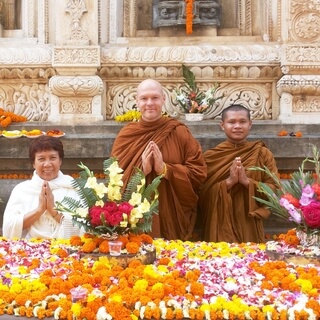
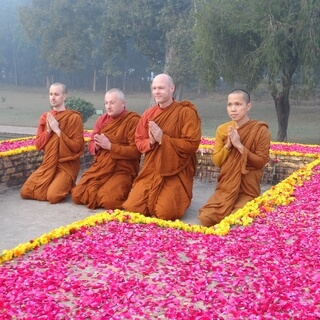
I had an invitation to teach at the Bodhi Tree during the,
In India,
At the annual Triptaka recitation.
I'd been invited and Ajahn Amro had encouraged,
Ajahn Kavili had encouraged me to go as well.
Many people know I've done a lot of formal sitting practice in Bodh Gaya,
Hundreds of hours,
Thousands of hours.
And I was considering whether or not to accept this invitation.
And I was thinking,
Well,
I have certainly had a lot of opportunity to cultivate my own practice.
And so it's probably appropriate to give some words of encouragement to people in India.
And what was nice about this situation is that it was going to be translated into Hindi.
And so I thought that would be a good thing to do.
One of the things Ajahn Pavaroi said was,
He said he would feel really terrible if I canceled because of him and he really wanted me to go.
So I decided to go and I was dedicating the merit largely to my good friend Ajahn Pavaroi.
But then after I also taught in Delhi a one-day retreat to a group of Indians who have established a charity,
A trust,
With the intention of opening an Ajahn Chah branch monastery in India one day.
So it seemed like a good situation,
Good group of people to encourage.
So when I got back from teaching in India and I got a phone call from Malaysia that Ajahn Pavaroi's symptoms had returned.
He had terrible headache and he couldn't remember what happened 10 minutes ago.
And I said,
Oh no,
Here we go again.
So when he went in for that first surgical procedure,
The thoughts that you can have is,
Well he might not survive.
Another thought that you have of course is,
Well he might never be the same.
And some people,
And what was interesting was the Ajahn Chah remembrance weekend was coming up in Malaysia.
A group of very devout Buddhists in the Kuala Lumpur area had arranged for many Mahateras to come from both Thailand and overseas to give a two-day teachings and guided meditations in honor of a hundred years since Lumpur Chah's birth.
So this second procedure that Ajahn Pavaroi was going to need to have synchronized perfectly with the day before the Ajahn Chah remembrance.
But of course the irony of the Ajahn Chah remembrance is that Ajahn Chah had a procedure on his brain after which he never spoke again and was paralyzed for 10 years.
So it's like,
Oh dear,
Of all the things that we remember of Ajahn Chah,
That one's not talked about so often that he had to be taken care of by the bhikkhus in the monastery in teams 24 hours a day,
Because he couldn't walk and he couldn't talk,
He couldn't go to the bathroom himself,
He couldn't even eat himself by himself.
So one is concerned.
I hope that's not what's going to happen to Pavaroi at this Ajahn Chah remembrance.
But as a reflection on karma,
I'm thinking of how interesting it is that Ajahn Pavaroi should have got his symptoms and needed surgical procedures in Kuala Lumpur at that time,
When there were 20 Mahateras in town.
And so what happened was the night before the surgery I was flying down from Bangkok,
Having got back from India just a day.
And Ajahn Pasanno,
Ajahn Jayasaro,
Ajahn Vajiro and Ajahn Jandi visited Pavaroi and chanted for him and Ajahn Kevali.
And the next day after the surgery a few more Mahateras visited him.
So it was very interesting for someone who believes in karma,
Literally,
As I do.
I have no,
Personally I have no doubts about karma in reverse.
And so what seemed to be happening for Ajahn Pavaroi is that how it looked to me was that it was his time to die.
And that was an old karma that was ripening.
And as we were trying to co-teach this retreat,
It was literally like he was evaporating.
Whatever,
Whatever Pavaroi was in terms of perceptions,
Memories,
Personality,
It was basically all gone by the time he was going into the operating theater.
And there was this vague glassy look in his eyes.
I do think there was mindfulness though,
Which is why he wasn't anxious,
Why he wasn't panicking,
Why he wasn't yelling at people.
So that's a very interesting reflection.
And again it points to the power of this practice.
That although the sannyas is disintegrating,
Evaporating,
Not working,
That quality of presence which doesn't make a problem out of things,
Which allows nature to be as it is,
That was clearly there.
I found this very a wonderful thing to notice.
And then when he'd had his second procedure,
Fortunately he did recover very quickly.
And actually the first day was even scarier than him not remembering.
He started telling me things that hadn't happened.
I'm like,
Uh-oh.
But keeping in mind that was the second general anesthetic in a fortnight,
And they'd literally had water washing over his brain for an hour,
Washing out the blood clot.
So he said to me,
I had a really nice chat with Arjun Jeevakar today for a couple of hours.
It was really good to see him.
The problem is Arjun Jeevakar is on retreat in a mountain in Nepal.
So there's no way,
Unless Arjun Jeevakar has developed his psychic powers,
He might have.
But in case he hadn't,
Probably Pavro was remembering things that didn't actually happen.
And then he said,
Kemiko,
I went for a nice long walk with Kemiko today.
So after this surgery you have to stay in bed for 48 hours.
He wasn't even allowed to go to the bathroom.
And I'm like,
No.
I didn't say no.
But when he said,
Kemiko's in Canada by the way,
So when he said the third thing,
I finally was able to have a shower today.
It was really nice to have a shower.
And I'm like,
You didn't have a shower,
Pavro.
I was losing my patience slightly and he said,
Oh yes I did.
I said,
No you didn't.
And he said to me,
You are mistaken.
I had a shower.
He said,
Well you had surgery this morning and you're on 48 hour bed rest and you haven't got up from this bed,
So you did not have a shower.
He said,
Oh perhaps I forgot that.
So fortunately the next day he wasn't remembering things that didn't happen.
But it is an interesting contemplation on this sannyā-anātā,
Sannyā-anīcchā.
Sannyā really is not sure.
And it's nice when it works.
And you can hold together a sense of being a conventional self in a fairly cohesive way that's useful for getting along in life.
Anyway,
So it's nine days since his surgery and he's doing very well.
The neurosurgeon said one in 20 people have a second bleed.
Very,
Very rare.
Only once in his whole career did he see a third person.
So hopefully he's okay now.
But what appeared to be happening to me was some kind of karma of it being time to die was ripening.
They also found in his blood a scrub typhus.
So I don't know how long that had been in his system,
But it's a parasite that sometimes people get it here at vatnā-anācchā.
From the squirrels.
The mites on the squirrels carry a very tiny parasite which usually causes high fevers and headaches.
So we don't know how long he had that in his blood,
But it was probably part of the complicated symptoms that he was experiencing that we on the outside were trying to work out what was wrong with him.
So he was treated for that.
But in terms of contemplating the power of our practice,
The benefits of our practice,
And the power of merit and the value of merit,
Isn't it interesting that Pāvrū became sick in Kuala Lumpur the week before the Ajahn Chah Memorial weekend.
In seven weeks time Ajahn Pāvrū was scheduled to lead a pilgrimage in northern India to the holy sites.
I shudder to think what would have happened if he started to have these symptoms while leading the pilgrimage.
Can you imagine?
He didn't know what he said yesterday.
He didn't know where he is.
He doesn't know what he's doing and he's got 20 people who are completely dependent on him to be the leader.
And then imagine he needs urgent medical care in the state of Bihar in northern India.
I think it would have been a very different outcome.
So that was the place he got sick.
This is where you see merit manifesting.
And I was saying to the lay people earlier,
You know if I had to go through such a procedure even in Bangkok,
It would be very unlikely that seven or eight or nine Mahārāj teras would visit me and chant for me because everybody has their duties.
Maybe one,
Maybe one would.
But there he was.
Ajahn Pāthāno,
Ajahn Jandi,
Ajahn Vajirā,
Ajahn Jayasaro,
Ajahn Kevali,
Myself.
Then after his surgery,
Ajahn Viridhamo,
Ajahn Jayanto,
Ajahn Siripanyo.
So quite extraordinary.
And so what I think was happening was the merit that had been produced by being a good bhikkhu,
That interjected.
And this basically it's like getting a visa extension,
Is how I see it.
That he's able to stay for a bit longer.
Interesting though is everybody asks,
How's Ajahn Pāvaro?
How's Ajahn Pāvaro?
Actually Ajahn Pāvaro was all right.
He was just lying on the bed and everybody's asking,
What do you want for breakfast?
What do you want for lunch?
Nobody asked,
How's Ajahn Achlo?
I was the one that had to be responsible.
And I was the one that was worrying,
How bad is it?
What's plan A?
What's plan B?
What's plan C?
Who's taking care of this?
Who's taking care of that?
Who's paying?
So all of that was on my shoulders.
So whereas Ajahn Pāvaro extended his life,
I think I might have lost a year.
But I'm happy to give that year to my good friend.
And what I just wanted to reiterate,
When he had to have the second procedure,
Once again,
No anxiety,
No bad moods,
No blaming anybody,
No feeling sorry for himself.
The only negativity that Ajahn Pāvaro expressed through these two procedures was when he had clarity and he realized what was happening,
He says,
Oh Ajahn,
I feel so bad about having caused so much trouble to other people.
That was it.
That was the extent of the.
.
.
And he would tear up,
He'd tear up with gratitude.
He says,
If I even think about how much people have helped me and he starts to kind of tear up and I said,
And I would say,
Pāvaro,
Shut up.
Just don't go there.
What are we going to do?
Of course we're going to take care of you.
Don't make a problem out of it.
Because I didn't want to cry either.
But it's very beautiful to see the qualities that were there when he was facing this very serious occasion was tranquility,
Serenity,
Equanimity.
When he was suffering,
Didn't know what to do in terms of when he couldn't pass urine and it's a very unpleasant feeling whenever a very bloated bladder and you can't pass urine.
So that he would think to chant the Metta Sutta quietly right there in the hospital.
And that the only negativity that he experienced was to feel remorse about causing trouble to other people.
So I know Ajahn Pāvaro very well and I know one of the biggest things that he suffers about is some wish that his practice would bear greater results than it has.
This is something for all of you people beginning your monastic training,
It's something to consider.
I've seen many people disrobe.
Somehow I'm still here.
Many people around 10 years,
Curiously enough.
Many people in the first five years,
Many people after five years.
But then the next time that we lose a lot of monks is after 10 years.
Oftentimes it's because they wanted more results than they have and they wanted better results,
They want faster results.
They're not content with the results that they have.
It's not the case that they're not good monks,
It's not the case that there aren't good results.
But basically it's greed.
They want more.
And so when they didn't quite get their Jhana and they didn't quite get stream entry,
They might have had Upajara Samadhi,
They might have had insights,
But they want more than that.
So then they start thinking about wife and kids and career and go and be a Buddhist psychotherapist and get yourself a Lexus or whatever it is.
It's a.
.
.
See these people after they disrobe and always wholesome qualities have degenerated.
It's always the case,
At least the ones that I knew personally,
That there were more wholesome qualities when they were still with the training and wholesome qualities degenerate when they leave.
So we don't.
.
.
We're not in control of the time frame.
As Lumpurcha says,
You plant the seed,
You pour the water,
You let the sun shine in it,
The tree grows,
The fruit will come when it's ready and you don't.
.
.
You're not in control of when the fruit comes.
When Ajahn Anand told me about my own practice,
He said you should grow like a hardwood tree.
Your roots down nice and deep and grow slowly but grow steadily.
And when the winds come,
The worldly dummers,
You can not be blown over by those winds.
Don't be in a hurry.
Slow and steady.
So these are good reflections.
But for what I observed in Ajahn Parvara's crisis,
In a way,
Crisis of health,
Was the benefits of the practice.
That at a time where he really might likely have died,
There was serenity,
There was tranquility,
There was equanimity.
And when he thought of something that he could do,
He thought of the Buddha's own words and was able to recite them because of this is the accumulation of having done our practices diligently.
So I just want to encourage people and affirm what we're all doing here.
It's very obvious to me that when you do your chanting daily,
You do your meditation daily,
It's seeping in.
I think there's a Zen saying,
It's like going for a walk in the mist or in the fog.
It doesn't feel wet,
But by the end of the walk,
Your coat is completely soaked through.
So Dharma practice can be like that.
These thousands of moments of Kanaka Samadhi,
These thousands of periods of Upajara Samadhi,
Some peacefulness,
Less hindrances,
These millions of times that we reflect wisely,
Apply antidotes to thinking unwisely,
This is seeping in and the mind is becoming a trained mind.
The power of greed,
Hatred and delusion is being weakened.
So we might not yet have enough spiritual power to completely uproot it,
Obliterate it,
Destroy it,
Explode it out of the mind yet.
But we do have the training,
We do have the practices,
We are doing something that weakens it and weakens it.
And in weakening the hindrances,
In weakening the group kilesas,
In developing the five spiritual powers,
The faith,
Energy,
Mindfulness,
Concentration and wisdom,
You are going to have the day where you do explode these dark qualities out of the mind.
So Hajananand says,
It's good to aspire for liberation.
That's part of right view.
There is nibbana.
One aspires to realize nibbana.
But if you don't get it this life,
Then it's important to understand that however much practice you do,
The number of births that you have is decreasing.
So it's not the case that you're not getting results.
The result is coming closer and closer,
However much you practice.
But if you take two steps forward and two steps back,
Obviously the result won't come closer.
So I hope that wherever you are in your practice,
That you just keep applying these practices.
Keep your sila.
Try to have a strict vinyas.
Do some meditation every morning,
Every afternoon,
Every evening.
Try to see,
Contemplate things according to the three characteristics.
When you have a strong hindrance in the mind,
Try to apply a remedy,
Reflective meditations.
Cultivate your meta.
It does reduce aversion,
Irritation,
Ill will.
Contemplate death.
Contemplate the nature of the body.
It does reduce lust.
It does help you focus.
Cultivate breast meditation,
A tranquil abiding in the here and now.
And nibbana and liberation is coming closer and closer.
So I offer that for your reflection.
Hope something I've said is useful.