Hello,
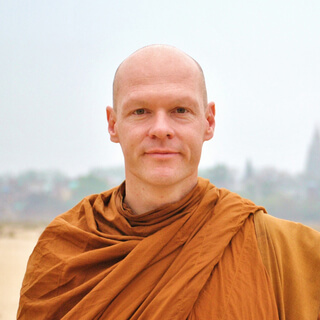
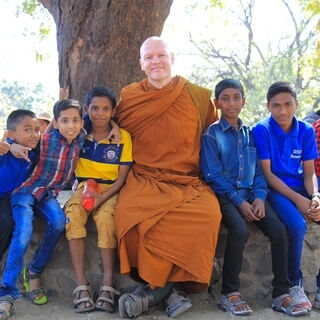
This is Ajahn Achalo.
Towards the end of the year 2015,
I led a three-week Buddhist pilgrimage to the four main holy sites in northern India and Nepal,
And other holy sites associated near those places.
During the time of the pilgrimage,
I actually kept something of a journal just to write a little about what we'd been doing,
Where we'd been,
Why we'd been doing it,
And some of the things that occurred in those places.
I did this in order to share with the pilgrims so that they could,
After the fact,
When they went home,
Recollect the pilgrimage.
Rereading the journals,
I felt that they could possibly have a broader appeal.
And so when I was teaching in Melbourne in May 2016,
There were a large group of people who were interested in the subject of pilgrimage,
And so I took the opportunity to show some photographs,
Tell some stories,
And also to read these journals.
Re-listening to that talk,
Once again I feel that for people who have an interest in pilgrimage,
Some of the content may be of significant interest.
So I've edited out quite a bit of the commentary of the slideshow,
Understanding that it's a bit abstract for listeners who can't see the images,
But I have kept some because of the stories.
So try to just listen to the stories,
Use your own imagination,
And after the comments about the pictures not long after,
They'll be the reading of the journal.
This is part one,
Where we talk about what we saw,
What we practiced in Lumbini,
Bogaya,
The cave where Lord Buddha practiced austerities,
The place where Sujata offered the milk rice,
The creamy rice,
Also Veluvana,
Vulture's Peak and Nalanda.
I hope you find some of the content helpful.
I've had the good fortune to be able to go on a Buddhist pilgrimage in India,
Northern India,
On four occasions.
Two of those occasions I led the pilgrimages.
The last pilgrimage in November and December was three weeks,
And I just shared some of the pictures.
And also I took a.
.
.
I wrote a journal,
Some observations and sharing of the practices we did.
The subject of pilgrimage is quite dear to me,
It's very rich,
Because you're studying the life of the Buddha,
The birth of the Bodhisattva and the life of the Buddha,
The central teachings that he taught in his 45 years of teaching,
And many of these wonderful characters that were around his personage.
So there's a lot of wonderful things to reflect,
Meditate upon,
Consider,
Contemplate.
And also the aspect of devotional practice,
Nourishing and generating more faith and expressing that faith.
It's a very brightening effect on the mind.
So share some pictures and read some journal entries.
Incredible India.
This says a lot,
This picture,
In terms of the modern and the not so developed,
The shiny new buses,
Trucks,
Mobile phones,
Etc.
But the very simple houses,
A lot of people in India,
Still quite poor,
Especially in Bihar and Uttar Pradesh,
Where the holy sites are.
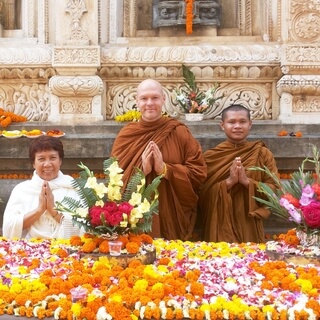
This is just to introduce the monks that came along.
This is actually in the site of the Buddha's kuti in Ajeta Bana,
Which was the monastery Lord Buddha spent 19 rainy season retreats in Savatthi.
My friends Ajahn Punyo,
Ajahn Gomol and Tanpe Salo joined us and about 26 or 30 people.
Looking cheerful,
We've done our morning puja.
So this was the group that joined us.
We have a good number of Malaysians,
A good number of Thais and one Caucasian Australian and a couple of Sri Lankans from Melbourne joined us.
Okay,
This is Lumbiniwana,
Starting with the site where the Bodhisattva was born.
They've developed a very large area around the site of the birth and you actually have to walk in.
They don't allow the buses and the auto rickshaws to come in.
It's very beautiful,
The sense of collecting the mind and really arriving and considering what happened there.
And then on either side of this long canal,
Off some considerable distance,
They've made land available for monasteries from different traditions.
So there's a lovely Korean monastery,
Tibetan monastery,
Thai monastery,
Chinese monastery.
In the Mahaparinibbana Sutta,
Lord Buddha gave some final teachings.
One of the things he said is that to offer these bright colours,
Fragrances and chanting,
Devotional practices at the Four Holy Sites would be of benefit for Buddhists.
He said Buddhists should make the effort to go because if they do,
That will be for their benefit for a long,
Long time.
He also said however that the best way to honour the Buddha is through the practice,
The meditation practices,
Keeping the precepts.
But we can do all of these things.
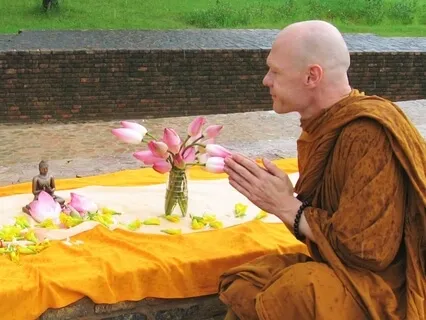
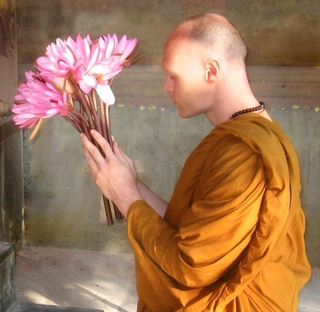
Make your offerings of flowers,
Colours,
Fragrances,
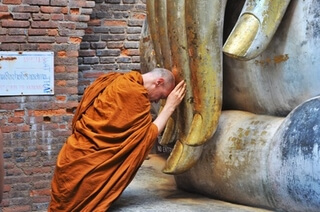
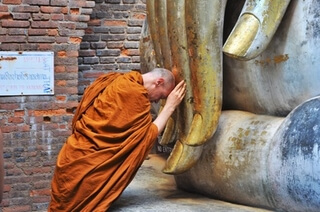
Bowing,
Chanting,
All of the things that people do,
As well as meditate.
So this is the building.
It's quite a small building.
Inside you can circumambulate and there's the site of one of the original Viharas.
I think it was 1700 year old bricks in the centre and the site where they feel,
The archaeologists felt,
Was the original holy site.
So you can circumambulate.
You can't take photos inside but you can circumambulate on the outside and then there's a little boardwalk where you go into the centre,
The little chedi and dome above.
And you can pay respects one at a time to the very site where the Bodhisatta was born.
Just read the journal entry from Lumbini.
Greetings from Lumbini.
Crossing the border from India into Nepal,
One's aura or energetic body seems to sigh with relief.
Less people,
Less dust,
More trees,
More space.
Ah,
Bihar and Uttar Pradesh in northern India are intense.
Walking into the Lumbini grove in the misty early morning there is a lovely sense of quiet and space.
The modest building that covers the partially excavated foundations of one of the original Viharas,
3rd century BC,
Which marked this most sacred holy spot has a strict silence policy inside.
This is very conducive for supporting pilgrims in taking the appropriate quiet time for recollecting the profound importance of what actually occurred here.
There is a boardwalk on the four sides of the inside walls for circumambulating.
Our group walked the three rounds silently.
Then one at a time we walked along another boardwalk into the very centre of the building,
To the exact site where the Bodhisattva was born.
Each person was able to take a minute or so with their head bowed down,
Just inches away from this special place,
To say a quiet thank you for the love and the kindness that moved and motivated the great being to work for so hard and so long,
In order that he might be able to help us to go beyond the painful fetters that bind.
After the silent walk,
The sacred circumambulation and the intimate thank you,
It was wonderful to take the time to just sit quietly for nearly two hours under a nearby ancient Bodhi tree,
Before our formal puja.
The nine hours on the bumpy bus ride,
Over a twelve hour period the day before,
Was quite gruelling.
So just sitting quietly in the cool and clean quiet air of the Lumbini grove was both deeply gratifying and restorative.
The longer I sat,
The more acutely I could feel a particularly sweet and nurturing energy in the air here.
I felt gratitude for Maya Devi,
The Bodhisattva's mother,
And then quite naturally for my own dear old mum as well.
I dedicated merit and spread loving kindness to her.
Giving some thought to the birth of the Bodhisattva,
I considered the causes that actually give rise to such beings.
Indeed it would seem to be a particular quality of especially vast,
Tender,
Loving concern.
For only a truly great and vast quality of mother-like love could fuel the long and arduous journey from being a budding Bodhisattva to an unshakable Mahabodhisattva,
Investing literally millions of lives of patiently perfecting qualities while accumulating oceans of merit.
At Lumbini one can feel a portion of the vast love that landed upon this earth at the time of that final birth.
No wonder there was a flash of light that illuminated all of samsara for a short period just after that momentous occasion.
Perhaps though,
It is the perfection of mindfulness,
Meditation and wisdom that actually gives rise to the Buddha upon this foundation of immaculate purity and ocean-like compassion.
Stretching the imagination to encompass eons and eons gone by,
One realizes that there must have been literally thousands of teachers who taught this great being to some degree.
All of the things that he was about to perfect.
What would be the requisite quality of the woman who would carry such a being in her womb in his final and ultimate life?
I suspect that the Bodhisattva's mother had no doubt carried this would-be Buddha being in her womb many thousands of times in previous lives.
And that was her tremendously significant contribution to the eventual birth of the Buddha.
How else could she have such an intimate connection and gain such a special honor?
And no wonder then that the Buddha had taken a special period of time after his enlightenment to teach the being who had been his mom,
Who had died not long after his birth.
It is said that he traveled to the heaven and taught his ex-mom who by that time was a male deva,
Living in Tushita heaven.
He she realized the spotless,
Immaculate vision of Dhamma and became destined for complete liberation within seven lives.
Realizing liberating truth of not-self would seem to be a most fitting reward for so much self-sacrifice.
Thank you indeed to Maya Devi,
The mother of the Bodhisattva,
Who in her own way was also a kind of mother to our Buddha,
Our Buddha's Buddhahood with regards to having enabled him to have what he needed in order to accomplish what he had to,
A physical human body.
In the afternoons,
Appreciating the graceful beauty of several traditional-styled monasteries built within the grove and taking some time to meditate in a few as well was a great way to stretch the legs and breathe in some cleaner air.
And so it would seem that Lumbini is the loving mother place.
The energy near the Maya Devi temple is sweet,
Tender and nourishing.
In general,
The Nepali people seem gentler and more quick to smile too.
Sadly,
There is still no escaping a few hungry begging children even here.
On the accommodation front,
The sheets in the Japanese-run hotel are particularly clean,
Crisp and fresh.
After 48 hours in Lumbini,
You feel almost as if you had received a big loving hug from your own mum and then had one of her hearty home-cooked meals as well.
Well,
At least that's how I felt.
Which is just what is needed after 16 days of modern pilgrimage in northern India and soon returning to Varanasi,
Sarnath,
For the final three days.
Bodhi leaves from Lumbini.
Ajahnachva has a habit of collecting bodhi leaves.
These are bodhi leaves from Lumbini.
This is our pooja in the fog.
It was quite cool up there at the foothills of the Himalayas.
The mornings are quite cool.
The Thai people sponsored the construction of this bronze image of the newly born Bodhisattva.
If you recall,
He took seven steps,
I believe,
And he raised his hand.
One raised hand.
One hand raised,
One hand lowered.
He said,
I'm foremost in the world.
And then the other hand pointed down.
This is my last birth.
So that's to commemorate that.
Bhagaya.
The stupa,
I believe,
Is about 54 meters tall.
Beautiful and quite an incredible presence when you approach the temple from outside.
This is just as you walk down the staircase and you come and you look up.
This is what you see.
These stupas on top of the temple are original stone stupas from probably more than a thousand years.
And that Buddha image in the circle.
So when they redid the stucco,
The concrete,
They put lots of the old original images in the little holes and niches,
Doing our pooja.
So we would do a pooja and then we would usually sit for an hour and a half or two hours after a pooja.
And the first hour we had to sit together and after that it was optional.
Most people found that they could sit for longer and mine became more peaceful in these places and they were able to work with pain more easily.
Many people found that they experienced less pain also.
Part of the blessings in these places seems to be that people can practice more with less dukkha,
Which is nice.
I just wanted to show this.
This is literally about 10 meters to the left of where our group was.
We have these Tibetan practitioners doing their full length bowels literally all day.
And this really adds to the atmosphere,
The sense of devotion,
Effort,
Energy that people give,
Expressing their love and gratitude to the Buddha.
It's a wonderful sense of practicing together all as children of Lord Buddha.
The Tibetans believe that making these full length prostrations purifies obstructive karma.
Often they'll be confessing whatever wrong actions they've done by body,
Speech or mind.
They acknowledge the fault.
As Mahayana practitioners they're actually making the aspiration to have the enlightened speech,
The enlightened mind and the body of the Buddha.
So it's quite beautiful.
Their energy,
Devotion,
Sincerity.
You see where we're sitting facing the stupa?
And just to the right of the chedi there,
That's the Bodhi tree.
You see it's quite a large tree.
And the one that we're sitting under,
Alexander Cunningham,
Was a something like a general or a colonel in the British Army.
And he rediscovered the holy sites.
He had the resources of the British Army in colonial India.
And for whatever reason he was particularly interested in the Buddhist holy sites.
And he was referring to the diary of one of those Chinese pilgrims,
Huang Sang.
And Tanajana Nan said to me one day,
It may be the case,
Tanajana,
That Cunningham was the reincarnation of that pilgrim.
Because it's curious,
Isn't it,
That this British person would be so passionately interested in rediscovering the four main holy sites.
And then when he found them there was the remains of an old trunk of a Bodhi tree and there was a couple of saplings coming out of the trunk and it was Cunningham that actually replanted this Bodhi tree on that site about 135 years ago.
So the current tree is only 135 years old.
It's the fourth one.
But it's on the very site.
It's on the site of the Enlightenment.
So whatever Bodhi tree happens to be planted on that site is very special.
And you'll see people get very interested in getting a Bodhi leaf from that Bodhi tree.
Bodhi leaves from the tree that we're sitting under don't count.
It has to be that tree.
So this is under the tree on the other side of the wall.
You see these groups of spiritual practitioners do their poojas.
You see the way they've put up these posts so that the tree can grow and grow and grow.
So it's actually wider than it is tall Bodhi tree.
It's probably about 20 meters tall and I think 35 meters wide.
Maybe even more,
40 or 50 meters wide.
It's quite a healthy big tree.
So all of those people are actually sitting under the shade of the Bodhi tree there.
This is the site of the Buddha's walking meditation path.
You remember one of the weeks after the Enlightenment the Buddha walked meditation for one of those weeks.
He spent another week staring at the Bodhi tree with gratitude,
Another week enjoying the bliss of liberation,
Another week contemplating the dependent co-arising backwards and forth,
The various things that he did.
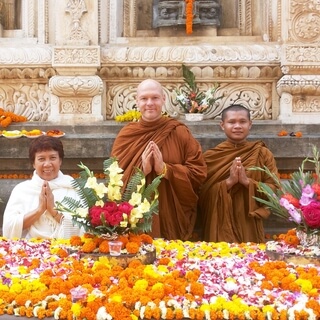
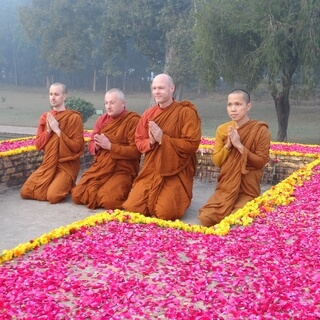
This is our group.
Pink,
Lotus,
Orange,
Marigold,
Red Roses.
It's the most common flowers available for making offerings.
There was one year a few years ago Ajahn Parvo and I decided to offer a garland of flowers to each of the images around the entire stupa.
And in those days you could stay overnight.
They changed the rules now.
So this was after everyone had gone and there were just a few people staying in overnight and walking along that rather thin ledge,
Placing a garland around each of the images.
Does he look cheerful?
Pleased with his accomplishment?
This is Buddha Metta.
This is the main Buddha statue inside the Vihara.
It's quite a small cramped room with very poor ventilation and there's a lot of interest in paying respects to the Buddha image.
It's actually made of black stone but it's been gold-leafed and the face has been painted.
And many people,
For whatever reason,
Many people do have the sense when they're paying respects,
It's as if Lord Buddha is there.
And it's a difficult thing to explain but the way I understand it is Lord Buddha had what they call Lokuttarajana,
Which is the jhana of an aryan,
Of an enlightened being,
Which is much more powerful.
And Lord Buddha explained that what you could do,
What one can do if one has jhanas is imponderable.
You can't fathom.
But they have very special skills.
And an enlightened being's jhana,
They have more skills than an unenlightened being's jhana.
That means someone who's attained to nipana.
And of course the Buddha had even more skills.
Ajahn Annan explained it to me that the Buddha is able to,
In a way,
How would you say,
I know how they say it in Thai,
Trying to think of an English word,
Is like the merit that he's built over four asankhyas and a hundred thousand eons,
That's a thing,
That's a potent,
Powerful force,
It's a real thing.
And he's able to fuse that to the land in these holy sites with the power of his samadhi so that when you go there,
Ajahn Annan actually says to pay respects with a mind of faith at the Bodhi tree and the Vajra asana,
The seat of enlightenment,
One gets merit equal to paying respects to Lord Buddha himself.
And the reason is,
A large amount of the merit of the Buddha is actually still there.
And the way people experience that and feel that is sometimes when you're meditating you feel that you're meditating with the Buddha,
And sometimes you pay respects to this Buddha statue and you feel that he's welcoming you,
Greeting you,
So that's a.
.
.
I'm not saying he is,
I'm just saying that that's how people feel.
And we know that Lord Buddha has entered Mahaparinibbana,
But the merit that he accumulated within Samosara is a thing,
And he seems to have been able to store it here for the sake of helping beings accumulate merit,
And that's why he said it would be for our benefit for a long,
Long time if we could go to these places,
I believe.
Sometimes people ask a question and hear the answer also very clearly,
It's very interesting.
Okay,
So can we go back to the Bodhi tree,
And I'll read something from Bodh Gaya.
Greetings from Bodh Gaya.
With a pilgrimage group of 31 this time,
We are spending 5 of our 21 days in Bodh Gaya.
Having had several lovely pooches and long sessions in the Mahabodhi temple already,
This morning we travelled outside of town to the site where Sujata offered the sweet milk rice on the eve of Lord Buddha's enlightenment.
We were able to have a fairly quiet sit as we arrived early,
To contemplate the role that generosity and loving kindness plays in nourishing a sincere and ardent practice of the Middle Way.
Scores of semi-hostile,
Thin,
Dark and dirty children were waiting for us outside.
And although all present wish to be generous,
Giving to these particular kids somehow doesn't seem so useful,
As they usually wind up fighting with each other as soon as anything is offered.
Feeling moved to mirror Sujata's kindness though,
We decided to travel to the Root Institute and make an offering to their very well-run charities there.
I was moved to see that together we were able to contribute 120,
000 rupees towards the health clinic,
Orphanage and school there.
It was a very suitable way to join in the spirit of Sujata's kindness and make some kind of a loving gesture towards modern-day Bihar.
I have been enjoying refining further my practice of offering fine fragrances at these special places.
I am making blends of pure essential oils and water and using a hand sprayer.
No smoke,
No chemicals.
This morning at Sujata's milk rice place we offered blue lotus and lavender.
At Sujata's house it was Moroccan rose,
Geranium and lavender.
I have also made some home-blended incense powder.
I have blended Burmese,
Indian and Chinese sandalwoods with Bhutanese juniper and real frankincense crystals,
Powdered from Oman.
It smells great.
My favourite offering practice is the sitting,
Followed by dedication of merits,
Which we are off to do more of in just moments.
This afternoon and evening we have more practice at the Bodhi tree and tomorrow we'll be at the cave where the Bodhisatta practiced the extreme of austerities.
As tomorrow is Austerity Puja Day,
We'll be having a very early rise and long early session at the Bodhi as well.
It is wonderful soaking up the sacred ambience and enjoying rejoicing in the varied pujas of so many others.
Merits dedicated to all.
So,
As just remembering what Lord Buddha said,
Offering of fragrances,
Colours,
Flowers accumulates very useful merit.
Lord Buddha said that we shouldn't criticise people who do practices for the sake of merit because merit is synonymous with happiness.
So this is a very important thing to notice.
If Lord Buddha explains that something produces merit and if it's within your means to do that thing,
I highly encourage you to make merit in all sorts of ways because the way merit works is when you have challenges and difficulties,
Things manifest to help you through your challenges and difficulties and you meet with influences that can help you to be happy.
And from that foundation of relative wellbeing you can hopefully accomplish a lot of spiritual practice.
We have some pictures of where Sujata offered the milk rice.
I think we have the austerities cave first.
So Bodh Gaya has a lot of police and soldiers protecting it.
It's a very important tourist site.
Bihar and Uttar Pradesh,
Two provinces where the three holy sites are and then Lumbini is in Nepal,
Those two states have 300 million people in them and I would say maybe 70% of those people are under the poverty line,
How we would understand it.
So when you leave the protection of the holy sites you tend to meet a lot of very poor people.
See they're quite thin.
This is going up to the cave where the Buddha practiced the austerities.
What's interesting is if you get away from the main holy sites,
Even though people are very poor,
They tend to be quite well behaved.
They have the kind of dignity of human beings but when these people gather in places where there are tourists and those tourists give things like pens and candies and books and money,
It tends to make them a bit wild and rude.
But when you try to give what you can,
Most people just want to respond with some kindness so that's what you do.
So in this little door they made a little wall but this is the cave where they say Lord Buddha practiced the extreme of austerities before having his insight into the Middle Way.
I think the next photo shows a small dark space with a small image.
Yeah,
There it is.
So it's quite a small space but it's a very intense energy in there.
So understanding Lord Buddha as he was looking for Nibbāna,
Looking for the deathless,
He had tried,
He had cultivated the jhanas up to the eighth jhana.
But he saw that it wasn't leading onwards,
That even that profound state would degenerate.
It's interesting to note that most people wouldn't have that insight because these forms of samādhi are so pure and so profound and so blissful.
Most people get attached to them and then would just enter the jhana again and enter the jhana again.
But Lord Buddha with his incredible mindfulness was able to see that those jhanic states,
As blissful as they were,
Ceased,
They degenerated.
And that can't be it,
He was looking for something totally dependable that didn't die.
So then he wandered off to this cave and if you recall his.
.
.
But here Lord Buddha was taking a very small,
A few grains of rice a day.
And he said that,
And he wasn't allowing his mind to enter jhana even though he had perfect ability in that area.
He was practicing the extreme of patient endurance and he was wondering if patiently enduring with painful feelings and austerity was the way out.
And we don't know how long he did it for but he did say that it's possible that someone might suffer as much as he did in their spiritual pursuit but it is impossible that anybody ever suffered more.
So we know that it was a pretty astonishing and awesome effort.
Then he had the memory that he'd entered jhana under a rose apple tree and that that pleasure was a pure form of pleasure and that it was helpful if accompanied with contemplation or reflection,
Investigation.
And so he came down and I think we've got some pictures of where Sujata offered the milk rice next.
He came down and he had a bath and it said that the Bodhisattva,
His body will shine like gold the day before the Enlightenment.
And so Sujata had actually wanted to make an offering to a deity.
She had no idea that he was going to be the Buddha and her milkmaid saw this very thin but very radiant being with gold skin radiating gold light and they rushed off and they told Sujata,
Sujata,
There's a deva sitting under a tree.
And Sujata got her milk rice ready,
Finest ingredients and came and offered it to him and that was the nourishment that helped him to attain to his liberation that evening.
So this is walking towards the site where Sujata offered the milk rice,
Some of those kids asking for pens and books.
Kind of kitsch but I kind of like these statues.
Concrete and painted.
This was a few years ago,
A few years ago it was all painted pink and then this was Ajahn Annan's group.
I've included this photo,
I've included photos from many different pilgrimages,
Many different photographers.
You see the way people have placed their lotus on the Buddha's lap and around Sujata and someone's given her a shawl,
Put some lotus candles on her bowl,
Someone has given the Buddha a robe.
This way that people express their devotion and gratitude and recollect what occurred.
Since then they've put some ceramic tiles,
It's not quite as fun but even so it's a great place to go and recollect what occurred.
Okay so if you notice between the picture of myself and the Thai monk,
That's the Mahabodhi Temple behind us in the distance.
This is the Niranjara River and there's no water that you can see but in the wet season it's full from bank to bank.
If you go to the,
Around the centre of the river and dig down about a metre or,
Metre and a half you will find rip water.
Water is flowing through the sand,
Under the sand and that's what local people do.
You have to be very careful when you go here because this is the toilet of the village.
But this is where Lord Buddha crossed the Niranjara River and headed towards the Bodhi Tree and he got his eight bundles of kusha grass and put them under the Bodhi Tree and he made his determination that he would not get up until he was enlightened and let his blood dry up.
Anyway his blood did not dry up and he did get enlightened as we know.
Just go back to that last photo and I'll read a little more.
Staying nearly six full days in Bogaya seems to have worked well as the beginning of our immersion into pilgrimage.
As the days went on the pilgrims began requests to stay longer than the scheduled two or three hour visits to the Bodhi Tree so that on the last two days most of the group were beginning the day at the temple by 5am and having a late dinner after closing time around 9pm.
It was wonderful to see everyone settling into longer sessions of sitting,
Having gotten more used to all of the sacred noise and trusting that the mind does settle if given enough time.
Most people learned to appreciate the various expressions of faith at the temple and came to see that what seemed quite disorderly and chaotic at first actually does have its own gracious rhythm if one learns how to relax and patiently observe.
In the right frame of mind it is actually an exquisitely beautiful thing to observe,
The way that so many diverse groups find their own time and place for expressing their faith and gratitude.
Perhaps only India,
With her tolerance of a bit of chaos,
Could accommodate such a diverse orchestra with its bands of multilingual choirs.
Don't forget to throw in a few hundred ragtag con men fake monks to make the scene just that little bit more rich and perplexing.
Perhaps no other place represents the Buddhas of the past,
Present and future like the actual Vajra Asana,
The seat of enlightenment,
Right there under the Bodhi Tree.
Seeing a good opportunity then,
Just after dawn yesterday morning I led the group in a ceremony for asking forgiveness of the Buddha's past,
Present and future for any wrong actions which we may have been either wittingly or unwittingly involved in.
Directly under the Bodhi Tree and just metres from the seat of enlightenment,
It was a powerful farewell ceremony.
The evening beforehand I had given a talk on the theme of truthfully acknowledging faults and mistakes.
Explaining that this is an essentially compassionate and wise activity,
Central to developing and purifying our minds,
Which has nothing to do with feeling guilty or being fault-finding.
It was actually quite wonderful to express a wholesome sense of remorse towards this most pure and compassionate object of refuge.
Most people had a palpable feeling of being blessed,
Which is difficult to explain,
Yet enormously helpful.
It felt good to set the intention to be more and more careful and it is reassuring to think that if karmic.
.
.