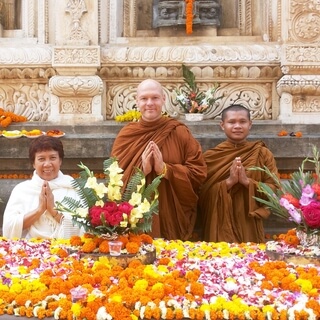
Welcome to our guests from Malaysia.
Some people have come seven times to join in offering Katinas.
Other people have come several times.
So I'm happy to offer some reflection on this occasion.
Please sit comfortably.
So I thought I'd touch on some basic Buddhist teachings and principles.
The wonderful thing about the Buddhist teachings,
Buddhist practice and Buddhist training is that the basics are always relevant.
And in fact,
The basic training is actually what liberates people because the basics deepen and people's understanding of those principles becomes more sophisticated and more refined over time.
So we know we have the eightfold path discovered by Lord Buddha.
This is often abbreviated as coming down to a threefold training,
Sīla,
Samādhi and Panya,
Virtue,
Concentration or collectedness,
And wisdom.
Lord Buddha's teachings are also understood as a threefold training in dhāna,
Generosity,
Sīla,
Again,
Ethical conduct,
Virtue,
And bhāvanā,
Mental cultivation.
Personally,
My favorite pithi shortlist of Lord Buddha's is the five spiritual powers.
When we talk about sīla,
Samādhi and panya,
There isn't mindfulness mentioned in that shortlist.
And dhāna,
Sīla and bhāvanā,
Mental cultivation.
I think mental cultivation to be effective,
To be holistic,
To be balanced,
Needs to have the three last of the five spiritual powers present.
Sati,
Mindfulness,
Samādhi,
Right collectedness,
And panya,
Wisdom.
After Lord Buddha was enlightened in Bhojpura under the Bodhi Tree,
In one of his weeks after liberation,
All of the incredible insight,
He'd be using his remarkable powers to recollect fifty,
Five hundred,
Five thousand past lives under the Bodhi Tree,
And having deep penetrative insight into dependent co-arising causal factors that give rise to birth.
He was wondering how can he avoid death,
How can he liberate himself from death,
How can he realize something deathless.
Then he considered that the cause of death was a birth.
So then he was trying to identify the cause,
What's the cause of birth,
And he was able to see with his laser-like mental faculties and his capacity to focus,
Combining right concentration with reflection,
Sustained focused reflection,
This is the middle way,
A certain amount of concentration combined with skillful reflection,
And he was able to discern that the root cause of birth was ignorance,
And because beings are ignorant,
They are affected by craving.
Craving for pleasant experiences,
A kind of inverted craving,
Aversion towards that which is not liked,
And craving for becoming.
So ignorant beings perceive things in terms of self and other,
Which has a certain validity in conventions.
Lord Buddha was able to see though that this was a big problem.
It is actually a view,
A way of seeing things,
An assumption,
A convention,
And also a very deep habit.
As it turns out,
It's a very bad habit,
And Lord Buddha was able to perceive something more dependable,
Deeper,
And in fact that conventionally there is a self,
But ultimately there isn't.
And to have this understanding,
One needs to do a lot of contemplation and reflection,
As well as for that contemplation and reflection to have enough power to weaken and uproot ignorance,
There also needs to be a certain type of collectedness,
Samadhi,
A certain amount of concentration,
And then this direct insight,
Seeing that everything,
Every thought arises and ceases,
The body changing from in the womb,
A few cells,
Early childhood,
Teenager,
Adult,
Aging,
Death,
Constant change,
Every thought,
Every feeling,
Every mind state,
Every emotion,
And the body,
All of it constantly changing.
So his wise reflection,
His penetrative insight that uprooted and destroyed ignorance.
What happens when ignorance is uprooted and destroyed?
What is remaining is clear knowing of the truth of the way things are.
Ignorance is not knowing,
Because we don't know we're affected by delusion.
We perceive things incorrectly,
Applying mindfulness and concentration and wisdom uproots and weakens the ignorance,
And then the mind directly perceives ultimate truth or deeper truth,
That the self is a convention,
And we refer to the body as me and mine,
But actually bodies are just a form arising due to conditions,
Feelings arising due to conditions,
Staying for some time changing,
Ceasing,
And all of the thoughts,
All of the conventions,
Past,
Present,
Future,
Oneself and others,
All of it arising and ceasing,
But there's no inherent unchanging,
Stable self there.
So,
Dhanah,
Malaysian people,
Very renowned for being very generous,
And Sila,
Ethical conduct,
Bhavan and mental cultivation,
This is the path that leads to complete liberation from all suffering,
And it's important to consider the way Dhanah deepens or the role it plays in this training,
Because it's very profound.
In the beginning,
We might give,
Because it feels good to share,
It feels nice,
Share something that you have and give others some happiness or help them,
Relieve them from a certain type of difficulty or suffering,
But on a deeper level,
When we're training ourselves to relinquish,
This has profound implications,
Because,
And it leads on to keeping the Sila,
Keeping the five precepts,
The ethical conduct,
Training ourselves to relinquish physical things,
Give up some of our time,
Some of the money that we work hard for,
Giving up these things is training ourselves to be able to relinquish,
Forsake.
So then,
This is very important when we come to keep the precepts,
Because certain desires will come up,
And if you've made a commitment to keeping the precepts,
You can't follow those desires.
So you have to relinquish the desire,
And if you can't completely relinquish it,
You have to contain it and be patient with it.
But generosity actually trains us to be able to let go of craving.
So craving is a very dangerous thing.
Lord Buddha explained that there is no river that floods as violently,
As incredibly,
As the craving in beings' minds.
And this craving,
If we follow it in an unabated way,
Leads to terrible things.
We hurt a lot of other people's feelings,
People steal,
People rape,
By following their cravings and their greed,
Invade other countries.
If you want the kingdom to be bigger,
You want the country to be more powerful,
Send the army in to destroy another nation,
All of these things,
This is how far craving can go.
So,
We don't obviously want to be a king or a president that decides to destroy a country in the future.
We would prefer to be a Buddha,
A Bodhisattva,
Or an Arahant.
So that means a relinquishing craving.
And keeping the precepts,
That means you can't kill another being.
No matter how angry or no matter how much they might have hurt your feelings,
Can't do it.
Can't steal,
Simply can't do that.
So we have to train in these various things.
You can't tell a lie and can't go and have sexual pleasure with someone else's partner,
Have to be sexually responsible,
And can't get intoxicated.
So desires to do these things are obviously going to keep coming up in the mind until you are in anagami,
Various ways that craving and aversion manifest.
So being able to see a craving,
A desire,
Recognize it as sometimes certain types of desires aren't all unwholesome.
So that's the function mindfulness plays with clear comprehension.
But knowing which desires need to be relinquished,
Which ones need to be contained,
Which ones need to be resisted.
And then obviously our faith,
Five spiritual powers.
I'm going to talk more about this list because it covers things very holistically and very simply.
When you have faith in the value of not following your desires,
Because you have faith that you too have enlightenment potential.
You can follow the path that the Buddha laid down,
The path that he walked,
That led to his liberation.
You have faith that actually following these things is going to have incredible consequences for your own future happiness.
So this faith is very important.
When we have to resist a desire,
Sometimes desires can be very strong.
So how do you resist it?
Well,
You have faith in the value of not following it,
You have faith in the value of patiently enduring,
You have faith in the value of relinquishing.
So after Lord Buddha was enlightened under the Bodhi tree,
One of the weeks before he wandered off and started teaching others,
He was reviewing what had led him to that incredible realization.
And he was able to see that the five spiritual powers,
He used this phrase,
Lead to the deathless,
Merge in the deathless.
He also said the same thing about the four foundations of mindfulness,
Four foundations of mindfulness lead to the deathless and merge in the deathless.
So I think this is very pertinent,
Obviously important to notice Lord Buddha after he is enlightened,
After his complete and utter enlightenment,
Complete abandonment of greed,
Hatred and delusion,
Was able to distill this simple list,
Five faculties that can be developed to become powers,
Faith,
Energy,
Mindfulness,
Concentration and wisdom,
Lead to the deathless and merge in the deathless.
Overlapping again,
Our dana,
We have faith in being generous.
We Buddhist practitioners have faith in the Sangha and practice generosity towards the Sangha because we understand that the Lord Buddha's teachings have been handed down to us predominantly by the Sangha and we feel grateful.
But Thanajanganha,
Who was a nephew of Lompurcha,
Once said,
The Buddha Sāsana,
The dispensation of the Buddha is not actually the monks and the nuns.
The Buddha Sāsana,
The way he saw it,
Is mindfulness and wisdom.
And so he was saying that whichever beings have mindfulness with wisdom,
That's the Buddha Sāsana in the world.
So some monks are good,
Those monks hopefully have good quality of mindfulness and good wisdom.
But many monks are not practicing well and they're just wearing a robe.
So that's not the Sangha.
Whereas a lay person who really does make efforts at being generous,
Keeping the precepts and meditating,
Starts to have a firm and resolute quality of clarity and starts to see things according to deeper truth,
The impermanent nature of phenomena,
The unsatisfactory aspect of conditions,
Begins to have some insights into not-self.
That lay person can be a more noble part of the Sangha on an actual level than a monk or nun who doesn't keep their rules and doesn't meditate.
So I thought that was a very interesting insight,
An interesting way of looking at the Buddha's teachings,
The Buddha's dispensation,
Buddha's practice.
What is it?
So mindfulness,
What is mindfulness?
It's worth considering this deeply.
We have our faith,
Faith in the Buddha,
Faith in his liberation,
Faith in the path that he walked and the teachings he laid down,
Giving us directions how to walk that.
Energy arises from faith,
Energy arises from keeping precepts.
When you keep the precepts,
You don't have your craving energy flowing out of your mind all the time.
Energy,
Good energy,
Builds up in your mind.
And this is laying the foundation for the samadhi or collectedness.
Satta,
Faith,
Virya,
Energy,
Sati,
Mindfulness.
What is it?
Ajahn Manindo sometimes refers to mindfulness as being truth-discerning awareness.
We often hear teachings at many places these days about just being mindful.
Just be mindful.
What does it mean to just be mindful?
I think we can delude ourselves following all sorts of desires and tell yourself that you're just being mindful.
You watch one more movie,
Smoke a joint,
Have a beer and just be mindful.
I think a lot of Buddhists in Western countries are practicing Buddhism in quite creative ways.
Probably not recommended by the Lord.
So let's consider the fact that there is fuzzy mindfulness,
Poor mindfulness,
Weak mindfulness,
Scattered mindfulness.
Everybody has some.
You couldn't put on your shoes,
You couldn't drive a car,
You couldn't open the door,
You couldn't go to the bathroom without some mindfulness.
Know what you're doing with your body and know where you're going.
But that doesn't mean that it's good mindfulness.
So this is where having kept ethical precepts is very important because this gives the mind a certain integrity,
Certain clarity.
The mind isn't spilling out through following on the sensual cravings and acting on aversions and saying everything you think,
Everything that comes into the mind,
Just blurting it out.
When one keeps ethical precepts and tries to not practice harsh speech,
Not to lie,
Be careful with speech habits,
You notice the mind develops more clarity.
And so mindfulness is like a presence of mind,
A clarity,
An awareness that pervades or embraces,
Is aware of the phenomena of the body and the mind.
So mindfulness is also sometimes described,
Good mindfulness is described as mindfulness and clear comprehension.
This is adding the wisdom component.
That's why I love this list again,
The five spiritual powers,
Because it's all there.
When people talk about mindfulness and don't include wisdom,
Then it's not a whole training,
It's not a whole practice,
And it's not going to be effective.
Actually you need several components functioning in the mind.
The Eightfold Path is sometimes described as being like a wheel.
It's not a picture,
We have a sandstone image of a dharma wheel on a brick post in the middle of the monastery.
The dharma wheel isn't the sandstone image,
It actually turns in beings minds,
Right view,
Right speech,
Right thought,
Right action,
These kind of things.
This is functioning in your mind.
Skillful view,
Skillful speech,
Skillful livelihood,
Etc.
So practicing meditation,
This is how we sharpen and clarify our mindfulness even further.
When you try to be for a period of time each day or several periods of time with one object,
Suppose the breath,
Then you're training the mindfulness to be aware of one phenomena rather than being scattered.
So try to be mindful of everything all at the same time.
You can hear an insect,
You can hear somebody wriggling on the mat,
You can feel a feeling in my toe,
Various things.
If you're sending your mindfulness out and all around trying to be aware of everything,
You're going to end up with a weak quality of mindfulness,
Scattered mind.
But if you train in restraining for periods of time,
Just trying to be aware of feelings involved in in and out breathing,
Anapanasati,
Then you're not giving attention to other things.
You might hear a sound but you're not listening to it.
You might be aware of a thought but you're not thinking it,
You're not following along.
And then what happens is energy stops flowing out the sense spaces and stops flowing out into concepts of past and future and others.
And the clarity is able to become more palpable,
More present,
More powerful.
And because of that it becomes more discriminating,
More discerning.
Because of that it's actually able to see things as they are,
More correctly,
More truthfully.
So for a quality of mindfulness to be a good quality of mindfulness,
It will be seeing things according to their characteristics.
So what does mindfulness know?
Mindfulness knows a body as a body,
Forms as forms.
Mindfulness knows a feeling as just a feeling,
Arising,
Staying for some time,
Ceasing.
Mindfulness notices impermanence.
A thought arising,
A certain type of feeling or a certain perception from a certain word,
A feeling in the heart,
Liking,
Not liking.
Mindfulness can see the way things overlap and the way the mind can fall into reactions.
But if the quality of mindfulness is very good,
Oftentimes the mind won't fall into a reaction.
If it's aware of a pleasant feeling or an unpleasant feeling,
If the mindfulness is good,
There won't necessarily arise a lot of craving,
Craving for or craving not for.
So if we have faith and we practice mindfulness in all postures,
Practice meditation,
Energy arising in the mind,
This is laying the foundation for Samadhi.
What is Samadhi?
Concentration,
It's often described as.
I prefer right collectedness.
Sammasamadhi is a certain collected quality in the mind.
So when you've been generous,
You're weakening your greed and your hatred,
Producing merit also,
The mind becomes brighter.
The darkening qualities of greed and hatred become weaker and the mind becomes brighter.
Then you have good energy in the mind,
Not bad energy.
The energy of chelazers,
Ajahn Mahabuwa talks about walking all over your mind like it's a doormat.
Greed and hatred,
The chelazers,
Just walking all over your mind and he encourages people to put up a fight.
Don't let these energies walk all over your mind like a doormat.
So when we restrain them,
We relinquish our desires,
We practice generosity.
The darkening qualities are less of greed and hatred and the darkening quality of ignorance and delusion,
Mindfulness with clear comprehension,
Concentration of wisdom are the direct antidote.
So when you practice these things,
The mind becomes brighter,
Lighter and you should notice that there's a thing of lightness in the body and mind.
So when these things are in place,
You can start to experience right collectedness.
You might be practicing mindfulness of breathing and the mind can become quite collected,
Quite bright,
Quite still.
Some right concentration,
Right collectedness.
And this collectedness with mindfulness and clear comprehension,
This becomes wisdom.
What does wisdom see?
It sees arising and ceasing,
Arising and ceasing.
And how can this phenomena which is constantly arising and ceasing be a permanent self?
Wisdom sees that it's not.
The self is a convention.
Ultimately,
Body is just a body,
Thoughts are just thoughts,
Feelings are just feelings.
So all of these things working together to chip away at ignorance,
Weak in craving and have begin to have insights into what's actually true.
And the experience of a mind that starts to have insights is suffering.
Dukkha,
First noble truth,
Falls away from the mind.
The cause of dukkha is ignorance and delusion and craving.
The eightfold path which leads to the cessation of dukkha,
Especially after generosity and seela,
Virtue,
You have mindfulness,
Concentration and wisdom.
Start to glimpse and start to experience a mind that doesn't contract around a self view,
Or a mind that doesn't believe the self view.
You might have what Tanajana Nan calls temporary liberations.
Experiences where you're aware of the body,
Aware of sounds,
Aware of feelings,
But there isn't a sense of self there.
A sense of self can fall away for periods of time.
And what's that like?
What's it like to experience a body and sense contact without a sense of self there?
Well,
There's an absence of suffering.
And this is where we realize that the self view can be quite a harmful thing.
Perceiving things in terms of self,
Things I like,
Things I don't like,
People I like,
Places I like,
People I don't like,
Places I don't like.
There's a lot of suffering.
There has to be a self there to like and not like.
If there's no self there,
It's just a feeling,
A pleasant feeling or an unpleasant feeling.
But a mind that has some equanimity,
Some composure,
Isn't actually affected by a pleasant or unpleasant feeling.
So this is where samadhi becomes a place where the mind can rest.
You see how these factors overlap and help to brighten the mind and help to reduce suffering.
And of course,
The practice deepens and deepens so that small insights and temporary liberations become profound insights and complete and utter liberation.
And so some of us are fortunate because we have met beings in this day and age who have completely realized this.
It's really wonderful.
More than 2500 years after the Buddha's final nibbana,
There are still beings who practice correctly and who experience this.
Earlier today,
A monk came to visit,
A good friend of mine.
Thailand has lots of interesting monks because there are lots of monks.
We have lots of interesting monks,
Some of them interesting in not a very good kind of a way and some of them interesting in a good way.
This monk is interesting in a good way.
How is he interesting?
So he's 29 but he remembers his past life.
So everybody calls him Lungpu,
Which means venerable grandfather,
But he's 29.
He also has a kind of a disease where he's missing a certain gland that causes aging.
So although he's 29,
He looks about 14 and everybody's calling him venerable grandfather.
Now this monk,
Very beautiful monk,
Has some skill and he was telling me about how he had Jnana Samadhi from his first.
.
.
Oh and by the way,
He can remember his past life where he was Lungpu,
Which is why they call him Lungpu.
So he was the old monk in the village last life,
Got born in the same village and the villagers still call him venerable grandfather as if he was the same monk.
That's what I mean about Thailand having interesting monks.
So anyway,
He was telling me that he had Jnana Samadhi in his first pancha and he felt that that's all he needed.
As long as he could enter his Jnana,
Go beyond the five hindrances,
Rest in that deep peacefulness,
That's all he needed.
So he wanted to live alone and he didn't want to bother with people and he thought that's enough,
He's got that,
He'll be fine.
So an interesting thing happened because so many people,
Buddhists,
Struggling to have some experience of Samadhi,
How many people want Jnanas?
Everybody wants Jnana,
What would it be like to have blissful,
Rapturous,
Still,
Cool,
Deep Samadhi?
Yeah,
I'm sure it's wonderful,
I'm sure it's great.
But what happened is this monk's Jnana degenerated even though he was living alone and even though he was quite adept.
Because he had aversion still present and because he'd been neglecting other aspects of his practice,
His Jnana degenerated and a very interesting thing happened.
He was telling me today,
He nearly committed suicide,
He wanted to kill himself.
This is very important to consider.
I sometimes tell people,
You shouldn't be too worried if you don't get your Jnana Samadhi together too quickly.
Because whatever efforts you put into developing your mindfulness and clear comprehension,
That you'll notice the way things arise and cease,
And whatever effort you put into being patient with craving,
Enduring,
Not following through,
This is actually developing important spiritual faculties.
You're developing your mindfulness,
You're developing your patient endurance,
Developing a capacity to be content with the way things are even though they're not yet perfect.
And so this beautiful,
Amazing monk who got his Samadhi together from the first year,
When it degenerated,
He almost killed himself.
He told me there was a pair of grass cutters and he was looking at them and he was going to slash his wrists with those.
So this is important to recognize that if we don't weaken the craving and if we don't have mindfulness of these craving energies,
Then that very craving energy will attach to Samadhi.
And then if you get separated from that which is loved,
It's like you might fall in love with somebody,
They decide that they don't love you anymore,
They go and fall in love with someone else.
And the newspaper and the television news is full of stories of bitter,
Jaded,
Jilted lovers who go and kill the person who the other person fell in love with.
And sometimes they kill the person that they were in love with because they don't love them anymore.
So where there is a strong craving with attachment,
Affection,
That can become hatred without mindfulness and wisdom.
So similarly,
Perfectly content with the Samadhi for a while,
And then when it degenerates,
So much grief,
So much attachment,
Such a sense of loss,
Almost killed himself.
So I asked this monk,
Where do you think you would have been reborn if you'd done that?
And he said,
Yeah,
Ghost realm or a hell realm or an animal realm.
And that's probably is the case,
Because the mind is very unwholesome.
The mind going from a Brahma Deva state to a depressed,
Negative state could have wound up in hell.
And this is someone who already has Samadhi.
So this is why I love this list,
The five spiritual powers,
You need to have the mindfulness and you need to have the wisdom,
As well as the Samadhi.
And if you can have all three of those on your foundation of generosity and ethical conduct,
Your faith in the Buddha,
Then you're going to have a very balanced,
Very powerful practice.
The good news is,
This monk had some insights about how to practice in a more balanced way.
And he said that having the Jhana Samadhi is like being in the shade of a tree.
But when you come out from the shade of the tree,
The greed,
Hatred and delusion,
The hindrances that come back,
It's like being in the baking sun.
It's hot again.
And then if you don't have the Jhana,
You're just stuck with the heat.
So he said a good quality of mindfulness,
Resilient,
Pervasive,
Good presence of mind,
Clarity.
So this is like having an umbrella,
So that you can come out of the Samadhi,
But you take this with you so that when you're walking in the heat,
You have some protection.
You're able to see pleasant feelings as just feelings,
Unpleasant feelings as just feelings,
And thoughts as just thoughts,
And not create a really big sense of self that falls in love or falls into hate.
It's going to become a Brahma,
Deva or a hell being.
And that good quality of mindfulness is what sees a thought as a thought.
A feeling as a feeling.
Understands that it arose due to conditions,
That it will stay for some time,
Change and cease.
So I enjoyed my Dharma discussion with Lumpur Nock and hearing of his insight.
Curiously,
He said once he maintained his mindfulness more consistently with the wise reflection,
The clear comprehension,
The Jhana did return by the way,
And it hasn't degenerated since then.
So he's found that when he had his spiritual powers balanced,
Jhana came back,
The amazing Samadhi,
The place of rest under the tree,
But,
And it didn't degenerate,
But outside of that time there's no suffering either,
Or very little suffering,
Because he's able to see phenomena as they really are without grasping and discern them correctly as they are.
So,
Generosity,
Practicing relinquishment,
Practicing putting things down,
Keeping your precepts,
Relinquishing desires which are the cause of so much trouble,
And to put our craving into a wholesome place,
A place of aspiration.
We aspire to realize what the Buddha realized,
We aspire to realize what the Arahants realized.
That's a very wholesome aspiration in Pali Chanda.
We train ourselves,
Whereas in the past we might love diamonds,
You might love French champagne,
You might love caviar,
You might love Ferraris,
And we train ourselves to love the Buddha,
Love the path of training,
Love the noble enlightened beings,
Love the bodhisattvas,
And train ourselves to have a more impartial and broad love aiming at loving all beings equally.
It's not that you can't love,
You can,
But the love needs to be refined,
It needs to be made broader,
It needs to be made more impartial,
And you will actually experience a lot more happiness and pleasure from that kind of love.
Pure metta,
Impartial quality of metta,
Kind disposition towards all beings equally.
And so,
Lord Buddha says this training is like refining gold,
Taking the silt,
Taking the black stuff,
And refining gold so that all that's left eventually is the wholesome,
But it's a process of recognizing what isn't wholesome and training in relinquishing it and containing it,
And small relinquishments become great relinquishments because what we eventually put down in the training is ignorance.
We put down the ignorance,
Put down the attachment to self-view,
And put down the cravings.
So this practice of generosity,
Training and giving things up,
Eventually what do you give up?
You give up all of the causes of suffering,
And what's left?
Unshakeable peace.
So it's very noble training,
It's very wonderful training,
And one gets a sense,
The longer I've studied Buddhism,
Practiced Buddhism,
One gets a sense that samsara is very long,
That we've been at this for a long,
Long,
Long time.
But all of these people in this room,
This meditation hall on this mountain,
I'm quite confident that you've been practicing generosity for a good number of lives,
And keeping your ethical precepts for a good number of lives,
Because you wouldn't wind up in a place like this in the middle of nowhere without some very powerful causes.
And so it's good to be confident about that.
Progress can seem slow,
So it's good to consider the fact that you've already come a long way,
And how much further there is to go,
I don't know,
It depends,
Just how much one has practiced.
But certainly,
Whatever effort you can put into your practice,
Tanajana Nan says,
Even if you don't attain the first stage of enlightenment this lifetime,
The degree to which you do practice this,
Dhanasila bhavana,
The number of lives are becoming less.
So it's not that you're not progressing,
You are.
Perhaps not as quickly as you'd like,
But what else can we do?
We just keep going.
So,
I offer this for your reflection,
I hope something that I said was helpful.
I rejoice in your practice of dhanasila bhavana,
And I hope that your spiritual faculties become truly powerful,
And that those powers lead you to the deathless and merging the deathless.