The theme that I'm going to talk about is the theme of determination and of making determinations and keeping determinations as a way of increasing our determination.
So Aditana is one of the ten parami,
Aditana parami,
Which the Bodhisattva had to cultivate for a very long time in order to,
One of the ten qualities the Bodhisattva had to cultivate for a long time.
And we can see it demonstrated in his final life when we read the biography of the Buddha,
When that sense of resolution that he had when he left his wife and child,
He was looking at them and he was aware that they were subject to aging,
Sickness and death as was he,
And he wanted to find a release for himself,
For them,
For all beings.
And he was determined and focused and this kind of determination,
This kind of focus had been conditioned by previous determination.
It's said that he found his way to Rajagaha,
The king of the Raja,
Modern day Rajagaha.
And it's said that the king Bimbisara saw the Bodhisattva wander by and he was so impressed by his regal countenance.
He knew instantly that he was from the noble warrior caste class,
Even though he was dressed as a summoner.
The king knew and the king followed him.
King offered him joint rulership of his kingdom and the Bodhisattva replied,
I am not interested in these things.
I see danger in them.
The king was more impressed.
The king said,
Okay,
I'll give it all to you.
No great king,
I meant it.
I'm seeking the deathless.
These things are bound up with death.
I'm seeking the deathless.
That quality of determination that he had,
Even that he knew that such a thing existed.
And so we can,
In particular,
We can see when the Bodhisattva was striving in the cave,
Practicing the austerities,
Just eating half a palmful of rice a day,
And not allowing himself to enter into the bliss of Jnana Samadhi,
Practicing for a period of six or seven years to see if patient endurance with painful,
Wracking feelings,
Tiredness,
Weakness would be the way to be released from the conditions.
After those six or seven years,
The Bodhisattva had the insight,
This isn't working.
But how amazing,
Six or seven years of half a palmful of rice and sitting patiently enduring painful,
Wracking feelings.
When he had the insight that he should take some nourishment,
Have a bath and combine wise,
Focused reflection with Samadhi,
That that was the middle way.
Once again,
When he put down his bunches of kusa grass under the Bodhi tree,
He made the resolution,
Let my blood dry up.
I am not moving from this post until I penetrate into the deathless.
So quite impressively resolute words.
And this we can see is the Bodhisattva's Adhitana-varami,
Manifesting determination.
And so probably most of us will acknowledge that we could be a bit more determined,
Or we could be a bit more consistent with our determinations.
And so I think it's helpful to,
I'll give a few examples from my life,
Just to make it personal,
Bring it to life as it were.
When I became a novice at Wat Pah Nanachat,
27 years ago today,
Actually,
I became a novice at the International Forest Monastery.
I determined to be a novice for one year.
And that was very important because I've said many times,
There was about five or six days a week that I wanted to disrobe.
So the way determinations can help us is if you've made the decision that you are going to do something,
When you get halfway into the process,
And you don't want to do it anymore,
You can't,
You're not,
You're not allowing yourself to grasp and believe that mind state,
You have put yourself in a situation where you are going to observe that mindset,
Because you're not going to follow it.
You've made a commitment.
Adhitana is closely linked to commitment.
And so because of that commitment,
That determination,
There were days where I felt light in body and mind and very contented to be where I was.
And I kept hearing dharma from my teachers,
Atan Pasno,
Atan Jayasaro.
And the dharmas that the dharma that I was hearing made very good sense to me.
And my faith,
The faith in Lord Buddha was already very strong.
Since since the beginning,
Since the beginning of my practice,
Actually.
But my my personal faith that the monastic training really was a good thing to commit to that deepened over time.
And so at the end of that one year,
I still had a lot of doubt.
But I did,
I did determine one more year.
Now,
Apparently,
The system of training at the International Forest Monastery Wat Nanachat is that you are supposed to make a five year commitment after this one year novice year program.
Fortunately for me,
Nobody asked me,
Are you determined to do five years?
Because I could not have said that I was.
I determined to do,
Actually,
I determined to do one rainy season retreat.
And then,
Not so surprisingly,
There were some difficult weeks and there were some days where I don't want to do this anymore.
I'm just okay.
I'm very happy that I was a monk for one rainy season retreat.
This this life has been of some benefit.
But at the end of the at the end of the rainy season retreat,
I'm going to disrobe.
I decided that.
And then I got through the end of the rainy season retreat and I'm like,
Okay,
One more year.
And so here I am 27 years later.
So the thing about making determinations and keeping the determinations is it is it increases your capacity to continue to do so.
So how it worked for me was that after two years of being a bhikkhu,
I determined,
Okay,
Three more years.
After being a bhikkhu for five years,
I determined,
Okay,
Five more years.
After being a bhikkhu for 10 years,
I determined,
Okay,
10 more years,
26 years now.
I'm not telling you what my current determination is.
But I am determined.
So the thing is,
If if I hadn't had if I hadn't established that sense of resolved and made that commitment,
I would not be here talking to you now in not at least in this form.
And there are there are other areas where I can see in my life there was there was a period of time I think many modern people have a quality of withholding of loving kindness towards themselves.
And sometimes when you really try to aim the loving kindness into these feelings of blocks that can come up in the chest area,
Heart area,
Some strong strong kind of ill will towards the self or self loathing can come up for modern people.
Sometimes we learn this from a lot of negative reinforcement from parents or teachers or sometimes there's a bit of a link,
I think in Judeo Christian culture,
The idea that Christ was sacrificed for your sins,
Original sin,
These kind of ideas that affect people.
And there was some there was a period of time where I made the resolution,
Okay,
I am going to develop loving kindness for this sentient being.
And sometimes it was really hard.
So I would like lie on the floor.
And I would put my hand on my chest.
And I would just say you are not moving from this posture until you have some thoughts of loving kindness for yourself.
And it really it really required that kind of determination when when I really got into these kind of blocks and some negative reinforcement that I'd received earlier,
And trying to shift those things.
So having this capacity to really,
To really go against the habits of the mind and being determined to establish new habits is very important and very helpful.
I must have had some when I came into the life to make those kind of results.
And I'm grateful for that.
Similarly,
When I when I accepted a piece of land to develop a monastery,
Things didn't go quite it's interesting now 12 years into it.
I love my life.
I love my monastery.
But the first few years were difficult,
Very difficult.
And I had made a resolution,
I will stay for at least three years.
And once again,
If I hadn't made that promise,
That commitment that I'd say for three years,
I would not have.
I would have run away.
And the reason I made that commitment was just about everybody I'd known had made a financial contribution,
People had been extremely generous.
So there were there were days where it was like,
Okay,
Right now I'm miserable.
But a lot of the people who I know are happy that I'm making this monastery.
So there's all these happy people,
And one miserable person.
So but if I were to leave,
A lot of those people would be sad.
So I'm going to stay.
And,
You know,
It's not it's not easy.
I'm sure any abbot you can ask any abbot,
I'm pretty sure they'll tell you being an abbot is a founding abbot creating a monastery,
Running a monastery,
Building projects,
And reforestation projects,
And all sorts of stuff,
Not easy.
And nobody,
Nobody starts the job with all of the requisite skills in place,
One has to develop a lot of skills on your feet.
And it's exhausting.
It's a bit different to other career paths where you'll tend to specialize in one thing.
Abbots tend to have to do many things,
Learn about engineering,
Construction,
Accounting,
Social working,
Leading tours,
And interior design,
Buddhist art,
All sorts of things.
But anyway,
Once again,
12 years later,
Here I am.
And that initial determination,
Okay,
Three years,
You have to stick with it for three years.
After three years,
There was that sense of,
Oh,
God,
I don't want to do that again.
If I go somewhere else,
I got through the hardest part.
I guess I'll stay.
So very helpful.
So in terms of you lovely people,
Buddhist students of Lord Buddha,
In terms of what,
What determinations might be appropriate,
I think most of us want to meditate a bit more,
Want to chant a bit more,
Want to be a bit more regular.
With the thing about making determinations is that you have to make it something that is achievable,
But that goes against the grain a bit.
And so if you don't meditate every day yet,
Most days,
But not every day,
You make some kind of a resolution,
A determination.
And you say for a period of time,
For example,
For the next month,
I will meditate every day.
And it's just a statement.
It's a non-negotiable contract.
It's like you're making a deal with yourself.
I am going to meditate every day.
If even,
Okay,
We all have busy days,
Unexpected things come up.
But if you,
If it come to the end of the day,
And it's bedtime,
And you haven't done your meditation,
Then you have to do it before you sleep.
Even if it's on your bed,
You,
You have to sit there,
And you have to do it.
If you do meditate every day,
Then you might be interested in adding another session.
And many people here are long-term experienced meditators who have been doing one session a day most days,
And it might be time to add another session.
And when we add a second session,
It doesn't necessarily have to be as long as the other session.
It's more just establishing that habit that I will come to do this practice several times a day.
Because in my experience,
And my understanding,
Very helpful if you meditate every morning,
Every afternoon,
Every evening,
This is what's going to make mindfulness very clear,
And strong,
And resilient.
Mindfulness has this tendency to get dissipated as we get,
As we get distracted and busy,
Restless,
Engaged in all sorts of things.
So we have to re-establish a clear quality of mindfulness.
Practicing with meditation objects helps us do that.
So wherever you are,
Where is it that you can lift your game a bit?
And then,
And it might be with the chanting.
There might be a particular chant that you've been reading the book for years now.
It's not that long.
It's not that hard.
If you really tried,
You could remember it.
You make some kind of resolution.
I am going to remember this chant.
Mindfulness is sometimes translated as right recollection.
And it's a big part of monks and nuns lives is remembering the chants and keeping the chants that we know,
Fresh in our mind.
So oftentimes,
When we're walking on our walking meditation path,
We might be chanting a chant,
Re-remembering a chant.
We're noticing that we're getting a bit rusty on something.
So there might be a,
There might be a chant that you really want to learn.
So you can make,
You can make a determination,
A resolution.
I will learn this chant.
And you give yourself a certain amount of time to do that.
And if it's possible,
And some people are very busy.
Some people have kids,
They're working,
Taking care of elderly parents,
Etc.
Some people have two jobs,
I understand.
But if you can establish the habit of practicing a couple of times a day,
If you see the benefit of that,
Then suppose you decide you're going to do it for a month,
Then you see the benefit of that.
Okay,
I'm going to,
This is my new habit.
I'm going to,
I'm going to maintain this now,
Because I see the benefit.
And in Thailand,
It's the custom at the beginning of the rainy season retreat that a lot of the monks will take on extra practices,
But also the lay people.
And so well known that alcohol sales go down for that three month period in Thailand.
People give up drinking,
A lot of Thai lay people give up drinking for three months.
And it's kind of I guess the Davas are very happy the day we enter the rainy season retreat.
And some of the Davas are a bit sad the day we come out of the rainy season retreat.
Everybody celebrates being sober for three months.
In my observation as somebody who has been involved in training people for a decade and a half,
I have noticed that it's the people who can give up drinking alcohol completely,
I have noticed that it is those people who are more likely to be able to add an extra session of meditation,
An extra chanting session.
And I have noticed that it's the people that still do have the daily drink tend to not just not increase their efforts.
And I think I think there is a link to this.
So if you if you're having your meditation session once a day,
But then you're having your drink with dinner,
It's like you're taking one step forward,
Establishing some clarity,
And you're taking one step backwards,
Kind of damaging your clarity.
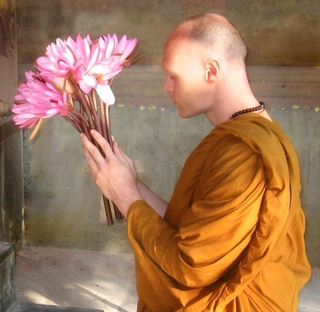
And the mind doesn't seem to get above the kind of I've been painting a lot of lotuses lately.
So and then one analogy could be the lotus trying to blossom above the water.
It's like the lotus doesn't quite get above the water and it doesn't quite fully blossom,
The lotus of effort.
And it's the people who have been strict with it.
It's a more mental energy,
More mental clarity develops over a period of months and a period of years that then the mind gets more interested in more peace.
And it's like it's can see or taste or hear what deeper clarity presence of mind rapture and tranquility is and it wants more of it.
But if we keep keep trying to get the lotus above the mud,
But then we keep throwing mud on top of it.
It's,
It's not going to be able to fully blossom.
So it's true.
I'm sure it's true that a half a glass of wine with dinner is medicinal.
I have no doubt.
I also have no doubt that it's bad for mindfulness.
So it's good for the physical organism.
It's not good for your mental clarity and your process towards liberation.
If it was Lord Buddha would have said so.
And that's not what Lord Buddha said.
So maybe people can think a little bit.
Where do you want to practice more determination?
I have one good friend,
Viku friend,
Arjun Yannicko.
He's in Bodhgaya at present.
And he and I,
We,
I'd made this vow to practice 3000 hours of meditation under the Bodhi tree.
I've mentioned it many times.
And Arjun Yannicko was my,
My comrade for the last 1000 hours of that.
And that was very helpful,
Having a brotherly companion,
Somebody sitting alongside through thick and thin.
And he's back in Bodhgaya now.
And he's current for a month.
And his current determined determination,
Adhitan,
Is to do 10,
000 full length Tibetan style prostrations around the outer circumambulation route around the chedi.
So it's about 200 bows per round.
And he has to do three rounds,
Two or three rounds most days to fulfill his vow.
And he did it for three days already.
He has some knee pain and today he's already caught a cold.
One of the problems of throwing yourself on the ground in India repeatedly is there are germs,
There are germs,
And one inhales them.
But very noble practice,
I rejoice in his practice.
And he's I think 42.
He's an age where he can do these things.
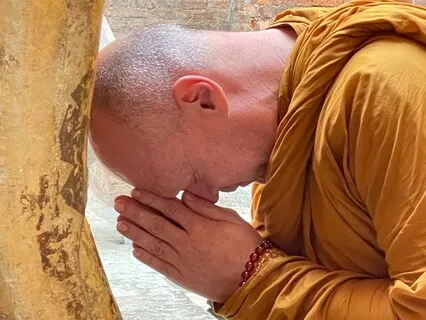
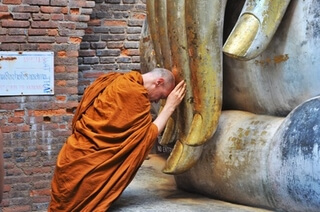
So I have done that.
I have done 10,
000 full length prostrations in Bodhgaya,
Something that I did myself about 15 years ago.
I didn't,
I didn't,
I did three of those outer routes.
I didn't do three a day.
Most of it was on a like a bowing board that the Tibetan practitioners use.
So it is an interesting when one does these kind of practices,
Remembering from my own experience,
I was actually talking with Ajahn Jnanak a little earlier today.
And he was saying on this,
It was the third day that he started to enjoy it.
This is the thing about making determinations,
Like he's on 600 bows,
He's on another 600 days.
And then it's the third day,
The final round of 300 that,
You know,
He started to enjoy it.
So sometimes we have to force ourselves to do something and do it consistently.
Before before we work out how to do it.
This is the thing about this is the thing about discipline and being consistent is we is we learn through consistency.
And we learn through making an effort.
And sometimes just making that decision that I am going to do it will will reveal kind of hidden gems that you don't know.
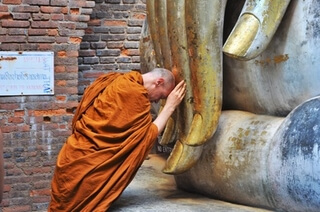
What I what I remember from my experience of doing the bows around the Mahabodhi temple was people people have the habit of spitting in that part of the world.
And a lot of people have chest infections and sinus infections.
And there's also a good number of mangy dogs around and with fleas and and also people are walking around you as you bow.
So and there's something about that,
You know,
That the part of the mind which,
Okay,
I'm not it is common sense to be aware of germs and to try to protect yourself from illness and try to maintain cleanliness and also to protect yourself from injury.
Okay,
That's all very common sense.
But I didn't notice for myself that when I just kept doing the bowing and letting go of worry,
Because the worry is one of the five hindrances.
Just doing the bowing and look,
I've made the decision I'm doing this,
I might get sick,
I might get stood on,
I might catch mange,
I might get fleas,
Whatever,
Whatever happens,
I'll deal with it.
But we are doing this.
And what I noticed was just kind of thinking of how grateful I was to the Buddha,
Again and again.
And again,
There was just this feeling of love for the Buddha,
Love for the holy site.
And I was extremely happy to throw my body on every millimeter of that holy land.
And there's something about lifting up the faith,
Why I'm doing it,
Why I'm doing it,
Letting go of the worry,
Letting go of the concerns,
The mind became very rapturous,
And contented,
And happy.
And the dust becomes sacred dust,
You know,
It's,
It all becomes sacred.
And Ajahn Samedho,
He once said to me,
Because he went around Mount Kailash in Tibet,
As he was already in his mid 60s,
He was getting on a bit already.
He said it was one of the most difficult things he ever did in his life.
Not sure if you're aware of this,
But Mount Kailash is about 5000 meters in elevation.
So there's,
There's not much oxygen there.
And it's like minus 20 at nighttime and 30 in the daytime in summer.
So and there's an occasional blizzard,
Etc.
He said the happiest people he saw in his life,
Were the Tibetans doing full length prostrations around Mount Kailash.
So there's these old people throwing themselves on these rocks and these boulders at 5000 meters,
It's hard enough just walking around,
Right?
And they're doing full length prostrations and bowing through the streams,
And covered in mud and covered in filth and their eyes shining like diamonds,
Because they're just rapturously happy with their recollection of the Buddha,
Dharma and Sangha and their aspiration to,
To become Buddhas as they practice in that lineage.
So this,
This practice of taking up,
Taking on practices,
Which are seem difficult,
But committing to them,
They,
They really do open up new vistas,
Vistas in our practice in our,
In our minds.
And so it's a good thing to experiment with,
Like how much I remember when I was building up the capacity to sit for 10 hours a day in Bok Chai,
A noisy place,
Crowded place,
I could only sit for about six,
And then I would just get irritated beyond what I could manage.
And I needed to go somewhere where there were walls around me,
Rather than constant seething masses and noise and dust.
But I just kept doing it.
And it became possible to do eight hours and then eight and a half and then nine and then 10.
And I don't,
I mean,
Some irritation,
Some irritation comes up.
But for now,
For example,
If I was,
If I was to think that I could go to Bhog Gaya tomorrow and meditate for 10 hours a day,
I would feel very happy about that.
Because I know that there are going to be periods of beautiful serenity and tranquility and rapture and lots of love and devotion and gratitude.
And,
And it came through working with the difficulties and learning how to work with the difficulties.
And one,
One teaching Ajahn Jayasaro gave,
Ajahn Jayasaro was one of my first teachers,
And he,
He didn't teach meditation methods very often.
He,
He just said people need to work it out themselves.
But one of the one of the things he did that we give people the opportunity,
And he would come and sit with us and he would,
He would remind us of pertinent and relevant dhammas,
But he wouldn't,
He didn't emphasize a method.
He said we had to experiment with what works and work it out.
But one of the things he did say was that a teacher who he had faith in,
I can't remember his name now,
But a teacher who he had faith with in when he asked him,
How do you practice?
And the teacher said,
Whenever the hindrances come at me,
If they come at me high,
I duck.
If they come at me low,
I jump.
If they come at me sideways,
I dodge.
And it's really like that.
We just,
We have to practice enough ourselves to know what are our hindrances,
How do they come at us and how do we get out of their way?
How do we not pick them up?
And so these are,
During that period of time,
When I was training myself to sit for longer sessions and a month or six weeks,
You have no choice but to work out how to massage your resistance and how to remember why you're glad to be there or how to make yourself glad to be there.
Because sometimes the mind can get so miserable.
It's like,
Okay,
Well,
Am I going to indulge this miserable mindset for the next month?
Or am I going to learn?
You set yourself up where it's like,
Okay,
Well,
I'm not going to do that.
What am I going to do?
And then it's like you create a transformative crisis in the mind.
It's like you've come to this point where you need to develop new skills or you need to develop your ability with the skills that you have,
The tools that you know,
You need to learn how to really master them,
How to really use them.
It's like an intensive workshop.
And there's a lot of benefit to it.
Because if we,
In my experience,
The more we do formal meditation practice properly,
It's not just putting in the hours,
It is making the effort to generate clarity,
Truth discerning awareness,
Cultivate the Brahma-viharas,
Develop insight,
Various contemplations,
All sorts of things we do in meditation.
But in my experience,
The more consistent we are with it,
And the more we do it,
Then the likelihood of experiencing deeper samadhi or having more profound insights,
It does increase.
There is a correlation to effort.
So I'd like to encourage you to make some determinations in your practice,
Practice a bit more,
A bit more consistently,
Learn some chants,
Or whatever it is that you develop true loving kindness for yourself as a foundation to have it for others,
Whatever it is that you,
Where you need to improve,
Set the results,
Make some effort.
And then the wonderful thing about it is when you lift the bar and you jump higher,
You become capable that becomes your new,
Your new level of what is possible.
And recently,
I've been doing an experiment,
I've talked about it a few times,
I decided to paint water paintings of lotuses,
That's my new genteel habit,
Post 50.
I want to master the water painting of lotuses.
It's a wholesome way to spend a couple of hours each day.
And,
And I have noticed I'm on my 38th lotus painting now,
And they are getting better.
And I'm not making any claims of mastery yet.
But I can see that compared to the first and second,
The 31st and 32nd,
They look nicer.
And it's a nice new,
It's a nice new skill to be developing.
I suspect that if a person is truly skilled in any craft,
It becomes possible to have distracted thoughts while doing it,
Because you,
You can,
You know it so well,
You can do it while thinking about something else.
I'm not at that stage yet.
If,
If,
If my water paintings are to turn out nice,
I have to be truly present and I can't think about much else.
So in that regard,
It's a good way to practice being present,
Being with a task,
Not sending the mind out.
I've been enjoying it so far,
Mostly.
So I hope that's something I said with regards to determination,
May have been helpful.