So some people know,
Some people perhaps don't know,
I used to live at Abhayagiri about 17 or 18 years ago and I spent a year and a half here.
My connection with Abhayagiri was of course Tanajanpasano.
So when I was an Agarika at what Nanachar,
Ajahn Jayasaro was the abbot and then Tanajanpasano had been on retreat in Chittas I believe for a year and then he came back and took over from Ajahn Jayasaro,
Picked up the abbot's duties once more and so Tanajanpasano kindly helped to train me up to ordain as a novice,
Samanera,
And took me off to ordain with Ajahn Maha Amon,
Lumpur Maha Amon.
Lumpur Pasano's final year at what Nanachar was my first year at what Nanachar.
So I had the good fortune to be his attendant and established a teacher-student mentor relationship.
That was my very good fortune.
So coming back 17 years later,
Seeing Abhayagiri as the same,
In the same place,
At the same time as a very different place.
In those days I think the community would have been about half this size and Lumpur was 18 years younger,
So was I.
It was very beautiful this last weekend to see this celebration,
Culmination of this offering of the meditation hall and the cloister complex of buildings.
And very happy to be invited and to be able to come and rejoice in all of the goodness.
I also played a small part in contributing.
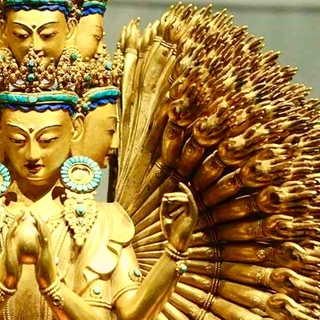
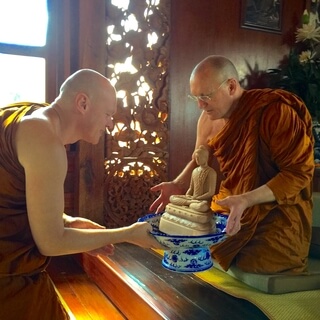
Tanajan Pasano asked me to help with the Buddha statue,
So that was my honor to help supervise the carving of the sandstone Buddha,
Which we can now enjoy in the meditation hall.
I'll talk a little bit more about that later.
This is actually the third,
This was the third attempt in Buddhism.
Sometimes we have to do things three times.
The main contemplation for me in this period of time,
Observing the changes and developments,
Is one of the results of commitment and determination and of kind of,
In a way,
Plodding,
But plodding in an unrelenting,
Unstopping,
Being determined never to go backwards manner.
As I know this Dhamma hall and complex of buildings,
The cloister buildings,
Took much longer to build than anyone thought they would.
It cost a lot more money than people thought they would and many more meetings than people would have assumed.
And yet the final result may actually also be better than what people had envisioned.
You're all noticing the beautiful,
Fresh,
Cool air that flows through the building,
Seemingly effortlessly,
And in a place that is very hot in summer,
What a wonderful refuge in terms of a physical space.
I was also considering the location,
Abhayagiri being very much a community and quite an engaged community to have this space specifically dedicated for meditation,
Chanting,
Contemplation of Dhamma,
Taking precepts.
To have this sacred space somewhere between the kitchen and the offices is a very good thing because it's a constant reminder.
It's not an ordinary place.
It's a monastery.
It's a place that exists for supporting people to train in thought and speech and action and to cultivate meditation or meditative qualities.
And so to have this sacred space in the middle of this complex is really wonderful,
Just as is having another Buddha statue that graces the hill looking down on this area.
That if everything seemed to get a bit much or we might be losing track of why we're here,
We have this beautiful reminder.
Take some space,
Establish mindful awareness,
Try to let go of the unwholesome,
Try to keep generating and establishing the wholesome.
So you have,
After 22 years of very consistent,
Diligent hard work,
You have this beautiful facility.
Similarly,
With this Buddha statue,
Thanajan Pathano saw one at Anandagiri,
The small monastery that I've been developing,
And he liked it.
And so we both thought it would be nice to have a stone image because of the simplicity and the elegance,
But also the kind of weight of stone.
It has its own weight and stillness.
It's a very beautiful medium.
And also it has a direct relationship to the ancient traditions of India,
Where the very first Buddha statues in Afghanistan and Pakistan and India were made of stone.
Unfortunately,
The first attempt,
Sometimes in Thailand,
Contractors,
Builders,
Tradespeople,
Agreements are not agreements.
So when Lampochar teaches us to see everything as maine,
Not sure,
Thailand is a great opportunity for contemplating this,
Because oftentimes agreements are not sure.
And so this artist who gave me his agreement that he would do his best work and do it himself at my request,
Had one of his subordinates make the first image and he did the finishing.
So the proportions were wrong.
And so I scolded him and I said,
No,
I meant it.
It has to be your work.
It has to be the best work because this is for one of my teachers for an important monastery and it has to be very good.
And so he did a second attempt and he did the same thing.
And then I gave up.
I said,
Okay,
I've given him two chances.
The first one we didn't have to pay for.
The second one we actually found a sponsor to offer it to a different monastery.
And in the meantime,
A period of two years,
I discovered a different sculptor who was more professional.
And so we asked him if he'd please take on this project.
And the third attempt came out quite nicely.
And I traveled up to Maesai in Chiang Rai province and supervised the finishing.
There's something that I noticed about the statue and coming in and meditating yesterday and also coming in and having a look today that I thought I'd share because I think it's relevant to our training and also to some of the habits that we have as people living in Western countries.
So if you stand one meter from this sandstone statue,
You'll notice that it appears to have blemishes,
Marks.
This looks like it could be moldy in part.
And that's just a part of the characteristic of this type of sandstone.
It has some colorings,
Some streaks.
And so you look really close,
You could find that unbeautiful,
Unpleasant.
You could be disappointed.
You think,
I want even color and tone.
But if you stand back about three meters from the very same statue,
You notice that it has a beautiful texture which announces that it's stone.
Stand back three meters and you see,
Oh,
What a lovely sandstone image.
It's the very fact of the diversity,
Some texture,
Some color that gives it that beautiful texture of sandstone.
If you stand back six meters,
What you see is a perfectly even yellowy beige sandstone image without blemishes.
So I think in our practice,
What I'm going to talk about now is the fault-finding mind,
Something that I think we all have some experience with.
And I'm going to tell a story about one life-changing experience I had with Sanatana Passana when I was a novice.
And I'll pull together a few themes here.
So I think it was about the middle of the panza,
The rainy season retreat.
I think I was a 23-year-old young man and I was Ajahn Pasanno's,
He wasn't yet Lompor,
Was Ajahn Pasanno,
Would have been about my age,
I think,
At that time.
And we knew him as Ajahn Pasanno,
Tanajahn Pasanno.
I was his attendant and Wat Nanachat had a branch monastery called Phu Chom Gom,
Which is in a national park on the border of the Mekong River in Ubon Province.
Very beautiful place.
Tanajahn Pasanno invited me as his attendant and also Tan Phun Yo,
My good friend,
To go with him for a few days to Phu Chom Gom to visit the monks from Wat Nanachat who were spending their rainy season retreat there.
And so I did that,
Happily went along with my Ajahn.
And when we got there,
I found that the bhikkhus were practicing very well.
They were very inspiring.
I recall Ajahn Chandakoh and Ajahn Suchatho wanted to discuss suttas with Ajahn Pasanno.
And Ajahn Sri Panjo,
Who was Tan Sri Panjo,
Ray Junior monk at the time,
That would have been his first pancha,
He was diligently learning to chant the Patti Mokka.
Unfortunately,
Rather than having a positive effect on my mind because I was experiencing a lot of doubts and restlessness,
And at that time,
The last thing I wanted to do was think about suttas.
And I remembered that I'd been really struggling to memorize the morning chanting.
And there was this pressure before becoming a bhikkhu at Wat Nanachat.
You have to know the morning chanting and the evening chanting and the parittas by heart,
The protection chants.
So I was trying to do my chanting,
But I was struggling.
And so I discovered that Ajahn Sri Panjo had learnt the Patti Mokka in six weeks.
The Patti Mokka is about a 40-minute chant.
And I was inspired by their applying themselves diligently.
But then I had a bad reaction to this.
I kind of thought,
My response to this was,
Whatever these guys are doing,
That's not what I'm doing.
And I had a kind of rejecting my own efforts.
I can't do this.
I'm not of this caliber,
Was the response I had.
And so Tanarjan Pasanno had just wanted to take Nobbe Sachelo for a bit of an adventure to change of atmosphere.
But I came back kind of depressed,
And this comes from comparing to other people.
And so still a vain young man.
I decided,
I think it was just a couple of weeks later,
It was just two weeks left before the end of the Haraini season retreat,
And I decided not to shave my eyebrows.
The reason I decided not to shave my eyebrows is I was going to disrobe.
And after I disrobed,
I was keen to find a new lover.
I was thinking that having.
.
.
This is how it was.
I was thinking that having nice eyebrows would be helpful.
And not having eyebrows might not be helpful.
So anyway,
I was sweeping the leaves around my lumbar's kuti.
And he said,
Somebody there Achlo,
You haven't shaved your eyebrows.
I said,
No,
I haven't shaved my eyebrows and I'm not going to.
Why not?
I said,
Because I've decided that I'm going to disrobe in two weeks.
And when I disrobe,
I want eyebrows.
It is a bit strange,
Shaving eyebrows,
It's a bit strange.
So he said,
Why?
Why have you decided this,
Achlo?
And I said,
Well,
We went to visit those monks,
Those inspiring monks.
And I just realized that I'm not doing the same thing as them.
They're reading suttas and learning the padimokha and I'm just still kind of sexually fantasizing and struggling.
And so I just kind of feel like it's been great,
But it might not be for me.
And so,
Harajan Pasano,
He asked some wise questions.
He said,
Achlo,
One year ago,
Were you having these thoughts?
I said,
Yeah,
Yeah,
I was.
And one year ago,
Not only were you having these thoughts,
You were acting on them.
Yeah,
That's right.
And he said,
So now,
And he asked me one year ago,
Did you think there was anything wrong with these thoughts?
No,
Not particularly,
My answer.
And he said,
So actually,
There's been growth and development.
You're now able to observe things that are in your mind and know that they're unwholesome.
And you have the aspiration to abandon them,
But you can't yet.
But at least you know what is wholesome and what is unwholesome.
And so he said,
That's actually development.
And he said,
So I think you're doing okay.
And you shouldn't compare yourself to these other monks,
Because sometimes it's not really about getting the form perfect.
That's part of it,
But it's not what it's really about.
What it's really about is different individuals growing,
Is their development from wherever it is that they are.
And so I heard his words and I thought,
Yeah,
It's true.
And then he said,
Achlo,
Go and shave your eyebrows.
And I said,
Cut.
And so I did.
And so it's like the fault finding mind,
It's like looking at the Buddha statue from a meter,
Isn't it?
There's marks,
There's streaks,
There's discoloration.
If you look at those and you only look at those,
It's not beautiful.
Step back a few meters and you look at a bigger picture or you look at a process.
And I think this is people who've grown up in countries like the United States,
Australia,
Canada,
Germany,
France,
All of these places.
We have a discriminating faculty and this is one of our biggest strengths and it's also one of our biggest challenges because when it's a strength,
It actually brings us to this training because we're capable of deducing that unsatisfactoriness is true.
There is definitely unsatisfactoriness.
And we're capable of sifting through various other paradigms.
Christianity might not work for us as a paradigm or Hinduism or various other things,
Yoga,
Whatever we might try.
And then we discover Buddhism makes very good sense.
And so our discriminating wisdom faculty actually and our intelligence brings us to this training.
When we get here and when we come to it,
I think so much more of our practice then is to stop judging and to try to stop discriminating.
But this is hard.
Sometimes the very habit that brought us to the training is the thing that causes a lot of pain once we start to practice.
And this is where I think the metta bhavana,
Cultivation of loving kindness is very helpful because the cultivation of loving kindness on a daily basis,
It helps us to accept things,
Lovingly accept things the way they are in ourselves and in others.
And then also the other side is when one can radiate loving kindness outwards as well.
But a huge,
I think in order to be mindful of things as the way they are,
Which is what is going to lead to insight,
Is we have to stop judging things.
We're doing that so often.
We think we know the way things are and we judge them.
And so the mind is often permeated with a kind of a critical fault-finding filter.
And when we apply this to the things outside of ourselves,
Then it's the karma of that is that we're applying it inwardly as well.
So however critical you might be at times about things outside,
The downside to that is that that very same habit will then be tearing your own efforts apart when you come to practice.
And so this can be a very painful and debilitating habit.
And it was for me as a junior monk,
So much so that I had no choice really but to become very diligent about cultivating loving kindness so that I would stop doing that.
And certainly now can see the benefits of establishing a discipline around loving kindness and that capacity to step back from things,
Metta,
Pavana,
Uncultivating,
Mudita,
All of these brahma-viharas,
Loving kindness,
Compassion,
The appreciative joy,
Empathic joy.
They make the mind more spacious.
And it's not that you don't see the faults,
But you understand that that's not all that's there.
And so Tanarjan Paschal on that occasion in the spirit of a true mentor was able to kind of peel the fingers off grasping that so tightly and to say,
Step back Achalo,
Look at the bigger picture,
Part of a process,
One step at a time,
Keep going.
And this is actually something that we need to say to ourselves,
Isn't it?
This kind of let that go,
Put that down,
Step back,
Keep going.
And you have to learn to speak to yourself with kindness and encouragement and you have to be able to rejoice.
This mudita,
Similarly with rejoicing about others good qualities,
You also have to be able to pat yourself on the back sometimes.
Speaking with one bhikkhu last night,
I won't mention his name because I don't want to embarrass him,
But he came to visit me.
He's learning the padimokha and he made a comment.
He says,
Yeah,
I'm learning the padimokha because I think it's one of the only things that I can do,
He said.
And I immediately recognized,
Oh,
Oh,
I know that.
I'm not sure about that.
So I asked that bhikkhu,
Well,
Can you do the morning chanting?
Yes.
Can you do the evening chanting?
Yes.
Can you do the protective chant?
Yes.
Can you do the funeral chant?
Yes.
Do you come and do your chores on time?
Yes.
Do you go to the meetings?
Yes.
Hmm.
Do you contribute to the work periods?
Yes.
Okay,
But the padimokha is one of the only things you're going to be able to do.
I said,
Sounds like you're doing okay.
Sounds like you can do a few things.
This kind of habit that people have of withholding kindness and not seeing goodness and belittling themselves is kind of an attitude.
This monk told me that Ajahn Pasna had told him that he had inherited,
Possibly inherited Catholic guilt from his parents.
This is something if we do have a guilt problem or a withholding loving kindness problem,
It is a problem and we do need to remedy it by practicing appreciation and kindness and learning how it's like replacement by opposite.
If we have a very pervasive habit of judging and being critical of ourselves and others,
You might not even notice how pervasive it is.
It's like the fish swimming in water.
It doesn't know what water is until it's taken out of it.
It's like putting chinks in the armor.
If you can have some genuine moments of metta,
Genuine moments of muditta,
Some appreciation,
See your own good qualities,
Then when that negative habit comes back,
You'll have a sensitized,
More spacious mind that recognizes,
Oh,
That's actually not wholesome and I don't actually have to believe that.
So this takes commitment and effort and discipline and really supports the capacity to be with the breath as it is.
If we can drop the fault finding that so often takes us away with being with the breath,
If we can,
This attitude of loving appreciation,
Actually we have to bring loving appreciation to the breathing and it's very helpful as a primer.
So I myself tend to practice metta meditation for about five to 10 minutes of every sitting and then I'll incline the awareness to just being aware of the feelings of the breath.
But I find that the metta helps to be with it with an attitude of contentment,
Less restlessness,
More wellbeing and the mind is more likely to still.
And when you get a sense for the energy of metta in the heart area,
You come to meditate and you might notice that there's some of the hindrances.
Now all of these hindrances have a feeling component in the heart area in my experience and it's always painful.
So this is part of our citta nuppasana and our vedana,
Awareness of feelings,
Awareness of mind states.
So we're doing breath meditation,
But you become aware there's feelings there,
Then there's mind states there.
And so with the metta,
You can use the energy of metta to pacify and almost like wash away.
So it's a way of pacifying the hindrances,
Gladdening the mind,
Brightening the mind.
And you don't have to get caught in the thoughts.
You don't have to get caught in the mind states.
You just notice that it hurts.
Ouch.
This is dukkha,
The first noble truth.
And then you respond to it with trying to let it go.
When you let go of the causes or craving for or craving not for or wanting to be something else.
You're accepting things as they are and you use this replacement through opposites.
The Buddha explains the brahma viharas as being extremely wholesome mind states that can be cultivated boundlessly.
So become a little bit adept at using metta to literally wash the hindrances out of your mind or pacify the pain and then probably find you can be very content to be with the breath and have quite long longer sessions because of the contentment that arises.
So I did want to say a few words about metta because I think for Westerners I think it's a challenge and I think immensely helpful.
Of course with metta if we do it too much and we don't balance our practice we can start falling in love.
And so as celibate monastics that's something we don't want to do too often.
So we balance it with other contemplations.
That's how wise contemplation,
Yoniso manisakara,
We contemplate death,
Awareness of death and impermanence and body contemplation.
The parts of the body,
The body as elements,
These are the balancing gamatanas that we practice along with breath meditation and buddhanusati,
The beautiful qualities of the Buddha and the sangha,
These ways that we brighten the mind and reestablish,
Deepen our faith and uproot the greed energies and pacify the angry hateful energies.
So these things balance.
And we're very fortunate in this tradition because we have all of these tools.
Lord Buddha gave us everything we need.
It's really incredible.
Anapanasati for calming,
Buddhanusati,
Damanusati,
Sanghanusati for deepening our faith,
Helping us feel secure,
Having a refuge,
Metta for pacifying irritation and aversion,
Body contemplation for uprooting the greed.
It's really,
We have everything we need.
It's quite amazing.
And it's simple.
I think another tremendous strength of the forest tradition is that it's simple.
It's not that complicated to understand.
The thing that's difficult is being consistent with all of our practices and making sure that we're doing them in a way which is balanced and is making our mind more balanced.
Thinking also a little bit about the results of determination and commitment,
Particularly as Ajahn Pasanno is going to be leaving this monastery soon after,
I think it's 22 years.
And he plans to come back but in a different function with a different role.
And just the incredible commitment that Lompopasanno demonstrated in helping to create,
Liaising and facilitating,
Along with Ajahn Amaro's help of course in the earlier years.
And all of the meetings,
Many of you know,
Many of you attend the meetings as well.
So you're very aware of the amount of meetings that are required to fulfill the bylaws for building in California in this day and age.
Contractors,
Architects,
Engineers,
Lawyers,
Committees,
Other monks,
There's really a lot of meetings.
So,
Ajahn Pasanno as far as I've observed has used this as part of creating a sense of community,
Which is the best thing you can do with it really.
What are you going to do about having to have lots of meetings?
Okay,
Well,
Embrace it as something that the community has to do.
And then through this establish a sense of community.
So that's very palpable when you come to a Bhai Giri,
Both in the Sangha and in the relationship with the Sangha and the laity.
It's a real sense of community.
This community knows what its duties are.
They do their duties well and they cooperate.
Everything's clean.
I had an experience during the Ngaan.
I think I put something down in the wrong place on two occasions and within five minutes it had been put in the correct place.
And I had to ask,
Where's my such and such?
But this shows that the monks have been well trained.
They've put things in their right place.
It's part of what makes a monastery look clean and well cared for.
You don't get this clutter building up everywhere.
When one makes this qualities of determination commitment are very closely linked.
So Adi Tana is one of the ten paramis in this Pali list.
And so Adi Tana is both making a determination.
So you set the determination that you're going to do something.
You want to do something.
You make that your goal.
But then you have to practice determination in doing that to fulfill it.
And so that's similar to making a commitment.
Once you make a commitment,
You have to be committed to fulfilling it.
And that's where we apply these four great efforts very closely related.
Maintaining these efforts to fulfill your commitments to meet the goal that you're determined to meet.
There's a lot of overlap with these various lists that has seen quite a remarkable,
The remarkable results of just sticking to it until it's done.
Tana Jan Paswanui said that he does feel a sense of accomplishment and it was very satisfying.
What a wonderful way for Tana Jan to be able to leave.
And both Ajahn Janika and Ajahn Kriyanidam are good friends of mine.
And they'll be taking on extra duties when Lom Poh leaves.
But he's handing over something in very good shape.
Also with a community that has trained in functioning as a community.
So I am confident that things will go well.
I'm also quite sure that there will be bumps and painful bits.
So I was going to talk a little bit about,
I can kind of see having been a junior monk and now being somewhere in the middle and also having been an abbot,
Albeit of a smaller situation,
But nonetheless has its challenges for the last seven and a half years.
I think I have some idea of what Ajahn Kriyanidam and Ajahn Janika might be going to have to practice with.
And I also have some idea of what the junior monks are going to have to practice with,
In having new abbots and with these two being new abbots.
So I thought I would say a little bit about that just as a hopefully broaden people's vision and to help you to have empathy on both sides and to continue to support each other in a process.
So my experience of becoming a new abbot was painful.
So if we understand that we all have some skills,
All of us have some skills.
When you come to have to take on a leadership role,
You will find that the skills that you have need to be developed further and quickly.
Not only that,
You'll find that the areas where you don't have skills are also areas where you need to develop skills quickly.
Also you don't get days off.
So the experience of having to further develop whatever skills you have at the same time as having to develop new skills day after day after day without any days off is exhausting.
The quality of fatigue I never could have known how tired I would feel and how hard it would be.
And so we have to add to this that everybody's like staring and very willing to mention when you don't quite meet the standard.
So you are having to learn new skills and stretch old skills in public with everybody very quick and fast to suggest ways you might do it better and why they wouldn't have done it that way.
And this isn't a pleasant process.
It is of course beneficial I believe.
So when I first was starting an undergiri,
I think within the first six months I actually came to pay respects to Tanajan Pasana and I asked for his blessing and I also asked him if he thought it was actually a good idea.
Do you think this thing I'm doing Lampur is something I should be doing?
What do you think about it?
And so at that time I was,
I'd been a monk for 14 years,
14 panthas plus novice and pikao,
So 15-16 years of training and just approaching 40 and Lampur Pasana basically said he thought it was a good thing for several reasons.
He felt that the community of Western monks in Thailand could benefit from another place that was established especially for people to deepen their meditation.
Not a training monastery as such but a place where people who've had quite a bit of training could go and then deepen their meditation practice.
And he also thought it was a very good thing that it was a long way from Bangkok because my hope to keep things fairly simple and connected in a grass roots way,
We have a chance.
There's some challenges with being a foreign monk in Thailand.
If you are close to a large city you will have many,
Many visitors.
So it's somewhat interesting to Thai people.
So being precisely in the middle of nowhere,
Petri Boon,
Khao Kor in Petri Boon,
Six hours from Bangkok and nine hours from Ubon,
I have been able to keep it fairly simple,
Fairly quiet place.
So I received Than Ajaan's blessing.
But I have another teacher,
Ajaan Anan in Thailand and he told me one day,
I was giving him a massage and he,
I think by way of warning,
He said,
Acha Lo,
You think your happiness is going to increase and increase,
Don't you?
And I'm like,
Yeah,
Maybe,
I suppose so.
And he says,
Soon you will know what hell is.
I'm like,
What?
Where'd that come from?
I'm like,
You think being an abbot,
You're going to be able to do things your way finally,
You're going to know how to do it.
And he says,
But there are going to be challenges.
And he said,
In the future,
You are going to have to patiently endure,
Acha Lo.
And I thought I'd already patiently endured.
And I said,
Well,
Why am I doing it?
Why would I do it?
If it's going to be that difficult?
The first thing he said was,
Well,
I felt like I had to tell you something because I didn't tell you,
You come back and say,
Why didn't you tell me?
Why didn't you tell me it's going to be that difficult?
So,
But he said,
I do support you in doing it and I do think you should do it,
But be prepared.
You'll have to patiently endure.
And he said,
The fact that you have been offered this land and you have some support to go ahead with this project,
That's merit.
The challenges and difficulties that you will meet,
That's your karma.
So I was warned.
And I won't go into the details of what the challenges were,
What the karma was,
But for sure there was,
I think something happens when you change your status from being someone that's living within a community to try to develop yourself and contribute to that community.
When that changes to actually leading something which will have benefit for a group of people,
You're getting involved in a lot of other people's karma in a good way,
But you have to expect,
We sometimes talk about Mara,
But we also have karma Mara,
Chilesa Mara.
So when we going to make a more strenuous effort at doing good that has wholesome and positive implications for a larger group of people,
You probably have to expect that Mara is going to visit in various ways.
So in terms of one's own limitations that we need to grow out of,
Expand our abilities,
And the worldly dhammas.
So the gain,
The offerings,
The loss,
The praise,
The blame,
The criticism,
The pleasure,
The pain,
The happiness,
The suffering.
So all of that gets amplified.
And so with that there lies the opportunity to further develop wisdom and patient endurance.
Tanajan Jandi once said,
Becoming an abbot is in his experience,
He said becoming an abbot is like suppose you're a sword,
You're the sword.
And he said so the sword is plunged into the hot coals and it's heated and heated and heated until it's flaming hot.
Then you take that out and you beat it and you beat it and someone's beating it on the edge to get that sharp edge.
And then as soon as it's almost sharp,
Plunge it back into the coals and make it flaming right again.
Take it out,
Okay,
Beat it,
Beat it,
Beat it.
He said that's his experience of being an abbot in the hot coals and then being beaten.
And so the analogy of the sword is of course wisdom.
So in the process of being heated and burned and in the process of getting beaten,
The abbot has extra opportunities to contemplate the equal nature of praise and blame and the equal nature of happiness and suffering.
It's just this much,
It arises and ceases.
And it's just having to come back to doing one's duty to repay a debt of gratitude and to help others to have the opportunity that you had.
And one of the things Tana Jampasno said to me when I came here as well was he said that it's hard,
It's a difficult path,
But what will be the final result is that things that used to affect you,
Little things that used to affect you,
You will find that they don't affect you.
Little things hardly affect you at all and that things that used to be really difficult become easier to endure because there's so much endurance involved.
And things that were hard become easy and things that may have seemed impossible become possible.
So that's the final result of surrendering to a advanced training in practicing with the eight worldly numbers.
So for the younger members of the community who might be having feelings like,
But Ajahn Kurnadham and Ajahn Yannick they're not lumpaw.
It might be worth considering that when Ajahn Pasana was first an abbot,
I think at seven panzas,
Seven or eight panzas,
At eight panzas when Ajahn Pasana was first an abbot he wasn't lumpaw either.
How many panzas you have now?
I have 44.
Yeah,
So 36 years later lumpaw is lumpaw and all of the qualities that you observe and lovingly appreciate the steadiness,
The equanimity,
The commitment,
The keeping cool and balanced response,
Well this is the result of a lot of practice.
And so this community has trained in supporting one another and functioning as a community.
And so now I ask because also Ajahn Kurnadham and Ajahn Yannick are my friends,
So I'm going to ask the junior members to try to be kind to them and understand and see them as being in a process.
And if when the challenges come these two venerables patiently endure and develop their insights further and just keep doing their duty,
You will find that in a period of years that they do have more of a sense of presence,
Dependability,
They will become lumpaw.
But you have to give them a few years and you have to understand that they will make some mistakes and they will have weaknesses and they'll have strengths and it's a process.
The other day for myself seeing lumpaw liam,
Ajahn Jayasro,
Lumpaw pasana and lumpaw virudhamo all together in one room all sitting quite close was very moving for me because Ajahn Jayasro ordained me as an anagarika,
Lumpaw pasana ordained me as a samanera and Ajahn Jayasro was my chanting acharya,
Took me to Wapapong to ordain with lumpaw liam and then Ajahn Virudhamo was the acting abbot at Amarawati when I spent six months there.
And so it's very interesting for me to be aware on one level that while I was training with these various people there were the parts of their character and the parts of their training that I appreciated and there were the parts that I really didn't like.
And go forward around 20 years what comes up for me now when I see those people is only gratitude,
There's just gratitude,
There's no feeling of fault-finding,
There's no feeling of why do they do it that way,
Why don't they do it that way,
There's just this awareness of these are the noble beings that maintained the infrastructure and the institution and kept reminding us of what we should be doing so that I could be here today and the only perception that comes up is how grateful I am to these beautiful bhikkhus and how much I love them.
And so that's also obviously a result of my practice that we don't hang on to our critical perceptions forever thank goodness and that we do develop more and more mudita and natural feelings of gratitude arise but it's not the case that none of those people had faults they all had faults they all had weaknesses but they all did their duty which is the important thing and they gave us they gave me and many others an excellent opportunity and so looking back on that and they all matured everyone's continuing to mature that's the wonderful thing about our training is if we keep at it wholesome qualities increase and wisdom increases mindfulness increases insight increases and negative qualities the greed the hatred the vanity the conceit all of these things decrease and everybody if they stick at it long enough becomes a beautiful venerable l'empore.
I'm very happy that Tanajan Pasanno after so much selfless service gets a big break I think that's a very well deserved and I also rejoice in Ajahn Kriyanidhamo and Ajahn Aniko's offering of a service the period this next period and I sympathize with the pain and the suffering that will be involved in the process on both sides for those venerables and also for the people in training at the same time I have total confidence that you are in a good situation and you know how to cooperate and if you all just do your duty that you'll continue to grow so I'm just going to talk for a few more minutes changing themes now but it's an overlap of themes for the different situation I was recently with my mother in Australia and hadn't been to Australia for two years my father passed away two years ago and so I had a opportunity to check in with my mum and she had been to Thailand 18 months ago she had a very nice visit and got to chat with her and she told me she relayed her last her experience of her last few days with my father and one of the reasons I'm going to talk about this is since I arrived a few people have come and personally thanked me for a series of guided meditations on death and dying so since I know that there are people in the community that appreciate that I'm going to just talk about this a little bit my dad had lung cancer and he smoked cigarettes a pack a day for 40 years so that's not so surprising but he had given up I think 20 years before and he was discovered that he had a unoperable tumor in his lung but he had some radiation and some chemotherapy and he was able to live another two years without without too much discomfort actually he was quite lucky it's interesting he was I think he was kind of in denial about it he's a what I would call a 50s man he was a football player and he was a boxer as well and he's tough guy tough my dad but good-hearted a good-hearted man and so he would never mention the cancer word he would say took sometimes refer to that that thing in my lung but he wouldn't mention cancer and so I used to feel a bit frustrated about this because I used to think that he should be more truthful about it what it is and where it's taking him and he should be preparing and so I you know that's what we do we practice being truthful and really having a good look at things and not denying it but my dad no it's not gonna talk about that but in hindsight it is curious that seemed to have served him because he wasn't depressed and he wasn't negative he was just determined to fight it in a way which is there's a bit of delusion there but it didn't allow him to become depressed or negative or resentful or ask why me he just got on with it so how that manifested was my dad was eating normally and going to the bathroom himself with a stage four cancer until six days before he died because he just wasn't gonna let it beat him then when he had to go to hospice they were very fortunate also turns out my mother's neighbor was the the senior nurse in palliative care in their city so when the time came that he needed palliative care she got him his own room just ten minutes walk from where my mum lived and so he went into care and so my younger brother was visiting him in his room so what happens is the fluids fill the lungs and the body isn't able to absorb oxygen and so they put in oxygen but basically when you get to that stage you don't have very long it's going to become a point where the lungs are full of liquid and you essentially drown in your own fluids so so he's in the bed and he can't move and he's got the tube up his nose and he says to my brother mate I don't think I'm gonna make it and it's like a few days before he died and my brother Craig's like no dad don't think you're gonna make it and but then so it was the night that he died it was two in the morning my mum was asleep in her smaller house and my dad was about to die and my mum she said she woke up as if this string was pulling her she said like almost like a fishing line or something like she was and she had to go my mother usually is a fairly fearful lady she's not the kind of person that's going to go walking around the streets on her own at night but she did she headed straight for the door and she was going to see my dad and my sister was staying with her and my sister asked my way going I'm going to see a father well I'll drive you know I want to walk well I'll come no I want to go alone she said so at two in the morning my mum she's 79 that time she was 77 walking to the hospice in pitch black at two in the morning and she went into the into my dad's the room that my dad was in and she just held his hand and it was like a few minutes later that he took his last breath and the reason I mention this now is it's also along this theme of commitment and determination so and how it works and how it affects the mind and so when my mum took her wedding vows for sickness and health through good and bad until death do us part and so she'd made a vow that she really meant and it was curious because when I was a teenager they used to fight sometimes and I used to wish they get a divorce because I didn't like the way they were speaking to each other I think if people are speaking to each other like this they shouldn't be together anymore but my opinion about that changed when I saw that when they were older and their children because Australia's like America it's a huge country and people tend to live not necessarily where their parents are their careers and their families their choices take them away so when they both began to have health challenges they were real friends to each other and really depended upon each other to get to their appointments and to take their medicines and so I saw how they became good friends in old age once life was less stressful without six kids so but I thought that was really beautiful that she'd made that vow until death us do part so there she was asleep she woke up my husband's about to die I made a vow to be there until death so she walks through the streets and she's holding his hand and you can't get emotional you change the subject so I get emotional when I think about it because very beautiful isn't it and so I was I was visiting my mum and she was telling me this with what was very nice to observe was a sense of accomplishment that she had because for her generation approaching 80 I'm not criticizing anyone who gets a divorce so like I said I used to wish they would get one but the fact that they didn't and what they cultivated in that relationship was a commitment patience capacity to forgive and not giving up on each other commitment and determination and then fulfilling a vow my mum she was telling me over the kitchen table she feels good that she was a good wife and that she did her duty to the last moment as a sense of dignity and a sense of accomplishment that she has about that as well as having raised six children but it is an interesting example of the way commitment and determination leaves very deep imprints in the mind that will have very particular results so obviously in this training very good to have commitment and commitment and determination so for the monks what Nana chart used to have this standard probably still does that you can try out being a novice but if you want to be a bhikkhu you have to make the vow to do it for five years and so I considered myself fortunate that nobody actually asked me at the end of my novice period are you committed for five years because I couldn't have said yes I would well can I just try for six months so nobody asked me and the way I had to approach determination and commitment being a very sensitive and emotional young man one of the reasons I jump person who called me achalo which means unshakable is that I was often shaking and he suggested that that was something to aspire to unshakability I could commit to one panza and in that first year I would say five days out of seven I wanted to disrobe as a as a 23 year old living in Thailand and then people often ask well why why didn't you and it's because of the other two days I was experiencing a quality of contentment and lack of remorse lack of anxiety that I knew I would not if I wasn't a monk I knew I would have no way as a lay person of experiencing that quality of blamelessness and contentment so I was willing to put up with it then when I got to the end of the first panza I determined okay one more panza and maybe it was four days out of seven that I wanted to disrobe but then after three pances I determined two more years I can do two more years I've got to three I can do two more years I've got to five pances and fulfill that commitment and maybe two days out of a week I wanted to disrobe when I finally got to five pances that's after about seven years of training I was able to increase my commitment to another five years and when I got to ten years I was able to increase my commitment to another ten and I won't tell you what my latest commitment is but but what's interesting is our capacity to make a commitment and keep it increases when we make the commitment to the degree that we can fulfill now our capacity to make a deeper commitment of doing something harder for longer gets developed but the commitment is important because I there's no way I would have survived the the first six months had I not had a commitment to make until at least the end of the rainy season retreat and then there's no way I would have survived the next year had I not made a commitment to staying for that year come hell or high water a very interesting thing happened at during my tenth panza which I which is related for whatever reason I was not thinking of disrobing but I just had no energy for practice it was a very strange rainy season retreat I just there was no energy there was no rapture there was no joy and it was the last day of panza and something kind of clicked in my mind are you going to continue the training and that's when I remembered that at the end of my fifth punta I'd made a determination that I would stay until the end of my tenth punta and so what was occurring in my mind was that there was an expiry date coming up and the energy was fizzling out because I didn't have a clear intention to continue and so I I wished I remembered that determination and I wished I'd been aware of the way it was affecting me at the beginning of the tenth panza because I would have determined more and I probably would have had a better a better rainy season retreat and so the question comes are you going to continue I was like well of course and so I determined another ten years actually I I was invited to go to India and I was I remade I made another vow in Bodh Gaya that I would continue for another ten years as a bhikkhu and then sure enough good energy came back so I think having determination and having a firm commitment definitely is conducive to the arousal of the energy that you need to fulfill that vow and so I don't know what people's determinations or commitments are but I just wanted to share that in my experience committing deeply and then making the effort to fulfill that commitment and then committing further when you can but being really clear you have commitment and you have determination so for laypeople that might be around how many times a week that you will meditate or how many times a day that you will meditate there might need to be some clear decisions and it probably needs to be unnegotiable so if you have a very busy life or you have periods where you're busy it might only be possible four times a week but if you're not so busy it might be good to make a commitment to every day or a couple of times a day I sometimes train my semi-retired Chinese Malaysian students I tell them that I hope that they will be able to do three sessions a day because if you want to be mindful throughout the day of your mind states and if you want to be able to let go of the unwholesome you are going to need good mental clarity and energy a certain amount of collectiveness to do that so in my experience meditating every morning every afternoon and every evening every day is what makes that possible and I often meet people who come and talk to me who've been practicing for 10 years or 15 years and they say I don't know if the methods wrong or I don't know if I'm doing it wrong or maybe I need a new method I've been practicing for 10 years or 15 years and I just don't feel like I'm getting very good results and I ask them well how long do you meditate and they say well half an hour or 45 minutes and I'm like well it's not for the kind of results you want the effort that you're putting in isn't yet enough and so if you can put forth more effort and you'll probably find that you'll get better results so it's an important thing to consider how much time do we spend with distraction or discursive activity and how much time do we really have and how do we use that time and then make some kind of resolutions and stick to them and just like your teacher O Lumpopasana has done so well and so publicly for all of you to see when he makes a commitment he follows through until a culmination and puts up with any number of difficulties in the process and just as I did I made it through my novice year my navaki years and I'm still here so thank you for taking good care of me and welcoming me it's very nice to come to another monastery as a senior monk I've been able to do as much meditation as I like in the morning and just come down to the meal no chores meeting though and enjoying these beautiful endless blue skies northern California and summer so I've enjoyed my stay and nice to get to know some more members of the community and I wholeheartedly wish you success and growth in this next interesting phase in your community's experience and the last thing I'll say just to bring it back to this hopefully central message is O Lumpopasana has been a very important part of your refuge and still is even when he goes away whatever memories you have of his teachings if you listen to his teachings if you read his books you continue to be part of your refuge of Sangha and your lumpo but the Buddha and the Kripa Ajahn's they're teaching us where the real refuge is and so the real refuge has to be inside your teacher going away for a year is I believe a very good opportunity and a creative challenge that you have now is I okay now you have to recollect what he taught you only have to try to do it whatever mindfulness you can have whatever concentration you can have whatever wisdom you can have whatever seal or whatever virtue that you maintain that that is then there in your heart well that's part of your refuge and that's the refuge that we're all cultivating and our teachers remind us what we need to do and our teachers can encourage us when we're struggling and our teachers can admonish us when we're being stubborn but the real refuge and the real place where you realize that the Dharma is a refuge the Dharma is being meaning truth the deeper truth of the way things are that has to be realized and experienced developed cultivated in in your mind in your heart and so Tanajan Pasanno Lumpopasanno going away for a year is your opportunity to deepen that refuge in your own mind and sometimes pain is growing pain and so I certainly hope that whatever pain that occurs in the process is a pain wet which is conducive to growth in having a deeper sense of refuge in your own hearts so I offer that as my reflection on that.