Just interested to know,
Did anybody find it easier to be mindful of the breath after loving kindness?
Very good.
The last three days I was attending His Holiness the Dalai Lama's commentary on a text by a Nalanda scholar called Shantideva.
Very profound philosophies that developed there.
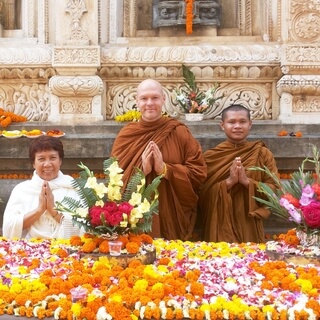
So for Theravardhan's Nalanda is a place where Venerable Sariputta was born.
It's an interesting fact for Theravardhan's to know.
And it's also the place where he passed away into final nibbana.
It was the home of his mother.
His mother had no faith in him until that final week of his birth.
The reason he went home,
He was reviewing his whole life as the chief disciple of the Buddha,
Having led thousands,
Possibly millions of beings to the shores of enlightenment.
He would realize that he didn't have very long to live and that his mother still had no faith.
So he walked back home to Nalanda and taught his mom.
She did develop right view before he passed away.
So Nalanda was also a place where they burnt the body of Sariputta and it's believed that that stupa contained Venerable Sariputta's relics.
So the site of that stupa later became what would have been a monastery for some time,
Some centuries and later became a monastic university for about a thousand years I think.
I think at its height Nalanda University had about 10,
000 monks in residence.
It was an interesting place because I think 300 years after the Buddha there were 18 different Theravada schools already and several different Mahayana traditions.
At Nalanda they were living and practicing together,
Apparently in harmony,
Which is nice,
Having some lively debate and occasionally attending each other's ceremonies and teachings.
So in the Theravada we contemplate Anicca,
Dukkha and Anatta very often.
It's that central core teaching reflection.
My teachers recommend and give the advice that as long as we're contemplating these three themes it's correct practice,
There will be a growth in wisdom and predominantly in the forest tradition we contemplate these things within our own body.
So that can be even with the in and out breath we notice the impermanence of the breath and with feelings we notice that they're born,
They stay for some time,
They cease.
And then in noticing this impermanence we contemplate,
Is it a self?
And at first we're using this level of contemplation and if we sincerely also we look at the parts of the body,
We try to investigate is there a self,
For example in the eyes or in the tongue,
In the ears,
In the nose,
Where is the self?
Is it in the bones?
So when we contemplate Anicca impermanent within our own body we do,
We do begin to see yes it is,
It's all changing,
It's all moving,
None of it stays still even for a second.
And then we try to find a self in that and we can get some working understanding of the fact that although I often feel like I'm a self and although it all feels very solid,
When I do a little bit of investigation,
Not very much investigation,
Just a little bit,
I can soon discover that there actually isn't one there.
It's what we would call a mental fabrication,
Something that we're adding on to experience.
This of course is normal,
There's six billion of us doing it on this planet at the moment.
So it's a deep habit,
A pervasive deep habit that we all have.
Probably animals as well also perceive themselves as solid separate entities.
They probably don't think as much as we do but probably think themselves in a manner.
Now this philosophy of shunyata,
Emptiness that developed in Landa it seems,
Although the Mahayana's would say that the Buddha taught it and I don't want to even discuss whether he did or he didn't.
I'm just going to say that there is a lot of wisdom in this teaching and in this philosophy and sometimes it's helpful to contemplate things from a different angle.
So that's why I attend the Dalai Lama's teachings,
It's just interesting to give the mind some exercise,
Listen to how this great scholar,
Who is also a good monk I believe,
Dalai Lama gets up at 3.
30 in the morning every day and meditates for hours,
Even with his grueling schedule he does do that.
It's very impressive.
He's studied and remembers many texts.
So in the teaching of shunyata,
Emptiness,
That seems to be placing more of an emphasis on noticing all phenomena that appears to one externally as well as internally.
So in our Theravada practice as far as I understand,
One tries to restrain one's mindfulness within the parameters of the body,
Develops one's insight there.
And then when one has a working,
A deeper understanding of impermanence of not-self,
Then we begin to see the things outside of ourselves also as having that nature.
That's a kind of a natural progression of that.
But in that Vajrayana tradition they're training people to contemplate the things out of themselves as having an empty nature.
And this is working in the same way but from a different angle.
So why would you want to see things as empty?
They're talking about training oneself to see things as being like a mirage or like a dream,
Although they appear solid that we understand that their very nature is empty.
And so one of the phrases that the Dalai Lama used,
He said that everything that is,
Is subject to disintegration.
And everything that is has been born from things which have disintegrated.
And I thought,
Oh,
That's interesting.
In the Pali tradition we say similar things,
All that has the nature to arise has the nature to cease.
But we're adding something else there,
That sense of actually everything that is,
Is also born from other things.
Precisely because of that,
It has no inherent solidity.
So it's like,
For example,
The glass came from sand.
The sand were rocks.
Before it was sand,
Rocks that got ground down.
And you can just contemplate things like that.
And you understand that this vase can only possibly be a vase for a short period of time.
It has to change.
And if one,
They're talking about analytical meditation,
We understand that if one contemplates that enough,
When one looks at the vase,
One won't even perceive it as solid.
One will perceive it as appearing as a vase for a period of time.
Similarly with the flowers,
Coming from seeds,
Growing,
Changing,
Even from morning to afternoon,
Some change there.
And shriveling up,
Going back to earth element,
Water element evaporating,
Basically not a solid thing.
That stay as a flower and nothing in the world could make it stay as a flower.
I suppose you could plastinate it and it would stay looking like a flower for a period of time.
But even if it was plastinated at a certain point,
It would have to change.
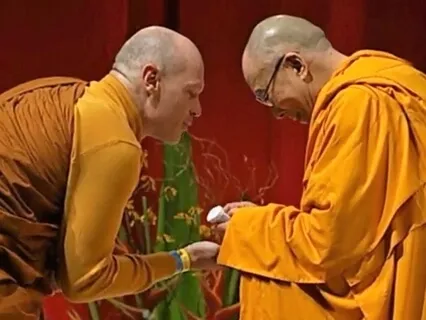
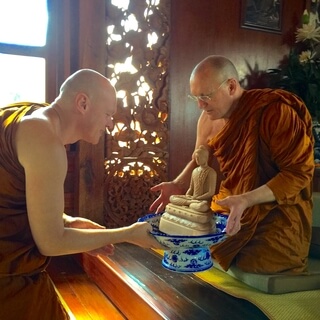
One of the things I recently gave,
I was able to give the Dalai Lama a small Buddha made from amber.
And amber is 300 million year old pine tree sap.
So that was interesting.
I like to look at that Buddha and I think,
Okay,
So that's a pretty old thing,
300 million years old.
But then you could ask yourself,
Okay,
Is this going to last forever?
And one of the good questions you ask yourself is,
Where's the pine tree?
It's like,
The pine tree is long gone.
It's a sap from a pine tree.
But where's the pine tree?
Well,
The pine tree is under the Baltic Sea.
Well,
It was.
And then the amber got washed up on the shore.
So even amber,
Which can last 300 million years under certain circumstances,
Is going to have the day.
The thing about amber is if you hold a flame to it,
It turns into a beautiful smelling sweet smoke.
They make incense out of it.
It's not very solid at all.
If you put it on a temperature over about 50 degrees,
It melts into a lovely golden puddle.
It's one of the reasons I wanted to get rid of it because I didn't trust myself to take care of it.
But I also wanted to give a very nice gift,
Of course.
So emptiness.
One person asked a question to another monk.
There was a question session afterwards.
They said,
Can you please explain emptiness for dummies?
And that monk said,
Well,
I'm certainly a dummy,
So I can explain it for dummies.
And he said,
What it means is things do not appear in the way that we perceive them.
So this is just an important thing to understand.
Because this is our big problem,
Actually.
That we perceive things incorrectly.
The reason we perceive things incorrectly is because we don't perceive them correctly.
So in Pali,
We're talking about avijja and moha.
Avijja is not knowing.
So that's what we don't know the truth.
Because we don't know the truth,
We have moha,
Which is delusion.
What delusion means is that we perceive things incorrectly.
Now the problem with delusion is that when we're deluded,
We don't know we're perceiving incorrectly.
So that's that solid feeling we have.
No,
I am a self.
And you're a self.
And you shouldn't have said that.
Completely deluded,
But very real to us.
And so the sense of when one can do analytical meditation,
So that if one trains oneself to the point,
If one,
Dalai Lama was recommending making the mind peaceful,
And then not allowing oneself to stay just with peace for too long,
But actually using a collected mind to contemplate wisely and train oneself to see the empty nature of all phenomena.
So that one could get to the point that even though this room is full of beings,
That you would perceive them as being like in a dream,
Like a mirage,
Not solid.
And he actually said,
And he was talking to 4,
500 people,
That he says when he does these prayers,
May I serve all sentient beings,
He instantly thinks there is no I.
And that when he thinks of they,
He perceives them as being like a dream.
And he said,
And when you have this kind of experience,
There isn't much tension and there's a lot of ease.
And then he laughed like he usually does.
And so one got that sense of,
Yes,
There is probably some value to training to not see things as solidly as we do,
And to understand the nature of phenomena.
But most of us here are training with the Theravada.
Trainings,
Methods,
Practices,
Which I believe are just as effective.
But just because,
I was listening to that for the last three days,
So I thought I'd try to share a little bit of what was being talked about,
Because we do,
It's kind of a given,
Isn't it?
We have a habit of perceiving things as permanent,
And we have a habit of perceiving things as solid.
So when we come to our meditation cushion,
That is kind of a given,
As that's where we're at.
And so then the point of practice is to use various methods to actually,
In that tradition they would say dissolve into emptiness.
In our tradition we would say mindfully let go of delusion.
The way we do that in this tradition is practicing the four foundations of mindfulness.
So we just see thoughts as thoughts rather than get absorbed into the content.
We just see a thought about the past is just a thought.
A thought about the future is just a thought.
A thought about myself is a thought,
And a thought about another person is a thought.
By doing that,
Pulling the mind in.
So when we have these projections and these habits,
We think about other people,
Other places,
The past,
The future.
Arjun Anand,
My teacher in Thailand,
Describes this as sending the mind out.
So we can't see that we're doing that,
But from his perspective he can.
He can see that we're sending the mind out.
So when we just see a thought as a thought and come back to the breath,
We're pulling the mind in.
Similarly,
And feelings are a very good way to do this.
This is one of the reasons we practice with breath meditation,
Is that we give the mind something to attend to,
Which is in the present moment,
Which you can't speculate or proliferate about too much,
Like you can other concepts.
So this is why we use the physical breath,
You're just going to place the mind on this one experience in this moment.
And in doing that,
Just allowing the other things to drop away.
But then it is good when the mind becomes a little bit peaceful,
And I often recommend a lot of meta-practice for people living in the city,
To help make the mind peaceful.
So that whole experience that we were talking about,
Of perceiving oneself as solid and perceiving the world as solid,
It is a painful experience.
Because it'll never go how we want it to,
Once we're that solid being.
Whatever plan we have will very rarely go the way we plan it.
And at work there's all sorts of frustrations and at home,
And just with the whole realm of sickness and disease,
Separation from the loved,
Association with the disliked,
There's just a lot of stuff that happens in life which is difficult,
When you think of yourself like we do.
So when you come to the cushion there's usually a bit of pain underneath,
That's normal too.
So it's good to offer that a sense of kindness.
We can use loving kindness as a summer to practice.
Offer that kindness,
Calm the mind,
Then try to be with the breath.
Most people will find that the mind will become peaceful sometimes.
Some people more often than others,
But for many people it will become peaceful for 5 minutes or 10 minutes.
And then it will move,
And that's normal too.
Because we've let it be busy for a very long time so it won't stay still for very long.
When we do these 10 day retreats,
We might experience longer periods of peacefulness which are very nice.
But we kind of have to do that,
We have to live in more simplified circumstances for the mind to really settle.
But one thing we can do is when the mind moves from that peacefulness is then to use that thinking mind before it starts to think about tomorrow,
Or whatever it's going to think about,
The email it needs to write or check or whatever,
Investigate the body.
So this is very stressed in the Theravada tradition,
Investigate the body.
Just go through with an interest.
You don't have to have an attitude of going to kill,
Delusion or fight anything or even to get enlightened.
You just bring an attitude of paying attention with a mind which has more clarity and just have a look at the body and what is it.
So this is a way of placing mindfulness again in the present moment in the experience in this body now.
I just think,
Usually they say look at the hair of the head,
Hair on other parts of the body,
Nails,
Teeth and skin,
That's the beginning of body contemplation.
And the reason that's the beginning is because it's easy,
We're familiar with these things,
We see them all the time.
We see them in the mirror,
We see them when you look at your hand.
It's also all earth element as well.
When we investigate in this way,
It's kind of sending the mindfulness,
Okay,
What is hair,
What is hair?
Just be interested.
And you get a sense for the dryness of it.
Contemplate the fact that it's earth element.
And then we ask ourselves,
Is this self that I habitually perceive,
Is it in the hair?
And so you ask that sincerely.
It sounds like a bit of a stupid question,
But it's a very important question.
Because we do perceive this conglomeration of things as a self.
We do.
And we understand that that's a cause of a lot of suffering.
So we want to bring a sincere interest in,
Okay,
Where is this phantom self?
Where is it?
And is it in the hair?
And we ask that sincerely and we just pay attention and we basically get the response no.
And then okay,
Hair on the other parts of my body,
Hair on my legs,
Under my arms.
Is myself there?
Once again,
No.
And nails,
Those fingernails.
Nails are good because they're very clearly earth element,
Isn't it?
You have to get the nail clippers out.
Click,
Click,
Click.
And it's hard.
It makes a clicking noise.
So it's like it's growing out of this flesh,
This blood,
But it's hard.
Probably slightly more difficult to contemplate if you put resin on top of it and paint it.
But even resin is earth element,
I suppose.
Contemplate the nails underneath the nails.
What are they?
And it's earth element.
And then teeth.
You can even go,
What's that?
They're like little stones,
Aren't they?
Little pebbles.
So is there a self there?
You just got to ask that sincerely.
Nope.
And then skin.
Is there a self in this skin?
So we're very concerned about skin,
Aren't we?
We don't like it when it gets wrinkly.
We don't like it when it has too many fat cells underneath it.
It looks bigger than we want it to.
But we have a look.
Is there a self there?
Is there a self in the skin?
No,
There isn't.
And we do this,
Hopefully,
When we do this sincerely,
There'll just be a sense in the mind of letting go of something.
And what we're letting go of is a delusion,
A habitual delusion.
And when we let go of it,
There is actually a temporary sense of a kind of a small liberation from something which is oppressive.
This is why we recommend doing it.
Even if you just get these few minutes of not perceiving it as a self,
It's a relief.
I say,
Oh God,
I don't have to take this thing personally when it's sick,
When it's getting old,
When it's turning pear-shaped.
It's not me.
It's just a body.
And then sometimes you find that when you investigate the nature of the body,
That it'll go back to the breath.
The mindfulness wants to rest with the breath and you might very well have another peaceful 10 minutes,
Sometimes 20 minutes,
Maybe half an hour,
If we really investigate the nature of the body sincerely.
And we find that there's no self there and there's a sense of letting go of something,
A type of delusion.
There's a sense of clarity,
A sense of space and a sense of peace.
And the mind needs to pick up something,
So it picks up mindfulness with a breath and it just stays with that.
When you don't pick up a sense of the self,
Then you don't pick up a world.
And it's very nice for that period of time.
Ajahn Chah would just encourage the monks when they were sweeping the leaves to notice the leaves falling from the trees.
It's a little bit easier when you're a monk living in a forest monastery.
It's a little less complication,
Less buildings,
Less people,
Less concepts.
But every day these leaves fall and go and sweep them.
Ajahn Samedho tells the story of getting irritated with having to sweep these leaves that were always there every new day.
And then there's also a good opportunity to investigate suffering.
Ajahn Chah came up to him and said,
Where's the suffering Samedho?
Is it in the leaves?
Is it in the broom?
It's obviously it's in his mind.
And Ajahn Chah would say,
You know,
If you don't pick it up,
It isn't heavy.
There's a sense that we can put down the mind's reactions.
This takes training.
Is that enough?
Give people the opportunity to ask any questions if they like.
Don't ask me too much about emptiness.
This is in relation to the weekend.
Nidhul Avalanda talked about the negative consequences of meditating with a dull mind.
I was wondering if you had any comment on that,
The idea that if you meditate for long periods of time with the wrong state of mind that you actually deteriorate the sharpness in your mind.
I think the particular thing Dharmam was talking about on that occasion was an attachment to deep peacefulness,
Which I just don't think is the challenge that most people have.
That was the perception I had of like thoughtlessness meditation.
So that's a meditation where there's no thought activity anymore.
That was the word he used.
That's about subtle dullness.
So that would be bhavanga in the Tibetan tradition,
In the Theravadan tradition,
Sorry.
So like a sleep-like state.
It's interesting because in the Thai forest tradition they say that state's better than thinking a lot.
So different traditions have their own kind of thing that Ajahn Tate would talk about that.
He called it tree stump samadhi.
He said nothing good could grow from it.
But it's better than just sitting there and thinking.
But what the Dalai Lama is saying,
It's better than sitting there being a tree stump.
It's better that you think wisely.
Many people do experience this bhavanga citta.
It's called,
There's a sense of sometimes the mind is tired.
It has a nanosecond of peacefulness and falls into sleep.
So that is something that many meditators have to work with.
Part of the problem is the fact that it's tired.
Modern people,
The mind is tired so it wants to sleep.
Sometimes I recommend breaking up meditations or you stop and stop and stop.
Same in the Thai forest tradition.
You would walk and sit and you would break up.
You'd have different sessions.
You would chant.
There were periods where you were memorizing chanting.
There were periods when you'd walk.
There were periods when you'd sit.
The other thing Ajahn Chah would do,
He would make sure that you have to be at certain places at certain times so you can't just vague out.
You have to come and cooperate with other.
And then necessarily the kind of contact that that would bring,
Contact with other human beings gives you something to work with because there's always the ones you like and the ones you don't and that whole kind of thing helps to keep.
So he established a kind of a structure.
I tend to think that part of the difficulty is actually knowing you're in subtle darkness.
How would you recommend identifying it in your own mind?
The thing about a mind which is collected will have a pronounced sense of clarity.
So if there's no thoughts but if there's a nice feeling of clarity of being more awake than normal,
That's not a problem because that sense of clarity when you come back will hopefully notice the characteristics of things with more clarity.
But if there's just a feeling of less thoughts but not much energy,
Then it's.
.
.
The thing a peaceful mind has energy.
You can look at those factors of Jhana.
It's like a pity and sukkha.
There'll be some rapture.
Kind of a quality of rapture or a quality of sukkha,
At the very least tranquility.
The tranquility is a deep calm peacefulness.
It's a feeling so that if the mind is peaceful that will be in the mind,
A pronounced feeling of calm.
So if it's not a pronounced feeling,
A heightened feeling of calm,
If it is low energy and dull,
Then it's probably.
.
.
It's not samadhi.
Sometimes you just have to stay with that dullness and being determined to know it as well and what can happen is clarity can start.
You have to bring a quality of determination to it before you see it.
It's like,
Okay,
If the mind gets dull,
I'm really going to at that point.
.
.
The mind follows its kind of directives and we're trying to train it like that.
You have to say,
When I get to that point when it's a bit dull,
I'm going to really be determined to be aware of that.
And then that dullness can fall away and the clarity can be there rather than just kind of get up and not.
.
.
We have to go past that as well.
But the other thing is,
And my teachers recommended and the Dalai Lama was recommending it,
It's like use your human intelligence to contemplate things which will give.
.
.
Which will develop wisdom.
When you contemplate in our tradition,
Anicca,
Dukkha and Anatta,
When you really see that clearly,
Like I was saying,
There's a sense of putting something down and in its place is a sense of clarity,
A clear awareness that just knows things as they are,
An awareness that knows the truth.
That's a very spacious,
Clear experience.
My teacher Ajahn Anand was saying,
If the mind becomes peaceful through investigation,
Leave it in that peacefulness for as long as possible,
If it really is peaceful.
And then when it moves from that peacefulness,
Investigate again.
So it's like you do need to utilize the power of a peaceful mind to cultivate wisdom.
But when it is peaceful,
Leave it to rest in that,
Let it charge up and then use the energy coming from the peacefulness to investigate.
But obviously that requires having a certain amount of time to do that.
Still good to understand how the process works though,
When we have periods of retreat,
How to apply these different mental factors.
His Holiness gave a public talk Saturday afternoon,
There were about 10,
000 people present.
And he was talking,
For the first time I've seen him talk matter of factly about karma and about rebirth.
And it was really nice to see,
Because,
And it was very skillful.
He didn't bring up the subject of karma and rebirth himself,
But it was advertised on the talk that he would talk about karma and rebirth.
And he pretended,
It seemed to me like he almost pretended that he'd forgotten that.
He gave a talk about ethics and how governments could be more effective and how to take care of the environment and how to prevent crises and all sorts of wonderful things.
And they said,
What was I supposed to be talking about?
Oh,
Never mind.
He said,
And then he said,
Are there any questions?
And then it was interesting that it was mostly Caucasian people,
White people,
Stood up and said,
One first question if I recall was,
If someone died tragically without time for preparation,
Would it be possible for them to have had a peaceful rebirth?
So it is very interesting that this white person was talking matter of fact without questioning it as an idea,
As a sense of,
And His Holiness was talking about some of the factors which would need to be in place in order to have a peaceful rebirth.
And then the next question was another white person,
If I recall correctly,
Asked,
How do I recollect the wisdom that I cultivated in my past lives so that I can develop more wisdom in this life more quickly?
And I thought,
Yeah,
Good question.
And then His Holiness then answered,
He was basically describing the method for recollecting past lives.
Now this is in the public talk in Melbourne,
10,
000 people.
And I thought this is really cool.
And he basically said,
If you have one-pointed samadhi,
You have one-pointed concentration,
And you set a firm determination that you want to recollect your past lives,
And there's a subtle awareness that can come from having cultivated one-pointed awareness that if you set that determination,
You can remember your past lives.
And he said several things,
He said,
Also,
When you're dying,
If you set the firm determination when you're dying that you want to be able to remember this lifetime in your next life,
If you have enough clarity when you're dying to remember that.
Yeah,
I want to remember this tragic.
But anyway,
People who train,
People who really train themselves,
They do remember to do that when they're dying.
And he said,
That's also very helpful.
And he said,
There's another,
If you can train yourself to be mindful of when you're dreaming,
That you can know that you're dreaming while you're dreaming.
He said,
That's the subtle kind of awareness that can know its past lives.
And then he said,
I know several people who can recollect hundreds of past lives.
And then he said,
And I think it was once again being very skillful and very humble,
He said,
And I myself also in this state,
Somewhat between sleeping and not sleeping,
Have had some memories of past lives,
Statement,
But very difficult sometimes to remember yesterday.
So very quickly move past the fact,
But basically announced to those 10,
000 people,
I've recollected past lives,
Fact.
Now I thought that this was good,
Because I thought this was a,
I think,
My personal sense of it,
I've attended Dailama's teachings in Australia the last five years.
I tend to time my visits home to visit my family with when he's teaching,
Because I find him a very extraordinary being to observe.
And I have the good fortune of being allowed to sit on the stage.
So I was about five meters from him for most of this event.
And so I observe him getting used to his style and watching him work.
And my kind of sense was that the Buddhist audience in Australia is maturing and that he's not holding back the punches anymore.
And at the same time as being incredibly careful not to offend the Christians or not to give ammunition that there he was indoctrinating certain views,
It was the white Australians that stood up and asked about rebirth as a matter of fact.
And I thought this is really clever,
Very skillful,
Very clever.
And so I just really love to watch him at work and laughing,
Joking,
Smoothing over things,
But basically sowing a lot of wisdom in our society to those people who want to cultivate it.
And even talking about the Christian view,
Incredibly affirming,
Telling people not to change their faith,
Cultivate their faith in God.
And then saying that a lot of value can come from that.
And it can.
And I'm not going to criticize Christianity either or Hinduism or any of those religions.
But in the very same talk,
And one would really have to be paying attention,
One would notice that he says to those people who have this faith,
Don't investigate not self,
Don't investigate selflessness because I don't want your faith to be challenged.
It was a very skillful way of saying,
If you apply mindfulness and wisdom to this view,
You won't be able to hold on to it.
But said in an incredibly humble and careful and skillful way.
And then he was talking about conditionality,
All causes having conditions.
And then he also mentioned,
So myself,
I think,
After the Big Bang,
Those beings who are coming into the world,
Possibly,
Maybe,
Have some type of karma.
Also very subtle,
But basically saying that beings are propelled by karma.
They have had previous births.
There's something behind the Big Bang.
So all of that was interesting.
Karma in rebirth.
So this thing,
Isn't it,
Anicca Duka Anata,
Conventionally,
Conventionally,
There is a self.
And if we don't get enlightened,
If we don't get liberated,
That conventional self is going to turn into another self.
And this is this thing that we're also talking about,
That everything that exists has been born will disintegrate and is born from other things which have disintegrated.
So this is the same with our emotions and our perceptions and our personalities as well.
It's like everything is going to disintegrate and everything is born from things which will disintegrate.
So this is an interesting contemplation for people who like to contemplate.
This character that you have,
These habits that you have,
Are born from the people that you were.
And then they will say,
I think it's Ajahn Chah,
I've definitely heard it in Thailand,
If you want to know who you were and what you were up to in your past life,
Have a look at your mind now.
And if you want to have a sense for who you'll be in the future,
Have a look at your mind now.
There's a sense of the importance of training,
It's like when these five khandhas,
We call them,
This body,
These thoughts,
These feelings,
These perceptions disintegrate at the end of this life,
Then if we're not enlightened yet we'll be picking up another collection of khandhas,
Probably be another type of body,
Another bunch of thoughts,
A whole bunch of feelings,
Depending on the kind of karma that we've produced.
So it's very valuable isn't it,
To listen to wisdom teachings,
To investigate this self-view and consciously try to live with mindfulness,
Try to do good things,
Avoid harmful things,
Get born with the good fortune,
Hopefully,
That you currently have,
Because everyone here does have good fortune.
Having a human body,
Meeting the Buddha's teachings,
Having enough sense to come and listen to teachings,
Very good.
If we keep doing this our situation will get better and better.
Eventually we'll be able to go beyond worlds themselves and others.
But until then we can try to have a good time,
Be nice people.