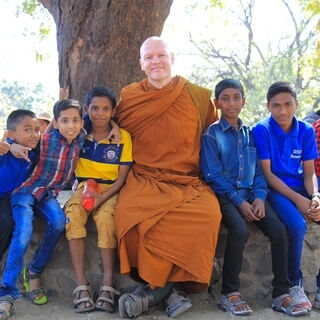
And just actually want to express my happiness to be here.
I'm very happy to be in Melbourne.
I'm very happy to have had the opportunity to encourage people and share to the extent that I can some of the things that my teachers have tried to teach me.
Some of you may have been here,
Must be 15 years ago now,
On Ajahn Anand's first trip to Australia.
And that was the first time I came to Melbourne,
Was attending to Ajahn Anand.
We came from Thailand and I remember that Ajahn Anand was sitting here and I was sitting down there,
One of five monks.
I also spent some time with Ajahn Kalyanoh a few years ago.
So I know a good number of you who were making offerings at that monastery as well.
So I think there's possibly some comic connection with the Buddhist of Melbourne.
And I'm very happy to come and encourage and share,
See my old friends.
Mostly this last week I was trying to point to methods in meditation.
How to recognize mindful awareness and how to,
In a way,
Distill or refine that awareness by training with skillful meditation objects.
And when we do this,
The things which cloud the mind,
The hindrances,
Various types of delusion,
Naturally drop away.
So just trying to point to that,
Mostly through methods,
Coming back to the breath,
Dropping the past,
Not picking up the future.
And also using metta and the practices of forgiveness as a way to clear out some of the negativities that can build up in the mind and making the mind brighter and happier so that it's more happy to settle in the present moment.
And then we've just been practicing together,
Staying in the present moment and just allowing things to drop away,
The various things that we pick up,
Training in meditation to put down thoughts about the past,
Not pick up the future,
Not send the mind out to thoughts about others and just stay within the body,
Allowing mindful awareness to become clear,
Bright,
And then seeing things more in accordance with the truth.
And when we do that,
As you've all had some experience,
There's less suffering in the mind and well-being is naturally there as a result.
That's how the Four Noble Truths work.
When we practice the path,
We recognize that which causes suffering and we are able to let it go.
So that's when we have sammasati,
Sammasamati,
Right intention,
And then we see the various things,
The way we grasp,
The things that we hold on,
The way they cause stress and pain in the mind.
And we get some practice at putting things down and then just resting in the mind's innate goodness.
And we can see that it's not really a case that it's all just suffering and then at the end you're an arahant or a buddha.
If we practice correctly,
In general,
Although the mind becomes more sensitive to this characteristic of suffering or unsatisfactoriness,
If we're practicing correctly,
We will have more and more space from that in the mind.
Because the mind that has mindfulness and concentration and right view,
Which begins to develop some insight,
Is able to separate from its mind objects,
From feelings.
You're able to see feelings as feelings.
You're able to see thoughts as thoughts.
And painful feelings are still painful feelings,
But when we can separate in the mind,
Pull back from these things,
Not identify with them as being a self and not grasp in the same way,
There's actually much less suffering.
So in this path it's a gradual training,
But in general,
A well-being,
Contentment,
Peace,
Deepen.
So that's the good news.
This does require a commitment to the practice.
It does require practicing consistently.
And I think this is the most difficult challenge that we all have,
Monks included.
Understanding the method isn't that difficult.
What is difficult is doing it every single day.
But this is necessary.
Because mindfulness as a quality,
If we neglect it,
If we neglect cultivating it,
Or strengthening it,
Training it,
It weakens,
It gets fuzzy.
And then when we come back to the practice,
The practice is difficult.
There's lots of thoughts and lots of dullness,
Lots of agitation.
So we really do have to stick with our practices and be consistent.
Because what happens is if you are,
You'll find that your mindfulness develops some strength and some integrity,
And the practice doesn't seem so difficult.
But if we do stop and start,
Stop and start,
Stop and start,
It all seems very difficult.
So as a gift to yourself,
You really need to try to be consistent,
Try to do your practice every single day.
And I recommend doing it in the morning because many people think they're going to meditate in the evening,
But they find they've had a busy day,
And they come to meditate and they're tired and they fall asleep.
So if you can begin the day,
Even if it's just 15 minutes or half an hour,
If you find if you begin the day by recollecting the Buddha and his teachings,
One,
You'll live a more skillful life,
But two,
You'll remember to practice and you'll remember to practice.
Being able to focus in that way,
You'll probably make decisions which help you to find more time to practice.
And if you've established the habit of practicing every single day,
15 minutes or half an hour,
When you see the benefit of that and you have that habit,
It's not so difficult to extend it.
You might find that after 15 minutes you just want to sit another 15 minutes,
Or you might find that after half an hour you want to sit another 15 minutes.
That's when we begin to experience the benefit of that sense of clarity and peace,
Not being so identified with everything.
Then you just want to stay with that.
If we do it in the mornings,
We can bring some of that quality into our life.
It makes us less reactive,
It gives us choice.
Sometimes we're about to have a reaction and we can tell ourselves,
Don't do that,
Don't say that.
Or sometimes we might be in the middle of a reaction and we can say to ourselves,
Stop.
But if we don't practice,
If we don't generate that clarity,
You'll find that the thoughts and the feelings swell up in the mind and we tend to grasp them and they tend to take us on a bit of a trip.
And it's afterwards that we think,
Oh,
I wish I hadn't done that,
I wish I hadn't said that.
So if you care for yourself,
And I hope you do,
Try to take care of your mind.
We all take very good care of our bodies,
We take care of our superannuation funds,
We take care of our cars,
Our life insurance policies,
Take care of your smartphone.
So the mind,
Which the Buddha says in the Dhammapada,
Is the forerunner.
All good things have to flow from your mind.
And I'm going to give a few examples,
A few anecdotes,
Personal stories a bit later,
Which point to this law of karma.
We really need to,
Once again,
If we care for ourselves,
We really need to be careful of the kind of karma that we make,
And we need to recognize the opportunities that we have to make good karma,
So that we utilize those opportunities because good karma ripens as good opportunities,
Supportive circumstances,
And whenever we have obstructions and difficulties,
If we've made enough good karma we find people help us through that.
So good karma is a wonderful thing,
And it's really good to embrace all of the practices which generate good karma.
That's an investment in this life,
Later in this life,
And also in your next lives.
So as I said,
Mostly I talked about the methods,
And mostly I led people in the methods,
But today I'm going to tell a few stories.
So this is a little bit more anecdotal,
Possibly a little more speculative,
But what I'm hoping is after contemplating these more personal anecdotes,
Then I want to try to point to the law of karma,
And the existence of heaven realms or other worlds,
Parallel realities,
And just as a pointer to remind us to be careful of the kind of karma that we make,
And diligent in making good karma.
So I'm just going to tell a few stories,
And I hope they're relevant.
When I was 20,
Living in Sydney,
I was working in Glebe,
I was working in a vegan cafe,
And I was working with the beautiful people,
The new agey types,
The ones that do yoga and study massage,
And I was pretty miserable actually.
And something that was really painful for me was I had this nice looking body,
Because I used to swim 2 kilometres 3 times a week,
And I used to do boxing training.
The reason I did boxing training wasn't because I wanted to hit anybody,
I just didn't want any fat on my body,
And so that was a way to get very aerobically fit.
And a lot of the customers that used to come to this vegan restaurant,
They used to think that I was a very happy person.
And I found that very painful,
Because I knew I wasn't.
So I remember being very depressed when I was in my studio apartment in Marrickville,
And I'd ride my mountain bike to work in Glebe,
And you know you'd hug everybody and smile at everybody,
And that's the practice of metta isn't it,
Being kind and being friendly,
But actually on the inside I was quite miserable.
And it was very painful that people thought I was a happy person,
But I didn't want to share my misery with people.
You know,
Here's your veggie burger,
How are you,
I'm very depressed,
I want to kill myself.
So you know you smile,
And you say,
I'm okay,
And then you go home and you feel depressed.
So I had this feeling since I was 15 actually,
Not to go to university.
I had this strong sense,
Don't go,
Don't go,
And my mum and my dad were asking,
What are you going to do?
I said,
I don't know.
And my dad wanted me to be a doctor and my mum wanted me to be a lawyer.
And I was thinking,
Well maybe,
Maybe,
But the day came when it was time to apply for university,
And I did apply for university and I was accepted,
I applied for a bachelor of behavioral sciences,
And I was accepted,
And my mum said,
Okay,
So you're going to do that,
You're going to be a psychologist.
And I'm like,
Yes,
But I'm deferring for a year.
So I deferred for that year and I just had this really strong sense,
Don't do it.
But I didn't know what I was going to do.
And so I moved to Sydney and I thought,
Well I'll study acting,
Study singing,
And I studied a bit of massage,
But I still didn't know what I was going to do.
None of those things seemed like something that I could commit to.
And I remember that my sister at that time,
She was a journalist for current affairs program.
She's quite a cynical person,
And she told me that I was the most irreverent person that she knew,
Because I just at that time in my life didn't have something to revere.
I didn't,
And so I was quite cynical in my speech and sarcastic in my speech,
And she actually enjoyed my company in those days.
Since I became a monk,
She doesn't like me as much.
But anyway,
What was interesting was the reason I was irreverent was that I had not yet found that I could truly revere.
But I remember one night coming out of the vegan cafe,
It must have been at about 11 o'clock at night,
And I was alone,
I was coming onto Glebe Point Road,
And I looked to the sky,
And in the ideal picture there'd be lots of stars,
But it's Sydney,
So there weren't any stars.
I was looking into the brown haze,
But I was looking heavenward,
And I said,
I accept it,
I admit it,
I don't know how to be happy,
And I don't know what to do with my life.
And that was after a couple of years of trying,
The massage,
The acting,
The singing,
The swimming,
The sensuality,
The movies,
The sex,
The beach,
And kind of like none of this is working.
But I made a vow,
And I think this must come from past life,
Because you know,
Why is this?
I didn't go to church,
And I wasn't allowed to go to religious education,
So I don't know where this came from.
But anyway,
I looked to this guy,
And I said,
If you give me a sign,
Because I had some kind of intuitive faith in angels,
I didn't believe in an all-powerful God,
And I wasn't sure about hell yet,
But I did have some kind of sense for heavenly beings.
I had a sense that they were benevolent beings that cared for us.
And so I looked to this guy,
And I said,
If you send me a sign,
I vow that I will follow.
And so some very interesting things started to happen.
And I think in part because,
One,
I was desperate,
And that desperation elicited a particular kind of sincerity,
So I meant it.
And so I came back to work a couple of days later,
And somebody forgot their lonely planet guide to Thailand,
And they left it on the bench.
And so I took that lonely planet guide home,
And I was reading,
And I discovered after reading that Thailand was 95% Buddhist.
I hadn't known that.
I didn't know that.
And I had done a Goenka retreat,
One of those Vipassana retreats,
A year or so before.
And since that time,
I had meditated every day.
And Mr.
Goenka said that meditation is like anything,
And if you want results from it,
You have to train,
Just like athletes train,
Or just like artists practice their skills.
If you want good results from meditation,
You have to do it every day.
So I did do that,
And I think that might be another factor in why I do think some beings interceded to try to help me.
I think the meditation,
Commitment to the meditation,
Might have been a factor.
So anyway,
The owner of the book came back,
Wanted their book back,
And I had to bring the book back.
But I didn't notice that Thailand was a 95% Buddhist country,
And that got me interested.
At that time,
At the age of 20,
I hadn't been overseas yet.
And I was thinking I should go overseas.
It might be good to go overseas.
Then a few days later,
Something else happened.
In those days,
We used to get paid in cash in an envelope once a week.
And so I was opening my wallet on payday,
And I was looking,
And I saw this coin that I'd never seen before as I was putting my pay in the wallet.
And I asked my friend,
What's this coin?
And she said,
Oh,
That's a five baht.
That's Thai money.
And when she said that,
My hairs went up on my arms,
And I had some kind of a,
Ooh,
Feeling.
And so I noticed that.
So that was the second sign in one week.
The following week,
An interesting thing happened.
I was the one that had to clean the fryer late at night.
And the fryer was Italian or German,
I think.
And the food was Japanese-inspired.
But there was this pipe that you had to attach to the other pipe to let the oil out.
It was kind of a round shape.
I'd been doing this for a year,
And I hadn't noticed something.
But as I was putting this pipe on this other pipe to filter the oil and refill it with fresh oil,
I noticed that this pipe had one word on it,
And I'd never noticed it before.
And that word was Thailand.
It didn't even say made in Thailand.
It just said Thailand,
Which is pretty weird,
Actually.
But I stood up and I said,
Okay,
I'm going to Thailand.
And I made a vow,
Within 10 weeks I will go to Thailand.
And I did.
Now,
Living in Sydney as a 20-year-old,
It was very difficult to save money,
Especially on a waiter's wage.
So I managed to save just enough money for the ticket,
And it was two weeks.
And I got my ticket,
And I got my passport,
And I got my visa,
And I had no money.
So I had to sell my bed,
My bike,
My computer.
I could sell anything I could sell.
I sold it to get some money.
But I did go.
Now,
An interesting thing happened.
Another interesting thing happened.
This must have been three or four days before I left.
A woman walked into the cafe,
And I had a feeling like I should talk to her.
And she was from Canada,
And she was a backpacker.
And she was traveling,
And she just arrived in Australia,
And she said,
Is there any work?
And I said,
Well,
There might be,
Because I'm just about to leave.
She said,
Where are you going?
I said,
Thailand.
She said,
I just came from Thailand yesterday.
She asked me,
Why are you going to Thailand?
And I said,
Well,
I'm embarrassed to say,
But this is what I said.
I said,
I hate winter,
And I like the beach.
It's coming up to winter,
So I'm going to go to the beach.
That's what I said first.
The second thing I said was,
And I'm interested in Buddhist meditation.
And she said,
I've just come from an island where there's a Buddhist meditation center with a view of the ocean.
And she wrote down the address.
She wrote down the address.
And so that was very helpful,
Because I went to that meditation center,
And I ended up spending five out of nine months there.
And it was enormously helpful to be able to.
.
.
The teachers were Westerner,
Rosemary was Australian,
And Steve was American.
They're teaching various meditation methods,
Buddhist meditation methods on an island.
They teach 10-day retreats.
And if you're an assistant there,
You would help people settle in for their retreat and clean and wash sheets and that kind of thing.
And then you would sit alternate retreats.
So I was doing that.
I was sitting retreat and then helping other people sit a retreat.
Now,
I look back on that and I recognize that I was incredibly fortunate because if it was Australia,
I think I would have found it very difficult to live in a meditation center where you had to keep the precepts and meditate twice a day.
And I have to admit that it was in part the sunsets over the sea and the Thai curries and the Thai people and the exotic location that made it possible for me to stay there as long as I did.
And it was very helpful because during that period of time,
Over that nine-month period,
I realized that what I wanted to do this lifetime was focus on meditation.
But I really needed that kind of container,
That kind of opportunity to explore meditation in an ongoing way.
And I remember when my visa was expired and I had to go to Malaysia,
I think I mentioned this the other day,
I would break a couple of the precepts because I wasn't sure yet about Sila.
I wasn't completely convinced.
I thought meditation was a very good thing,
But I wasn't sure about those five rules.
And so I'd go and break a couple and I'd come back.
And this was very helpful because I couldn't help but notice that before I went and broke the precepts,
I was actually fine.
I felt fine.
And there was some energy and I felt a bit frustrated and the mind was saying,
You just do this,
That'll be fun.
And then you go and you do it.
It wasn't too bad.
It was fairly moderate,
But it was against the precepts.
But anyway,
I would go back and I would see that my mind was much happier.
Before I did that,
I was experiencing for myself and I really had to somewhat begrudgingly admit that it really seems like Lord Buddha knows what he's talking about.
That if you keep these precepts strictly for long enough,
There's a well-being that blossoms in the mind.
And when you break them,
There's an increase in anxiety and neurotic thoughts,
Compulsive thoughts,
Obsessive thoughts,
And basically you feel less happy.
So once again,
I'd stick around,
Do more meditation and keep the precepts and the visa would expire and I'd go and I'd continue with my experiment.
And by the end of the nine months,
I really saw meditation and keeping the precepts.
I was the happiest I'd ever been.
And so that was a very good thing to see.
Part of the reason I tell that story is pointing to this law of karma.
I believe that there must have been some good supports there from a previous life,
Which I'm very grateful for now.
And so why is it that something's responding when I ask for help?
And why is it that that woman walked into that vegan cafe on Glebe Point Road on that day and wrote down that address?
Because this was before the time of the internet.
There was no way I could search that.
You needed to rely upon kind people giving you a pointer.
So I look at that and I'm very grateful to that woman.
I'm very grateful to Stephen Rosemary.
I'm very grateful to the good karma that helped me to get there.
Similarly,
When I was on that island,
I met a man who just come from the International Forest Monastery in Ubon Ratchathani.
I had no idea that such a place existed.
So once again,
I had to depend upon one kind person to tell me that there is a monastery in Thailand for English speaking people,
And you can go and train there.
And so I went and I had a look.
And I never had the thought that I could be a monk or that I would be a monk.
But I started to have a feeling that I had no choice.
And so I went there and they had this gradual training.
They had this situation where you could keep eight precepts for six months,
Ten precepts for a year,
And then you decide whether you become a monk.
So I went and I had to try.
I just thought,
Okay,
We'll try.
And so I'm very grateful to that person as well who gave me a pointer.
But yet again,
Why is that occurring?
It has to be occurring because of wholesome conditions laid in the past that someone was able to come and tell me about that monastery.
So I'm very grateful.
This is 17 years,
18 years later.
Recently,
More recently,
Again,
I just tell these stories hopefully to point to the law of karma.
I was intending to go to India for a six month period.
I think this is about four years ago.
After spending some time in Ajahn Kalyananda's monastery in Bodhihuana.
And I went to pay respects to a very senior monk.
I think he was about 103 at that time.
And reputed to be a bodhisattva practitioner.
So a lot of samadhi and a lot of metta and psychic powers.
So I was going to pay respects to him and all I was doing really was asking for his blessing for that long period in India.
So as I was paying respects to him,
I said I'm going to India and if possible if you could please spread blessings and keep me in mind,
I'd be very grateful.
And he looked at me and he said,
In five months your monastery will be ready.
Now what was very interesting about that statement was that I hadn't mentioned any monasteries and I hadn't asked any questions.
So I thought,
Oh.
And I had assumed that it would probably be in Australia,
Interestingly enough.
So anyway I went to India and I ended up coming back.
I didn't spend six months.
I spent two months and then a couple of months back in Thailand and then another two months.
But in those couple of months back in Thailand,
Someone who had practiced with me five years ago at Wat Nanachat's branch monastery on the border of Laos came and said to me,
I have a friend who owns a resort in Petchabun province.
He has a piece of land which is ideal for meditation and he doesn't use it enough and he feels it's a shame.
And he's asked me to find a monk that might be able to develop that place so that people can benefit from it.
Now what was interesting about this was it was exactly five months since the venerable monk mentioned this.
So I thought,
Okay,
Well I better have a look.
And I discussed it with Ajahn Anand and Ajahn Anand said,
Go and have a look.
I said,
Hello.
So I went and I had a look and something interesting occurred because once again I had never even thought to be an abbot in Thailand.
Honestly,
Never once as a long term proposition.
But when I was on this land,
I had a feeling in my bones,
A feeling of kind of this is the place.
I might die here.
So that was very interesting.
So again,
This points to a few things.
It points to not self.
Life often doesn't go how we plan it.
But it also points to karma,
Things ripening due to things done in the past.
And so I was assuming that that very senior monk had a perspective that I didn't and he could see that something was about to ripen.
And I'd also discussed interestingly enough just a couple of weeks before the man offered the land,
I discussed with Ajahn Anand what he thought I should do with my future.
And he had said,
You should be an abbot and you should do it in Thailand.
So he'd said that two weeks before and this Bodhisattva monk,
Lumpok Kleean,
Had said five months before,
The monastery is coming.
And that gave me the courage in a way to commit to the place because there was no water,
A very rutted road and I didn't know anybody there.
So I knew it was going to be difficult.
But we received a phenomenal amount of support very quickly.
And now I have six kutis,
We had seven monks there just two months ago.
We've built six kutis,
We have two meditation halls,
We have a meditation platform,
We even have a stupa from Nepal.
We have electricity,
We have water.
So a lot of support came very quickly.
But it's just pointing,
Isn't it?
It's pointing to karma and it's also pointing to not self.
It wasn't something that I'd planned.
It wasn't the way I'd planned it.
Even once I'd accepted it,
I expected that I'd be living with one or two monks,
Maybe three.
And within two years it was seven monks.
So again,
It's not really up to me.
You just have to work with conditions as best as you can and then things turn out differently.
I'm going to talk about another experience in India.
When I was in that two month period,
I'd spent some time in Ladakh and then I spent some time in Savati.
Something interesting happened in Ladakh and something interesting happened in Savati.
When I'd gone to Nepal on pilgrimage,
I think it was eight years ago,
We'd spent one night in a very nice hotel in Buda,
In the Kathmandu Valley,
It was the Hyatt.
Beautiful stupas in the lobby carved from stone,
Very traditional,
Beautifully carved stone stupas.
And I remember feeling that they were very beautiful because they were small and elegant but full of sacred symbols and potent meaning,
Symbolically beautiful,
But elegant,
Not too big,
Not covered with gold leaf and I really liked them.
I remember thinking it was a real shame that they were in a hotel lobby and nobody was relating to them in a way which inspired wholesome mind states.
So there we were in Ladakh and we were going to a lake,
A Himalayan lake,
To do some meditation.
My attendant and I,
We stopped at this town literally in the middle of nowhere called Chumatang,
Which is a town before you turn off to the lake.
And one man,
An American man,
Was walking back from that lake and he spent one night there and we spent one night there.
As it turned out,
He studied sculpture with the man who made those stupas in Nepal.
And he spoke fluent Nepali.
So because where I live was actually a place where there was a lot of guerrilla warfare for 10 years,
A communist insurgency and the most,
The scariest communists fled to that part of Thailand because there's a lot of valleys and a lot of jungle.
And so I did feel on some nights that there were some creepy energies around,
Probably a lot of ghosts.
I felt that it would be good to do something to brighten up the psychosphere a little bit.
So I thought maybe I should make a stupa,
A little stupa.
And so it was just fascinating that that stupa that I'd seen six years ago,
Which I really loved,
Seemingly by coincidence I met a student of the sculptor who spoke Nepali and I was able to liaise with him.
So it's been a great joy to be involved in that project.
And we were able within the first year to build a stupa and put relics in it,
Buddha relics,
Relics of Arahants in the very center of the monastery on the highest piece of land with that American man's help.
But once again a story that points to karma and not self.
It wasn't something that I arranged.
It wasn't something that I planned.
It was something that just happened.
But it must have supportive conditions.
And we all love the stupa.
It's what we circumambulate on Magga Puja,
Visakha Puja,
Asala Puja.
And it's at the highest point in the monastery.
And for me it helped me feel that the monastery was a monastery.
It's a sacred space,
A place of spiritual practice,
Has this beautiful symbol of the Buddhist enlightenment in its center.
And it was an auspicious thing.
Another thing that occurred was when we were in Sabati,
The day came to go back to Thailand.
And my friend Francois,
A French man,
Told me the morning that we were leaving,
He said,
Ajahnacharya,
We need to leave four hours early.
I'm like,
What?
He said,
Yeah,
I have this really strong feeling in my meditation that we need to leave four hours early today.
And I remember thinking,
I'm not sure if I want to leave four hours early.
I don't know.
I don't want to wait four hours in an Indian airport.
But I listened to him.
He was very speaking sincerely and he was adamant.
And I thought,
Okay,
Well,
I can't hurt.
Something very interesting happened.
On the way to the airport,
We had a flat tire three times.
And we got to the airport half an hour late,
Even with our four hours extra.
Fortunately,
The plane was one hour late,
As is often the case in India.
But isn't that interesting?
So why did he have that feeling in meditation?
What was that?
I didn't.
I was meditating too and I felt fine.
But he told me at breakfast,
Ajahnacharya,
We need to leave four hours early.
So I listened and he was right.
Actually,
We should have left four and a half hours early.
But how unlikely is it that you would get three flat tires on one 300-kilometer journey?
We came up with a theory that the boys that repair the tires are throwing tacks on the road because half a kilometer down the road is this tire repair place by the side of the road.
So I suspect that there's something going on there.
But I'm very happy that my friend had his intuition and that we did get to the airport on time.
Another story,
This one's about a little boy,
A good friend of mine,
Who died.
I met him in America.
He was Thai.
His name was Todd.
He had a condition called thalassemia,
Which is there's a problem with the bone marrow.
Bone marrow doesn't make all of the things that bone marrow is supposed to make properly,
So there's a problem with the blood cells.
And the doctors suggested to him,
Well,
They said that it was possible.
With this condition,
You have to take the iron out of.
.
.
You need blood transfusions and you need to take the iron out of the blood.
But people with this condition tend to have their lives shortened.
They don't live to a ripe old age.
So there is a procedure where you have your bone marrow extracted completely and you have the bone marrow of a donor put in.
And there's an 80% success rate but a 20% fatality rate.
And so this young boy,
I think he was 10 or 11,
He visited many monks,
Including me,
And he paid respects to those monks and he was given a decision and he knew the possibilities and he was asked to make the decision himself.
Did he want to continue with the blood transfusions and taking out the iron and all of the needles and live to maybe 40 or 50?
Or did he want to have the bone marrow transplant with the possibility of a long life,
With good health,
No more needles,
But a 20% chance of fatality?
And he said,
I want to have the transplant.
And he did.
He had the transplant.
And before he had the transplant he became a novice monk at our brunch monastery in California.
And Todd was a very sweet boy.
He was very naturally generous.
Everybody liked him.
He was a little bit hyperactive,
His teachers said,
But I felt it was more that he just had more energy than most people.
He had a lot of accumulated virtue from past lives.
That was my sense.
He was very radiant,
Very humorous,
And naturally good-hearted little boy.
Except his teachers.
And so he had the bone marrow extraction and he had the transplant and basically it didn't take.
And his immune system attacked the new bone marrow.
And he had to have what was basically a slow and painful death,
Which is a horrible story.
But the night or a couple of nights before he lost consciousness he had a dream.
And he saw Lompera Upart,
Who is a wonderful,
Very gifted senior monk in Thailand,
Also reputed to be Bodhisattva practitioner,
Lots of samadhi,
Many lives of practice behind him.
He came and then Ajahn Pasana was there,
Ajahn Anan was there,
My teacher,
I was there.
And every monk that Todd had ever paid respects to came to him in his dream and chanted the parittas for him.
And he woke up in the morning.
Get emotional,
Think about it,
My friend.
He woke up in the morning and he told his mum,
Mum,
Last night I dreamt of every monk I ever met came and chanted the parittas for me.
And his mum said,
That's really wonderful Todd.
And so not long after he died I asked Lompera Upart,
Who has gifts in Thailand,
What happened to that little boy,
And he said that he was reborn as a little angel.
And not in one of the highest heavens,
But in a heaven quite close to the human realm.
And he said that he still visits the monasteries and the monks that he knew,
And that basically he's fine.
But I just ask you to consider what was occurring in Todd's mind,
What is that?
Because obviously the monks didn't really go and chant the parittas,
But the monks were spreading loving kindness,
They were dedicating merit,
They were chanting for him.
And what I think was occurring is just the sensitivity of Todd's mind.
He was a good person,
He'd been a novice,
He had some good karma,
He had faith.
And so his mind was receptive to perceiving those blessings somehow.
And so how he perceived it was as all of the monks he'd ever met and paid respects coming and chanting for him.
And so it's just an interest,
I like to offer it out there as an example of the ways that merit and the ways that faith can support us.
And again,
I'm aware that it is speculative,
But at the same time it was enormously helpful for that little boy to have that dream the night before he died,
Or a couple of days before he died.
And I'm pretty sure that in that hospital which had hundreds of patients,
Many of them dying,
That he was the only one that dreamt of all these monks coming and chanting him and blessing him.
So it's just one of the ways I think that the faith faculty can support us and that the merit that we make can also support us.
There was another man I was visiting,
Janaki's father in hospital,
And he was dying.
And he was having visions of dark beings around him and he was feeling quite scared.
And I told him,
You should recollect the good karma that you've made,
And you should do the chanting that you've done,
And I did some chanting for him.
While I was chanting he saw light come and he felt better,
And he never saw those dark images again.
He never saw those dark beings again.
So again,
It's just an example of making merit,
Recollecting the merit,
And then recollecting the Buddha.
And it has a brightening effect on the mind,
An encouraging effect on the mind.
And he also,
As I heard,
Died quite peacefully.
Another story about karma.
I met a boy recently,
14-year-old boy in Bodhgaya.
When you go to Bodhgaya,
When you walk from your monastery or guest house or hotel to the temple grounds,
You have to pass a rich mix of samsaric phenomena.
And it's pretty amazing actually,
In just a couple of hundred meters there are lepers,
There are polio victims,
There are homeless people,
Alcoholics,
Drug addicts,
Flower sellers,
CD sellers.
And I've gone many times and I feel like I know them all.
I feel like they're part of my family.
The first time I went to India when I came back to Thailand I was depressed for two months.
But I've gone many times now and I've practiced so much loving kindness and loving acceptance of these people just as they are that now I see them and I feel like they're my friends,
And just working through their karma.
And there was one boy who struck me as being particularly intelligent and he came and he was trying to sell me CDs and I said,
Well I already have some.
And he says,
Well what about your friends?
I said,
Well my friends have some too.
And he says,
Well,
You know,
How am I supposed to make a living?
And I'm like,
Well why aren't you in school?
So I was stupid enough to ask a question.
And he said,
Well,
My father was an alcoholic and we didn't have enough money to go to school.
And so I left home at the age of 11.
He said,
I sell these CDs and when I have enough money I go home and I give money to my mum so she can put my brothers through school.
And me being a big softy I'm like,
Ouch.
Then I said,
Well how's your dad now?
And he said,
Well,
I put him through detox and he doesn't drink anymore.
And he's gone back to riding rickshaws,
Driving rickshaws.
But he doesn't quite get enough money so I'm still working to make the money to help my mum and to help my brothers.
So I was very touched by this.
And because I was there for six weeks recently he approached me as I was walking to the temple and approached me as I was walking back from the temple and I got to know him quite well.
Eventually the other monk I was with and the lay steward that I was with decided to help him out a bit.
We gave some of our fund to help his parents and to help his brothers and to get him some new clothes,
That kind of thing.
But he has a very difficult life.
Can you imagine leaving home at 11 with an alcoholic father and going to live somewhere where you don't know anybody and selling CDs to tourists?
And I asked him,
I said,
Do you have a dream?
Do you have a vision?
If I was to try to help you in some way,
What could I do that would help you in this lifetime?
And he said to me words I'll never forget.
He said,
I have no plan,
I have no dream,
I just want to leave this place.
So a very difficult life.
And for us who go as pilgrims,
Bogaia is like the best place in the world.
It's a wonderful place.
You go with faith and you go with health and you have a safe place to live and you go and you meditate and you experience rapture,
You recollect the Buddha you feel grateful.
But if you have to live there among the lepers,
The beggars,
The drug addicts and the mafia,
It's a very difficult life.
So it's really striking and there's just this sense of how did this kid land here?
And you can look at these beings and they can seem.
.
.
One of the things I used to do in the beginning was I would kid myself,
They're not really humans,
Just think of them as ghosts.
Dedicate merit to them,
Don't try to talk to them,
They're not on the same realm.
I remember another boy I met,
His name is Vikram,
He was nine.
He never used to wash,
His clothes were filthy.
We bought him a new set of clothes,
He still didn't wear them.
Partly it's because people feel more sorry for the ones that look really dirty and give more money to them.
So he didn't wear the new shirt.
But I was just looking at him and I was thinking,
We were going to Varanasi the next day and I was looking at him and thinking,
God,
He looks like he's from another planet.
And he looked at me and he said in perfect English,
I want to go to Varanasi with you.
And I was like,
He's not from another planet,
He's from this planet.
And of course he wants to go to Varanasi with us.
And it just breaks your heart.
He's got no shoes and he's filthy and he's living in this rat race.
And you just really see.
Karma,
When it's heavy enough,
Is very,
Very oppressive.
And that boy,
Actually he was sponsored to go to school by one kind person,
But he doesn't go to school and he lies to people.
This is Vikram,
Not Gautam,
The 14-year-old boy.
The 14-year-old boy seemed to have some kind of inner integrity,
Some sense for what was virtuous and what wasn't,
What was right,
What wasn't.
Vikram was much more of the ilk of he was going to take what he could get,
However he could get it.
And the thing is when you see that,
You understand it.
You understand why this kid would use his intelligence to just get what he could,
Having such a harsh life.
But you also know it's a disaster karmically.
He never shares,
He never gives,
He just asks and he lies to get what he can.
So with that paradigm things can only get worse.
So your heart breaks for these kids.
We took him for breakfast and for lunch a few times,
But bought him a new shirt.
But basically he wasn't doing anything to help himself.
And that's perfectly understandable because being born in that situation,
Where everyone is just grabbing what they can get,
It's understandable.
But it's a disaster.
I'm very concerned for his future.
This other boy,
Actually his name was Arun,
But he changed his name to Gautama because he felt it was lucky.
So Gautama is the one who put his father through detox and who takes care of his parents.
He had a certain uprightness,
A certain integrity.
And I'm just looking at this kid and thinking,
Where did he get it from?
Because he didn't get it from Bihar in the year 2013.
So it's just another kind of a contemplation.
It's like,
Well he must have come in with that.
And just as Vikram,
The lying,
Cheating kid,
Came in with something else.
But he had made obstructive karma.
And there's another thing I saw,
Which I'm just going to share with you too,
Because it illustrates an interesting point about karma.
The morning that the monk,
The other monk,
My monk friend and I and my attendant had decided that we were going to give him some money to help his family,
We told him to meet us at the Om Tibet Cafe for brekkie.
And we were walking there.
And as we were walking there,
He just sold a CD to someone.
And an Indian man had come over and said,
Don't buy those CDs.
They're very poor quality.
They're not worth it.
And Gautama had raised his hand in anger.
And that Indian man had put his hand around this little boy's neck and squeezed it very hard,
So much so that when Gautama pulled back,
He had very deep scratch marks in his neck and his eyes were just full of tears.
So I walked past at that moment.
And he was calling a friend and he was saying to his friend,
I want you to come over and kill this guy.
So this was at the age of 14.
And I was able to explain to him that if he did that,
Everything would get worse.
And I explained to him a little bit about karma.
But what was fascinating in that exchange is just think about it.
It's right when a few kind-hearted people have made the decision to try to help him that this very painful experience occurs where something comes and oppresses him.
That has to be karmic.
And you see this again in India.
I've given tiger balm.
The Indians like,
There's a brand of balm in Thailand called Monkey Holding Peach and it's got a picture of a monkey on it.
Now the Indian beggars like this because for them it's like a gift from Hanuman.
So they love to see the monkey.
So I usually get a good supply of Monkey Holding Peach balm and take it to India.
And actually many of the beggars around the holy sites in India know about Thai monks' kindness because they see you and they say,
Balm,
Balm,
Balm,
Balm,
Balm.
So occasionally I respond by giving some balm.
But anyway,
I remember giving some of this balm to a little boy.
He must have been four.
The moment I gave it to him,
Another boy came and tackled him and punched him and stole his balm from him.
And it's like,
You just see,
My intention is to relieve his suffering and give him happiness for a second.
The moment he gets it,
More suffering.
So you see this and the dogs,
The dogs don't have an owner.
The dogs just wander around and they like Westerners because they've worked out that we like dogs.
So they tend to come towards us and all the Westerners are patting them,
Which is ridiculous because they're full of parasites.
But anyway,
We can't help it.
We see a dog and we pat it and they know that.
So anyway,
This dog came and I was patting this dog and as soon as I patted this dog,
Another dog,
Right next to it,
Very jealous,
Bit his neck.
It's like it couldn't have happiness for a second.
So these are just reflections about karma.
If we make enough bad karma,
Life gets really,
Really difficult.
And even when people try to help us,
More of our bad karma ripens and we suffer more.
But if we do have enough good karma,
Enough supportive karma,
When we meet with difficulty,
People help us and people point us along our path.
So I'm just trying to relay a bunch of stories and hopefully the theme is let's get serious about recognizing our opportunities to make good karma and let's make lots of good karma.
And the other thing of course is let's be really careful not to make bad karma,
Understanding that we all have enough obstructions.
We've already made mistakes in our past lives affected by ignorance and delusion.
So don't make any more mistakes.
We have to utilize the opportunities we can to make as much good karma as we can,
To get as much help as we can along this path of dana,
Sila,
Samadhi,
Banya,
Mental cultivation and I guess I should make one more point or one more point I'd like to make.
When we work with karma,
We're aiming to go beyond karma.
So the Buddha and the Arahants have attained something which is beyond karma.
In Thai they use the phrase beyond the world,
Above the world,
North of the world.
But we have to work with karma.
The Eightfold Path is a karmic path.
You work with wholesome karma,
Skillful karma,
To attain to that which is beyond karma.
But even when people have attained it,
This is really valuable to contemplate.
Think of Mahamoghalana.
Mahamoghalana was actually beaten to death.
Now this is a very rich and wonderful example because Mahamoghalana was equal to the Buddha in psychic powers.
He was enormously powerful.
He could multiply his bodies,
He could recollect his past lives,
He could fly to heavens,
He could visit the hells.
He was a superhero in terms of his psychic power,
Equal to the Buddha.
But when these people came and beat him up and his body died,
At first he used his psychic powers to put his body back together and then they came and beat him up again.
And he reviewed his past lives and he saw that in one life,
A long,
Long time ago,
He'd killed both his parents.
And so this karma was so heavy that even as an arahant and even as a foremost disciple of the Buddha,
He couldn't escape that karma.
So this points to a very important principle.
One,
Law of karma,
The power of karma is even more powerful than psychic powers.
So we're working with a very,
Very powerful force which can be very oppressive,
Very obstructive,
So we have to be very careful.
Mahamoghalana wasn't experiencing any suffering,
Which is wonderful,
Because his mind was beyond conditions.
He wasn't grasping at them,
He wasn't perceiving them as a self.
But even with all his power,
He couldn't avoid the power of karma,
The law of karma,
It's all powerful.
So for those of us who are not yet beyond karma,
Not yet above the world,
Beyond the world,
North of the world,
We have to work with karma.
And the best thing to aspire for when you make your good karma,
Please don't wish,
May I be rich,
May I be rich.
Because people used to come and say that at Arjuna's monastery and he would say all they're wishing for is may I suffer,
May I suffer,
May I suffer.
Because rich people have suffering,
I know a few of them,
And they suffer just like we do.
And what we need to aspire to is through this act of generosity,
May I meet with opportunities to practice,
May I meet with teachings,
May I meet with good teachers,
May I meet with opportunities to practice.
And then also I'd add something else,
When I meet with those opportunities,
May I practice.
So you set the intention to have the opportunity to practice and you set the intention to practice.
Because that's the best that you can get within the karmic realm,
Within the realm of conditions,
Is conditions which support you to practice so that you can realize the unconditioned.
I hope that something I said was interesting or helpful.