Now I officially say hello.
Good morning.
Nice to see you.
So it's three years since I was last doing any teaching in Melbourne.
That seemed to go quite quickly.
Now here we are.
This morning I wanted to talk about refuge and about faith and about our training in the precepts.
And I wanted to do the ceremony of taking precepts,
Going for a refuge,
Actually as a contemplation.
I just ask how many people in the room consider themselves to be Buddhists?
Please raise your hands.
Is anybody not sure?
That's okay too?
Raise your hands.
Okay,
We've got a room full of Buddhists.
So that would mean that most of us have done these ceremonies before many times.
And it's important to have a look at what we're doing,
Why we're doing it,
How we're doing it.
You review what we're doing and we are training in doing things with mindfulness and clear comprehension.
So I like to have a fresh look at these ceremonies and contemplate them a bit because they're very beautiful actually.
And as with anything that we do habitually it can become a little bit empty.
Empty in a not such a good way.
There's the other type of emptiness,
Profound emptiness,
Blissful emptiness.
Your meditation and contemplation will help you to realize.
If you do your study,
You listen to the Masters,
We hear that if one attains to stream entry,
First stage of enlightenment,
There's no more superstitious grasping at rites and rituals.
Some modern people misunderstand this.
There's a sense of,
Sotapannas don't grasp at rituals,
Therefore stream entryists don't grasp at rituals,
Therefore the rituals aren't important.
That's not what the real practice is.
Real practice is the method.
So you have that in a way scientific bias,
You want to grasp at the method.
I think the correct way to understand it is superstitious grasping at rites and rituals,
Thinking that the rite or the ritual or the ceremony is the thing that will get you enlightened.
That's the misunderstanding that falls away.
Ceremonies on the other hand,
When practiced with mindfulness and with awareness,
Have an important function.
So even the stream enterers that I know do lots of ceremonies.
They do them mindfully.
So it's understanding how to use something as a skillful means,
As a tool,
To help you to continue to train your mind.
So we say these words,
Buddham sarinam gacchami.
I go for refuge to the Buddha.
It's interesting that we say it for the second time and a third time in that ritual.
I think there's a reason for this.
I think Lord Buddha knew that we have a tendency to rush through things and not consider what we're doing.
So even he's asking us to say it a second time,
Say the third time.
I think he wants us to think about this.
So I'm going to talk about these refuges and after I've talked about them a little bit I will ask you to repeat after me as a contemplation and as a way of engaging the ceremony,
Hopefully with a little more understanding,
A little more sincerity and enthusiasm,
Making the ceremony vibrant,
Making the ceremony something which generates energy,
Enthusiasm,
Faith,
That we can then bring to our meditation practice.
So what is Buddha?
Who's the Buddha?
So we know from our own experience that the mind is affected by greed,
By irritation,
Aversion,
Sometimes hatred.
Sometimes we don't recognize that the mind's affected by delusion because delusion dilutes us.
We are deluded and it's when we train to recognize our delusion,
Delusion can start to fall away.
But we,
Most of us as Buddhists,
Will acknowledge that there is greed,
There is aversion,
Irritation,
Hatred and there is delusion.
So Lord Buddha realized something beyond that and then he explained how other beings can accomplish that.
So having gone beyond greed,
Hatred and delusion,
Sometimes described as enlightenment,
Sometimes described as liberation,
So what did he become enlightened to?
With regards refuge of Dhamma.
Dhamma is truth,
Nature.
So it was in seeing the truth of things as they really are,
With mindfulness,
Clear comprehension,
Quite a bit of concentration,
The Buddha's mind was liberated.
So it's through seeing ultimate truth,
Deeper truth,
That the delusion fell away.
Ignorance is the reason that greed,
Hatred and delusion continue to function in our minds.
The remedy to ignorance,
Ignorance,
What does ignorance mean?
Ignorance means not knowing,
Not knowing things clearly according to their true nature.
Because we don't know,
We misperceive them,
That's delusion.
Because we misperceive things,
That's why it's possible to be greedy,
That's why it's possible to have aversion,
Irritation,
Even hatred.
When the mind has enough clarity and mindfulness,
Really sees a body as just a body,
Arising due to conditions,
Changing,
Dying.
And all of those thoughts arising due to conditions,
Changing,
Ceasing.
Seeing that it's not a self,
What is there to be greedy about?
What is there to be angry about?
Who is there to love and who is there to hate?
And so it's through seeing Dhamma,
The truth,
That Lord Buddha became Lord Buddha,
The one who knows ultimate truth.
This is not an easy accomplishment.
All of you who've been meditating for some time,
Aware that the power behind the habit is pretty awesome actually.
The various habits that we have,
The things we crave for,
The things we want,
The things we don't want.
And many times you come to meditate and you might know that various ways of thinking are diluted,
Unskillful,
But they don't necessarily go away.
Still thinking the same things or similar things.
One gets a sense that these habits have some momentum.
And this is,
If you take what Lord Buddha said literally,
Samsara has no discernible beginning,
It does have an end for the individuals who uproot their attachment to it.
Literally millions of past lives,
All of us.
It's interesting isn't it,
We first begin to consider the concept of previous lives,
Future lives,
As this limited personality with its perspective tries to imagine a few lives before and a couple of lives after.
And Lord Buddha is saying actually it's hundreds,
Thousands,
Millions of lives.
Myself I believe this.
I don't have any doubt.
Having got a bit of a whiff,
A bit of a sense for the power of my habits,
I don't doubt that they have quite a bit of momentum behind them.
Lord Buddha liberated himself from the cycle of rebirth through letting go of his attachment to bodies,
Thoughts,
Feelings,
Sights,
Sounds,
Tastes.
And then he described his experience as being an experience of unshakable peace,
An experience he usually describes it in terms of negation,
He describes it in terms of what isn't there,
There's no suffering or no experience of anything even subtly unsatisfactory.
So what that means is his experience of enlightenment was completely satisfactory,
A very satisfying experience.
So when we go for refuge to the Buddha,
There are many ways that we can contemplate that,
Many feelings,
Wholesome feelings that we can have in relationship to that.
One is awe.
Isn't it amazing that this being found a way out?
And then that same feeling of awe you can bring inwards and understand isn't it wonderful?
Lord Buddha explained that's my potential.
Lord Buddha realized ultimate nature,
His ultimate nature also which is not self.
We have to use a conventional speech.
He realized not self.
He did.
And we have that potential to realize not self and in realizing not self be liberated from the way that we grasp at all these things which is painful and experience something with no suffering at all.
So awe for the Buddha's incredible spiritual faculties that was so well honed and so sharp that he could see things according to their nature.
In doing so,
Uproot ignorance and through doing that actually destroy delusion,
Was destroyed in his mind.
The darkness of delusion was exploded out of his mind with the light of mindfulness,
Concentration and wisdom to the extent that it could never affect his mind again.
It was liberated from great hatred and delusion.
And so for myself when I think of Lord Buddha's enlightenment I feel grateful.
And gratitude is a very beautiful emotion.
So when we recognize the value of something and we feel grateful towards it,
Even love,
Love the Buddha not in a romantic way,
Not in an affectionate way,
Not in a recognizing the conventional being that put the enormous effort into realizing that potential.
For myself I really love the Buddha's effort,
The Buddha's spiritual faculties,
The Buddha's wisdom,
The Buddha's liberation.
Allow the mind to love that.
It's gonna love anything.
Love the Buddha's realization,
Love the Buddha's example,
Love the Buddha's qualities.
It's very wholesome because we all love things.
We all want to love.
It's like training ourselves to put this faculty to love somewhere where it's going to be most helpful to us.
And so myself I feel grateful towards,
I feel in awe of the Buddha's realization and I love the conventional Buddha.
And in a way also that's a way of loving your ultimate potential.
It's very important.
So it's putting something else in the habitual way that we think.
We're kind of judging,
Often judging our minds,
Judging ourselves,
Wanting it to be different.
There isn't much of a sense of blessing yourself or blessing this incredible potential that you have.
So in loving Buddha,
In loving Dhamma,
In loving Sangha,
In recognizing that your nature is Dhamma and when you realize Dhamma your liberation will be the same liberation as Buddha.
It's training yourself to appreciate and recognize something incredibly valuable,
Wonderful,
Beautiful in your own mind.
And so when you go to the Buddha for refuge you're also going for refuge to your potential.
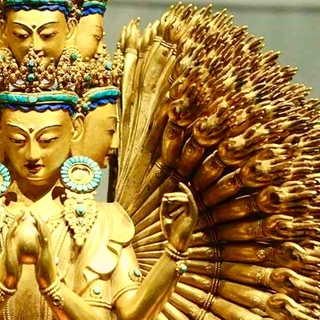
Buddha is not the statue.
And the Buddha isn't even his 84,
000 verses of Dhamma teaching.
And the Buddha wasn't his body.
And the Buddha is the being that realized ultimate truth which is above,
Beyond,
And better than all of those things.
So when you go for refuge to Buddha,
Going for refuge to your own incredible,
Extraordinary,
Beautiful potential to be enlightened and go completely beyond every type of suffering and experience unshakable peace and then also be a refuge to others.
If you realize that you'll be able to help a lot of people.
So if you don't mind,
If you repeat after me.
Buddham saranam gacchami.
I go for refuge to the Buddha.
Dhammam saranam gacchami.
I go for refuge to the Dhamma.
Sanghang saranam gacchami.
I go for refuge to the Sangha.
So I hadn't said much about the Sangha yet.
Sangha is all of those wonderful beings that realized in the Buddha's footsteps what he realized.
That's the monks and the nuns,
The laymen and the laywomen since the time of the Buddha.
Lots of devas too.
So this is yet another wonderful positive affirmation.
It's not that the Buddha was this fluke,
Only he did it because he's some kind of superhero.
Millions.
We don't know how many.
Maybe it's tens of millions,
Maybe it's hundreds of millions,
Maybe it was billions.
I don't know.
But we know it was a lot.
A lot of people realized the liberation that the Buddha realized.
And that affirms his liberation,
All of their liberation and your potential to be liberated by practicing Dhamma.
And so when we go for refuge to the Sangha,
Once again,
Just affirming that this path,
The Eightfold Path,
Practicing realizing the Four Noble Truths,
Cultivating the Eightfold Path,
Four Foundations of Mindfulness,
This liberates beings.
It's liberated millions of beings.
And as long as the beings continue to practice it,
It will continue to liberate beings.
So that a little bit more about the Dhamma,
Those practices,
The Eightfold Path.
These are descriptions of what we need to do in terms of cultivating mental faculties and developing insight.
The Dhamma is realized.
So the Dhamma isn't on one level.
The Dhamma is 84,
000 Dhamma verses,
A bookcase full of teaching.
In terms of what it really is,
All of those teachings are pointing to,
We understand that the Buddha gave these teachings to different individuals.
Some of those people were enlightened after hearing one or two verses.
It's not necessarily the case that you have to study hundreds and thousands of suttas.
We understand that the Buddha had the miracle of teaching.
He knew how to teach people in a way that they would understand.
And many of those people understood quickly because their spiritual faculties were right because of previous Dhamma practice.
So Dhamma practice is these simple lists,
The five spiritual powers,
Faith,
Energy,
Mindfulness,
Concentration and wisdom,
Lead to the deathless,
Merge in the deathless.
I love that list.
It's so simple.
And you have faith,
You stimulate your faith,
Generate your faith,
Gives rise to energy,
Appreciation,
Gratitude.
The mind is very wholesome with those qualities.
And then you apply that wholesome energy to being mindful of the object.
Being mindful of the various objects.
Collectedness arises as more stillness,
Collectedness,
Spaciousness,
Concentration.
And then you perceive things more accurately as they are.
Arising and ceasing,
Arising and ceasing.
Seeing that clearly,
Sense of self drops away.
And you experience not self.
It isn't a self.
I'm deludedly grasping at it as being a self.
But when I see it very clearly,
It's not.
And seeing it clearly,
It lets go.
The mind lets go of it.
You experience the mind without the self construct,
Self concept,
Self grasping.
So Dhamma practice is occurring in your mind.
And Dhamma realization is occurring in your mind.
And all of the teachings are pointing us there.
There's wonderful phrases in the suttas.
It's within this fathom-long body that liberation occurs.
That doesn't mean the liberation is going to occur in your bones or in your blood.
What it means is that liberation occurs within the very space that your body is.
It occurs in your mind,
In the center of your body.
So refuge in Dhamma.
Simple things.
These mental faculties that become mental powers.
Faith,
Energy,
Mindfulness,
Concentration and wisdom.
Lead to the deathless,
Merge in the deathless.
What does that mean?
That means that these five things when cultivated will liberate you completely.
Deathless means nibbana.
A state that has transcended,
Rebirthed and death.
So going for refuge to the practice,
Going to refuge to your potential.
I'm going to refuge to truth.
And so we'll do it again another two times.
Hopefully with a little more understanding.
Buddham saranam gacchami.
Go for refuge to the Buddha.
Dhammam saranam gacchami.
I go for refuge to the Dhamma.
Sangham saranam gacchami.
I go for refuge to the Sangha.
And the last time we'll do it together.
Buddham saranam gacchami.
Dhammam saranam gacchami.
Sangham saranam gacchami.
Very good.
So it's explained that a being in samsara has had to accumulate quite a vast amount of merit before meeting the Three Jewels.
In a way this is another positive affirmation because so often,
Especially modern people,
We judge our practice,
We judge our life,
We judge others.
The modern world is a lot of critical thinking in the modern world.
And it's good to become mindful of,
Be aware that there's already been a lot of practice done which was skillful.
So you don't meet teachings about how to realize your most subtle nature and your ultimate potential if you haven't been extremely generous for many many lives.
And if you haven't developed a genuine true deep loving appreciation of virtue,
Ethical conduct.
So that's already accomplished.
I like to mention to people you already accomplished millions of wholesome,
Skillful,
Generous,
Kind deeds.
And you already trained yourselves to behave morally,
Ethically,
Responsibly,
Skillfully,
Hundreds of lives,
Possibly thousands of lives.
I really believe that because you don't meet this teaching,
You don't get this path of practice,
You don't get these pointers about how to get liberated without a lot of auspicious supports.
So unfortunately if what Lord Buddha says is true,
More beings in hell and more beings as ghosts and there are human beings,
I have a terrible feeling it's true.
So with that perspective you understand that if you're deluded,
Ignorant,
You don't know how to relate to these greedy thoughts,
Angry thoughts,
And you act on them.
That's what happens.
You get frustrated.
You try to find a way out of your frustration.
If you try a bit more greed,
A bit more aggression,
A bit more anger,
You're gonna get in a lot of trouble.
But that's what most people do.
The frustration gets to a certain point and then you think okay it'll be through fulfilling a certain passion that I'll get a relief from my suffering or expressing my irritation and anger I'll get a relief from this suffering and of course it makes it all worse.
You can't see that very clearly when there's a lot of delusion in the mind.
So a lot of beings having made mistakes,
Not seeing things clearly,
Have found themselves in a much more difficult situation than the one we're in.
And so we have compassion for that but the point that I'm making here is recognizing that where you are is okay.
In fact where you are is very good in the samsaric perspective.
Because I think human beings actually have a quite a gift for feeling sorry for ourselves.
And then if you recognize that you're very fortunate,
It's a definitely a workable situation,
Then you can drop the pain of feeling sorry for yourself and stop wasting energy as well.
Waste a lot of time and energy feeling sorry for ourselves.
And here we are in Melbourne and I was told that Melbourne is the most livable city in the world so what more could you possibly want?
But I know that that could be very depressing,
Can't it?
Here you are in the most livable city in the world and you still feel frustrated and depressed and these things are always relative.
One of the ways that the devas suffer is being jealous of each other.
You think about the suffering of devas,
Different types of suffering in different realms.
So apparently they have these celestial mansions and it's a bit like keeping up with the Joneses,
Like how come his celestial mansion is more beautiful than mine?
So the devas suffer as well.
Teachings of the Buddha,
He describes this himself,
Teachings of the Buddha lead to heaven and beyond.
So we're mostly interested in the beyond.
But if you practice Dhanur and you're being generous and you keep your ethical precepts and you meditate it creates a lot of merit and then the result of having created merit is you get born in places with more pleasure,
More pleasant experience.
So practice of Dhamma will lead you to heavenly rebirth whether you want it or not.
If you do it sincerely that's where it leads but I also encourage people to set the intention especially at the time of death.
I set the intention to be reborn but you have to do it before you die.
You have to kind of put in these imprints.
People kind of get a bit,
You know,
We want to grasp,
We want a guaranteed good situation in the future.
I think it's more about having the aspiration and the clear intention rather than the details.
So I often tell people coming out of their meditation when the mind's peaceful to set the aspiration,
At the time of death may I be reborn in a place where I can practice Buddha Dhamma.
And you don't need to worry about where it is.
Just have that intention very deeply in the mind.
At the breakup of the khandhas,
The body and the mind at the moment of death,
May I be reborn where I meet the Buddha's teachings and can practice Buddha Dhamma.
That's all you need and then hopefully as you're dying,
Buddha,
Buddha,
Buddha,
The breath will stop.
You can't be mindful of the breath anymore but what you can do is you can hold Buddha,
Synonym for mindful,
Aware,
Awake,
And your refuge.
Buddha,
Buddha,
Buddha.
If you can hold on to that as you're dying and you've already set your intention,
It's a bit late then to be worrying about where you're gonna be reborn actually.
The life that you've lived before you die is what's going to affect your rebirth more.
The last thoughts are important.
Tanajana Nanavik asked him about this and he explained that two things are most important.
The level that your mind has habitually been on throughout its life.
So if you've been hanging out mostly in an animal realm,
If you haven't been strict with your precepts and you've acted on passions and irritations and compulsively,
It's very difficult to get a human rebirth.
If you've really tried to be ethical,
Maintain some virtue,
Practice some restraint,
Some patience,
Some forgiveness,
Incline the mind toward metta,
Compassion,
Then quite likely to be born as a human.
But it's this making merit and then determining in a particular way.
See the mind becomes like what it attends to and the intention with which you do things affects the result.
So many,
Many people making offerings in Thailand,
Modern-day Thailand and with the wish to be more rich.
And so that's dangerous because you can be reborn in a situation where you might well be rich but you might not have virtuous friends or ethical friends and you might use that situation to make a whole bunch of bad karma and go to hell after that.
So be very careful.
There's this noble wealth,
Arya sap,
Like you say in Thai.
Thanacharnan talks about it a lot,
That we aim to accumulate the noble wealth.
That means your faith,
Thousands and millions of moments of mindfulness,
Collectedness,
Skillful types of collectedness,
Moments and periods of time where the mind is bright and full of merit.
That's a noble wealth that can go with you.
Arjanan explains no flood,
No fire,
No storm,
No famine can take that away from you,
No war.
It can take away the merit that you've accumulated.
So that's what we need when we're dying.
We need to have accumulated quite a lot of good karma and skillful habits and then set the intention,
Especially when we take days of practice like this,
When we come out of a peaceful mind state.
Okay,
I recognize that practicing Buddhadharma is the most precious thing,
Most valuable thing.
I don't want to get more deluded.
I want to be less deluded.
So may I practice in every life until I realize liberation and at the time of death may I be reborn in a place where I can practice.
So I don't know where that is.
If this world degenerates more and more it might be a heaven realm.
There might be certain heaven realms where devas are practicing Dharma.
Or it might be another human world where there could be a teaching,
Buddha teaching right now in another world.
Buddha describes some Sarah or the universes as Ananta,
Jagawan,
Unending,
Never-ending universe.
So within that never-ending universe there are other worlds,
Other form worlds,
Other human worlds.
So the condition that gives rise to human birth is having kept five precepts.
And the condition of meeting the Buddha's teaching is having practiced Buddha's teaching.
Not necessarily under previous Buddhas.
It might be the case that in previous lives you were practicing Sīla in a different religion with a different name but you were practicing what the Buddha taught,
Being generous,
Being ethical,
Being virtuous.
And you might have practiced Samatha,
You practice calming meditation.
So practicing Dāna,
Sīla and Bhāvanā in enough lives that you finally meet the Buddha's teaching.
And then he says on top of this Dāna,
Sīla and Bhāvanā you need to apply skillful reflection,
Wise contemplation.
That was his insight.
When he was practicing the austerities in the cave he realized that the extreme of patient endurance with painful feelings,
Racking feelings,
Wasn't leading onwards.
He remembered the time that he had attained to a Jhana under a rose apple tree as a young prince.
And he realized,
So he had the insight,
Or he wondered,
Could I combine a certain amount of collectedness,
Concentration,
Focus with wise contemplation?
Is that the middle way?
And he had the realization that it was.
And then he wandered down,
He had a bath.
Sujata and her milkmaids offered him some milk rice.
He was offered eight bundles of kusagrass.
He sat under the Bodhi tree.
He made the resolution,
I'm not getting up.
Let my blood dry up.
I'm not getting up until I get enlightened.
Fortunately for us he did.
But what he did under that Bodhi tree was contemplate a certain amount of collectedness.
And then he directed his contemplation.
And actually because of his incredible accumulated virtue he was able to look at hundreds and thousands of past lives.
And in seeing that he saw arising ceasing,
Arising ceasing,
Arising ceasing,
Arising ceasing.
And he saw karma being born in happy destinations due to having produced merit,
Being born in unhappy destinations,
Having produced bad karma.
He had inevitable insight.
You imagine that you're really paying attention to it and you really have the faculties to see birth,
Aging,
Death,
Birth,
Aging,
Death,
Birth,
Aging,
Death,
Birth,
Aging,
Death,
With a very focused mind.
Not so focused that it's just the lighting in an absorption and the bliss of samadhi,
But focused with reflection and seeing.
How could any one of those be a permanent self?
The whole thing is changing and is seeing it more and more clearly.
And he saw that it was because of the ignorance as to the impermanent nature that Pukadeva was grasping,
Clinging,
Upadana in Pali,
Attachment and clinging.
And he also understood that it was because of grasping at the pleasure that was available in psychic existence,
Fed,
Nourished the next rebirth.
But then with that incredible clarity he was able to see that there's much more suffering than there is pleasure.
And he was able to see it's not worth it.
It's a bad deal.
And then seeing the danger in samsara,
Seeing that grasping at the hope for pleasure meant that all this pain and aging and death and rebirth came again and again and again and again.
He thought this isn't worth it.
Seeing that,
Letting go of the deluded attachment,
Seeing that it hurts,
Let go.
He was able to let go.
Seeing it clearly as impermanent,
Impermanent,
Impermanent,
It's not self.
It's dukkha,
Letting go.
And then experiencing the mind which knows impermanence,
Knows dukkha,
Knows not self,
But isn't a self.
So that's sometimes referred to as the nibbana-dhatu,
Enlightenment element,
Buddha nature.
So that's our potential when the Buddha realized it through practicing his combination,
The middle way,
Focused recollection,
Focused contemplation with a certain amount of concentration,
Investigating,
Seeing things clearly as they are and being liberated through seeing things clearly as they are.
So the other part of the ceremony that we usually do of course is taking these precepts.
So we take them with understanding these root defilements,
Greed,
Hatred and delusion have to be weakened.
Even if you understand the teachings,
You have the teachings,
You have the methods,
You know the teachers,
If the power of greed and if the power of hatred is still powerful in your mind,
It's not possible to realize.
It's the weight of the kilesa kind of holding the mind down and binding the mind to samsara.
So those things need to be weakened to a significant degree through this training.
That's what makes it possible for the mind to be liberated.
A large part of what makes it possible is having restrained ourselves from doing greedy things,
Angry things,
Hateful things and then restraining ourselves from activities that increase and feed delusion.
So that's what these precepts are for.
It's not like some judgmental God saying you're not allowed to have any fun,
You can't do this and this and this and this otherwise I'll punish you.
I don't think any gods think like that anyway by the way.
It's a misinterpretation.
As this talk about the going for refuge and taking precepts ceremony was quite a long one,
I decided to split the talk into two separate ones.
This brings us to the conclusion of the first part going for refuge with deeper understanding.
The second talk pertaining to the taking of precepts and training with precepts is titled purifying virtue with deeper understanding.
Feel free to listen to that talk next if you have time.