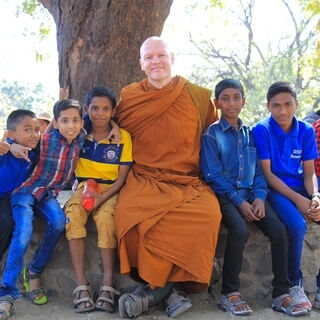
Many times in traditional Asian cultures where most people are what we would call faith types and religions become institutions,
Very normal,
And then our practices become ritualized and we have traditions.
This happens over a period of centuries.
This is normal too.
And there's a lot of goodness enabled through traditions and through institutions.
But many times what we want from religion is somewhat superficial.
And so we see many people,
Especially in Thailand,
Many people want to make offerings so that they can be rich.
And so they come to the temple and they make offerings.
And many people not being so strict with precepts.
And even many people listening to Dhamma talks and wanting to notice which list of Dhamma that Ajahn talks about.
If it's the 37 wings to awakening or the 5 powers and the 5 hindrances and they think that's the lottery number.
And they take down the number and they go and they want to win the lottery.
And Ajahn Chah sometimes said,
All these people who come and they're making the wish,
May I be rich,
May I be rich,
May I be rich.
He says,
All they're doing is wishing for more suffering.
So it's like sometimes lay Buddhists,
They want the monks to be like a devata,
A radiant being,
A field of merit.
And you puja and you make offerings and then the result one hopes will be happiness.
But as many of you know,
Even when you have enough stuff and you have some money,
Doesn't necessarily mean you're happy,
Does it?
And so the Buddha,
When he was a bodhisattva,
When he was a prince,
Before he was a Buddha,
As we were talking about,
He saw a sick person.
And then he saw an old person.
And then he saw a dead body.
And he became very reflective,
Very sensitive,
Very wise.
And he saw this and he asked his driver,
What is this?
And then he realized that he was subject to this and everyone was subject to this.
And there he was with all of the comforts possible,
All of the talents in terms of inner resources.
He was very good at everything.
In terms of outer,
You know he had very talented,
He could do whatever he wanted really.
And in terms of outer resources,
He was a prince who was going to inherit the realm.
But he saw the danger.
So the fourth thing that he saw was a wandering ascetic.
And he asked his driver what's that?
Because in the palace he'd never seen one of those.
He'd seen the Brahman priests,
But he hadn't seen somebody who'd gone forth from the homeless life.
And the driver said this is someone seeking for liberation.
And so Ajahn Chah,
When he was talking about what monks are,
He said that they're people who have seen the danger in samsara.
So the word for this is devaduttah,
Means a holy messenger.
It's also like a wake-up call.
When the Buddha woke up,
From his ambivalence,
His apathy and spiritual urgency was aroused in him.
When he realized,
I'm subject to sickness,
I'm subject to aging,
The body's subject to dying,
I don't have very long.
The days and nights are relentlessly passing.
So the job of monks,
Actually we're not supposed to be devaduttah.
We're supposed to be devaduttah.
We're supposed to wake people up and we're supposed to remind you that the world is a place which is full of danger.
And that's not very entertaining and it's not very joyful message.
It's very sobering.
But that's actually the real job of a monk.
That's my job,
I have to say to you.
You're going to get older,
You know.
There's no going backwards.
And I'm supposed to say to you,
Everything that you love,
You know,
You're going to be separated from it.
That's my real job.
And I also have to say,
Even if you're rich,
No matter how rich you are,
You're going to suffer.
That's my job,
My duty in fact.
So some monks forget this.
Some monks can just say in various ways,
Give to the sangha.
Give to the sangha,
This will be of your benefit for a long time.
And it's true to some degree.
But the benefits of dana,
They have their limit.
And actually the real benefit of dana is the ancilla.
When you start to meet monks and nuns who are practicing,
They start to talk to you about practice.
And so everyone here this last week,
We've been practicing.
So in a way you've heard the message of the heavenly messenger.
And we're practicing,
We're having a look.
But as we've been talking about,
And this is very important,
It's not just all bad news.
It's not just the message that it's dukkha,
Dukkha,
Dukkha,
Everything is dukkha.
There's this growing understanding that that which knows suffering isn't suffering.
And there's a growing understanding that if you really maintain your mindfulness consistently,
That you'll start to experience a tremendous sense of peace.
And that if you cultivate wisdom and you start to understand the worldly numbers,
You understand praise is just praise,
Blame is just blame,
Pleasure is just pleasure,
Pain is just pain,
Fame is just that much,
Ill-repute is just that much,
They're pairs.
And you find that there's much less reactivity and more wisdom and then you realize,
Oh this is really valuable,
This is really worthwhile.
Because as spiritual practitioners one of the ways that we measure growth isn't so much by an increase in wealth or fame or even in pleasure.
The way we begin to measure growth is by an absence of suffering.
So the Buddha's teaching suffering,
The causes of suffering and the path leading away from suffering.
If you're practicing correctly what you'll really notice is,
Oh look,
Less suffering.
And that's really wonderful.
Because actually a lot of rich people have a lot of suffering.
You become very wealthy,
Then you get a big ego,
And you have a lot of staff and some of them please you,
Some of them displease you.
You can become very attached to comfort so that the slightest bit of discomfort is very irritating.
So you know being wealthy,
Being successful,
Not necessarily meaning an increase in happiness,
It does give one a certain amount of freedom,
But it gives one a lot of headaches as well.
Other people want your wealth,
You don't know who you can trust.
Even your children fighting over their inheritance,
Quite ugly sometimes.
I've had wealthy people in Thailand complain to me about their children,
Even after they've given them a large part of their inheritance,
Before they die the children come and ask them,
Can you give me more?
And they're giving,
Some of these people give big donations to the Sangha and the children come and complain,
Why do you give so much to the monks?
I want it.
And the parents find that very depressing,
That they send their kids to the best schools and the best universities and buy them houses and cars and set them up in business and then they come and say,
Why are you giving my money away?
Because greed,
The Buddha says greed is like a river.
He said there is no river that floods like greed,
It can be boundless.
If we feed it,
That's one of the dangers of being too wealthy as well,
Is that you can feed your greed all the time.
So the world is a dangerous place in terms of increasing delusion,
In terms of increasing kilesa.
The Buddha is teaching a middle way,
Knowing the right amount,
Knowing moderation.
And training in contentment,
So knowing the right amount and then being content with that.
Giving the precepts,
It forces us to practice contentment,
There are things that we want to do that we can't,
All of a sudden,
Can't do it.
And so there is a sense of a desire being frustrated.
And when that desire gets frustrated,
Then one actually has to relinquish the desire and then one has to practice contentment.
But if one does this sincerely,
When you realize,
Oh,
Contentment is actually very nice.
When we train in being contented,
It's like,
Oh,
This is what it feels like to be content.
It's really nice actually.
Actually quite a bit nicer than getting what you want all the time.
We get what we want all the time as a,
You know,
There is a kind of a heat to that,
A dizziness,
An intoxication,
Not very much mindfulness,
But a big sense of self and very vulnerable.
You get what you want a lot.
What happens when you don't get what you want?
You get a lot of suffering.
We are used to having what we want.
So practicing relinquishment.
The Buddha mentioned this yesterday in the Anapanasati Sutta also,
That the monks are relinquishing.
And so we practice relinquishing some of our desires and relinquishing some of our wealth.
And when we do this,
Putting things down and you're discovering the cool empty space of the mind and realizing that having less is really nice.
Less to worry about,
Less to think about,
Less to carry around.
So the heavenly messengers,
Those who see the danger in samsara,
That's our duty.
Our duty is to remind you all this chanting that we do,
I'm going to get old,
I'm going to get sick,
I'm going to die,
I'm going to be separated from everything I love.
This is a message to help prepare you not to suffer too much when these things happen.
You have some wisdom,
So this means you have a reasonable sense of what is possible in the world rather than an unreasonable sense of what is possible.
So that you don't suffer too much when you get sick.
Oh yeah,
I knew this could happen.
As you're dying,
Oh yes,
I was ready for this,
I knew this could happen.
A sense of honest,
A sense of what one can expect from the world of conditions.
And then more importantly from sobering up,
From becoming wise,
Getting sincere about finding the real refuge and the real place of safety which is inside.
And if a monk or a nun does their job properly,
They won't be saying,
You should have a lot of faith in me,
And you should come and support my monastery,
You should buy this amulet,
This amulet is really good.
If a monk or a nun does their job properly,
They'll be saying,
You need to look inside,
You need to find your refuge,
You need to take your refuge where you are,
You need to practice at home,
You need to practice in your daily life.
And of course taking opportunities to do retreats if you can.
But when the heavenly messenger does his or her job properly,
He'll be training you to find your refuge,
Taking refuge in the Buddha in your heart in the present moment,
Taking refuge in the Dhamma,
Which is the truth which is everywhere all the time,
It's not in the monastery.
Taking refuge in the Sangha actually means becoming part of that Sangha.
One who practices correctly,
Practices rightly.
And seeking out friends,
Good friends,
Good Kali Anumitta.
Sangha isn't the people who put on the robes.
Sometimes people with robes are Sangha,
Sometimes they're not.
Sometimes people with robes on just have a robe on.
What makes one a Sangha is one who practices correctly,
Rightly,
Insightfully,
Directly,
For the sake of the cessation of suffering.
And Ajahn Chah says in one of his talks,
Lee,
Women at home can be Sangha.
He's addressing many of the older ladies that come to the monastery and say they can't practice because they're old,
And he's saying,
Yes you can,
Your knee pain,
Your back pain,
That's your teacher,
Have a really good look.
And he's saying you can,
You can be Sangha right there at home if you practice honestly,
Sincerely,
Truthfully,
Consistently,
You can grow in mindfulness,
You can grow in wisdom.
And as we've experienced,
Like Theravada and Buddhism,
It's not about beautiful temples,
It's not about beautiful chanting,
It's not about desiring heavenly rebirth,
Pure lands.
It's about the peace of mindfulness,
Concentration and wisdom,
To be experienced individually by the wise here and now.
And this is very dependable.
And I'm sure many of you now,
Many days of meditation have experienced this kind of happiness.
The Buddha says peacefulness is the highest happiness.
So it's like,
Can you have a look at that,
When the hindrances are weak,
When a bad mood evaporates,
When you notice the impermanence,
When you can be with pain with patience,
When you can observe things that you used to react to,
That you're not reacting to.
It's really nice.
A real sense of relief,
A sense of coolness,
A sense of fullness,
Very rewarding.
So that's why we take,
That's why we do these contemplations.
They orient us to take responsibility,
To contemplate the truth,
And to really have a good look inside,
And to find that refuge.
And when we do that we find it's very rewarding,
In a very cool,
Simple,
Natural way.
So I encourage you,
Today's your last full day,
Very good opportunity,
A lot of good practice already,
A good momentum.
And so just be really interested,
Where is that refuge?
The Buddha says it's in my heart,
Is it?
Within this fathom long body is a place,
That's the place where one is liberated.
That's very interesting,
Isn't it?
You don't have to go to the Pure Land to get liberated.
So let's have a good honest look,
What's it like when we can really be mindful,
And really be with our breath?
Really notice the three characteristics,
Anicca,
Dukkha,
Anatta.
Some people were saying yesterday,
They were relaying how rapturous it was,
Just to be able to be with pain,
And see it for what it is without reaction.
What it's like to just really be with the breath,
A sense of oneness,
A tremendous sense of the absence of suffering,
A sense of putting samsara down for a few minutes.
So we all have this potential.
And today we have an excellent opportunity to deepen our practice,
Deepen our sense of knowing where that refuge is,
And discovering our potential.
So returning to the breath meditation.