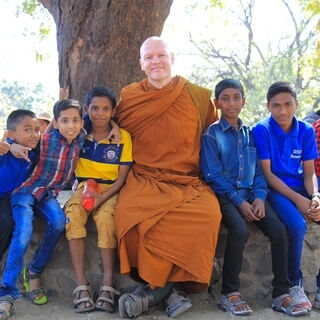
Good morning everybody.
Good morning.
Lord Buddha explained that the cause for a human birth,
So we're all sitting here with human bodies,
It seems,
The cause for a human birth is having kept five precepts in past lives.
So,
To be here with this particular body,
We understand that you've been virtuous in past lives.
You've had good ethical standards,
Probably for several lives,
Possibly many lives,
That you would meet the Buddha's teaching,
Would also be conditioned by having been generous,
Having been virtuous,
And probably having practiced meditation before also.
So,
In Asia,
This kind of.
.
.
Monks can make these kind of statements,
And that's.
.
.
Most people don't question it,
But in more industrialized,
Materialistic cultures,
Sometimes,
It's not a given that people believe these things.
But these kind of beliefs,
I believe,
Are skillful.
They are skillful.
Ajahn Anand,
My main teacher in Thailand,
Frequently explains to people that if they're not keeping the five precepts.
.
.
Well,
First of all,
He explains the benefits of keeping the five precepts.
So,
The benefits of keeping the five precepts is one has a certain confidence,
Self-esteem.
At the end of the day,
One feels like one is a good person.
The drawbacks of not keeping the five precepts is remorse.
One can experience a certain amount of remorse,
And a certain lack of confidence,
Ill-ease,
Anxiety,
Lack of self-esteem.
So,
On one level,
We could think,
Are these monks telling us to keep the five precepts?
It's boring,
It's oppressive,
Come on,
We need to have a bit of fun.
The mind can think like that.
But what the monk's duty is is to point to the reality of your mind,
And your experience.
It doesn't really have much to do with what the monk is saying,
It has to do with whether it's true or not.
If you keep the five precepts,
Do you feel better?
Is there a lack of remorse?
When you break them,
If you're honest,
If you're truthful,
If you look inside when you break them,
Is there an increase in anxiety,
More remorse,
Less clarity?
So this is,
As Buddhist practitioners,
This is what we have to be truthful,
Don't we?
We have to have a closer look at our reality,
Our mental reality.
We can always justify,
Human beings can justify what we want to do,
And our unskillful habits,
We can defend them.
But if we're truly interested in being peaceful people,
Wise people,
And if we believe in karma,
Introduce several of the themes of this talk.
So I've made several statements.
First of all I say this,
What I was saying Ajahn Anand says in Thailand frequently,
He says if you're not keeping the five precepts,
He says your body is human but your mind isn't completely human.
So he says if you're not keeping the five precepts,
The level of the mind isn't functioning on a completely human level.
So that's a pretty challenging statement actually.
And I've always admired his courage in telling,
As many of the people who come to Ajahn Anand's monasteries when he gives this talk,
Many of them aren't keeping the five precepts actually.
Thai people like to have a drink,
And seem to like sex quite a bit.
So it's not a given that the people in the monastery are keeping those five precepts,
But what Ajahn Anand seems to do is he'll lift the face,
Explain the benefits of keeping the precepts,
But then admonish people.
The other thing he says is that of course people break precepts occasionally,
That's normal enough.
We have periods in our life perhaps,
Or you have periods in your life perhaps,
Where keeping the precepts more strictly and periods where they're not so pure.
That's kind of normal.
But the important thing is that we're training with them,
That we're taking them as a standard,
And that we're understanding if the Lord Buddha recommended these,
He had good reason.
And then we try to,
As I was saying,
We're born with this body and with this opportunity because of previous causes,
Previous good causes.
So one of the values or important functions of maintaining the precepts is taking care of that goodness,
And hopefully building on it,
Not letting it degenerate.
So I've mentioned,
I've referred already a little bit to past lives,
And of course the implication is future lives as well.
So Ajahn Anand he would say to people,
He would say,
So if you consistently break the five precepts,
You can't actually take it for granted that you will be reborn as a human being.
If the mind is not functioning on the level of being truly human,
It is in fact likely that you won't be.
Which is a very serious statement to make,
But I believe he wouldn't be saying this if he didn't know it,
If he didn't know that this was the case,
He wouldn't be making such a statement.
So it's a serious thing to consider.
Because Australian popular culture won't tell you that,
Australian popular culture will tell you that you're a good bloke,
Or a good sheila,
If you have a few beers,
And stealing from the government isn't a problem,
If you can.
And hiding something from the taxman if you can,
That's a good thing,
And etc.
So we have to have a look at where are we taking our cues,
Who are we letting inform us with regards to our level of virtue.
Then I'd also like to tell a few stories now,
And then weave some of these themes in stories about ghosts and devas.
Because I think it's helpful if people tell stories of their own experience,
Kind of can bring this,
And again come into this theme of what is a ghost,
So a ghost would probably be someone whose precepts weren't kept so well,
And who might have died in a confused state,
Or didn't have enough merit to move on,
So if one doesn't keep precepts,
Or one dies with a lot of confusion,
Or perhaps a heavy karma ripens from a previous life,
It's possible that one can get born in a ghost state.
Similarly,
If one is virtuous and also meditates,
And is generous,
Then it's quite possible,
Even likely,
That one could get born in a heaven realm,
Or in a deva state.
So I'm going to talk a little bit about some experiences which I think had something to do with ghosts and or devas,
Angels,
Not from the perspective of someone who can see them,
I don't have the purified divine eye,
Although I know some monks who I believe do,
But I'm not coming from that perspective,
I'm just going to talk about some really kind of obvious examples of interesting things which happened,
And share that with you for your contemplation.
So once at whatnonechart,
First of all I say that I do believe that if someone is virtuous,
Angels or devas,
Some of them will take care of you,
At least some of the time.
So virtuous people have guardian angels,
You could say,
And I've talked with some of my teachers about this,
And they say that it is the case,
That if you are virtuous,
That other good beings that cannot be seen,
Take an interest in taking care of you.
So it's not that they're there all the time,
But they'll be there probably at important times,
Or some of the time,
Because these devas are living in a parallel universe,
And they've got their own lives,
But I guess,
You know,
Maybe if we have past karmic connections with some of these beings,
And they have a sensitivity,
They might be aware when we're in trouble,
Or if there's a good opportunity or whatever,
And so devas can sometimes,
I believe,
Do things,
Which so I'm just going to give one example,
I'll give several examples.
One time when I was at whatnonechart,
I think I was a guest monk at that time,
I think it was my eighth pancha,
It was about six years ago.
I was doing quite a bit of service at that time,
If I recall,
I was a guest monk,
Had to chat quite a bit,
And receive guests.
And then we tend to get up early,
And we have this big meal once a day,
And then most monks will have a nap,
A siesta,
In the middle of the day.
It's very helpful to have a half an hour lie down if you've had a big meal,
And then you feel fresh in the afternoon,
And you can stay up to quite late.
But during this period I was a bit tired,
And my midday nap was getting a bit long,
And it was getting past the two hour point at one point.
I remember waking up in my kuti,
Which is in a forest,
At whatnonechart,
And I was thinking,
You know,
If I was my guardian angel,
I would really kick my butt right now.
So thinking that.
So then I got up from my mat in my bed,
Which is a little pillow on the mat,
On the floor in this kuti,
And I noticed that there was a bit of dust,
There's a lot of bugs in Asia,
A lot of dust,
So I saw this dust and these bugs,
And I thought I should sleep.
So I went,
The broom was outside,
I'm going to get my broom,
One of those grass brooms,
Sleep a kuti,
And do some sitting meditation.
So I opened the door to get my broom,
And a snake came in the door the moment I opened it.
And then,
What do you think it did?
It went to my pillow,
And it crawled up in a coil under the pillow.
And I thought,
Well that's very interesting.
And I thought,
Now that's quite an admonishment,
Isn't it?
It's like,
Biku,
The pillow is dangerous.
So the snake didn't do me any harm,
But it seemed to me to be a very clear message there.
And I said,
Yes,
I'm aware that sleeping things become a bit of a problem.
Now please,
Leave.
So I got the broom,
And I encouraged the snake to go outside.
And one interesting example I think of,
Probably a subtle body being influencing another being,
To send a message to a biku to try to take care of his virtue.
So that would be my interpretation of that experience.
Another thing that happened once was,
After my fifth pancha,
I was on Tudong.
So the monks,
After their fifth pancha,
You have permission to make your own decisions and go where you want to.
It's a bit of a tradition in Thailand,
That after your fifth pancha,
You kind of break out of the monastery with your bowl bag and you hit the road.
Because for years you've had this kind of morning chanting,
Evening chanting,
And all this kind of,
You have to be here at this time,
This kind of traditional monastic training.
And you have to go to the vinyas study,
You have to go to the afternoon sitting,
You have to be at the morning chanting,
You have to,
Have to,
Have to,
Have to.
Young men can experience that as oppressive sometimes.
So one finishes,
You get out of your fifth pancha and there's this sense of,
Okay,
The open road.
And so,
And then within not long you miss the monastery.
But anyway,
So I was on Tudong.
And at some point,
I'm not proud of this,
But anyway,
At some point I started to smoke cigarettes.
Because in those days,
The Dhamma Yut tradition has a lot of senior monks smoke cigarettes.
Because I don't know why,
Whatever it was in that culture.
And even the enlightened Arahants,
Many of them smoked.
So it just turns out that in the Dhamma Yut forest monasteries there's large amounts of tobacco.
And the roll your own kind of stuff.
And so on Tudong,
You walk for many hours in the sun and you've got these heavy bags.
And so I did discover that when the body's very fatigued and tired,
If you have a cigarette it feels a bit better.
And if you're hungry,
If you're hungry late at night,
Also you have a cigarette and you don't feel so hungry.
And also if you feel a bit lonely,
You have a cigarette,
You don't feel so lonely.
So I was out wandering and I'd been wandering for a little over a month and I realized that in the past when I was in the monastery,
If I felt a bit tired I'd try to go and meditate.
If I felt lonely I'd meditate.
If I felt hungry I'd meditate.
And I noticed that here I am on Tudong and when I feel any of these things I have a cigarette.
So I thought,
Okay,
So things seem to be degenerating.
And so I gave up.
I gave up the smoking.
But then it was a couple of weeks later and I was walking in the morning and I was thinking yeah,
I know I've given up and I know smoking isn't good.
It's not good for your health,
It doesn't look good,
It's not inspiring,
But you know what?
I just want one.
And it's not against your precepts.
And I didn't think just that I wanted one.
I thought,
And you know what?
I want a menthol one.
And by then I had a favorite brand which is called Siphon,
Which means falling rain.
It's a Thai brand of menthol cigarettes.
So I was thinking I want just one.
I want one of those falling rain cigarettes.
So you're probably not going to believe me,
But about a hundred meters later on the road before my feet was one perfectly clean,
Fresh,
Falling rain menthol cigarette.
And I thought,
Okay,
So now if you understand that some of the enlightened teachers of Thailand were smokers,
Well then some of the devas probably don't think it's such a bad thing if monks smoke.
And I think if he wants one,
He wants one.
I don't know if the deva had to steal that from somebody.
I don't know how it ended up there.
And I don't know for a fact if it was a deva,
But I didn't notice.
That's very interesting,
Isn't it?
Because many monks have had these experiences as well.
It's often the case that you're trying to be with buddho,
You're trying to be with your footsteps,
And you're trying to contemplate painful feelings.
Because the muscles get fatigued,
The bags weigh on your shoulders,
The sunburn blisters,
It's difficult.
And so you're practicing with these kind of things.
And every now and then your mind slips and you think,
Well yeah,
You know what,
I just really want to coke.
And so many monks have had this experience that not long after thinking that a car stops and someone gives you a coke.
It's fascinating.
It happens a lot.
And I was just kind of sharing this as another example to suggest that perhaps subtle bodied beings who are somewhat close to the planet can hear our thoughts.
And perhaps they do things to encourage us,
Or perhaps they do things to admonish us.
Depending on what seems appropriate.
So I'd like to give another example.
This is more in terms of,
I think,
The merits that people have.
Once I was in a jungle on an area on the border of Burma.
And Thanarajana Nang came to visit during this time.
I was very fortunate.
It was the first time I met him.
That was my second pancha.
And not long after that he became my primary teacher in Thailand.
But he was there with a group of monks for about five days.
And we were having several conversations.
And the group from Wat Nanachat was about to walk into the jungle.
So we decided that we would leave that place and then walk in with them.
It's a bit of a tradition at Wat Nanachat.
To walk into that forest retreat area.
And most of the monks from Wat Nanachat spend March and April in this area of forest,
Deep forest,
In the hot season.
So we were driving out with Thanarajana actually.
Thanarajana Nang to meet the group from Wat Nanachat.
One of the things we were talking about,
Sudhantu was,
Adhyan Sudhantu,
He's now an Ajahn,
He wasn't then.
He was a good friend of mine.
Now he's an abbot of a new monastery in Portland in America.
He was saying to Thanarajana Nang,
You know Ajahn I think I must have made a lot of good karma with food.
Because often when I just think I would like to eat something,
It comes the next day.
He said suppose I was to say to you Ajahn Nang,
I like pizza.
I said many times I might say that.
And the next day pizza comes.
And Ajahn Nang said yeah it's possible.
It's possible that you've given a lot of food in the past,
Possibly to monks.
So this is one of the things,
One of the ways it can ripen when you think about something that you want it comes.
This is a result of merit.
Of course there's monks who try not to do that.
I think yesterday was my birthday and I didn't tell anyone because I didn't want too many cakes you see.
It's not good to eat too much cake when you're trying to meditate all day.
So the next day we left this jungle and we were on a road in the middle of nowhere.
And literally no village for many many many kilometers.
And the place where we were coming from was a place with no village.
It just has that monastery.
So when the monks stay there there's a kitchen and they prepare food for those monks for that period of retreat.
So this car is coming and it stops.
And they said oh I heard the monks talking to the money.
I heard there were some monks out there so I was coming to make an offering.
I said oh we've just left but there are some monks there.
And the driver said well okay but please accept this for now.
And he handed him a pizza.
So it's in the middle of nowhere and there's not even a village.
And this monk who had said he had good karma with food had said suppose I said I like pizza that pizza might come tomorrow.
And it did.
So again there's several things.
It is speculation.
I guess you can't prove it.
But one theory,
One likelihood,
Is that yes that vikku has offered a lot of food.
And yes possibly devas are involved in listening to the thoughts of monks and practitioners.
And whispering in the ears of donors what might be appreciated.
So another thing and I better not mention the name but I just want to give an example of monks,
Teachers reading the minds of students.
So I have to be careful because these monks are very modest and they don't like it if you reveal their skills.
So I've gotten in trouble in the past for mentioning names so I'm not going to mention any names.
But again when I finish telling these stories I'm going to try to make a few points or pointers.
So I was saying as a junior monk with one revered meditation master in Thailand and we were having a cold snap.
And by that I meant that I got down to about 20 degrees.
Now when it gets to 20 degrees in Thailand,
Because people are so accustomed to the heat their lips turn blue and their skin cracks.
And it's kind of unimaginable.
If you live in Melbourne you couldn't really imagine that.
But in Thailand it really isn't the case.
If it gets down to 20 degrees their skin starts to go blue and they look like they're really really cold.
So someone had made a donation of baby oil for the monks.
The Thai are very solicitous and kind towards the monks and so someone turned up with a bunch of small bottles of baby oil.
So I think the monks could rub their cracking skin.
And so this monk was coming towards me with this bottle the Ajahn,
A very sweet Ajahn with a lot of metta,
Was giving his monks some baby oil.
A very tender gesture of nurturing.
And this realized master was coming towards me with this bottle of baby oil and I didn't have enough mindfulness.
And so I've never liked oil since I was a child.
I don't like greasy feelings.
I remember seeing that oil and I was thinking I don't like oil,
I like cream.
And this monk stopped and turned around and walked away.
And I felt terrible.
I thought here in Enlightened Mastery is going to give you a gift and you're going to think about your preferences.
And I was very embarrassed.
But then what happened the next day was this monk called me to his seat.
I said,
Achyut,
My knee.
Come here Achyut.
So I went there and he handed me a bottle of cream.
And I thought that's very interesting.
Again,
It's very interesting isn't it?
So a lot of interesting things are happening there.
One,
He wasn't judging me for having preferences.
He just,
On one level obviously he heard,
Oh he doesn't like oil,
He likes cream.
And so he arranged,
Or someone arranged,
And the cream came and he gave me some cream,
Vitamin E and aloe vera,
It was very nice.
And so I still remember that.
That I think was the first occasion which really helped me to understand that this mind reading thing isn't you know,
It's real.
It's like I didn't say to this monk I don't like oil.
And I didn't make any gesture.
So the only way that he could have,
The way I reviewed the situation,
The only way he could have known that was if,
There's this phrase I use in the sutras,
Embrace consciousness with consciousness.
So if a monk has a very developed meditation,
He can embrace or a nun,
Your consciousness with his consciousness and read your thoughts as if they were his or hers.
So there's been many subsequent experiences since then where it was very obvious that some of these masters know exactly what their disciples are thinking in extraordinary detail and subtlety.
So also there's points to something,
One of the points I'm trying to make and I think this is important is that because we live in a very materialist culture and all sorts of assumptions are affecting us that I am the body.
It's very deep and that that kind of nihilistic thing that's in western culture,
Scientific not actually based on science but science believed it for a period of time and they're discovering otherwise now I think.
But that when the body dies,
Consciousness dies.
That consciousness exists because of the body.
So in Buddhism we don't believe that,
We believe that the body comes to be because of consciousness.
So propelled by karma.
And then so this sense that the mind and the body are separate phenomena.
So this is actually very important Buddhist principle to contemplate.
The mind and the body are separate but they live together for periods of time.
It's like the mind is with the body now.
But at the time of death consciousness has to go on and the body isn't going to go on is it?
The body is going to be,
The Buddha says in not very long this body will lie on the earth like a log,
Like a useless log.
And he says about his own body.
So it's not the body that gets reborn.
And many people can notice if you go and you look at a corpse,
If you do see someone that's dead,
A relative or something like this you can see that the body is there but there's this sense that the person isn't there.
Many people have that sense and it's a very valuable thing to see actually.
When you see your friend or your mum or your dad or whoever it was and you're looking at the body and many people have that sense,
Yeah they're not there.
The body is there but they're not there.
So that's something many people will have that experience at some point in their life.
And so this is a good thing to contemplate isn't it?
So what was it that was there that you thought was your mum or your dad or your friend?
So it's their mind isn't it?
And it's like and then this whole phenomena of being able to read minds.
So what is that?
It's not a body that reads someone else's thoughts and it's not a brain that reads someone else's thoughts.
It's a faculty of mind.
So I don't have this skill but I've met some people who do.
I think it's valuable and once again in Thailand it's just taken for granted that the enlightened masters can read people's minds.
It's a given.
Nobody doubts it for a second.
They're very paranoid when they're around their teachers.
They know that he or she is going to see everything.
But they also know that they have a lot of metta.
So they probably won't scold them.
Sometimes they do for their benefit.
So just another example,
Another story from India.
I was doing an extended period of pilgrimage last year and I was in Ladakh with a good friend,
A close student.
We were staying in a small guest house on the edge of the village.
We had the whole upper floor.
It was a very peaceful place and a beautiful place,
Beautiful Buddhist family.
They were doing their long puja in the morning,
Their long puja at night and their full length prostrations.
A very devout Vajrayana family in that Himalayan India.
And so he was meditating with me in the afternoons.
I invited him to my room and I'd set up a shrine and we were meditating.
And so we were meditating and towards the end of an hour there was a Muslim call to prayer because there's about 10% Muslim population in Ladakh.
Ladakh is close to Kashmir,
Northern India.
And so there's that loud prayer.
And then I was thinking at the time towards the end of the meditation,
Okay it's close to the end of the meditation,
I looked at the clock and I let my thoughts wander a bit and I was actually thinking Ladakh was a very important place during the time that the Islamic Turkish invasions were occurring because a lot of Buddhist scriptures and statues and teachings were there.
And the Muslim invaders didn't make it as far as Ladakh,
Those Himalayan valleys because it's very difficult to get to.
My friend was meditating behind me at that same time was thinking you know this is a predominantly Buddhist place and you know it's just too loud and I'm going to write a letter to the tourist authority and I'm going to tell them to tell those Muslims to turn down that volume and blah blah blah blah blah.
So what happened at this time?
We were in a room meditating and there was a wooden shutter and he and I felt something cold move into the room and the candles fluttered and this window shut by itself.
And we both got a chill up our spine and Francois,
He's French,
He said Ajaan?
I said yes Francois,
He said something is wrong.
I said yes Francois,
I think possibly a ghost just came into the room and I've got a funny feeling it's a Muslim.
And we both felt like a little unsafe,
It was a very upset energy and I said okay we better do some chanting Francois,
Let's do our and so we did the Metta Sutta and started dedicating merit.
Then I asked him,
We left the room and I was thinking about it and I asked him what were you thinking just before that happened?
He was thinking yeah Muslims,
Muslims,
Muslims,
Islam Islam and I said you know what I was thinking,
I was also thinking about when the Muslims kind of killed all the Buddhists and destroyed all the temples and we need to make it a practice,
We need to include Muslims in our loving kindness meditation Francois.
And so then I was talking with the owner of the guest house and I had no idea,
We didn't know any of this,
But it turns out that the property right next to the guest house was owned by a Muslim family and that Muslim family were trying to get a title deed and the predominantly Buddhist government in that region was giving them a hard time and they didn't I don't think they got their title deed.
So one I don't have the skills to know for sure but one could deduce that perhaps it's possible that,
And it's a good thing to contemplate as well,
That a being who was very attached to that land,
Who had a Muslim faith upon dying was still there without a human body but there probably as what we would call a ghost and that subtle body being had the capacity to hear thoughts,
Which is what is said about ghosts by the way and Davis,
So they hear our thoughts so we have to be careful what we think,
In the sense of okay so this is the thing about in public and in private having thoughts of loving kindness and just to be aware that when we're by ourselves that it is possible that our thoughts affect beings and that the Buddha praises having even thoughts of loving kindness to the degree that we can and certainly not to indulge really angry thoughts or grudges so on that occasion we did dedicate merit and that kind of energy hung around in the room for about a day or so and I remember I went to the window at some point and I said look okay,
You're Muslim and I'm a Buddhist and you want this land but this is my meditation space so let's make a deal,
You stay over there and that's yours,
Have it,
And we'll stay here and we won't go there and let's just be friends,
Let's be friends with healthy boundaries and the energy did go away,
Just a sense of making a compromise,
But giving each other some space so let's see if I have any other interesting stories I do but I just want to check,
Are people bored with these kind of stories?
Would anyone like to hear any more interesting stories?
Okay Told you about the pizza,
Told you about the snake and the cigarette,
Okay.
So this is a nice story when I was in Bogaya two and a half years ago so it's been said by one of the realized masters of Thailand who has a divine eye,
Purified divine eye,
He said at the Bodhi tree at the Mahabodhi tree in Bogaya there is a little deva living in every leaf because it's a place that,
Especially if one was a Buddhist deva,
It's the kind of place that one would want to live and then when those leaves fall apparently that deva has some choice about who to give that leaf to before going up to the top of the tree and moving into a new leaf so I don't know if that's true or not but I have seen some very interesting things happening around the Bodhi tree with Bodhi leaves and some people go and stand under the tree and say I would like a Bodhi leaf and one falls and other people do that a hundred times and one never falls you know you could believe either the theory is true or not but you could also believe or maybe it was does depend on one's level of merit,
One's level of sincerity,
Whether or not you are attracted to devas.
So I was meditating,
I made a vow to do a certain amount of sitting meditation and everyone gets sick in Bogaya in winter,
You get chest infections so I was sitting under the tree early in the morning and it was cold and I had a chest infection and I was thinking,
After about an hour I was thinking you know this really isn't working,
Maybe I should be in bed because I am sick and I thought no,
What particular virtue you are trying to cultivate here Ajahnachala during this period of time is discipline,
Patience consistent effort,
So the point isn't to be peaceful the point is that you came and sat anyway even though you fell sick,
That's the point and so what do you think happened?
A Bodhi leaf fell into my right palm and it was as if it was like that's right Ajahnachala you should develop consistent discipline and patience and it's not just about being peaceful every time,
It's about making this effort and just being there and then so another thing happened,
I was there for a month and a couple of weeks later,
You know stuff comes up in India,
It's a really intense place and if you have a relationship with anyone,
A friendship or a partner or whatever it will definitely be challenged,
I always make a deal with whoever I go to India with,
I said I want to make a deal with you,
I said after we've had our conflict that we promise that we'll still be friends because it's so dirty and it's so noisy and you get sick and the food isn't as nutritious and basically it's stressful and it's also wonderful,
But at some point people's stuff gets triggered and there are conflicts so we make this kind of deal that we forgive each other so one of the lay people who was there with me,
She was going through some difficulties and another of the lay people I was with,
We had an appointment and he didn't show up and I was looking at my watch and I was thinking so I didn't wait for very long,
I thought you know what,
I spent too long with the one discussing the various issues and problems and then I was disappointed and he didn't show up and I got to the tree and I only had 45 minutes instead of an hour and a half or whatever it was and I just had this thought,
I said you know what,
I do not show you have to be really determined to not get caught up in other people's karma,
Yes you have to have compassion but don't get unnecessarily caught up and maintain your focus because that's why you came here and that's why people supported you to be here and what do you think happened?
I was sitting under the tree so at that stage a body leaf fell in my left hand and I was like that's right,
And again it seemed to be kind of a that's right,
Maintain your focus don't get caught up unnecessarily,
Come here and practice so those were nice experiences.
Another experience was I was doing Tibetan style bows actually at this particular time because I saw those Tibetans doing those bows and I thought that's a very beautiful thing to do and I tried doing walking meditation in Vodkaya,
It's very difficult,
Sometimes there's 10,
000 people in that one compound and they don't walk backwards and forwards,
They walk in circles,
So it's difficult and I thought well one thing that might be nice,
Because it's actually not that dissimilar to walking meditation in as much as you're doing this physical activity this kind of bowing and then you go down and then you go up and there's particular steps and it's quite similar to kind of,
Okay so I thought I'd try it and then I tried it and then it's like this sense of wanting to express gratitude,
Wanting to express respect to the Buddha and then you can get your own kind of bowing board and you realize that the temple's right there and the Bodhi tree's right there and you can actually take the Bodhi tree and the place of the Buddha's enlightenment as your meditation object and I decided to do that and I felt very rapturous,
I thought oh this is really lovely practice and some of the Thai people and the Thai monks were looking at me,
So it was very strange and I thought okay I'm going to take refuge in my intention and I did it anyway,
So I decided that I was going to do 10,
000 because I was there for a month and I did do 10,
000 and this was during the same time when the Bodhi leaves,
So what happened was after the 10,
000th bow a senior monk from the Vajrayana tradition walked past my bowing board,
His name is Ling Rinpoche,
He was the Dalai Lama's senior tutor,
If that means anything to anyone,
But so he just kind of walked humbly right in front of my bowing board and I'd just finished my 10,
000th bow and I thought that's interesting and then he went and he sat under the Bodhi tree and I could see where he was and I said well I should pay respects to him because I do have faith that some of these very high lamas have a lot of accumulated virtue and if one has the opportunity to pay respects to any monk or nun that is truly well developed well then that is for our benefit,
So I put on my robe and I went and I paid respects to him and that was a very nice thing that I said Rinpoche I don't have any gifts,
I wasn't expecting to see you but I'd like to pay respects and I paid respects over another Bodhi tree and then he handed me a Bodhi leaf and that was just a sense that perhaps,
Again we don't know,
But to get through those 10,
000 bows was hard work and I just got through them and I said maybe that was kind of like an Annamodana or a rejoice in this effort so of course to do 10,
000 full length prostrations in Bogaia isn't such a big deal because the Mahayana's count their bows in sets of hundreds of thousands but for a kind of middle aged fat white guy 10,
000 seemed like a pretty good effort I thought and I did get that Bodhi leaf at the end of the 10,
000 so interesting things happening in Bogaia,
Now look most recently and this was I think even a little bit more amazing most recently I was in Bogaia again so in Thailand,
Bangkok's a three and a half hour flight from Bogaia and lots of Thai people go to Bogaia these days so it's not so difficult to get there thank goodness and so I've gone every second year for the past eight years and if I go I'll tend to spend a month because I like to do a lot of practice and I go with some students sometimes some other monks but this time I found from meditating a lot under the Bodhi tree that there's a particular spot which is more peaceful,
Which is more helpful,
There's a lot of noise and a lot happening,
A lot of people and so on the very first day I went down and I said I can't see the devas but I have confidence that they're there and so I said devas who support practitioners,
Devas who live in the Bodhi tree,
I have this intention,
I want to sit meditation 200 hours in the next 40 days,
45 days under the Bodhi tree and there's this particular place that I find conducive and so if you think that it's appropriate,
If you would support it,
If you could please help that space to be available when I come down with my cushion in the morning so I know before I even finish this paragraph I just want to say I'm not making any claims to being special,
What I'm saying is that the devas I believe,
The devas of the Bodhi tree are very kind so what ended up happening was I came down every day for 40 days and every single day without fail that space right next to the stupa just before the Jonkram Path where people have been,
There's this little space and one can face the stupa and the tree kind of wraps around that corner just there and there's not much traffic,
People are talking a lot as they get to the Bodhi tree they get some awe,
They get some reverence and they tend to be hushed here for a few minutes,
For a few seconds,
So this is a nice place to sit and so I like to sit there and so some days it was very crowded many different teachers were passing through,
Different,
There was the Theravadan Pali Triptaka recitation,
There was like this thousands of Theravadans,
Cambodians,
Laos,
Khmer's that were doing their Pali recitation,
It was really beautiful to sit and listen to Pali being chanted in all these different accents coming from every different direction and then the Karmapa came to actually get his teachings in the temple so there was all these people from Hong Kong and Taiwan but what was interesting was I came down and I came around that little corner and that little space,
Even sometimes everything else was full,
That little space was available so it's just like,
And the point again I'm making is if there are these subtle bodhi beings that want to support or practice,
Well then it's really good to be clear about what kind of support we need,
So sometimes if you make it clear what your intention is,
You can actually ask for specific support,
Because I believe anyway that there are these beings that want to help practitioners but they also need to know what you need and they also need to know what your intention is,
So it's like sometimes if we set a clear goal and we say this is what I would like to do and if the benevolent influences in the universe could support that,
That would be really helpful,
It doesn't mean that they will,
But we shouldn't get too attached to it and we shouldn't get upset if they don't,
But it's a good thing to do because just in case I might get a bit of help.
So with that,
Once again I had two chest infections in Bogaia last time but I did manage to get through that 200 hour sitting so I'm very grateful to have that.
The other thing that happened was about half way through I was walking three kilometers to and from the temple where I was staying and I got a bit fed up with lugging the sitting mat and the cushion because it's cold marble and you have to have something in the winter and so I decided after ten days or so to leave my mat and my cushion in that spot folded up and people said to me it's going to get stolen,
This is India,
It's going to get stolen and I said okay well it might get stolen but it didn't.
So it stayed there for three weeks and it didn't get stolen and many other people were saying that's amazing,
I've never seen anything left under the boarage tree without it.
It didn't get stolen.
So just my kind of sense of that if one makes a sincere effort it's possible that benevolent influences will try to support us and try to take care of us.
So just a little bit more talk about this sense of ghosts,
Staves and humans.
So as I started this talk saying that the Buddha was explaining that the standard to be truly human is keeping these five precepts at least most of the time.
This is what makes our mind a human mind and then this is what makes human rebirth likely,
Probable.
And then similarly if we are unethical,
If we don't keep our virtue very well it's quite possible that we.
.
.
Talk about the Nagas,
Like from what I hear about the Nagas and most people believe in Nagas is the serpent realm.
I don't want to offend the Nagas because I know there are very good Nagas but generally from what my teachers have told me the Nagas have a lot of merit and they're talented.
They have.
.
.
They have talents,
They're skillful they have a lot of merit but they didn't keep the five precepts.
So they get born in this serpent realm and it's said that you can't realize Dharma in that realm because it's too much pleasure.
So they experience a lot of rapture and a lot of sensuality in that realm and it's a kind of a passionate very sensual realm apparently but you can't realize Dharma in that realm.
So it's possible,
It's not necessarily that if you didn't keep five precepts you have to be born as some kind of miserable ghost.
You might be born as a type of deva which has a lot of pleasure but you might not be able to realize Dharma in that state.
So it's like,
It's good that we set this intention in terms of rebirth.
So some people wonder,
You know,
Modern Buddhist practitioners wonder,
Is the whole heaven,
Hell,
Ghost,
Animal thing,
Is it a metaphor?
Is it all really in the present moment?
Cosmology,
Maybe I don't need to take that on,
Maybe I should understand this as a metaphor.
My own personal feeling is that it's both.
It's in the present moment and it is a metaphor and it's something that we can practice within the present moment.
So you can understand that if you're feeling patient and benevolent and kind and loving and kind and radiant and spacious,
Okay,
So you've got a deva's mind state right there.
And that's in your human body but the mind's on the level of a deva in that moment.
So similarly someone's heard our feelings and we're feeling really dejected and we fall into a serious depression and there's a feeling of heaviness and sadness,
Oh it's just not fair and here we are again.
Well that's a ghost's mind state isn't it,
Right there in this human body.
There's a ghost's mind state.
And then anger,
You might get really angry someone says something again and you might be really upset about it.
They've said it a hundred times,
You've asked them not to,
You get really angry,
It's just not fair,
You should know better.
And you get really really angry.
So this could be like a asura or a demonic or a yaka,
This is kind of an angry giant.
Right there in this human body we have these mind states that,
So I think it's the case that the level of the mind from moment to moment is functioning on different realms.
And then the thing that's going to,
At the end of our life if one is interested in a rebirth,
At the end of the life it's like well what has the level of the mind being mostly?
And then you've got a pretty good guess for where it's going to go.
So if you've been mostly human you'll probably have a human birth.
But if you've been hanging around on the animal realm quite a bit,
It's likely that that's where it's going to go,
Or the naga realm.
Similarly if you're very good with your precepts,
You meditate a lot,
You're generous,
You're forgiving,
You practice a lot of metta,
It's quite likely that you could go to a deva realm if that's where you wanted to go.
The most important thing I try to recommend to people is that they determine they set the intention to wish to continue to practice.
So I don't think you need to even determine whether you want to be a human or you want to be a deva that you just set that as the intention.
I want to continue to grow in this path of dhāna,
Sīla and mental cultivation.
And so may I be born in the place which is most conducive to that.
And then just if you set that as your firm intention.
And then the other thing to be careful of of course is when we're dying.
And I talk quite a bit about death meditation and I encourage people to do death meditation and to recollect scenarios where one might die,
Possible scenarios for several reasons.
Obviously to develop the insight into impermanence that all Buddhist practitioners need to keep cultivating.
But also to be somewhat ready so that when the time that we're dying comes that we're not taken to by surprise and having a panic response or a response of incredible attachment.
Because the mind state that you're having at the time of death is also,
My teachers have explained,
Two most important factors.
The first most important factor,
The level of the mind,
This lifetime,
The realm that you've actually been functioning on psychically is going to have a large determining factor.
The other most important determining factor is the mind state at the time of death.
So even if you've been a good person,
If you haven't done any contemplation of death and death comes and you totally freak out at that time,
It's going to be difficult to have a virtuous rebirth.
So just kind of contemplate that.
We've all had that experience where you're walking along and you slip and you can just get a glimpse of that incredible anxiety and grasping that comes up.
That kind of sense of,
So if that's what it's like when you slip,
When you're frightened about it,
What's it going to be like when you're really confronted with the fact that the body is dying,
It's time to go.
You have to let go of everything you know.
Now.
So we don't do some preparation from that.
It's not going to be easy to let go.
What's that feeling of you think you lost something in the car,
Something that's important to you,
Or you lost your credit card or you left your car keys.
So you're walking down a thing and you realize my car keys,
My credit card and there's a sense of,
Oh no!
What's it going to be like when you confront it?
And sometimes you might not have much warning,
But what's it going to be like?
But it's not just the credit card,
It's not just the car key,
It's not just the car,
There's everything and you've got this moment to let it go.
Well sometimes we have some warning and if we do that's good,
But we might not.
So I think it is really important understanding that the implications for our rebirth is that one,
Try to accumulate quite a bit of virtue if you can,
Try to be an ethical person,
Meditate a lot,
But also contemplate death so that you'll be ready for it.
And hopefully that you can be born into a benevolent situation.
I don't know if you realize it,
But your current situation is incredibly benevolent.
And Australians,
We can overlook this.
We don't realize that you're sitting on a mountain of merit.
And it's good if you use your mountain of merit.
I like that phrase,
Mountain of merit.
And it's good to be aware of it and it's like we don't want to lose it.
So you have opportunities and you want your opportunity to continue.
So you have to sow the causes for that.
And it's like another example I give,
Suppose I'm going to India again.
You know I have to get a visa.
I'm aware of which medicines I'll likely need.
The diarrhea medicine,
The chest infection medicine.
I'll try to get a whole bunch of supplements so that hopefully I won't get an infection.
I do anyway,
But I take the supplements just in case.
And then I believe that the supplements will help get better more quickly.
But basically I get the warm underwear,
I get the supplements,
I get the medicine,
I get the antibacterial cream,
I get the iodine,
I get a whole bunch of stuff.
And I put some thought into it.
And I get the visa and I make sure my passport is valid and I know what time the plane is leaving.
Basically you plan it,
Don't you?
And you put some thought into it and you're careful.
So that's just within this world that's going somewhere that I've been before.
You put all this care into something.
So if people can understand that their death is like this huge trip that you really should prepare for.
So it's like how you prepare for it.
Accumulate lots of good karma if you can.
So if people tell you that something produces a lot of merit,
If it makes good sense,
Do it.
And if something produces demerit,
If something's going to weigh the mind down,
Darken the mind,
Cause obstructions,
Don't do it.
Or at least do it as little as possible.
And then meditate a lot so that that part of the mind which can not identify with phenomena,
With too much attachment,
Sense of personal identification,
That there's a little bit of spaciousness,
A little bit of clarity,
Some practice with non-identification.
And then contemplating death.
So that when it occurs,
You hear this like my example of my mother,
My father had a stroke two years ago,
A very serious stroke.
And my mum,
She's 73 now,
She said,
I couldn't believe it.
I was thinking is this a dream?
Is it television?
I said,
What?
She said,
The when he was dying.
And I said,
Well it's not surprising because for someone who hasn't contemplated death,
That's what it's going to be like,
Isn't it?
And I was like,
No mum.
Mum,
How old are you now?
71.
I said,
And you have not yet seriously considered,
Despite the fact that I've been telling you for 12 years,
That death is like the next big thing for you guys.
But no,
They don't.
Even with a monk as a son,
They don't really take it to heart.
And that's another little story I might tell you.
My dad's near death experience,
Which he didn't die,
Was I was in England,
One last story before I.
.
.
I was in England at the time and my father had a huge stroke and I had a mobile phone at that time.
My father had prostate cancer a few years ago and since that time I've had a mobile phone,
Trying to keep in touch.
The Buddha said one shouldn't reject one's family,
So your parents in particular,
So I try to keep in touch,
Even other parts of the world.
So I had my mobile phone and I was at the meal line and I was eating food in the bowl and I got a text message.
Not many people had the number so I didn't get many messages.
So I went and had a look and my brother said,
You better call now.
So I called him and he said,
Well,
I've got some bad news.
Dad's had a stroke.
I said,
Yeah,
Okay.
And the doctor said he'll be dead within five hours.
And then also one sees at these moments one's attachment.
This was a good for me to glimpse my attachment to the mother and father.
Just instant tears came to the eyes in that moment.
Even with a lot of meditation,
Even with a lot of mindful sleeping,
With a lot of practice.
The fact that dad's going to be dead in five hours.
And then so I called and my mother.
.
.
I'm not going to talk about this too long because I'll cry.
But anyway,
My mum.
.
.
I actually said goodbye to my dad over the phone.
She put the phone to his ear.
She was by his side.
And then I was walking back and I thought,
Okay,
Well I didn't want to take the meal that day so I put down the phone.
And I was walking back and kind of started crying.
And I thought,
I had enough mindfulness to think,
You know,
Crying might not be the most helpful thing right now.
Why don't you do a puja for your dad?
Why don't you do some chanting?
So I put a picture of my mum and dad on the shrine and I.
.
.
I don't know.
Anyway,
I dedicated merit to him.
And I was doing some chanting and I was thanking him.
And then I had this thought,
You should call Ajahn Anand because Ajahn Anand also has a mobile phone.
So I stopped my puja half way through and I called Ajahn Anand and I said.
.
.
And he answered the phone from England to Thailand and I said,
Ajahn Anand,
Could you please bless my father?
And help him to have an auspicious rebirth.
And Ajahn Anand made this noise.
He was like,
He was very displeased to hear this news.
And so I said,
He said,
Okay,
He'll do what he could.
So I put down the phone and I went back to my puja and I was dedicating merit to my father.
And anyway,
I got another call,
Also on the mobile phone,
It was my brother and he said.
.
.
Sorry.
These are kind of happy,
Happy tears.
He said,
I don't know what happened,
But dad just became conscious again.
And he just walked to the bathroom.
So what I think was occurring in that occasion,
And he's still alive now by the way,
We just had my twin brother got married at Brunswick Heads on the beach two weeks ago and I chanted paritta at the ceremony.
It was one of those kind of Byron Bay beach weddings.
I didn't go to the party,
But I chanted a paritta at the beach.
Anyway,
My mum and my dad were there.
And it's the first time in 23 years that all six children were there in one place.
So it was a nice,
Nice occasion.
But what I think was occurring there is that,
You know,
There's a certain amount of merit.
If you live a virtuous life,
And I was dedicating that merit to my father,
And then someone like Ajahn Anand has the skill to probably make sure that the file gets through.
And so I suspect that he was using his samadhi to get that merit that I was dedicating and get it to that situation.
So,
My mum and dad are still here for now,
And we're all still here for now.
So,
Encourage us to grow in this path of dana and sila,
Meditation.
And if anyone has any questions about things I've been talking about,
It's okay.
You can ask some questions,
Make some comments.
I was in a hotel in Paris,
It was my birthday in December,
And we were going to get a leaf,
No leaves for you,
I was sitting there,
Suddenly a little leaf,
Half brown,
Half green,
Just falls in front of me.
And from nowhere a lot of people died from it.
Very good.
I do believe that the devas of the bodhi tree are involved in these kind of things,
That's very nice.
Did you talk to your father about his after death experience?
This is an amazing thing,
He can't remember anything.
And to me and to all of my friends in Thailand it's so obvious that my doing the puja and Ajahn Anand helping was involved.
No one in my family has any faith at all.
The doctor described my father's recovery as miraculous,
He said he had never seen such a thing before.
My father still drives,
He has no paralysis,
He had a huge frontal lobe bleed,
It was huge.
And he has some damage in the area of numbers and dates,
But basically he still drives,
He knows who everyone is,
It was a miraculous recovery.
He doesn't remember anything.
Did you feel that your father would come to you?
Something shifted,
I was doing this puja through tears and all of a sudden I stopped crying and I was thinking where's that food?
Because I put down my arms bowl.
Something definitely shifted.
Half way through that puja there was this sense of and then my brother called up and said,
He just walked to the bathroom.
Are you Buddhist today?
No,
Not Buddhist.
It's this Australian thing,
If I was going to be religious I might be Buddhist.
It's a kind of apathy.
And my mum says,
Is it a movie?
I say no mum.
But they are good people,
But they are not,
For whatever reason,
Not particularly receptive yet.
My mum did have a,
This is an interesting story too,
My mum had a vision of Ajahn Anand standing in her room smiling at her.
And since that time she developed some faith.
Because she hadn't met him.
So then she asked me to look at photographs.
And she said,
Yeah that's him,
That's him,
That's him.
So he wasn't sending a divine body,
What he was doing was sending loving kindness.
I asked what he was doing.
So apparently what happens is someone has very deep meditation.
When they send their loving kindness it's like a carbon copy.
An image of the person who's sending it goes with it.
So apparently my mum had enough sensitivity in her mind to be able to see that at that time.
She was lying in bed and she couldn't sleep.
And she saw this monk standing in the room smiling at her.
A monk she'd never met before.
So she did pay respects to Lumpurlum and Lumpurlum came to Brisbane.
She had enough faith to go and offer some chocolate and some,
And to bow.
So that took about 14 years of effort to get,
To get that result.
But when Sahariputta's mum did not accept the teachings in the last moment.
That's right.
She had to see Brahma come and pay respects to Sahariputta.
And also in Thailand and I think there are so many people who have dreams sometimes after people have died.
They dream of the person.
And sometimes they dream of them as looking a bit hungry and not having good clothes.
And then they will go into the temple and make a bunch of offerings.
And they'll have another dream and they'll see them happy.
And so it's like,
Sometimes it seems that consciousness is in a state where it might be experiencing some difficulties but if making particular types of merit and dedicating that merit,
Somehow it's able to affect that being.
Again,
I don't know,
We don't have the skills to really see it,
But it's just as a monk who's becoming more senior and speaking Thai and receiving more guests in Thailand.
I hear this a lot.
That someone's parents died and they had a dream where they seemed to be experiencing some difficulty.
They made particular types of offerings and they had a subsequent dream where they appeared to be not experiencing difficulty.
So I think just again,
There seems to be so much I don't know if you call it evidence,
But at least a lot of people have experience of this.
And it seems to be something to this generating merit consciously and dedicating it consciously can have effects possibly for those in this world and also those already moving on to other worlds and other realms.
This is a quick last question.
I have a question about that.
Let's say if it's a patient lying in bed there with other morphine because of great pain.
Would the consciousness still be there although the feeling is numb because of the morphine injection and the person do pass away let's say?
Are they still conscious or not?
Would the consciousness still be there?
Are they conscious?
Are their eyes open?
No they're not.
When a person is in great pain,
The doctor generally injects more morphine.
So it's like close to death you mean?
Yeah.
I'm not sure if it's very close to death,
But other medical terms I know that when the patient is in great pain when they're dying,
The family say let the patient die painlessly.
So they inject lots of sedative or no.
No,
It's not a good thing.
Their consciousness is,
I believe consciousness is there and it's completely stoned.
Stoned?
Yeah.
It's not a good thing to do.
So it's for the comfort of the people witnessing.
It's not for the comfort of the person dying.
So the reason I can say that is there's a hospital in Bangkok called Sumithiwet Hospital.
The director is a good meditator.
She's a very good practitioner.
And a monk was dying in that hospital.
And he told her,
He said you know how you have this practice of giving them drugs?
These people as they're dying you give them a lot of drugs so that they can't move and so that they don't cry out.
He said it's like,
It says a really bad karma.
Because that consciousness still in the body is basically very drunk.
And then it leaves that body very confused.
So,
And that monk I think died in a meditation posture in the hospital,
If I remember the story correctly.
So he was a very gifted monk.
So he recommended that they give some sedative and some pain relief to take the edge off.
But not so much that they're just,
They're not making any noise or anything.
Although,
See although a person can't speak anymore,
If consciousness is leaving there's,
I've heard many stories when people come back from that state that they were aware of what was happening in the room.
They were aware of who came to see and who didn't.
They were aware of what was said.
So it's like awareness can still be there and it's almost like the divine ear or the subtle ear that devas have.
As a person is close to death gets developed in the human mind.
They call it the elements open up and consciousness gets,
It's about to move.
It gets a heightened awareness.
So some people have this experience in surgery as well that although part of the consciousness is sedated,
Some people can remember what the doctors and the nurses were saying.
So it's like good to be in the middle way with these things.
Like if I'm dying and I really have a lot of pain from cancer and stuff,
I definitely want some morphine.
Please,
If you're there.
And if any of you are there when that's happening,
If that happens.
But not so much that.
You want to take the edge off it.
So you want the person still to be practicing mindfulness.