So in a couple of hours,
People who've joined us for the three days will be going back to their normal life.
Somebody said to me,
Ah-chan,
You called this retreat the five spiritual powers that lead to the deathless.
And have you addressed these yet?
The person asked.
And actually I have been talking about these things,
Not as one talk,
But as themes.
If you recall,
Just as a little synopsis now,
If you recall when we were taking refuge,
We were exploring what is Buddha,
Who was Buddha,
What were the conditions that gave rise to a Buddha,
What are the qualities of Buddha,
And then as importantly,
Recognizing that Lord Buddha demonstrated our potential.
And so understanding that the refuge in Buddha is refuge in nature,
Ultimate nature,
And your ultimate nature,
And kind of affirming that,
That at the heart of your experience is this extraordinary potential.
So the first of the spiritual powers is faith.
And then faith,
When it's in the right place,
Is an extremely powerful and useful energy.
So Lord Buddha says about these,
The five powers,
Actually they're faculties.
So they come up in the 37 wings to awakening as two separate lists.
The first is listed as the five faculties,
And then the second time it's listed as the five powers.
How I understand this is that these faculties exist in our minds.
We have a faculty of faith.
And so if you don't have faith in Buddha,
People,
You'll find they have faith in something,
Or they put their faith in something,
And sometimes that faith is skillful,
Sometimes it's unskillful,
Sometimes it's wise,
Sometimes it's unwise.
You see a lot of young people these days,
If they don't have a spiritual worldview,
Or if they don't have a spiritual mentor,
If they haven't met spiritual practitioners with integrity,
They see how devoted they can become to singers and actors,
Plaster the wall with the pictures of movie stars,
And listen to every silly thing that they say on their Twitter account.
You see people have a loving devotion to celebrities.
So in a way,
For many people,
Celebrities have become the deities of the modern world.
And unfortunately,
We see so often celebrities falling from grace,
Having great difficulties in their own lives,
So in many respects,
They're not very sound role models,
Perhaps some occasional exceptions.
But when you have faith in Buddha,
Place your faith in Buddhahood,
Lord Buddha,
The qualities of a Buddha,
And then you recognize that that's your potential,
Buddha potential,
Buddha nature,
Sometimes called.
The fact of having a mind which is affected by greed,
Hatred and delusion,
The very fact that we start with that,
If that's the starting point,
Mind can be purified.
So this is a cause for optimism.
And it also makes it clear what our work is,
The teachings of all Buddhas,
Do good,
Avoid harm,
Purify the mind.
So that doing good and the avoiding harm,
This is a very important part of purifying the mind,
Weakening the power of greed,
Weakening the power of hatred,
Putting it within a container,
That's our ethical precepts,
Practicing patient endurance.
In a way,
This is like nurturing that potential.
And if we allow cause forms of greed,
Cause forms of greed,
Cause forms of hatred,
To take root and grow,
Find expression in our speech and in our actions,
Then that mind is not being purified,
That mind is being defiled.
So we understand that the ethical training is to support your potential,
To allow it to shine through.
And I often talk,
When talking about Sila Ajahn Anand explains that when you keep these precepts,
You don't break these rules.
It's not just the case that you refrain from unskillful things.
What occurs is virtue is a palpable quality that then resides in your heart.
So you become,
I don't like the word morality myself,
But I love the word virtue.
And I like the word ethical responsibility,
Ethical conduct,
Ethical standards.
So because we maintain an ethical standard,
We have ethics.
What happens is your virtue is able to blossom and you become a person imbued with,
Possessed of virtue.
It's a very beautiful quality.
And when you keep these precepts long enough,
You can feel this goodness and inner goodness,
Inner worth,
Inner value.
And when you break the precepts,
You can feel that you harmed something and there's a healthy sense of remorse.
You want to take care of your goodness.
And so faith in your Buddha nature,
Your Buddha potential,
Then you have to nurture that.
Work in accordance with the laws of nature so that your nature can blossom,
Shine,
Grow in these beautiful ways.
So I was affirming that in the very first day.
Faith in Buddha's liberation is also faith in your potential.
And we were talking about the fact that as a bodhisatta,
Even before he was a bodhisatta,
He started just the same as us.
Basically the starting point of any Buddha is an ordinary mind which is affected by great hatred and delusion.
Because of incredible sincerity,
A great deal of effort and determination over a very long period of time,
The Buddha becomes a bodhisattva and then a great bodhisatta.
At a certain point,
He meets a Buddha and he becomes so inspired.
But even before meeting that Buddha,
This being has exceptional compassion,
Aspiration,
Altruism to wanting to help many beings to be free from suffering.
Where at some point the bodhisatta meets a Buddha,
He's so inspired by the Buddha,
He makes a lot of offerings and then makes a vow,
Due to this merit may I be a Buddha also.
And then he receives a prediction,
A confirmation.
And that Buddha then is able to say,
Through the power of that merit and also through the power of that Buddha's mind,
He is able to see the future Aeon,
Where that being will become a Buddha.
And so after that point,
Spending an incredible amount of time working on the perfections,
The paramis.
So when we consider that,
We can all feel grateful,
I was even encouraging feelings of awe for the extraordinary millions of acts of kindness,
Millions of acts of renunciation,
Millions of acts of restraint,
Thousands and thousands of lives of contemplation and meditation,
Listening to Dhamma,
Perfecting the wisdom parami,
The sīla parami,
The metta parami,
It's incredible.
But in terms of our Buddha potential or our Buddha nature,
We don't have to develop all of those qualities to that same degree.
When you look at Lord Buddha's teaching,
There is this path,
Dāna sīla pavana,
The eightfold path.
We are generous,
Warm-hearted,
Good-hearted and then ethical.
And then we practice our meditation and develop our mindfulness.
So this is faith,
Putting it in the right place,
Understanding the true refuge is ultimate nature.
And the only way you realize your ultimate nature,
The only way you get liberated from delusion that obscures ultimate nature is through practicing the threefold training.
So we have then faith in the path,
Faith in the ultimate truth,
Faith in ultimate nature,
And faith in a path that is sometimes used as a phrase,
Living in accordance with,
Practicing Dhamma in accordance with Dhamma.
So you have to walk the path so that you can realize Dhamma.
So you might have a lot of study,
You might have a lot of knowledge,
Might listen to a lot of Dhamma talks,
But if you still can't get it together to keep the precepts and have a daily meditation practice,
You're not going to realize it.
The thickness of the chilesa will obscure insight.
But if you do practice correctly in accordance with Dhamma,
The chilesa gets thinner and thinner and the mindfulness gets stronger.
Wisdom gets sharper and then you do have penetrative insight and the insight literally weakens and then finally uproots and destroys the roots of the chilesa.
And then that's how a mind is purified,
But it is a gradual process.
So understanding what we have faith in and then really making a lot of that faith,
Giving rise to that faith and taking care of your faith.
And so there's finding ways to express it.
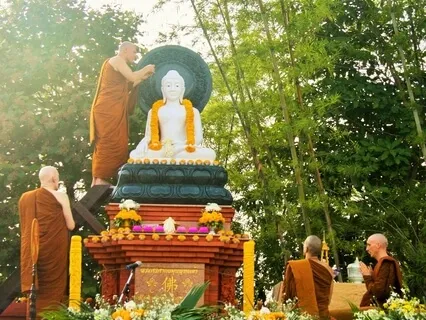
So we've been doing the morning and evening chanting.
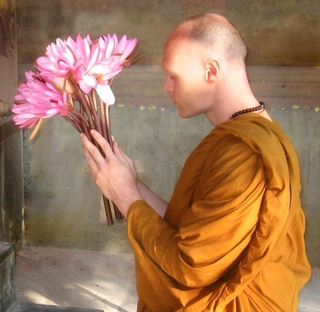
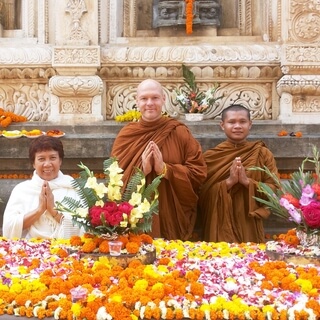
I always light candles,
We've got some nice flowers,
We offer fragrances.
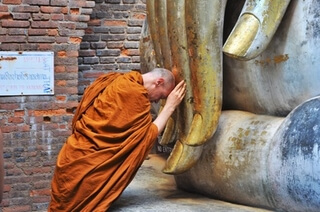
These are ways that we express our faith and our gratitude,
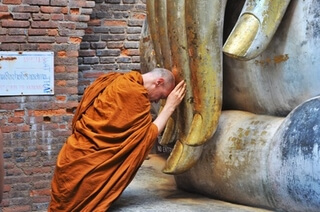
Bowing,
These kinds of things.
It's faith and then energy and then sati.
So what I've been emphasizing as well is the consistency of the mindfulness,
Placing it on the breath,
Coming back to the breath,
Being aware of thoughts as thoughts,
Not picking up the thoughts,
Not following on the thoughts.
So this has been the emphasis on the mindfulness,
Which we'll continue for those who are continuing on in the retreat.
And so what I think you will have noticed is that in the very act of restraining the mind in a skillful way,
And coming back to the breath again and again and again,
Not following on with the thoughts,
Not picking up the thoughts about the past and gently coming back,
Gently coming back and not letting the mind go off into the future and not thinking about a situation at home,
A situation at work and just saying deal with that later.
What happens is energy builds up in the mind.
So you've got sata,
Faith,
Viriya,
Energy,
Sati,
Mindfulness.
So I wasn't placing emphasis on energy.
I was encouraging you to practice in a way.
And I think what you'll notice now,
You've already done 15 sitting meditation sessions and a good number of walking meditation sessions.
So even just within three days of practice,
I think that people will be able to feel that there's more energy in the mind.
That would manifest as a feeling,
A palpable sense of presence,
A sense of clarity,
More of a sense of space around your thoughts,
Around your feelings.
And then because of that,
Because of that,
Then we come to the next one,
Samadhi.
So samadhi,
I like to call it right collectedness.
Samadhi is right collectedness.
So modern people have a debilitating habit of not recognizing the samadhi that they have,
Wanting more and not noticing.
And I really like the way my teacher Ajahn Anand talks about samadhi because he doesn't he doesn't just talk about jhana and the jhanas as being samadhi.
Basically karnika samadhi is when the mind is peaceful for a couple of minutes and upajara samadhi is when the mind is peaceful for longer periods,
Five minutes,
10 minutes,
15 minutes,
20 minutes.
Basically this is all samadhi.
And so in appreciating the samadhi that you have and in inclining the mind to rest with its collectedness,
That's exactly what will condition the arising of jhana in its own time according to nature.
But you have to bring the mind to whatever stillness,
Whatever collectedness it will come to and bring it to that again and again and again and then just stay still.
But it's with this an attitude of appreciation and with an attitude of contentment,
Other qualities I keep mentioning,
Care,
Cherishing,
Appreciation,
These very beautiful mental qualities that the samadhi deepens by itself.
So the way I understand Ajahn Chah's focus is it's the maintaining of mindfulness in all postures.
Mindfulness with clear comprehension,
It's like knowing pleasant feelings,
Neutral feelings,
Unpleasant feelings,
But also knowing wholesome thoughts as wholesome,
Unwholesome as unwholesome,
Various factors of skillful view.
It's in maintaining mindfulness and clear comprehension that the samadhi develops by itself.
And when it does it's a samma samadhi,
It's correct samadhi,
Samadhi that is wholesome,
Not the unskillful type of samadhi.
And so you can see how faith plays a large role in having the energy to then apply the mindfulness consistently,
Having the resolution.
And so we were talking about examples of the monks and nuns going off where there were ghosts and going off where there were tigers and various things that they did because they had faith,
But they were concerned about laziness or lack of consistency.
So they would take themselves to a place where they would really pick up this practice as part of their refuge and then experiment.
What's it like when you really embrace the meditation object and maintain it in being consistently and often getting really great results?
And we had a challenge where we don't have the tigers and we don't have the haunted cemeteries.
So what do we do?
And I was recommending contemplating not just death but also rebirth because myself I have a fear of taking an inauspicious rebirth if I can't be mindful as I'm dying.
I have some fear,
I think it's a wholesome fear,
Skillful fear,
Of not being able to patiently endure with painful,
Racking feelings if I should have a debilitating disease as I approach death.
And so with that kind of healthy concern then feeling inspired or feeling determined,
Feeling resolved to be consistent with the practice,
Keep trying,
Keep trying,
Understanding especially these retreat situations,
The limited time that we have is a time to really investigate is it true what the Ajahn is saying?
If I'm consistently with my mindfulness,
Does some samadhi arise?
If we're kind of looking for amazing,
Blissful,
Radiant states,
You won't even recognise the samadhi that you've experienced.
But basically those periods when there wasn't much thinking and there was a sense of stillness,
A sense of coolness,
A sense of clarity,
A sense of tranquillity,
That's samadhi.
And it's in bringing the mind to that and then resting and doing this again and again and again that that samadhi becomes the jhana samadhi that the people crave for.
But it only comes through laying the causes and bringing the mind to that space and allowing it to rest,
Deepening.
So we have our faith in Buddha and our potential,
We have the energy that arises both from faith and also from consistent practice.
Also energy arises from keeping the precepts.
So when you don't keep the precepts you'll have a lot of remorse,
Anxiety,
Lacking in dignity and self-respect.
So I also put focus on forgiveness because there's no point dwelling on past mistakes,
That's already done.
We do hopefully learn from it but I put emphasis on forgiveness,
Loving acceptance because metta is another way that we empower the mind,
Energize the mind,
Bless the present moment rather than have useless regrets about the past.
The past is the past,
It really is gone.
And yes we all make mistakes but we have to learn from them.
It's when you have metta for yourself that you don't do the mistakes again because you care for yourself and others and recognizing and respecting your potential and then wanting to honor it,
Wanting to develop it,
Wanting to realize it,
Then you won't do things that obstruct that.
So the metta practice,
Another way we give rise to energy.
Faith gives rise to energy but especially the consistency with the mindfulness practice,
Not allowing the mind to run off in fantasies,
Not being distracted in the social media,
In the news and gossiping and all of that stuff.
And so when the energy comes up,
That's what becomes samadhi,
When the energy settles,
When the energy collects,
When the mind isn't flowing out the sense doors as much and isn't flowing out the mind doors as much in thoughts about the past and future,
When it's just able to be in the present and you'll notice it gets more and more energized,
More and more palpable,
A sense of energy that can become rapture and tranquility.
And so I'm sure everybody has some experience of some tranquility and some rapture.
Then we come to wisdom.
So we've got the faith,
Energy,
Mindfulness,
Collectedness,
Samadhi and then wisdom.
So I'm going to go through the Anathalakanasuta,
Speaking of wisdom,
I promise people would go through that.
Basically when I was instructing you to notice the impermanence,
Notice the arising and the ceasing,
Notice the arising and the ceasing.
So that's the wisdom practice.
And then in not thinking about the past and in not thinking about the future,
In just trying to stay in the present,
Seeing a thought as a thought,
Less identification.
That's also wisdom.
A thought arises and ceases,
It's not self.
So when you pick up the thoughts,
Follow on with thoughts and get lost in the thoughts,
There's no wisdom.
But when you're able to detach a little and just see a thought as a thought,
There is mindfulness and wisdom present.
It's just a thought.
Same with the feelings,
Encouraging people to bear with them as much as they can,
Investigate,
Notice the constant change and flux in feeling.
So the awareness of Anicca.
And when you're able to detach,
It's no longer my knee pain,
It's just pain.
And also when mindfulness is good and clear,
Sometimes it's not pain,
Sometimes it's rapture,
Sometimes it's just feelings,
Pleasant feelings,
Neutral feelings,
Painful feelings,
All of them arising and ceasing and changing,
There's actually millions of little feelings there.
If we have a closer look with a clearer mindfulness.
So this emphasis on bright mindfulness,
Consistent mindfulness,
In just looking at things as they are,
Wisdom arises.
Mindfulness is sometimes called truth discerning awareness.
I like that phrase.
So mindfulness is that which sees things more correctly as they are,
With less delusion permeating the experience.
So in those four foundations of mindfulness,
The Lord Buddha is asking us to see the body as a body,
See feelings as feelings,
See thoughts as thoughts and mind objects as mind objects,
Dhammas as dhammas.
In doing this,
Just applying the bare awareness,
The clear awareness,
It sees these things more objectively,
That sense of identification falls away and then you look closer and closer at sight with a magnifying glass or with with good glasses,
Just seeing the characteristics of things.
When you don't identify things as being a self,
That's actually wisdom.
And then letting go of the feeling of being a self,
Not picking it up,
Not projecting it,
Not making karma with it,
And just being aware,
Arising and ceasing,
Arising and ceasing,
Just feeling,
Not my feeling,
Just thoughts,
Not my thoughts.
This is mindfulness and wisdom.
As the retreat progresses and if people are diligent,
This foundation or this momentum,
The insights get deeper.
There can be a really clear seeing of impermanence and then there's a more profound sense of the sense of self dropping away,
An experience of a radiant mind that experiences the body without perceiving it as a self or thinking that it's a self.
So these very practices that you're doing are correct,
The methods that you're doing are correct,
And when you maintain it with enough momentum and so you already have some mindfulness,
You already have some samadhi,
You already have some wisdom,
And it's just continuing and doing it with momentum that these things become deeper,
They become more profound,
And the little insights become deep insights and deep insights can become profound insights,
Profound insights can become liberating insights.
But nobody says it's easy.
It does require diligence,
Consistency,
A surrender,
Really embracing the practice wholeheartedly,
But at least I know some of you have to go back and I respect the fact that you were able to come for three days and you tried really hard.
I think everybody's behaved very well and I'd like you to make a commitment while you have some clarity and while you're recognizing your potential and your nature a little more clearly.
I'd like you all to make some kind of a resolution to take care of these practices and try to make the time to come to another retreat,
Several retreats,
Whatever you can manage,
But just make this a focus because another phrase Ajahn Anand uses is the Arya Sap in Thai,
It's the noble wealth.
Often people are chasing wealth outside and Ajahn Anand says this is the inner wealth and this is the wealth that you can take with you when you die not yet liberated,
Have to take a rebirth,
This wealth you can take and Ajahn Anand says quite beautifully no flood,
No fire,
No storm,
No earthquake can destroy your inner wealth and even death can't destroy it.
So this is what should be the focus of our lives is accumulating inner wealth and it's something that's for people who've grown up in very materialistic cultures and in consumeristic societies,
It's a subtle thing to to really get that every moment of mindfulness,
Every period of collectedness,
Every little insight is actually wealth but it is,
It's the true wealth,
It's the inner wealth,
It's the noble wealth and it's the only wealth that you can take with you.
So I hope that short discourse helped you to understand the five spiritual powers that lead to the deathless.
We're going to have a look now,
The Anattalakana Sutta is a fairly short clear Sutta.
The people who have to leave,
I just want to ask,
Can you raise your hands,
The people have to leave?
Okay,
I'm just going to ask you now,
Who understands what Buddha is a little more clearly of those people?
Very good.
How many people feel more mindfulness than they did three days ago?
Okay,
Did anybody experience periods of collectedness,
Some tranquility,
Stillness?
Very good.
How about seeing things as impermanent more clearly?
Yeah,
Okay.
Less identification with feelings,
With emotions,
With moods?
Very good.
So this is the five spiritual powers functioning in your mind due to diligent practice.
Very good.
Just as a little bit of an introduction to the Sutta,
These five monks in the Deer Park had been practicing with the Bodhisatta when he was practicing the extreme of austerity.
So if you recall,
He was taking,
I think,
A little bit less than half a palm of rice and he said that he became so emaciated that the stomach skin was touching the back skin in his body.
And when he rubbed his when he rubbed his arms,
The hairs were falling out.
And when he got up to go to the toilet,
He would fall over.
And he said that he wasn't allowing himself to enter Jhana,
Even though he was adept.
Because if you recall,
The Bodhisatta had studied with two teachers,
And those teachers had taught him the Jhanas,
Both the form Jhanas and the formless Jhanas.
So the first eight Jhanas,
The Bodhisatta had mastery of.
He had seen that they are a conditioned phenomena that degenerates.
So even though it's incredibly blissful and boundless,
And most people,
By the way,
Would be completely deluded by that.
You would grasp it and you would love it.
And as soon as it degenerated,
You'd do it again.
And it's only the Bodhisatta with this incredible mindfulness and wisdom already present as spiritual powers that he could see this isn't the deathless,
This also dies.
So then he was experimenting,
What about the absolute extreme of patient endurance?
So that meant just bearing with,
I'm sure he was sitting doing this pain practice.
So you all know what it's like to have knee pain if you don't move for an hour.
And imagine the Bodhisatta just sitting all day in the one posture and the racking pains and not to mention the hunger pains and the cold and the heat and all the rest of it.
And so he said about his heroic striving during that period that it is possible for a spiritual practitioner to have suffered as much in the past because of,
As we know,
There's been many previous Buddhas.
But he also did say it is impossible that any spiritual practitioner ever suffered more.
So we know that it was pretty intense.
So at a certain point he realized this isn't working either.
And he decided that he was going to take a bath and he decided that he was going to have some nourishing food because he remembered under the rose apple tree as a youth prince,
He entered an absorption.
He entered,
He remembered that first experience of entering a Jhana,
It was the rice ploughing ceremony at the beginning of the wet season.
And he was under the rose apple tree and he was looking at the beautiful colors and the nice ceremony and the joy and the lovely weather and he closed his eyes and he entered Jhana.
So when you get your Jhanas together for lifetimes,
It might be that easy for us in the future too.
But anyway,
He was looking back on that experience and he realized that that was a kind of a pleasure that was harmless.
It was a type of pleasure that was pure,
It had a certain quality of purity,
Pure mental pleasure.
And he wondered if I was to combine that kind of concentration with focused investigation or contemplation,
Might that be the way that leads to the deathless?
And he had a direct knowing,
Yes,
Yes,
Yes,
That's it.
And so he decided to give up the austerity practice.
So what happened at that point is these five other monks thought,
Gautama has reverted to luxury.
That's the phrase they use,
Gautama has reverted to luxury.
He's a,
And they were disgusted and they abandoned him.
And now the Buddha of course wandered down,
Had a bath,
Sujata and her milkmaids offered him some milk rice.
He accepted eight bundles of kusagras.
He sat under the Bodhi tree and he made his aspiration,
I will not get up until I'm liberated.
Let the blood dry up.
And fortunately for us,
He was liberated.
After he was liberated,
He was thinking,
This is subtle,
This is profound,
Most beings won't understand,
This is going to be difficult to teach,
I don't think I'll bother.
And he delighted in the peace of the liberation for a week.
At a certain point,
Was it Brahma or Indra?
Brahma Saham Patti came down and said,
Lord,
Please teach because there are beings that will understand.
They have little dust in their eyes.
So the Buddha,
Newly enlightened Buddha,
By that stage,
Imagine his spiritual powers totally blossomed,
Totally ripened to their fullest potential.
His divine eye was extraordinary.
In fact,
One of the ways part of his enlightenment experience was reviewing hundreds,
Even thousands of past lives,
Both of himself and other beings.
So incredible divine eye faculty,
Laser-like precision and vast in its capacity to contemplate.
So he scanned the beings of the universe and he saw that beings' minds were like lotus and most were like these small buds in the murky water or down in the mud.
And it was true.
Those beings will not understand teachings on the middle way.
They will not understand the four foundations of mindfulness.
But then he saw there are other lotus buds higher up,
Some close up to the surface of the water already beginning to open and those above the water.
And he realized there are those beings with little dust in their eyes who will understand.
He also,
The Brahma Saham Patti said,
These beings are wilting through not hearing the teachings.
Please help them.
There was a possibility that beings could degenerate if they don't hear this in time.
So Buddha started to think,
Well,
Who could I teach?
He thought of his first two teachers who taught him the Jhanas and he saw with his divine eye that they'd already been reborn in very high Brahma realms as a result of their absorptions.
They'd already died.
They were older than the Buddha and they'd been born in very high Brahma realms and he realized he couldn't teach them.
Then out of compassion he thought of these five companions even though they rejected him and insulted him.
He saw their spiritual faculties were ripe enough that he could teach them and they would understand.
So he walked from Bho Gaya.
By that stage they'd moved on to the Deer Park near Varanasi.
The Deer Park in Isipatana.
So when he went there they said,
Don't greet him,
Don't pay respects to him.
Here comes that reverted to luxury monk.
When they saw him they saw that he was very radiant and they did get up and take his bowl and his robes and made him a seat.
They couldn't help themselves.
Then he tried to teach them in the Dharmachakra Sutta and I think they said,
You reverted to luxury how could you know anything?
And he said for a third time,
Have I ever spoken to you like this before?
I have found it deathless.
If you listen to me I will explain.
And they said,
Okay you haven't spoken like this before.
And so they did listen and Anya,
Kondanya,
Kondanya became a Sotapanna upon hearing the teachings of the Four Noble Truths.
That Dukkha has a cause and that the cause can be abandoned.
In hearing the teaching that there is a cause of Dukkha and the cause of Dukkha can be let go of and that the mind can be liberated from Dukkha,
Anya Kondanya had the insight all that has the nature to arise has the nature to cease and he became the first Sotapanna.
So in the following days Lord Buddha taught this Sutta where he explained when you look at it the words it's a very basic and so just as a bit of a lead up so what we can recognize here is that these were like spiritual heroes.
They were practicing austerity if not as extreme as the Bodhisatta,
Gautama,
A very similar level of practicing hardships and so these people had great patient endurance they had incredible resolution,
Incredible sincerity.
So we read this simple teaching and we understand it as a theory that by the end of the two pages we're not Arahants.
But when Lord Buddha explained it to these bhikkhus after those two pages they were Arahants.
And so this is the five spiritual powers that I was talking about.
When cultivated,
When made much of,
Lead to the deathless,
Emerge in the deathless.
So whatever practice you do cultivating your faith,
Developing your energy,
Sustaining your mindfulness,
Developing insight,
Establishing concentration,
So that becomes a power.
If those powers are not yet powerful even you hear the correct teaching you don't yet become enlightened.
So one does have to cultivate them and then they do need to be at a certain level.
That lotus needs to be about to blossom.
So if we're still down in the mud we've we've got work to do and it's not necessarily that the Ajahn didn't explain it properly.
What's the difference between the Jhana and the rose-up tree and the Jhanas that don't lead to the deathless?
No they do but his insight was combining it with investigation and contemplation.
And was it all of the Jhanas or is it one in particular?
So it's not in the Jhana that you contemplate.
You enter the Jhana and one comes out of the Jhana and then uses the energy from the Samadhi in the contemplation.
So it was the contemplation element that he wasn't?
That's right.
And then the second question is why did he have to be asked to teach?
Like his enlightenment,
When he had come to that himself?
There's different theories about it.
One is,
One interesting theory,
There's a little bit of distraction but one interesting theory is that the powers of Mara and the powers of delusion are very powerful.
Obstructive forces in the universe are powerful.
So when a Brahma god descends from heaven and says Buddha please teach,
All of those heavenly beings notice that and they see oh there is a Buddha,
He's enlightened.
Then they have to do their duty to protect the Buddha and protect Dharma practitioners.
Whereas if they weren't aware of that they might not do their duty.
So that's one possibility.
It might have been a posturing so that that could happen,
So that all those heavenly beings then get with the program and make their Barami as well in protecting the practitioners and the Buddha.
So I think there's probably something to that.
Thus have I heard,
At one time the Blessed One was dwelling at Banaras in the Deer Park.
There he addressed the group of five bhikkhus.
Form bhikkhus is not self.
If bhikkhus,
Form was self,
Then form would not lead to affliction and one might be able to say in regard to form,
Let my form be thus,
Let my form not be thus.
But since bhikkhus,
Form is not self,
Form therefore leads to affliction and one is not able to say in regard to form,
Let my form be thus,
Let my form be thus,
Let my form not be thus.
So it's true isn't it?
Average age of this retreat is a little bit over 50.
Can any of you will your bodies to be 15 years old again?
So it goes its own way doesn't it?
And we can't stop it.
So we refer to it as my body,
But it seems to have its own nature.
Feeling is not self.
If bhikkhus,
Feeling was self,
Feeling would not lead to affliction and one might be able to say in regard to feeling,
Let my feeling be thus,
Let my feeling not be thus.
But since bhikkhus,
Feeling is not self,
Feeling therefore leads to affliction and one is not able to say in regard to feeling,
Let my feeling be thus,
Let my feeling not be thus.
So that peaceful mind state that you had,
Were you able to hold on to it and only experience that?
How many people had the experience of a peaceful mind state degenerating being replaced by a painful one?
And how many people had a painful mind state becoming a peaceful one?
Very good.
But we can't will it to be as we like when we like.
What about the knee pain?
Can you just decide that it goes away?
How about arthritis?
I no longer have these painful feelings.
Perception is not self.
If bhikkhus,
Perceptions were self,
Perception would not lead to affliction.
One might be able to say in regard to perception,
Let my perception be thus,
Let my perception not be thus.
But since bhikkhus,
Perception is not self,
Perception therefore leads to affliction and one is not able to say in regard to perception,
Let my perception be thus,
Let my perception not be thus.
So all of the things we've experienced in the past,
That's how we perceive things.
We perceive things according to our memories,
To our experience.
And so things come up and we perceive them in a certain way.
And it's largely due to the way we perceive them in the past.
So we can't just decide that I'm going to perceive all of the people in the room as devas and appreciate their beautiful qualities every time I see them.
Certain people you see them and there is,
Certain people you see them and there's like,
Ah,
And you know,
This is things latent in the mind functioning.
And there's the same with the weather,
You know,
How people perceive it.
Cold chilly mornings and the mind can become depressed if it's grey for too long,
Become happy and exuberant when it's very sunny.
And these things,
We're not in control of it.
We can be mindful of it,
We can try not to let it overcome the mind,
Overpower the mind,
But we can't control the way we perceive things.
Mental formations are not self.
If bhikkhu's mental formations were self,
Mental formations would not lead to affliction and one might be able to say in regard to mental formations,
Let my mental formations be thus,
Let my mental formations not be thus but since bhikkhu's mental formations are not self,
Mental formations therefore lead to affliction and one is not able to say in regard to mental formations,
Let my mental formations be thus,
Let my mental formations not be thus.
So many times I've said,
Thoughts about the future,
Don't pick them up!
Deal with the future when it comes.
How many people even with this instruction found that the mind ran off into the future and they couldn't really stop it.
Similarly with the past.
And so I mean I mentioned that practice I do myself of noting how many times I think a thought when I get a bit fed up with it just to give myself the message yes I heard it the first hundred times but you can't just say don't ever think that thought again and mine is particularly stubborn if you do say don't ever think that thought again you'll probably find that you're thinking more.
You just have to see thought as a thought not identifying with it but you can't forbid thoughts it doesn't work and so we understand their nature.
How many people feel tormented by their thought formations at times?
Yeah everybody.
So it does lead to affliction.
Consciousness is not self if because consciousness were self.
Consciousness would not lead to affliction and one might be able to say in regard to consciousness Let my consciousness be thus Let my consciousness not be thus.
But since Because consciousness is not self Consciousness therefore leads to affliction.
One is not able to say in regard to consciousness that my consciousness be thus that my consciousness not be thus.
So Sandra must see is a complex thing to understand we have Neconsciousness eye consciousness,
Nose,
Tongue,
Body and mental consciousness.
But just one example is a sense of the bright and happy mind with some samadhi.
That's a radiant mind state,
It's a radiant consciousness.
And so we can't just will that into being.
And then there's the same with depression.
If the mind falls into a depression and there's a sense of gloomy,
Glum,
Grey heaviness in the heart,
In the mind,
You can't just will that away either.
So you can't just say,
May I have the consciousness of.
.
.
Or if you could,
I mean entering jhana at will,
Just these things are a process.
You have to understand their conditions and lay the causes and work with the conditions.
Even with people who are adept at jhana,
There's a process for entering and there's a process for coming out of.
And that was the bodhisattva's insight,
Even the jhanas.
They have causes and conditions and they degenerate.
So that was his profound insight about the jhanas,
Is that they're not permanent.
We can't just have the state of the infinite base of space constantly.
One has to keep generating that conscious state.
So it's not dependable and it is because of that it leads to affliction.
What do you think about this,
Because is form permanent or impermanent?
Impermanent,
Lord.
But is that which is impermanent painful or pleasurable?
Painful,
Lord.
Is it fit to consider that which is impermanent and painful of a nature to age as this is mine?
I am this,
This is myself.
It is not,
Lord.
What do you think about this,
Because is feeling permanent or impermanent?
Impermanent,
Lord.
Is that which is impermanent painful or pleasurable?
Painful,
Lord.
Is it fit to consider that which is impermanent painful of a nature to age as this is mine?
I am this,
This is myself.
It is not,
Lord.
What do you think about this,
Is perception permanent or impermanent?
Impermanent,
Lord.
Is that painful or pleasurable?
Painful.
Is it fit to consider that which is impermanent painful of a nature to change as this is mine,
I am this,
This is myself?
It is not,
Lord.
What about mental formations?
Permanent or impermanent?
Impermanent.
Painful or pleasurable?
Painful.
Is it fit to consider that which is impermanent painful of a nature to age change?
This is mine,
I am this,
This is myself.
It is not,
Lord.
What do you think about consciousness,
Because is consciousness permanent or impermanent?
Impermanent,
Lord.
But is that which is impermanent painful or pleasurable?
Painful,
Lord.
But is it fit to consider that which is impermanent painful of a nature to change as this is mine,
I am this,
This is myself?
It is not,
Lord.
So then Lord Buddha instructs them now how to relate to these things wisely.
Wherefore,
Because whatever form there is,
Past,
Future,
Present,
Internal or external,
Gross or subtle,
Inferior or superior,
Whether it is near or far,
All form should,
By means of right wisdom,
Be seen as it really is thus.
This is not mine,
I am not this,
This is not myself.
This is not myself.
Whatever feeling there is,
Past,
Future,
Present,
Internal or external,
Gross or subtle,
Inferior or superior,
Whether it is far or near,
All feeling should,
By means of right wisdom,
Be seen as it really is.
This is not mine,
I am not this,
This is not myself.
Whatever perception there is,
Past,
Future,
Present,
Internal or external,
Gross or subtle,
Inferior or superior,
Whether it is far or near,
All feeling should,
By means of right wisdom,
Be seen as it really is thus.
This is not mine,
I am not this,
This is not myself.
Whatever mental formations there are,
Past,
Future,
Present,
Internal or external,
Gross or subtle,
Inferior or superior,
Whether they are far or near,
All mental formations should,
By means of right wisdom,
Be seen as they really are.
This is not mine,
I am not this,
This is not myself.
Similarly with consciousness,
Whatever consciousness,
Past,
Future,
Present,
Internal or external,
Gross or subtle,
Inferior or superior,
Near or far,
All consciousness should,
By means of right wisdom,
Be seen as it really is thus.
This is not mine,
I am not this,
This is not myself.
Seeing in this way,
Bhikkhus,
The wise noble disciple becomes disenchanted with form,
Becomes disenchanted with feeling,
Becomes disenchanted with perception,
Becomes disenchanted with mental formations,
Becomes disenchanted with consciousness.
Becoming disenchanted,
Their passions fade away.
With the fading of passion,
The heart is liberated.
With liberation there comes the knowledge,
It is liberated and they know.
Destroyed is birth,
The holy life has been lived out,
Done is what had to be done,
There is no more coming into any state of being.
Thus spoke the Blessed One,
Delighted the group of five bhikkhus rejoiced in what the Lord had said.
Moreover,
While this discourse was being delivered,
The minds of the five bhikkhus were freed from the defilements through clinging no more.
So that's a really wonderful and awesome paragraph and that sentence in particular.
Becoming disenchanted,
Their passions fade away.
With the fading of passion,
Their heart is liberated.
That's simple.
So this is an interesting word,
Disenchanted.
I think in Pali it's Nibhida.
And the passion's fading,
Viraga.
So there's some important things to acknowledge about that as a process.
So we are fascinated,
We're engrossed and fascinated,
Deluded by our bodies and our minds.
And we're very committed to it.
And when things go wrong,
We like to blame things.
It's the government's fault or it's the weather's fault,
It's the neighbor's fault,
It's the kid's fault,
It's the dog's fault.
And often we don't look at the fact that it's our grasping that's the fault,
It's our attachment that's the fault.
And so when we become more mindful and more wise,
We get that.
We get that,
No,
It's my attaching,
It's my thinking that I'm a self that's a problem.
And it's my liking and disliking,
That's the real problem.
And then this sense of dispassion,
You get fed up with that.
And the reason I wanted to mention this,
This is wholesome.
This is a growth in wisdom,
By and means.
This sense of being weary,
Being fed up.
And that doesn't mean to say that you get angry and depressed and bitter and cynical.
You have to understand kind of a spiritual weariness is a wholesome thing,
But it's no longer fascinated.
You don't buy it anymore.
You no longer think that you're going to be able to get samsara right.
You're not going to be able to get samsara in order.
You're not going to be able to arrange it in a certain way that you don't suffer anymore.
You get that condition of being weary.
You're not going to be able to getSNWF AIDDIXiS The physical conditions are flawed.
They are painful.
They are impermanent.
And then you get that you have to let go of your attachment to it.
And that's where you become disenchanted with all of the tastes,
The sounds,
The sights.
Because you know,
They only give so much pleasure.
And that pleasure doesn't last.
And then there's the pain of being separated from it.
And in being attached to the pleasure you don't just get the pleasure,
You get all the pain that's associated with the body and mind as well.
And you just get that sense it's not worth it.
It's not a good deal.
And you develop that intuition there's something better.
And that confidence you are capable of experiencing something more dependable,
More satisfactory,
Ultimately completely satisfactory,
But it takes work.
But this process of being disenchanted,
Becoming weary.
This is what brings people to meditation retreats.
This is what brings people to their meditation cushion.
And one of the proximate causes for the arising of faith is actually suffering.
If you don't have much suffering you don't get around to investigating spiritual refuges unless you are born into a spiritually rich culture which still has some integrity.
But most people it's when life gets painful past a certain point that they start to seek the spiritual refuge.
In becoming disenchanted that means that you don't go chasing after it anymore.
That's what allows the passion to weaken,
Becoming dispassionate,
Weiraga.
So there's the weariness.
You spend more time alone.
You spend more time meditating.
You don't chase after these things.
You restrain your sealer and you refine your sealer.
In not acting on the greed,
In not acting on the hatred,
It starves.
And the thickness of that chelaza that obscures your capacity to see things truthfully,
The darkness of the greed and the hatred gets thinner and thinner and thinner.
And this thin veil of greed and hatred and then the spiritual powers,
The mindfulness,
The wisdom,
And then the energy.
You have the capacity to throw it off the mind,
Explode it out of the mind if you like.
And so this process,
Becoming weary is actually an important part of the process.
And then seeing the suffering,
I was talking about Ajahn Anand says the beginning stages of practice can feel like you're in the burning house.
Everything's on fire and it can feel like you don't have anywhere to go.
But seeing the dukkha clearly is really important because that's what inclines the mind to want to go inwards to the only place where there isn't dukkha.
The only place where there isn't dukkha is your own purified mind and your own capacity to let go of your attachment.
Then Anand Samedho says that which knows suffering isn't suffering.
Anand Anand said it's through patiently enduring with knowing those painful feelings.
So that's patiently enduring with mindfully knowing the unsatisfactoriness that it becomes possible to see the burning house but not be in the middle of it burning.
Part of the mind which knows this dukkha is cool.
Mindfulness starts as a bit weak but through training in mindfulness consistently it becomes strong mindfulness.
Strong mindfulness becomes consistent strong mindfulness and that becomes eventually what they call mahasati.
Mahasati has the power to destroy the kilesa.
So this is a process becoming weary.
Then you have to put energy into cultivating your powers because if you want something better you have to work to establish that which is better in the mind.
Other people who did it,
The Buddha and the Sangha,
But we have to do it.
That's when it becomes the inner refuge,
The spiritual qualities that become your own inner Buddha,
Your own inner Sangha.
You become one who is practicing correctly,
Practicing rightly.
Then you experience what it's like to have good sati,
Being able to detach,
Being able to see things as objects,
As feelings,
As a body.
In doing this more consistently the passions fade.
In fading the mind is liberated.
So good to have confidence where it goes.
Once those faculties have become powers and once those powers are powerful enough the day will come where you will be able to say done is what had to be done.
There is no more coming into being and you became one of the noble ones.
So I offer that for your reflection.