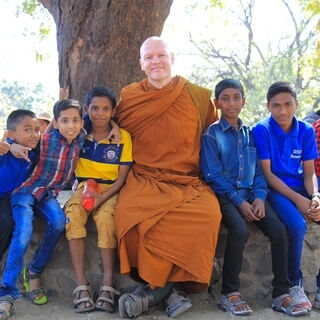
It seems like not many Australians know about Ladakh,
But it's a very popular holiday destination,
Particularly for French people and German people.
Possibly because these people like mountaineering,
They have Alps.
So the capital city of Ladakh is 3000 meters high.
That's the lowest point.
And then everything else is higher.
So to go to this lake,
This lake had the name Somareery,
Lake Somareery,
And it's at 4,
700 meters,
But you had to pass a 5,
000 meter pass.
So we stopped and we meditated at this 5,
000 meter pass.
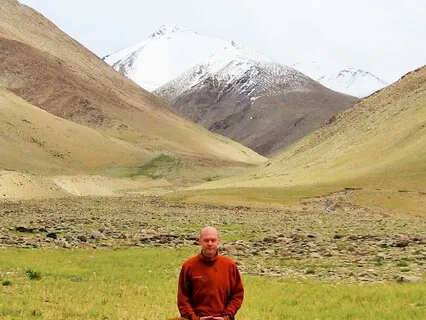
Very beautiful,
Open expanse,
And it was surrounded in the distance by a mountain slightly higher which had snow on top.
It looked a bit like being in the middle of a lotus,
A huge lotus where the petals had snow in every direction.
And then this blue sapphire,
Blue sky,
No clouds on that day.
And I was kind of contemplating that and getting a sense for why these so many French people and German people will come all this way,
Go trekking to try to be close to that sky and to be on those mountains.
And you notice that it's hardly any trees.
In fact there's no trees once you get past a certain point in summer,
Very few clouds.
So there's a certain kind of austerity to the aesthetic.
Just brown dust and white caps and blue sky.
The other thing about Himalayan air for people who've been there is because there is so little dust and so little moisture,
It's crystal clear.
So you can see very vast distances as if they're not very far away.
And so I was thinking,
What it does is it seems to help the mind still when you're in that kind of environment when there's not much to send the mind out towards.
I think many people who don't meditate find that in that environment they experience a heightened sense of spaciousness,
Have a bit of an experience of emptiness.
And then I think that combined with less oxygen,
I think people feel tired.
So they don't quite have the same amount of energy to think.
And so what I suspect is going on is that people are getting on these planes,
Saving up a lot of money,
Getting on these planes,
Coming this great distance,
Experiencing altitude sickness,
So that they can experience a little bit of spaciousness in their minds and less thoughts and notice emptiness.
So when we were at this lake,
This is 4700 meter lake,
There was a high point with this incredible view.
This lake is huge,
Maybe 5 kilometers wide and 20 kilometers long.
And at the end of the 20 kilometers was Tibet.
And geographically it is on the Tibetan plateau.
And so for myself it felt very much like,
Okay,
I feel like I've been to Tibet now,
As being kind of up there,
Seeing the snow,
Seeing that big sky and hearing that silence.
And so I was meditating on top of this mountain.
And on top of this mountain it was very beautiful visually,
But whenever I closed my eyes,
A slightly creepy feeling,
I couldn't explain what it was because everything was empty.
But I meditated there anyway many hours and I found out that that particular point at the top of the mountain was where they'd been burning bodies for several thousand years.
So that was the charnel ground.
And something happens in these places where you burn bodies for a long time.
It gets a certain kind of a,
I suppose you'd describe it as a creepy feeling.
And that probably comes from maybe a certain number of tormented spirits still hanging around that gets somewhat stuck.
And so even you don't know it's a charnel ground.
If you go there and there's a beautiful empty sky and it's a sunny day and there's nothing,
You cross your legs and you meditate and you can feel,
This is interesting,
What's this energy?
And so I found out that that was the place where they burnt bodies.
Of course the Buddha recommends meditating in those places.
One meditates in those places to contemplate impermanence and not self.
But most people will agree anywhere where they burn lots of bodies there is a slightly creepy feeling.
So the next day I thought okay I'm going to find a different meditation spot and I walked down to the bank,
The bank of that lake.
And so I found this little,
I suppose it's a beach but it was about three meters wide because everything else was rocks and steep.
And I found just around this rocky ledge a three meter long,
One meter wide beach of pebbles which was directly joining this crystal clear lake.
And I thought okay this looks like a nice place to meditate.
And so I was meditating there and a funny thing happened after about half an hour.
I enjoyed that,
The sky and looking at the reflection.
You see the mountains reflected perfectly in the water,
Like it's mirror-like reflection.
It's a beautiful,
Very nice visual thing to take in before meditating.
So I closed my eyes and then after about half an hour I heard these footsteps.
Stomp,
Stomp,
Stomp,
Stomp,
Stomp on the stones.
And then I heard this noise,
A woman's voice and she went,
Ah!
And so I opened my eyes and I turned around and it was a Caucasian lady and I said,
Hi.
And she said,
I am looking for the perfect place to meditate and this is it.
And you got here first.
So it turns out that she was German and she was working in an airport in Frankfurt and she had five days off so I asked her who she was,
What she was doing.
And I said to her,
I said,
Well I have a lot of time to meditate and there's plenty of places to meditate.
I'll give you this beach if you really think it would be helpful.
You can have it.
She said,
No,
You got here first but you must admit it's the perfect place to meditate.
I said,
Yeah,
It's a very nice place to meditate.
But it's just very interesting,
Isn't it,
That if you haven't trained in meditation there's a sense of you need that environment.
It is a helpful environment but actually you don't need it.
And you see this poor woman who saved up the money and got on the plane and has battled with altitude sickness and stomping across the mountain and she finds what she thinks she needs,
This little bit of beach next to this lake,
And she finds someone else's there.
Oh.
So that was interesting.
But my kind of work was contemplating observing the various tourists and just that sense of,
And then also observing the nomads.
Observing these nomads and you can see the big empty sky in their eyes,
These people who live up in the mountains.
They don't think they think about very much and then they have these prayer wheels and they're kind of,
So basically they're doing their mantra,
Which is very similar to buddho in the Thai tradition.
It means staying with one object and you use this mental recitation to do that.
And of course they're spreading loving kindness,
Which we also do with our inbreaths and outbreaths,
But they're doing it with their prayer wheel.
So they're doing their mantra and they're doing their prayer wheel.
Basically they're staying one-pointed and they're ready and in loving kindness.
And you see these very old ladies and these old men just completely covered in wrinkles and I heard a rumour that they bathe once a year but I think it's not true.
The ones I saw looked like they hadn't bathed in about five years.
So they're very dirty physically and the wrinkles are covered in,
They're full of black grease,
But they look really clean.
Their minds look really clean and their eyes look really beautiful and they're very pleasant people to be near once you get over the smell.
And so I think it's true,
That kind of environment can be helpful for meditation.
But it's not necessary to go to the Himalayas of course.
It's like many people go into caves,
Don't they?
And it's for the same reason.
The reason you go into a cave is to cut back on the sensory input so that you can have a more simple visage and you don't have so many things impinging the mind.
But I just wanted to affirm that we don't need to go to the Himalayas,
We don't even need a cave.
All you have to do is close your eyes and then that world is gone.
And then what we do,
If the world is still impinging,
That's because we're doing something with our minds.
So when we're practicing breath meditation,
We're practicing dropping the world,
Letting it go.
And if you can stay with this perception of the breath,
If you can just be with the feeling of the in-breath and be with the feeling of the out-breath,
Of course at the beginning of the session there's going to be thoughts about the past,
Thoughts about the future,
Thoughts about other people.
There'll be kind of lingering feelings,
Things that people said that hurt our feelings or maybe somebody is picking a fight or being disharmonious or maybe we said something that we regret.
You know,
Often we close our eyes,
We come to our meditation cushion,
There's something there,
That's normal too.
But then we're using the breath to kind of ventilate that experience,
Wash away emotions and basically put it all down.
And then let that empty nature of awareness simply arise in the mind.
Because the mind has that nature,
The nature of knowing there's nothing solid about it at all.
For Mind Gets Peaceful,
Most people experience a feeling of spaciousness,
Of openness,
Of lightness,
Of brightness,
Just like you might do on a sunny day in summer on top of the Himalayan mountains.
But that's right there,
Inside.
And all we have to do is be diligent,
Without being too tense,
We be diligent about dropping the thoughts,
Restraining the mind gently,
Keeping it in this present moment and using that breath as a tool.
So we simply notice the feeling and we place our awareness,
Mindfulness on the feeling of the breath,
The in-breath and the feeling of the out-breath.
And the longer you can do this,
Just by being interested and just by maintaining this focus,
This gentle focus,
You will experience things just drop away.
And then another thing drops away and then another thing drops away.
And then if we meditate for long enough,
Lovely sense of emptiness,
Not-self.
Feelings are not-self,
The body is not-self,
Thoughts are not-self,
They arise,
They pass away and they're not-self.
So we practice a bit more breath meditation for the next half hour.
Just want to encourage you to use the method that you've trained with most.
So if you're using a mental noting,
Some people it's buddho,
Budd on the in-breath,
Do on the out-breath.
Other people it's in and out,
Other people rising and falling,
Other people count.
Any of those methods are okay,
We're just remembering the purpose of mental noting is to keep us with our task,
Restrain the thinking,
Using a skillful means to restrain the thinking,
And just coming back to be with that in-breath,
Be with that space between the in-breath and the out-breath,
And then to be mindfully aware of the out-breath.
So the Buddha and other enlightened beings repeatedly explained to us that this thing called merit or punya in Pali is very helpful,
And supports us.
The Buddha said once that we should not criticize people who do things for the sake of merit,
Because he said merit is synonymous with happiness.
So the result of merit is more pleasant feelings in life,
More opportunities,
People help us,
Obstructions are cleared away more easily,
Supportive influences manifest.
So merit is a very helpful thing.
So we might go through what are the ways that one produces merit.
Most people know,
I'll just ask you,
How do you make merit?
If you want to make merit,
What do you do?
Any ideas?
Be generous,
A good dana.
So what are some ways to be generous?
Yeah,
To be charitable.
What do we offer?
What do we give when we're being generous?
Our time,
Our energy,
Yep.
Anything else?
Some money,
Money that we worked for,
And things,
Useful things,
Various ways to be generous.
And the result of generosity,
I was talking about this last week,
Is that it makes other people's lives easier.
So what that does,
The kind of karmic force that that sets in motion is that if we meet with some difficulties,
Supportive influences come,
People help us.
We've made a lot of good karma,
When we get in trouble,
People help us.
If we get separated from our wealth,
If we've been very generous,
There may become new ways,
New incomes or money comes from mysterious sources,
If we've been generous.
Another way to make merit?
Meditation.
Yeah,
Meditation,
Very good.
It's traditionally taught as a threefold training.
So what comes before the meditation?
Sela,
That's right,
Virtue.
So maintaining ethical standards,
Being a virtuous person creates punya.
So what this means is a very interesting idea to contemplate.
It's not just what we do,
It's also what we don't do.
So not doing certain things makes good karma.
That's very interesting,
Isn't it?
The reason it makes good karma is to keep these five precepts strictly,
Is you actually have to consciously restrain some of your desires,
Don't you?
So we all have the idea that we want to do certain things and then if we have conscience,
Sometimes we think,
Well,
That might not be such a good thing to do.
And we have to restrain things in the area of sexual desire,
In the area of greed,
In the area of aversion.
We have to put a container around it,
The greed and hatred that visits our minds.
And so in maintaining that and resisting these energies,
It creates a lot of good karma.
That's a good thing to know.
And then we come to our meditation practice.
So skillful meditation,
Placing the mind on a wholesome meditation object,
Creates good karma.
But if someone's sitting there and indulging in unskillful fantasy or thinking the whole time,
That's not going to make any good karma,
Is it?
So it has to do with the meditation object also.
It has to do with the purity of the intention.
So when we understand the five hindrances as hindrances,
We talked a little about those last week as well.
We see restlessness as restlessness.
First of all comes essential craving.
So we see craving as craving,
Try not to follow it in the meditation.
We see irritation,
Aversion,
Anger as another hindrance,
Try not to follow it.
Drowsiness here,
That's another one,
That's the fifth one,
And the fourth one.
But anyway,
So restlessness we have,
Restlessness and agitation.
And then we have sleepiness,
Dullness,
And then we have doubt.
So when you doubt about the meditation method or you doubt,
Maybe you wonder was the Buddha really enlightened or the Arahants really enlightened?
Is there such a thing as enlightenment?
These kind of things,
These can obstruct meditation.
So in right meditation,
Skillful meditation,
We mindfully apprehend a hindrance,
We see a hindrance as a hindrance,
And then we try to let it go.
The way we let it go is by placing the mindfulness,
And I've been saying this repeatedly,
Is by placing the mindfulness on the actual meditation object.
So when we do that correctly,
The other things just drop away.
So you don't have to fight the hindrances,
You don't have to kill them,
You don't have to grab them by the neck and throw them out.
It's like you just know that there are hindrance,
Try not to be interested.
Take the interest off them and put the interest on the meditation object,
Which today has been breath meditation,
Contemplation of death of impermanence was another one,
Loving kindness was another one.
So we know at the beginning of the session,
We know what our meditation object is,
We set the intention to meditate upon that object.
And then when the hindrances come,
We simply know a hindrance is a hindrance,
And we try to let go of it,
Place our interest on the meditation object.
What usually happens if we do that sincerely enough,
With enough resolution is that the hindrances do drop away,
Or at least they get more subtle.
So you get nice spaces,
Gaps between thoughts and feelings,
And really important to notice those spaces and notice those gaps.
And this is what meditators get very interested in,
Because the world is full of things,
And I think about the outside a lot.
So in meditation we're turning inwards,
And we notice these spaces open up,
I was talking a little bit about that Ladakhi Himalayan sky that people travel a long way to see.
They say,
Well actually if we meditate correctly,
That kind of spacious vista opens up internally.
Clouds drop away and you just get an experience of no things.
It's like nothing.
It's not nothing,
But there's no things.
So it's awareness.
What remains is awareness,
Hopefully aware of its object.
And as people who cultivate breath meditation a lot,
Eventually discover is that at some point even the breath can drop away.
When that awareness gets so profound or so clear or so bright,
Even the breath drops away,
And there's an even more profound experience of emptiness,
Spaciousness,
Beautiful quality of knowing which is established very firmly in the present.
So one of the things in terms of we're talking about making merit,
Coming back to that theme,
Making the mind peaceful,
Creates a great deal of merit,
Generating loving kindness because it's intensely positive.
It's at the most wholesome spectrum of emotions and mind objects,
Loving kindness,
As well as compassion,
Appreciative joy and equanimity.
The Brahmovihara is the divine abidings,
Also called the immeasurables,
Boundless qualities.
So any of those meditations create a great deal of good karma.
And then the other one,
You might be interested to know this,
Is one moment of a clear perception of impermanence creates the most merit possible.
So that's why you might wonder why monks are always going on about impermanence.
And it's somewhat of a duty that we have because the Buddha said that contemplating impermanence is always skillful,
Always correct,
It's in accordance with truth.
As far as contemplations go,
It is the contemplation which is most conducive to cultivating wisdom.
So we consciously contemplate impermanence.
And one of the best ways to contemplate impermanence is to contemplate our own death and the death of others.
Because the body,
The physical body is the thing that we are most identified with generally.
So when we contemplate the fact that this physical body,
Which I tend to think is me,
Is going to meet the day where the breath stops and the body stops moving and the people around us will say,
He's dead or she's dead.
So that's going to happen to all of us.
And when we contemplate that with sincerity,
Something happens in the mind.
For some people,
There might be a bit of anxiety or a bit of fear,
But if we just stay with that contemplation,
What usually happens is a kind of a stillness.
The mind just kind of sobers up and it kind of gets it.
It's like,
Oh.
And then there's this,
I keep talking about these spacious moments,
Moments of collectedness where hindrances drop away.
It's like the mind became sober.
It's just interested.
It's like,
We're usually fascinated with my life and my thoughts,
My feelings,
My future,
My plans.
And when all of a sudden we kind of confront it with the fact that that could stop today.
Everything that I identify with that seems so engrossing and so important,
It could all stop today.
So then the mind gets interested.
Well,
Maybe it's not that important.
Well,
Then what is the most important thing?
And then we could develop an interest in this emptiness,
This spaciousness,
This silence,
This other thing,
Which is much more subtle.
It's like the nature of the mind itself.
So various analogies can be used.
Like we start to pay attention to the sky instead of the clouds,
Or you pay attention to the sea instead of the waves.
It's like it's going,
Going down deeper.
It's more subtle.
One of the challenges of monks is to try to talk about impermanence and death in ways which are interesting,
Because we've all heard lots of impermanence talks.
So I'm going to try to talk about impermanence in a way which is interesting.
I don't know if I'll succeed or not.
But one of the nice things about going on pilgrimage back to India is that you do end up with some interesting things to talk about.
And it's nice to be able to share that.
So last year in Varanasi,
I had the opportunity,
I had some friends from England actually,
A good friend of mine.
I don't know if anyone's seen these Dharma thread CDs,
But he stores all of the data at his home and he prints them all.
He does it for free and then sends it up to people who distribute these things.
So thousands and thousands of CDs.
He's been in hundreds and hundreds of Dharma talks and thousands and thousands of CDs.
He's been directly involved in producing for free distribution all around the world.
And I met him in England,
A very lovely man.
And he was saying how he wanted to go to India one day,
But didn't want to go alone.
And so I thought,
Well,
I'd like to help him.
Because going to India from Bangkok is a four hour flight,
It's very easy.
A lot of Thai people go to India now.
And in fact,
Many people I know go to India once a year.
In the seventies in Thailand,
People would go to remote monasteries in Thailand and try to pay respects to Arahants.
They still do that,
But now they try to go to India,
India once a year instead,
Or to Bhutan or Tibet or somewhere.
They like Buddhist pilgrimage,
Being Buddhists.
If they go on a holiday,
They want to practice on their holiday,
Many of them.
So I met,
I agreed with Julian to meet him in Varanasi.
So Varanasi,
Many people know,
In Varanasi there's a river bank called the Burning Ghat.
And so he had arranged for us to stay for two nights at a guest house on that river,
On the Kanchi River,
Directly on the river with the view of the river.
And that sounds very romantic,
But if you knew some of the things that went on in that river.
But anyway,
You can witness from your window.
And so anyway,
We arrived and they'd arrived from England,
I'd arrived from Bangkok.
My friend Julian and his friend Paresh,
He was Indian.
So we were lucky,
We had an Indian with us.
And so we were thinking,
What should we do?
Should we rest?
But we were in Varanasi and I had this sense that to go and look at the Burning Ghat late at night would probably be the best time because it's almost,
It's a very big tourist scene now too.
It's quite a scene.
And so you tend to get harassed in India if you're in a tourist scene.
And so it was very close to midnight.
And we decided to walk down from the guest house to the,
To the Burning Ghat,
To the main Burning Ghat.
And so we were walking down there and so we were standing there.
And I think there was about five bodies burning at that time,
That was at midnight on piles of wood.
So in India,
What they do is they wrap them in cloth first.
They wrap them in cloth so you can't actually see the body.
And then they place them on top of this wood.
And then they place some kind of fragrant herbs and things on top,
A little bit of tinsel,
Some decorations.
And,
But what you do see is that because the wood is very expensive,
Often the body doesn't get completely burnt.
And so there's these dogs,
There's these dogs waiting around for the,
For the leftover bit of barbecue basically.
And so,
And then so it's a very fascinating scene at midnight in the dark because they're on this riverbank.
There's like five bodies in the process of being burnt.
And I think there were three or four wrapped up,
Ready to go that weren't yet placed on the pyres.
And then there was kind of,
You know,
One or two that are kind of being scraped into the river and dogs kind of taking the leftovers.
And then you've got the families,
Kind of grieving families and all the whole scene around that.
Some men are busily shaving their heads because when I think when somebody dies in a Hindu family,
The eldest son has to shave his head and he has to light the fire and all these Brahmanical rituals.
But it's a very interesting place,
Very powerful place to contemplate death,
Isn't it?
If people have the opportunity to go to places like India,
I think it is good because it's a,
It's a good thing to see.
So it's standing there and you can see,
Okay,
Five bodies burning,
A couple waiting to be burnt and a couple already burnt dogs eating remains of human beings and all these people grieving and just this sense of the timelessness of that experience,
Like how long that's been going on for.
And so we did a rough calculation.
Like it was said,
It's said in the suttas that Varanasi had already been a big thriving city for a long time by the time the Buddha was born in that final birth.
So that's 2,
500 years ago.
And so I was just thinking at that place where I was standing,
Suppose,
Because it's a city,
Suppose 10 people a day got burnt on the banks of that river for the last 2,
500 years.
We worked that out.
That meant nine million bodies.
So my friend pulled out his mobile phone and he was like,
It kind of was a postmodern pilgrimage.
And everyone in,
Almost everyone in India has a mobile phone now too.
And the middle class,
The lower middle do.
And so it was just standing there and it was a very powerful reflection,
Isn't it?
To think that on this bank of this river in 2,
500 years,
Nine million corpses have been burnt.
It's just a,
And it's very powerful.
It's like a lot of people,
They say that Varanasi is a holy city,
A sacred city.
If you ask me,
When you're down by that river,
It's really creepy.
And when you get up to the alleys where there's all these kind of statues of Ganesha and Krishna and there's all these little temples and there's all these cows,
Okay,
That's got a different feeling.
But when you're down by that water where all those bodies have been being burnt day after day after day for thousands of years,
There's a particular feeling there and I wouldn't describe it as holy.
And so on that note,
I have a story from another monk,
A student of a monk.
So she was probably an old Hindu and she'd been born in Thailand and she wanted a souvenir from the Ganges River.
So she took some of this water in a little bottle and she took it home.
And then she dreamt for night after night of these angry Indian ghosts,
Hundreds of them coming to her in big rows,
Kind of upset.
And so she went to one of our teachers and she and she said,
I keep dreaming of these Indian ghosts.
And he said,
Well,
Well,
Is there anything in your house?
What's going on?
She said,
Well,
I took some water from the Ganges River.
And he said,
Oh,
And he explained that so because in the Hindu belief system,
If you just get,
If you just make it to that river,
When you die,
According to that Hindu belief,
You can wash away your sins and Shiva will take you to his Brahma realm.
And so many people have this belief on a kind of a folklore level.
And so many people desperately ill,
Very,
Very old,
You know,
Kind of getting to,
And you see this,
You know,
People trying to get to Varanasi to die by the river.
And so,
And at that time,
We were standing on the river with these bodies burning for sure.
There were many people in the hostels and places close by waiting to die.
Many people very close to death waiting to die,
Because they believe if they get burnt on those banks and get thrown into that river,
That they get to go to heaven.
It's a guarantee.
And apparently it seems like it's not a guarantee.
And as the Buddha said in the suttas,
If you've made a lot of meres,
Talking about rebirth,
He said,
Actually,
Even if we have a lot of good karma,
There's no guarantee for heaven.
He said,
Because we've all made bad karma as well.
He said,
At the moment of death,
It's like you throw up a stick,
And you don't know,
And it's spinning,
And you don't know which end is going to hit.
And he said,
That's what happens at death.
There's no guarantee.
But generally speaking,
If people make a lot of good karma,
They're going to go to a good,
A good destination with opportunity.
And if they make a lot of bad karma,
They're not going to go to such a good opportunity.
So it's like,
He said,
It's like throwing butter into a river for those people with a lot of punya,
A lot of good karma.
You throw the butter into the river and it floats.
Similarly,
If you've made a lot of bad karma,
A lot of negative deeds,
It's like throwing rocks.
And it's like,
It's very difficult to get a rock to float.
And so what he was explaining,
That teacher was that those beings,
Consciousness was so attached to the idea of the river.
The river was going to absolve their sins and wash away their sins and it was going to be their ticket to heaven.
So they're dying in that last moment with all this attachment to the river.
So he said,
Almost every molecule of that stretch of the Ganges in Varanasi is full of ghosts.
So I said,
That would explain the creepy feeling that,
That I had anyway,
When I was down by the river.
So it's a,
It's very interesting.
Now,
Of course,
If someone did have merit,
I don't want to say anything anti-Hindu,
If someone did have merit and they really had belief in,
In Shiva,
If they had enough merit,
Quite likely they can go to heaven and live with some kind of Godhead,
Some kind of deity in a heaven realm for a period of time.
But this is conditioned by merit.
And,
But the thing that really makes something holy,
I was contemplating this on the banks of the Ganges is,
Is what we're doing with our minds,
Isn't it?
So when the Buddha says to,
To really pay attention to this truth of impermanence and to allow consciousness to be informed by this.
And then with that,
If we understand feelings are impermanent,
Thoughts are impermanent,
The body is impermanent,
Contemplate this,
And then the mind becomes very peaceful and that sense of self can drop away.
And then you have something holy happening.
You have a genuinely peaceful mind with wisdom and that's holy.
And that has to occur in,
In our minds as individuals,
In our mind streams,
Wherever we are.
So as I was saying before,
You don't need to be on the mountaintop in Ladakh and you don't need to be on the banks of the Ganges to have a holy or a sacred experience.
What we need to have is mindfulness,
A correct meditation object,
Sustain our mindfulness on that meditation object,
Apply some wise reflection.
And then if you have an experience of peace and insight into impermanence,
Well then wherever you are is a holy place,
Isn't it?
And that,
And that mind state is sacred.
When we're cultivating the Eightfold Path,
Or having an insight into the Four Noble Truths,
Then wherever we are,
That place is a sacred place.
So here we are at the BSV,
And we can try to make it a holy place.
So close our eyes.
I might give a few death reflections,
Something of a duty.
I know some people don't like it.
And it's just,
But it's good to be,
It's good to have that context,
That understanding that a true perception of impermanence creates the most merit possible.
That's going to have enormous benefit for the future.
Being mindfully aware of the fact of death and having meditated upon death also increases your chances of dying peacefully with less anxiety,
Less worry,
Less fear.
We just accept it.
This is a part of life actually.
And until you're enlightened,
I'd like to think of death as being a part of life.
It's the opposite of birth,
But it's not the opposite of life.
Because if you're not liberated,
Death only goes for a few moments.
Consciousness has to go on to another birth.
So it's like,
Death is just a few moments and then there's rebirth.
So it's the same with our breath,
Isn't it?
We breathe in and then we breathe out.
It's the birth and the death of a breath.
And the same with the feeling.
It comes,
It stays for a while,
It ceases.
The birth and the death of a feeling.
And it's the same,
We've been told and I believe,
With these bodies.
They're born,
They live for a period of time and then they die.
And then consciousness fueled by karma will pick up another kind of a body,
Another kind of conscious experience.
So it's just good to be somewhat ready for our death whenever it occurs.
Having contemplated the possibility,
Having accepted this truth.
But we start with some breath meditation.
Closing the eyes,
Being mindfully aware of the in-breath.
Being mindfully aware of the out-breath.