Begin by offering my greeting.
Good morning to our friends in North and South America.
Good afternoon to our friends in the UK and Europe.
Good early evening to our friends in the Arab states and India.
Good evening to our friends in Thailand,
Malaysia,
Singapore,
Indonesia and good late evening to our friends in Australia.
Good to see you.
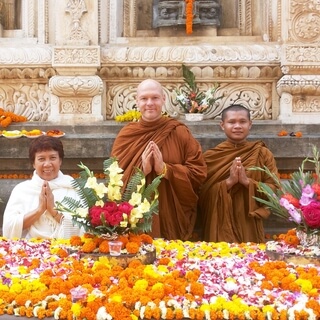
We recently had our Katina ceremony,
An annual event if you have more than five bhikkhus for the rainy season retreat.
It was attended by 43 monks including Tanaj and Anan,
10 other abbots and we had about 55 residents in the monastery for about a week,
Another 15 at a house in front of the monastery,
70 plus 30 Malaysian guests in a nearby resort.
So we had approximately 100 friends for a week and 300 day guests on the day of the Katina.
So a little bit tired but happily,
Happily tired.
So many friends.
We had the offering of a new Maha Thera reception complex in the monastery.
Tanaj and Anan said that many auspicious influences did manifest,
Give their blessing at the ceremony.
So it was quite auspicious,
I believe.
Nice to see your faces.
We have some questions.
Yes,
Kap.
Question one,
In order to one day become a Sotapanna in this lifetime or some lifetime very soon,
Should we try to emulate qualities of a Sotapanna to sort of fake it till you make it?
Many suttas in Samyutta Nikaya 55 describe the various qualities of a Sotapanna.
They have faith in the Buddha,
Dhamma and Sangha,
Have ethical conduct loved by the noble ones.
They don't kill,
Lie,
Steal,
Commit sexual misconduct,
Engaging in the various aspect of wrong speech or consuming toxicants.
They are freely generous and love giving.
And they have wisdom of arising and passing away,
Of dependent origination.
The stream is defined as the Noble Eightfold Path,
Right view,
The right concentration.
And the stream entry is said to possess the Noble Eightfold Path.
Majjhibani Kaya 115 also says that the noble disciple cannot view any conditioned phenomena as permanent,
Pleasurable or a self.
And they cannot murder their mother or father,
Intentionally injure Buddha,
Cause schism in the Sangha or dedicate themselves to another teacher.
With gratitude for your thoughts and advice.
The question with regards for people who have the aspiration to become a stream enter in this lifetime,
Or a life soon after.
So that's what is a stream enter.
Stream enter is someone who experiences deep insight into the ultimate nature of mind and conditions,
Experiences the unconditioned and then has unshakable faith in Buddha,
Dharma and Sangha,
And is then predisposed to being ethical.
So those five precepts that Lord Buddha recommends that lay people keep,
Apparently stream enters can't break them.
Their goodness is so established in their heart,
They know what is virtue,
What is non virtue,
What is ethical,
What is unethical.
And if it's unethical,
They won't do it.
And the mind is aligned with profound goodness.
They have had insight into the three characteristics.
So because of that,
They don't grasp at conditions as being permanent or satisfactory or grasp at them as being a solid unchanging self.
So the question is,
Do we try to behave like that as a positive affirmation as a mode of being?
Would that be conducive to realizing that goal?
And the answer is yes.
So that's exactly why Lord Buddha recommends that we keep the five precepts.
When we keep the five precepts strictly,
Your behavior is like a noble beings,
Like someone who has attained to Dhamma.
So it's like,
You may have the desire,
Someone who's attained to the stream of Dhamma,
The desire to do unskillful things will be much less.
But when when you have the desire,
But you live within the parameters of the ethical precepts,
You're restraining that even though you have these strong desires,
You're restraining them,
They're within skillful parameters.
So that will that in itself will make less bad karma.
There will be less to feel remorse about.
And the act of restraining greed and hatred,
Delusion,
The act of even restraining that is producing certain type of merit.
It's good karma.
And then we look at the other lists,
The four great efforts,
The effort to prevent,
The effort to maintain.
These efforts and the right effort is part of the Eightfold Path.
And it creates auspicious karma that will help you deepen in your cultivation,
Development of insight.
With regards to the,
The stream enterer will understand that rites and rituals are not what leads to liberation.
And someone who has not yet had that insight will tend,
The mind will tend to be somewhat superstitious,
Or at least hopeful,
That by doing a certain number of hours of sitting,
A certain number of hours of walking,
Certain number of chants,
Certain number of mantras,
Certain number of offerings that it that you can get enlightenment,
That the self view tends to think like that,
I do this,
And then I'll get that as kind of a rewards.
We're also conditioned by ideas like graduating from high school,
Graduating from university,
Paying off a car in five years,
We,
We have that kind of tendency to think that if we do certain things,
We'll get certain results.
So the stream enterer will know that it's not the rites or rituals or ceremonies that get them liberated,
Because they will have experienced a liberated mind for a period of time,
And they will have known what they were doing that led to that.
And what they were doing was being mindful,
There was a certain amount of mindfulness,
Collectedness and wisdom present in the mind.
And so the stream enterer will have an understanding of the factors,
Mental faculties and factors that were present in the mind when the insight occurs.
Now the thing about this,
The rites and rituals is if a rite or a ritual or a ceremony is conducive to developing mindfulness,
Is conducive to bringing the mind to some collectedness,
Is conducive to producing merit that brightens the mind and helps ripen the mind towards enlightenment within the rites and the rituals and the ceremonies are skillful.
So we need to understand that some people,
They want to behave like a sotapanna and they'll say,
No,
I don't do rites and rituals.
And I don't want to do too many ceremonies.
I want to be a stream enterer.
So I'm not going to do ceremonies.
And that's not necessarily very wholesome.
We,
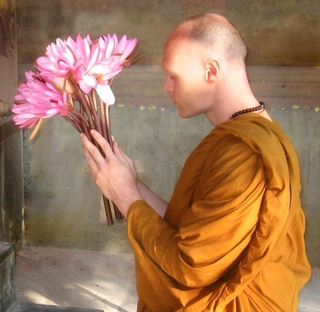
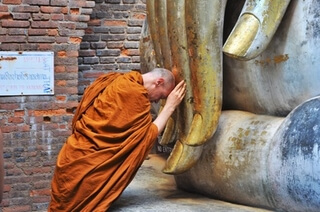
The skillful ceremonies are offering some flowers,
Bowing,
Chanting,
Things that make the mind humble.
Remember the Buddha,
Dhamma and Sangha with respect.
These are very wholesome.
And I often recommend committing to a certain number of hours of sitting,
Certain number of hours of walking,
Certain number of amount of chanting.
It's not that you're collecting brownie points and at a certain point,
You'll cross the finish line.
But the point is,
When we sit in formal meditation,
We are making an effort to establish better than normal mindfulness.
We are inclining the mind to collectedness.
So that when we look at the path,
You've got right mindfulness.
And we need to do the formal meditation because that makes us more mindful.
When we take one meditation object and truly are with that meditation object,
The mindfulness becomes sharper.
The mind,
The stability in the mind becomes more.
And then when we're engaging in other activities,
We're able to apply that mindfulness in our other activities.
So you'll be more likely to notice when an unwholesome mindset is arising and you'll have more energy in the mind to restrain it.
But if you don't do the formal practice,
There's another kind of misunderstanding people,
Modern people make of like,
I'm just going to be mindful in all position postures.
I'm not going to meditate because I'm just going to be mindful.
And it's like,
Mindful while they're watching a movie,
Mindful while they're looking at porn,
Mindful while they're smoking dope.
You know,
It's like that can go in all sorts of directions,
Uh,
Quite not quite heading towards Nirvana.
So you do have to have the commitment to the ethical precepts and you do have to do enough meditation that the mind can recognize what is wholesome and unwholesome and restrain the unwholesome.
So good mindfulness can actually contain and restrain unwholesome,
Unskillful things.
And if you think that you are being mindful while you're smoking dope or looking at porn and watching a movie,
Then I would suggest that it's not very good mindfulness,
Not the kind of mindfulness required to liberate the mind.
And some people might disagree with me and that's fine.
It's a so unshakable faith in the Buddha.
So that's the result.
Obviously,
If you can have deep faith in the Buddha first,
That's going to be helpful.
Lord Buddha said,
Even if a person has no wisdom or no real understanding what the Buddha taught,
If they have deep faith in the Buddha,
It's as if they have one eye.
So suppose you need two eyes so that you know where to go.
At least if you have faith in the Buddha,
You have one eye,
You're beginning to see more correctly.
Obviously,
When you have mindfulness,
Concentration,
Wisdom,
You're going to have two eyes,
You'll see better.
So at first,
Our faith in the Buddha is based on the tremendous effort and energy he made in developing qualities,
Cultivating merit,
Realizing what he realized.
A person who has insights,
Faith in the Buddha becomes a different quality of faith.
It's the Buddha understood the ultimate kind of pure,
Immaculate nature of mind when the kilesas are eradicated from it.
And then he explained to us what we do to experience that.
And so a person who has an insight when they experience their deeper nature,
Ultimate,
Ultimate potential,
Then the feeling of gratitude to Lord Buddha is enormous and natural.
It's like when you because people have no idea at first,
We may have an intuition,
There's some goodness here,
And there's some potential here.
But it's often obscured by the five hindrances by ignorance,
By delusion.
But when a person's when the self view falls away for a period of time,
Or a person experiences a liberated state,
Or has a deep insight into one of the three characteristics,
The quality of serenity,
Bliss,
Tranquility,
The absence of suffering,
The radiance,
And peace,
The coolness,
The absence of heat,
Of warmth of the kilesa.
The fire of the kilesa is so sublime and stunning and beautiful.
And people feel that and it's like,
They come out of that experience.
And when the habitual self comes back,
That self feels enormous gratitude,
Because there is the understanding that if we didn't have the Buddha,
Who explained how to meditate,
How to be ethical,
All of these things,
We would not have that experience.
But when we follow the instructions,
And we cultivate the Eightfold Path,
And we and a person has that experience,
Then the faith in Buddha,
It's like when Buddha,
Dharma and Sangha,
When Anya Kondanya became a stream enterer in the Deer Park,
The first enlightened disciple,
He was like the living proof that what the Buddha realized could be realized by other human beings.
And in the Tibetan tradition,
They talk about Buddha nature or Buddha potential.
So underneath the great hatred and delusion,
When ignorance is uprooted,
Purified mind exists,
Can be experienced.
So we cultivate our faith.
And then we also meditate.
And when we have insights,
Our faith in the Buddha becomes deeper.
And it's a becomes a wise faith that is informed by correct practice and experience of less suffering.
So the first noble truth,
Suffering,
Unsatisfactoriness,
Cause of suffering,
Craving,
Grasping.
There is a cessation of suffering.
How?
If we cultivate the Eightfold Path,
So we do our daily meditation,
We keep our ethical precepts,
We do retreats,
We go on pilgrimages,
Etc.
You will begin to experience the mind with much less suffering for periods of time.
Sit meditation,
5-10 minutes,
Much less hindrances,
Maybe some peacefulness,
10-15-20 minutes.
This is as a result of following Lord Buddha's instructions.
And then we understand,
If I have right mindfulness,
And I'm meditating on a skillful meditation object,
There's more rapture,
More tranquility,
More serenity,
Less suffering,
Even on even in the present moment basis,
If we follow the instructions.
Sometimes we have some difficult sits,
But in general,
If you meditate every day,
You're going to have experience and peacefulness.
And we can start to feel deep gratitude.
It's true what the Buddha taught.
It's true the remedies he suggests work.
It's true that when I train my mind in a little bit of collectiveness,
I get more energy and more clarity throughout the day.
I'm able to think more wisely,
Speak more wisely,
Restrain unskillful.
Then I have less things to feel remorse about.
It's a natural feeling then of feeling grateful to the Buddha.
Not everybody does.
And this is a,
You know,
Some people have a tendency just to,
To not give credit where it's due.
Some people follow instructions given by others get some good results and then kind of think they worked it all out by themselves.
Some people have that kind of a tendency towards arrogance and a lack of gratitude.
But most people,
Most people will naturally feel some gratitude.
And for myself,
I feel,
I feel a combination of gratitude and loving respect for the Buddha.
Even though,
Even though he's gone to Nibbana,
There's still for myself a feeling of deep love and gratitude.
And I think that's quite wholesome.
So we cultivate our faith,
Recollect the benefits we've received and deep,
Very closely relinked to gratitude and respect.
And so yes,
Keep the five precepts,
Meditate each day.
The stream entrants have more mindfulness because they've uprooted a certain amount of ignorance and delusion.
So we have to bring more mindfulness to our experience.
That's what the commitment to daily meditation does.
So that's like behaving like a stream entrant and a deep commitment,
Unshakable faith.
So you have a deep commitment.
You're going to do what it takes to fully realize the goal.
Keep cultivating that eightfold path.
Keep recollecting the refuge daily.
Keep those precepts.
Do retreats.
Give freely.
Lord Buddha did say that if we truly knew the benefits of generosity,
We wouldn't eat a single meal without sharing some of it.
He could see the consequences of generosity.
So yes.