Or to talk about tonight.
And for first I thought I'd talk about the actual enlightenment.
But then I thought it would be better to talk about the birth of the Bodhisattva because you don't have the enlightened Buddha without the causes.
In a few days I'll talk about what the Buddha realized under the Bodhi tree.
One of the ways that what the Buddha realized is recorded is as the Vajjicā,
Samuppāda,
Dependent,
Co-arising.
And the abbreviated understanding of that teaching is that all things arise due to conditions.
And all of those things have the nature to cease.
So everything that arises due to conditions ceases.
Those conditions are impermanent.
The condition for the arising of a Buddha,
Of course,
Is the birth of a Bodhisattva.
And the condition for the arising of the birth of a Bodhisattva is the thousands.
If you say thousands,
It doesn't really capture it.
It's actually millions of lives that the Bodhisattva has to build the perfections so that he can have the necessary qualities to attain to that level of insight and liberation and be able to teach us how to cultivate that path.
So I'll talk a little bit about the birth because we can see right from the birth that in fact I'm going to talk a little bit about before the birth when Ananda,
The story here is Ananda is talking in Jetavana.
And of course Ananda is one of the Buddha's biggest fans.
He's his attendant and he really loves and respects his Lord.
And he was talking about the way that the Buddha was wonderful and marvelous as he often does.
And he was talking about how the Buddha in his own words had described his previous life in Tushita heaven and his birth then as the Prince Siddharta.
So the Buddha walked past this conversation in the Jetavana,
One of the places we'll be going in a couple of weeks,
And asked Ananda to continue with his telling of the story of the birth of the Bodhisattva.
So I think that's a nice beginning.
Then also you'll see,
And then I'm going to talk about the renunciation and the striving before the enlightenment.
But we'll be able to see even from the striving,
You'll be able to see that this was no ordinary being,
This was a really extraordinary being.
The spiritual faculties that the Bodhisattva had as he was practicing is really amazing.
So it's nice to bring to mind,
It's good to bring to mind,
It's skillful to bring to mind the fact that a Buddha is really awesome.
So I was just thinking about that on the bus as we were coming to the Bodhi tree.
I was just thinking the fact,
Especially when you're in a place like India and you see how much poverty,
How much difficulty,
How much dust,
How much dirt,
How much challenge there is in the human realm.
And then you realize that to even know of a Buddha,
To know that there is the potential for any being to realize Buddhahood,
It's really incredible.
And it's our extraordinary good fortune that we know of this Lord Buddha and that we've met these teachings.
So now we have the good fortune to contemplate the cause of the arising of the Buddha,
The awesome practice of the Bodhisattva.
And I'm going to read from the life of the Buddha now.
Thus have I heard,
On one occasion the Blessed One was living at Sabati in Jeta's Grove,
In Atapindika's Park.
Then a number of bhikkhus were waiting in an assembly hall where they had met together on return from their alms round after their meal was over.
Meanwhile it was being said among them,
It is wonderful,
Friends,
It is marvellous,
How the perfect one's power and might enable him to know the past Buddhas who attained the complete extinction of defilement,
Cut the tangle,
Broke the circle,
Ended the round,
And surmounted all suffering.
Such were those Blessed One's births,
Such their names,
Such their clans,
Such their virtue,
Such their concentration,
Such their understanding,
Such their abiding,
And such the manner of their deliverance.
When this was said the Venerable Ananda told the bhikkhus,
Perfect ones are wonderful friends,
And have wonderful qualities.
Perfect ones are marvellous and have marvellous qualities.
However,
Their talk meanwhile was left unfinished,
For now it was already evening and the Blessed One,
Who had risen from retreat,
Came to the assembly hall and sat down on the seat made ready.
Then he asked the bhikkhus,
Bhikkhus,
For what talk are you gathered together here now?
What was your talk meanwhile that was left unfinished?
What the bhikkhus and the Venerable Ananda had said was related and they added,
Lord,
This was our talk meanwhile that was left unfinished,
For the Blessed One arrived.
Then the Blessed One turned to the Venerable Ananda,
That being so Ananda,
Explained the Perfect One's wonderful and marvellous qualities more fully.
I heard and learned this,
Lord,
From the Blessed One's own lips.
Mindful and fully aware,
The Bodhisatta,
The being dedicated to enlightenment,
Appeared in the heaven of the contented,
That's Tushita heaven.
And I remember that as a wonderful and marvellous quality of the Blessed One.
I heard and learned this,
Lord,
From the Blessed One's own lips.
Mindful and fully aware,
The Bodhisatta remained in the heaven of the contented.
For the whole of that lifespan the Bodhisatta remained in the heaven of the contented.
Mindful and fully aware,
The Bodhisatta passed away from the heaven of the contented and descended into his mother's womb.
Just to mention there,
Ordinary beings don't die mindful and fully aware.
So this is one of the special qualities of the Bodhisatta.
Mindful and fully aware even as he's dying and being reborn.
When the Bodhisatta had passed away from the heaven of the contented and entered his mother's womb,
A great,
Measureless light,
Surpassing the splendour of the gods,
Appeared in the world with its deities and its Maharas,
Its Brahman divinities,
In this generation with its monks and Brahmans,
With its princes and men.
And even in those abysmal world interspaces of vacancy,
Gloom and utter darkness,
Where the moon and the sun,
Powerful and mighty as they are,
Cannot make their light prevail.
There too,
A great,
Measureless light,
Surpassing the splendour of the gods,
Appeared,
And the creatures born there perceived each other by that light.
So it seems that other creatures have appeared here,
And then the ten thousand-fold world system shook and quaked and trembled.
And then too,
A great,
Measureless light,
Surpassing the splendour of the gods,
Appeared.
When the Bodhisatta had descended into his mother's womb,
Four deities came to guard him from the four quarters,
So that no human or non-human being or anyone at all should harm him or his mother.
So those four deities is the four kings of the realm of the four kings,
The first heaven realm.
When the Bodhisatta had descended into his mother's womb,
She became intrinsically pure,
Refraining by necessity from killing living beings,
From taking what is not given,
From unchastity,
From false speech,
And from indulgence in wine,
Liquor and fermented brews.
So just from the fact of having this being with all this amazing accumulated merit in her womb,
She became incapable of breaking the five precepts.
When the Bodhisatta had descended into his mother's womb,
No thought of man associated with the five strands of sensual desires came to her at all.
So she had no lustful thoughts,
This being in her womb,
And she was inaccessible to any man with lustful mind.
When the Bodhisatta had descended into his mother's womb,
She at the same time possessed the five strands of sensual desires.
That means very pleasant sounds,
Tastes,
Good food.
And being endowed and furnished with them,
She was gratified in them.
When the Bodhisatta had descended into his mother's womb,
No kind of affliction arose in her.
She was blissful in the absence of all bodily fatigue.
As though a blue,
Yellow,
Red,
White or brown thread were strung through a fine beryl gem of purist water,
Eight-faceted and well cut,
So that a man with sound eyes,
Taking it in his hand,
Might review it thus,
This is a fine beryl gem of purist water,
Eight-faceted and well cut,
And through it is strung a blue,
Yellow,
Red,
White or brown thread.
So too,
The Bodhisatta's mother saw him within her womb,
With all his limbs and lacking no faculty.
" So this is very interesting.
Imagine a Bodhisattva with millions of lives of cultivating merit,
And amazing samadhi,
And boundless metta,
And all of these qualities inside your body.
And the Bodhisattva's mind is inside your own mind.
And then so,
The enormous merit,
So this pleasant,
Pleasant,
All of these pleasant experiences coming.
And also the purity,
No very few defilements,
And keeping the precepts impeccably.
Then you get to see some of the samadhi of the Bodhisattva that the mother can actually see.
This is like a divine eye faculty.
She can actually see the baby in her womb the whole time.
So we get the sense right from the beginning that this is no ordinary being.
It's very special.
There's one story,
Some people say it's actually a previous Buddha's life story,
Where there were three visions or three experiences that the prince had.
Apparently his father,
The king,
Didn't want him to see old people,
Sick people.
And so he would make them leave the palace.
When people got old they had to leave.
He was told at the birth that this by a sage called Asita,
We'll read more about the birth when we come to Lumbini,
But just in brief.
He was told by a great sage that this baby,
When this sage saw this baby,
He said this baby will be one of two things.
He will be a will-turning monarch.
That means he would rule the whole world.
Or he will be a great spiritual leader.
So when the king heard that he thought he was going to do everything he could to have him absorbed in luxury,
And not to see anything that would give rise to a spiritual aspiration.
So he kept sick people and old people away from the prince.
But the prince got curious and asked his driver to sneak him out of the palace at nighttime.
But I have read that it was actually a previous Buddha,
But maybe something similar happened.
And at a certain point three vanities disappeared in the prince's mind.
The vanity of youth,
When he saw an old,
Really old person,
He said,
What's that?
It's an old person.
Am I subject to that too?
Yes.
And then the other vanity was hell.
So he saw a sick person,
He'd never been sick before,
Never seen a sick person before.
And he asked his chariot driver,
What's that?
And that's sickness.
Is everyone subject to that?
Yes,
You too.
And the other was the vanity of life.
So he saw a corpse,
And that's death,
And we're all subject to that.
And so this very important spiritual emotion is actually this thing called Nibbidah,
And sometimes called Sulot Samweg or Samwega,
Spiritual sadness.
So the prince,
Seeing that we're all bound to death,
We're all bound for death,
And we're all bound for sickness,
And he felt that he wanted something better.
There must be something better than this,
And he aspired for something better than this.
And so I imagine in myself as looking at his wife,
Who I'm sure he loved,
And his son,
Who he loved also,
And I imagine him just seeing their nature to die,
And their nature to be separated from that which is loved,
And having to be associated with that which is not loved,
And wanting to do something to help everybody.
So he left the palace,
And he strove.
I'll read a little bit about the striving,
The renunciation and the striving.
Now I will tell of the going forth,
How he,
The mighty seer,
Went forth,
How he was questioned and described the reason for his going forth.
The crowded life lived in a house,
Exhales an atmosphere of dust.
But life gone forth is open wide.
He saw this,
And he chose the going forth.
By his so doing,
He refused all evil action of the body,
Rejected all wrong kinds of speech,
And rectified his livelihood besides.
He went to Rajagaha town,
The castle of the Magadans.
Then he,
The Buddha,
Went for alms.
With many a mark of excellence,
King Bimbisara from within his palace saw him passing by.
And when he saw the excellence of all the marks,
Look sirs,
He said,
How handsome is that man,
How stately,
How pure and perfect is his conduct.
With downcast eyes and mindful,
Looking only a plough's yoke length before him,
He has no lowly lineage.
So just to comment about this a little bit,
This is a king of one of the greatest kingdoms of that day,
Two of the biggest kingdoms of that time is Magadha,
And Rajagir is in Magadha.
And this is the king of Rajagir.
The other really big kingdom was Kosala,
Where King Pasenadi was the king.
So Siddhartha was a prince from a warrior caste,
And the king,
Just to kind of get a sense for the fact that the Bodhisattva is special,
That the king recognizes something very developed.
And the king then says,
Taking the road to Pandava,
He must live on the hill of Pandava.
Now when he came to his abode,
The messengers went up to him,
Though one of them turned back to give the king the answer to his question.
The Bhikkhusaya,
Like a tiger,
Or like a bull,
Or like a lion,
Is seated in a mountain cave upon the eastern slope of Pandava.
The warrior heard the runner's tale,
Then surmounting a coach of state he drove in haste out of the town,
Out to the hill of Pandava.
He drove as far as he could,
And then descended from the coach.
The little distance that remained he went on foot till he drew near the sage.
The king sat down and he exchanged greetings and asked about his health.
When this exchange of courtesy was done,
The king then spoke to him these words.
You are quite young,
A youth,
A boy in the first phase of life.
You have the good looks of a man of high-born warrior noble stock,
One fit to grace a first-rate army,
To lead the troops of elephants.
I offer you a fortune,
Take it.
Your birth I ask you also,
Tell it.
There is a prosperous country-sire and vigorous right up against the foothills of Himalaya,
Inhabited by Kozalans,
Whose race is named after the sun,
Whose lineage is Sakyan.
But I have not gone forth to seek sense pleasures.
I have gone out to strive,
Seeing danger in them,
And seeing safe refuge from them in renouncing,
And that is my heart's desire.
" So I've also heard an extended version of this meeting when this gone-forth prince refused the fortune that the king of this huge and prosperous kingdom asked him.
Then apparently King Bimbisara said,
Take half my kingdom.
And then the Bodhisattva replied,
No,
I'm not into it.
I don't want wealth.
I see danger there.
And then he said,
Okay,
Take the whole kingdom.
No,
Seriously,
I don't want your kingdom.
I know a little bit of it,
Or all of it.
What I want is liberation.
I want Buddhahood.
And so then King Bimbisara asked him,
Well,
When you find it,
Please come back and teach me.
And that's actually very important because after the Buddha gave his first teachings in Isipatana,
The dear park near Varanasi,
He came back to Rajgir having had this invitation from the king.
So now I'm going to talk a little bit about the Bodhisattva's training with his first teachers.
I went forth from the house life into homelessness to seek what is good,
Seeking the supreme state of sublime peace.
Therefore I went to Alaracalama and I said to him,
Friend Kalama,
I want to lead the holy life in this Dharma and discipline.
When this was said,
Alaracalama told me,
The venerable one may stay here.
This teaching is such that in no long time a wise man can enter upon and dwell in it,
Himself realizing through direct knowledge what his own teacher knows.
I soon learned the teaching.
I claimed that as far as mere lip recitation and rehearsal of his teaching went,
I could speak with knowledge and assurance and that I knew and saw.
And there were others who did likewise.
I thought it is not through mere faith alone that Alaracalama declares his teaching.
It is because he has entered upon and dwelt in it himself,
Realizing it through direct knowledge.
It is certain that he dwells in this teaching,
Knowing and seeing.
Then I went to Alaracalama and I said to him,
Friend Kalama,
How far do you declare to have entered upon this teaching yourself,
Realizing it through direct knowledge?
When this was said,
He declared the base consisting of nothingness.
So just to mention what that is,
I believe that's the seventh jhana.
So it's an extremely profound state of samadhi.
It is not only Alaracalama that has faith,
Energy,
Mindfulness,
Concentration,
And understanding.
I too have these faculties.
Suppose I strove to realize the teaching that he declares to enter upon and dwell in,
Himself realizing it through direct knowledge.
I soon succeeded.
So once again,
Just making the point that the spiritual caliber of the aspiring bodhisattva is phenomenal.
But he soon attained the seventh jhana.
Then I went to Alaracalama and I said to him,
Friend Kalama,
Is it thus far that you declare to have entered upon and dwelt in this teaching,
Yourself realizing it through direct knowledge?
And he told me that it was.
I too,
Friend,
Have thus far entered upon and dwelt in this teaching,
Myself realizing it through direct knowledge.
We are fortunate,
Friend,
We are indeed fortunate,
To have found such a venerable one for our fellow in the holy life.
So the teaching that I declare to have entered upon,
Myself realizing it through direct knowledge that you enter upon and dwell in,
Yourself realizing it through direct knowledge.
And the teaching that you enter upon and dwell in,
Yourself realizing it through direct knowledge that I declare to have entered upon,
Myself realizing it through direct knowledge,
So you know the teaching that I know.
I know the teaching that you know.
As I am,
Say you,
As you are,
So am I.
Come,
Friend,
Let us now lead this community together.
Thus Alara Kalama,
My teacher,
Placed me,
His pupil,
On an equal footing with himself,
According me the highest honor.
" So that's pretty amazing.
This is one of the greatest spiritual teachers of the day.
And he,
Like the king,
Offering the Bodhisattva the kingdom,
Now the spiritual luminary is offering him joint leadership over his community.
The Bodhisattva's extraordinary mindfulness and wisdom,
He knew,
This is what he knew about that state.
This teaching does not lead to dispassion,
To fading of lust,
To cessation,
To peace,
To direct knowledge,
To enlightenment,
To nibbana.
But only to the base consisting of nothingness.
I was not satisfied with that teaching.
I left to pursue my search.
So we're talking about one of the most profound forms of samadhi that anyone can experience.
And when we experience this kind of samadhi,
If one experiences this kind of samadhi,
It suppresses the hindrances and basically you experience really,
Really profound peace.
And if you can enter that state from what I gather,
At will,
Then there's really not very much suffering there because the suffering is,
In a way,
Suppressed through the power of samadhi.
But the Bodhisattva could see with his amazing mindfulness and discerning,
Discriminating wisdom that the jhanic state degenerated.
So he was able to have that subtle awareness that could see that the profound peace degenerated and the mind went back to a more ordinary level.
And that's how he knew,
This isn't it.
I'm looking for the deathless.
This also dies,
Though it's not the deathless.
The Bodhisattva knew he was aspiring to go when he wanted to renounce the palace.
He saw that beings were still subject to death and he thought,
Because there is death,
There must be a deathless.
And that's another amazing intuition because it's not an intuition that most people have.
Because there is death,
There must be a deathless.
Most people just try to ignore death.
But he knew just for the fact that there is death,
There must be deathless,
That there is condition,
There must be an unconditioned.
And so he could see here,
This was conditioned,
This was also subject to death.
So still in search of what is good,
Seeking the supreme state of sublime peace,
I went to Udaka Aramaputa and I said to him,
Friend,
I want to lead the holy life in this dharma and discipline.
His experience under the guidance of Udaka Aramaputa is told in exactly the same words,
Except that he learned from him the still higher attainment of the base consisting of neither perception nor non-perception.
So that's the eighth jhana.
And that Udaka Aramaputa offered him the sole leadership of that community.
But the conclusion was the same.
I thought this teaching does not lead to dispassion,
To fading of lust,
To cessation,
To peace,
To knowledge,
To enlightenment,
To nirvana,
But only to the base consisting of neither perception nor non-perception.
I was not satisfied with that teaching.
I left it to pursue my search.
Still in search of what is good,
Seeking the supreme state of sublime peace,
I wandered by stages through the Magadan country.
That's where we are now.
We're in the Magadan country.
And at length arrived at Sena Ni Kama near Uruwela.
There I saw an agreeable plot of ground,
A delightful grove,
A clear flowing river with pleasant smooth banks,
And a nearby village as arms resort.
I thought this will serve for the struggle of a clansman who seeks the struggle.
Now before my enlightenment,
When I was still only an unenlightened bodhisatta,
I thought,
Remote jungle thicket abodes in the forest are hard to endure.
Seclusion is hard to achieve.
Isolation is hard to enjoy.
One would think the jungles must rob a bhikkhu of his mind if he has no concentration.
So this is a bit of a lion's roar,
Which I'm going to share with you.
Suppose some monk or Brahmin is unpurified in bodily,
Verbal,
Or mental conduct,
Or in his livelihood,
Is covetous and keenly sensitive to lust for sensual desires,
Or malevolent with thoughts of hate,
Or a prey to lethargy and drowsiness,
Or agitated and un-calming in mind,
Or doubting and uncertain,
Is given to self-praise and denigrating others,
Is subject to fright and horror,
Desires gain honor and renown,
Is idle and wanting in energy,
Forgetful and not fully aware,
Unconcentrated and confused in mind,
Devoid of understanding and driveling.
When such a monk or Brahmin results to a remote jungle thicket abode in the forest,
Then owing to those faults he evokes unwholesome fear and dread.
But I do not resort to a remote jungle thicket abode in the forest as one of those.
I have none of those defects.
I resort to a remote jungle thicket abode in the forest as one of the noble ones who are free from these defects.
Seeing in myself this freedom from such defects,
I find great solace in living in the forest.
" So all of those faults,
Which I'm pretty sure most of us here have,
Actually all of us here have,
I know I have a good number of those.
Hopefully not in large amounts,
But we're working on it.
But isn't that amazing?
The Bodhisattva can say,
I have none of those faults and none of those defects.
And he's not saying that with pride either,
Because he's not an egotistical being.
He's saying that just by knowing it as a fact.
I don't have these other faults.
These are the weaknesses of a spiritual practitioner and I don't have them.
And I'm applying myself to the best of my ability to realize the deathless.
Okay,
So this is where the Bodhisattva then decided that if attaining to the highest levels of samadhi,
The deathless isn't the unconditioned,
Is still subject to death,
Is still a condition.
Then he thought he might try patiently enduring the extremity of austerity and pain and see if that was a way to crack out of the samsara.
Everyone looks a bit cold.
Turn the air down a bit.
Okay,
Cessation.
Liberation from the freezing hell.
Back on the human realm.
Thank you.
Okay.
I thought,
Suppose I take very little food,
Say a handful each time.
Whether it is bean soup or lentil soup or pea soup,
I did so.
And as I did so,
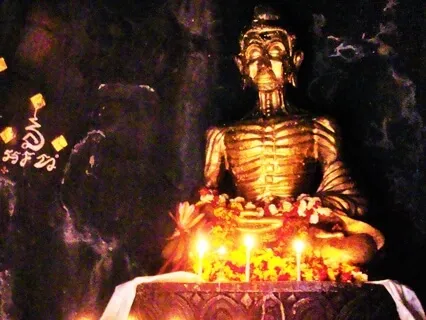
My body reached a state of extreme emaciation.
My limbs became like the jointed segments of vine stems or bamboo stems because of eating so little.
My backside became like a camel's hoof.
The projections on my spine stood forth like corded beads.
My ribs jutted out as gaunty as the crazy rafters of an old roofless barn.
The gleam of my eyes sunk far down in their sockets looked like the gleam of water sunk far down in a deep well.
My scalp shriveled and withered as a green gourd shrivels and withers in the wind and sun.
If I touched my belly skin,
I encountered my backbone too.
And if I touched my backbone,
I encountered my belly skin too.
For my belly skin cleaved to my backbone.
If I made water or evacuated my bowels,
I fell over on my face.
If I tried to ease my body by rubbing my limbs with my hands,
The hair rotted at its roots,
Fell away from my body as I rubbed because of eating so little.
When human beings saw me now,
They said,
The monk Gautama is a black man.
Other human beings said,
The monk Gautama is not a black man,
He is a brown man.
Other human beings said,
The monk Gautama is neither a black man nor a brown man,
He has a fair skin.
So much had the clear bright color of my skin deteriorated through eating so little.
Here's another wonderful lion's roar.
The Buddha spoke some verses while he was striving,
Which he later relayed.
And I think Ananda,
Or one of the other great disciples then,
Recorded it.
As I strove to subdue myself beside the broad Niranjara,
That's a river,
Absorbed unflinchingly to gain the true sasis of bondage here,
Namuchi came and spoke to me,
So that's another word for Mara.
With words all garbed in pity thus,
Oh you are thin and you are pale,
And you are in death's presence too.
A thousand paths are pledged to death,
But life still holds on part of you.
Live sir,
Life is the better way.
You can gain merit if you live.
Come,
Live the holy life and pour libations on the holy fires,
And thus a world of merit gain.
What can you do by struggling now?
The path of struggling too is rough and difficult and hard to bear.
Now Mara,
As he spoke these lines,
Drew near until he stood close by.
The Blessed One replied to him as he stood thus,
Oh evil one,
Oh cousin of the negligent,
You have come here for your own ends.
Now merit I need not at all.
Let Mara talk of merit then to those that stand in need of it,
For I have faith and energy and I have understanding too.
So while I thus subdue myself,
Why do you speak to me of life?
There is this wind that blows,
Can dry even the rivers running streams.
So while I thus subdue myself,
Why should it not dry up my blood?
And as the blood dries up,
Then bile and phlegm run dry.
The wasting flesh becalms the mind.
I shall have more of mindfulness of understanding,
I shall have greater concentration.
For living thus I come to know the limits to which feeling goes.
My mind looks not to sense desires,
You see a being's purity.
So one thing I found not quite finished there,
I'll read the rest next.
But one thing I find interesting about this is at this point the Bodhisattva is confident that this is the correct way of practice.
So he's applying himself with 100% sincerity and he says that he believes at that point that this practice will increase his mindfulness and concentration and understanding.
But actually a little bit later he had the insight that it wasn't.
But it just shows you how willing he was,
How sincere he was and how much integrity he had in his search and when he did something doing it with absolute complete commitment and integrity.
So he then continues to address Mara,
Showing us once again how much he understood the mind and negative qualities that affected and the ways to be aloof from those negative qualities.
Your first squadron is sense desires,
Your second is called boredom.
Then hunger and thirst compose the third and craving is the fourth in rank.
The fifth is sloth and acidity,
While cowardice lines up as sixth.
Uncertainty is the seventh,
The eighth is malice paired with obstinacy.
Gain honor and renown besides and heal one notoriety.
Self praise and denigrating others,
These are your squadrons,
Namuchi.
These are the black ones fighting squadrons,
None but the brave will conquer them.
To gain bliss by the victory,
I fly the ribbon that denies retreat.
Shame on life here I say,
Better I die in battle now than choose to live on in defeat.
There are ascetics and Brahmins that have surrendered here and they are seen no more.
They do not know the paths the pilgrim travels by.
So seeing Mara's squadrons now arrayed all around with elephants,
I sally forth to fight that I may not be driven from my post.
Your seried squadrons,
Which the world with all its gods cannot defeat,
I shall now break with understanding as with a stone,
A raw clay pot.
It's pretty amazing what the Bodhisattva knew as a negative quality and with the confidence that he can talk with Mara because for the rest of us,
We are looking at those qualities.
You go and strive in a cave and you are not eating anything and you are rotting.
Do you think sense desires would affect your mind?
Do you think boredom would get to you a bit?
Craving all of these things,
I'm pretty sure most of us would be struggling with all of these mind states and the Buddha is saying,
I see them all,
They are not affecting me and I'm going to break.
He's going to smash through.
And in this amazing utterance,
Whatever a monk or Brahmin has felt in the past or will feel in the future or feels now,
Painful,
Wrecking,
Piercing feelings due to striving,
It can equal this but not exceed it.
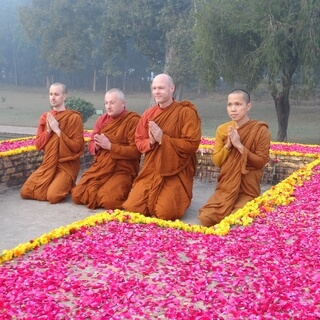
So this is one of the reasons I wanted to read this today because when we go in in Peris Vex to the Bodhi tree again tomorrow in the Vajra Asana,
The Seat of Enlightenment,
It's good to recollect,
Appropriate to recollect the sacrifice that the Buddha made in order to have his realization and that that was motivated by compassion.
So this isn't a guilt trip,
This is a really important thing to understand.
I think it's incredibly touching when one opens one's heart and allows your heart to be touched by the compassion of the Buddha and you understand that he experienced as much pain as is possible.
No one could have exceeded it.
So that he would have this realization because we realized that and you realize that he was motivated by compassion for us and all beings.
Then a natural response is just an incredible feeling of gratitude.
You think,
Oh wow,
Amazing,
Isn't it incredible that the Bodhisattva practiced so hard to realize what he realized,
Motivated by compassion.
And then we just feel this very humbling sense of gratitude and awe for the sincerity of the effort.
Then the Buddha had an insight.
Whenever a monk or Brahmin has felt in the past or will feel in the future or feels now,
Painful,
Racking,
Piercing feeling due to striving,
It can equal this but not exceed it.
But by this grueling penance I have attained no distinction higher than the human state.
Worthy of the Noble One's knowledge and vision,
Might there be another way to enlightenment?
So keeping in mind the Buddha had all eight jhanas and during the time in the cave he didn't allow himself to absorb into a pleasant samadhi state at all.
So he was really depending upon the extreme of patient endurance,
Out of determination to see if that was the way out of samsara.
But he's just had the intuition,
The insight,
The understanding it's not working.
And then I thought of a time when my Sakyan father was working and I was sitting in the cool shade of a rose apple tree,
Quite secluded from sensual desires,
Secluded from unwholesome things.
I had entered upon an abode in the first meditation.
So as a young prince he entered the first jhana under the rose apple tree.
Again that shows,
It's kind of alluding to the fact that he's practiced samadhi for thousands of lives.
He's just sitting under the rose apple tree appreciating the scene and he absorbed into a jhanic state.
Then he had the insight,
Following up that memory there came the recognition that this might be the way to enlightenment,
That this was the way to enlightenment.
Then I thought,
Why am I afraid of such pleasure?
It is pleasure that has nothing to do with sensual desires or unwholesome things.
Then I thought,
I am not afraid of such pleasure for it has nothing to do with sensual desires and unwholesome things.
So the first meditation is the first jhana and it can be,
As we'll see tomorrow when we explore the process of the enlightenment,
It can be accompanied with focused and directed thought.
I thought it is not possible to attain that pleasure where the body is so excessively emaciated.
Suppose I ate some solid food,
Some boiled rice and bread.
And another thing,
A very interesting thing happens now,
The Buddha is having a correct intuition and he's on the mark and he's on target and he's going to become enlightened very soon and this is what happens.
Now at that time five bhikkhus were waiting on me thinking if the monk Gautama achieves something he will tell us.
As soon as I ate the solid food,
The boiled rice and bread,
The five bhikkhus were disgusted and left me thinking the monk Gautama has become self-indulgent.
He has given up the struggle and reverted to luxury.
So those five monks were wrong.
They rejected and abandoned the Bodhisattva and the Bodhisattva honored his intuition and was not affected by the praise and blame and he,
As we'll read tomorrow,
Considered tomorrow,
Had some food,
He had a bath and then he wandered over to the Bodhi tree and actually became enlightened.
So it's nice to have a little bit of background,
The extraordinary qualities of the Bodhisattva and the incredible integrity of his spiritual search.
I just wanted to say a few words about it so that when we go in tomorrow we recollect some of what we discussed and considered this evening and allow yourself to be nourished and touched by gratitude and the blessing,
The blessing of knowing about,
Even knowing about Buddhahood,
Even hearing the word Buddha is amazing.
So a lot of people in India are aware of the Buddha but they don't know what it means.
Buddha,
The way the Hindus teach it,
Is an avatar of Vishnu.
So it just got absorbed as one more God in their pantheon of Gods.
So most Hindu Indians have no idea that one seeks enlightenment by practicing the middle way,
Cultivating the four foundations of mindfulness.
Most Hindus think that you still have to pray to God and it's the only way that you get liberated so there's basically no way they're going to get liberated doing that practice and this is one of the ways that Mara and Karma slowly corrupts the teachings so that they disappear from the world,
They change.
And so the Hindus are taught that the Buddha was an emanation of Vishnu,
One form of Vishnu and so they pay respects to Buddha as another form of Vishnu and they don't know about the middle way and they don't practice the middle way.
So we're very fortunate to not only know of the Buddha but to have heard something about his very particular teaching contemplating not the Self,
The three characteristics,
Aninsha,
Impermanence,
Dukkha,
Unsatisfactoriness and Anarha,
Not Self.
So most Hindus and most Muslims in this country pray in and hoping to go and live with God in heaven for eternity and I'm not criticizing those practices,
Those are skillful practices to be reborn in heaven,
Practicing Sila,
Having faith,
Recollecting deities,
All of that is wholesome but what will occur,
How we understand it,
Is after that life in heaven when the good karma runs out people have to come back again and they're still subject to death and they haven't attained the deathless.
So the Buddha's teaching is very special because it's leading to heaven and beyond.
So skillful Buddhist practitioners also get born in heaven realms as a result of their merit but that's not the goal,
Our goal is to keep practicing until liberation,
In talking for nearly an hour so I might let you rest,
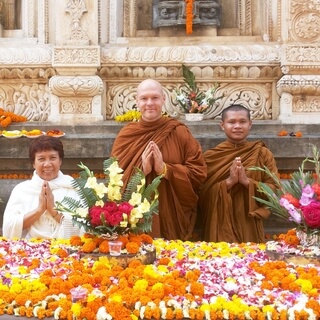
It's been a big day and I'm glad we went straight to the Bodhi Tree and I'm glad we had a good look at what occurred there the first evening just to set the tone of some sincere practice and some sincere contemplation.
Just ask again how many people felt some peacefulness in the meditation under the Bodhi Tree today,
You could show me.
Yeah,
It's interesting because there's a lot of noise and there's a lot of other things happening so it is interesting that the mind can become peaceful there.
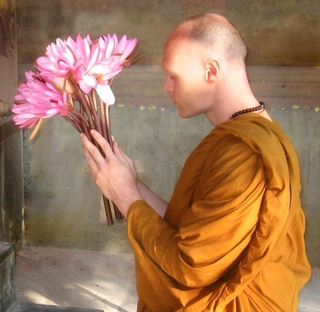
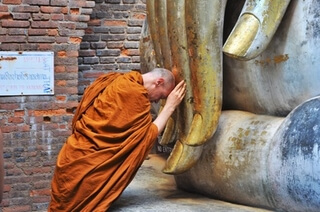
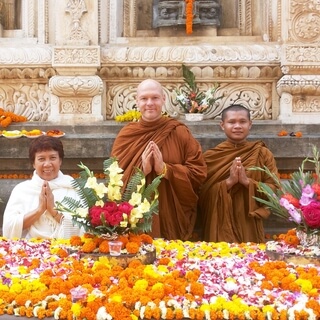
And then offering the flowers and people went closer to the Bodhi Tree and into the Buddha statue,
Did anybody feel some special energy there?
It's okay,
About half the group.
Sometimes when the mind is tired it's a bit dull as well and that's one of the reasons that we're spending four full days here,
We have lots of time to go in and with a fresher mind and when it's less,
I think the first time for people who have never been here it can be a certain amount of anxiety affecting the mind as well because there's so many things happening as soon as you get off that bus,
There's all these different energies swirling around at the same time and beggars,
Crippled children,
Beggars,
Con artists,
Fake monks,
Sri Lankan katina ceremonies,
Drums,
Trumpets,
Conch shells,
The whole thing.
I rejoice in your good fortune,
Your paid respects at the Vajra Asana,
Mahabodhi Tree.
May this merit speed us to enlightenment.