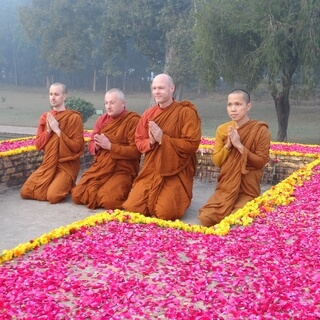
Having a sense for the sitting posture.
Just aware that the body is sitting.
Feel the palms,
Palm resting on the hand,
The other palm perhaps pressing against your legs,
Your lap.
Just aware of those feelings,
Just getting a broad sense of the sitting posture.
And then feeling your bottom and your thighs touching the mat.
The cushion just feeling the pressure,
Aware of the surface beneath and just aware of those physical feelings,
Aware of the body.
And then aware of the shoulders,
Kind of a broad awareness of that shoulder area.
If there's any tension,
Consciously relaxing,
Just relaxing those shoulders.
And just aware of the face and the head,
Aware of the feelings on the skin in a broad way.
And now we turn to the breath and initially trying to know the entire breath,
Nose,
Chest,
Abdomen,
Abdomen,
Chest,
Nose.
We're using the word buddho to remind us about being wakeful,
Being aware,
Being present in the body,
Aware of the feelings.
And breathing in,
Mental recitation buddho.
Breathing out,
Mental recitation do.
Using buddho to maintain a consistent awareness,
Making the mindfulness clear,
Steady,
Consistent.
Breathing in,
Buddho.
Breathing out,
Do.
And just knowing the natural feelings of the breath.
And knowing one in breath,
And knowing one out breath.
And just knowing the natural feelings of the breath.
And now just bringing the awareness back to the top of the head,
And just holding in awareness the hair.
Investigating its quality a little,
Just seeing that it's dry.
The internal parts of the body are moist,
The hair on the head is dry,
Unless you wet it.
And just being aware of these many strands on top of the head,
And just knowing the nature of hair as one part of the body.
And then just acknowledging that it's actually earth element.
And just aware of hair on the head as earth element.
Then coming back to the breath,
Knowing the feelings of the in breath and the out breath,
And being with buddho.
Breathing in,
Buddho.
Breathing out,
Do.
Feeling the awareness in the present moment,
Within the parameters of the body,
Using the breath awareness.
Being centered,
Present.
Aware of the in breath,
Buddho.
Aware of the out breath,
Do.
And now bringing your awareness to your fingernails.
Still aware of the in and out breath in a broad way.
But considering the nails.
Getting a sense for what they are.
Once again,
Dry and quite hard.
Compared to fleshy parts of the body,
Nails are quite hard.
And just aware of that dryness,
Hardness,
Holding it in awareness as one part of a body.
And trying to see it as separate from the other parts for the sake of the concentration,
Just holding the awareness of the nails in the mind.
And then just acknowledging that the nails are earth element.
If the body were to die in the forest,
The nails would slowly disintegrate and become earth.
And then coming back to the breath.
Feeling the clarity of mindfulness and the clarity of knowing,
Resting in the awareness of the feelings of the natural breath.
Breathing in buddho,
Breathing out do,
Gentle mental recitation.
One in breath buddho,
One out breath do,
Mindfully knowing.
And now I ask you to bring your awareness to the teeth,
The teeth in your mouth.
And just trying to see these as a separate part of the body and get a sense for what they are.
Noticing the hardness.
Aware of teeth like rows of little stones.
And just aware of them.
Not conceiving of a self,
Not my teeth.
Just seeing teeth.
Aware of it as one part.
And then once again acknowledging the teeth are composed of earth element.
And then coming back to the awareness of the breath.
Aware of the natural feelings.
Breathing in buddho,
Breathing out do.
Maintaining a consistent clear knowing awareness of the feelings of the natural breath.
One in breath and one out breath.
And now I ask you to bring your awareness to the teeth.
And just aware of the natural feelings.
And then once again acknowledging the teeth.
And then coming back to the awareness of the breath.
So in terms of guiding meditation on the parts,
That's all I'll suggest for today.
If anybody on their own wants to take the concentration further,
It's possible to bring to perception a skull or the backbone or the rib cage or the whole skeleton.
Investigating this earth element.
Investigating the nature of bones.
You can do that if you want to.
In reading Ajahn Anand's talk before,
We noticed that he cultivated the Brahmoviharas in conjunction with cultivating investigation into the body.
And these practices balance each other to some degree.
Feelings of loathesomeness can come up.
But when we practice body contemplation correctly,
It should be a nice feeling of clarity,
Sobriety,
Stillness.
You just get that sense that the habitual delusions drop away.
And the mind is peaceful when it lets go of its belief and grasping that bodies are beautiful.
That they'll stay young.
Just seeing them as made up of parts,
Destined to crumble.
We accept this and the mind can become very peaceful.
Sometimes in doing body contemplation there can be difficult moods come up afterwards.
So this is the value of cultivating metta.
And Ajahn Anand also had an insight into the value of chanting,
The pujas.
The faith inspiring practices also have a role to play.
Keeping our practice balanced.
Balancing our practice with faith,
Energy,
Effort,
And mindfulness,
Especially of the nature of the body.
Physical feelings in the body.
So just continuing the awareness of breathing.
If anyone would like to do some walking meditation that's okay too.