Okay,
So where were we?
Part two,
Arjun Achalo's spiritual biography.
So,
Nice to see you all again.
I believe we left off,
I was at Wat Mahabhjan.
I'd met Than Ajahn Anand in the jungle and he had given me some very good meditation instruction and a bit of a sense of context and a helpful long-term view.
And so that was my second Panterasa Bhikkhu.
I would have been about 25 years old,
I think,
Maybe 26.
So one thing I didn't mention,
I may have mentioned,
But as one of the only Western monks at a time monks who could speak English,
It was as wonderful as it was for having a lot of time to meditate.
And for that I'm generally grateful.
On another level,
There was some,
I guess what you might call,
Social awkwardness or anxiety.
Kind of not really understanding what was going on around you and not understanding the context and what people were saying about one,
For example.
And so although I loved my teacher and I'd benefited from his guidance,
I did,
After seven months,
I felt like it was time to go back to live with the Western monks again at Wat Nanachat with Arjun Jayasaro as the And so one more trip to the jungle in March and April and learning,
Learning to get better at structuring the time,
Practicing,
Sitting,
Chanting,
Some study,
And another rainy season retreat at Wat Nanachat for my third Panterasa.
But then I started to struggle.
You know,
This is one of the reasons I'm willing to share this aspect of the bhikkhu's life is sometimes I think people assume you put a robe on and people expect that you become a saint.
You know,
It's in the robe.
But this is silamata baramasa.
It's not rites and rituals.
Putting on the robe is committing to a training.
And it's,
The Buddha says,
The most fertile field for cultivation.
You get a lot of support to practice,
But you come in with your personality,
You come in as an unenlightened being.
Basically,
It's saint training.
You don't start as a saint,
But you,
You have to knuckle down and,
And try to cultivate a saint-like behavior at least.
And it's not easy,
As one analogy is also living in community is like rocks with sharp edges being turned around in a tumbler,
Chipping against each other,
Because you don't get to choose your friends.
You don't get to choose what you do with your time.
Morning chanting is morning chanting.
The mealtime is the mealtime.
The food that's offered is the food that's offered.
There's no singing,
Dancing,
Entertainment and perfume,
So on any of that stuff.
So yes,
It's training in renunciation.
Now I'm gonna be careful not to mention any names,
But those of you have to be,
But I'll just try to accept the context a little bit,
Like what the struggle was.
So I have great faith by this stage in Lord Buddha.
I have great faith in the training.
It doesn't mean that I don't have my preferences,
And it doesn't mean that the training isn't hard.
So there was one monk who used to sit to the right of me,
And he was kind of good at everything,
And he,
He didn't have to try very hard,
And he could do things quickly.
And this monk,
An inspiring bhikkhu,
Beautiful monk even,
But he was,
I suppose his weakness might have been that he wasn't so patient with less inspiring monks.
So that particular monk would look at me sometimes and kind of sneer,
And that wasn't much fun to be on the receiving end of.
And then the monk,
Another monk who sat,
Because we have to sit in according to our hierarchy,
And so the monk who sat to the left of me he was practicing on his,
He was getting his asubha,
Loathsomeness of the body practice together.
So I would like look at him,
And he would have this this kind of look on his face,
Contemplating how disgusting bodies were.
So the guy on my right was sneering at me for not being enough,
And the guy on my left was disgusted with the natures of body.
And Aten Jayasaro at the time was a very very inspiring abbot.
It was my great good fortune to live with him during that time.
At the same time he was being really strict about only sleeping four hours a night,
Because that's what the suttas said.
So with all of his abbot duties,
And the once a night all night practice,
And his receiving guests,
So sometimes I was just kind of feeling like I need a bit of love,
You know,
A little bit of love,
A bit of warmth.
So I might go and wander towards Aten Jayasaro,
And he used to look at me,
To be fair,
Like I was an irritating impingement in his awareness.
And that that wasn't what I was looking for actually.
I was looking for a little bit of love,
A little bit of encouragement,
A little bit of a Lompor vibe.
Now Aten Jayasaro at the time,
He was he was only 40,
And part of the reason I think Lompor Aten Jayasaro had not yet come into his benevolent generative Lompor phase,
Was because he wasn't there yet.
He was like,
He was making his mark in the world.
He was at that time he was becoming a renowned respected famous Dharma teacher in Thailand,
And he was still knuckling down and doing his practice.
He was being impressive.
He was making,
And he was keeping up all of these high standards.
And he didn't have that much energy for needy,
Struggling junior monks with a fault-finding tendency.
So he would kind of see me coming,
And I think,
Oh God,
Here he comes again.
And not just me,
Here comes another one.
Here comes another idealistic fault-finding Western monk who's,
Who's going to tell me the way things should be,
And the way things shouldn't be,
And which things aren't good enough.
He later said,
Aten Jayasaro said,
After he had been,
He made a determination to be the abbot for five years.
And after that period of time,
Many years later,
He said that in hindsight,
He realized that maybe he should have allowed himself to sleep for five hours a day.
That if he wasn't,
If he wasn't quite so exhausted,
He might have had a little bit more energy to be kind of energetically available for the for the junior monks.
So yeah,
You know,
We live and learn.
We're all a work in progress.
We're all,
But you know,
You,
One has to acknowledge at least that that is impressive.
Okay,
Aten Jayasaro was doing any number of impressive things.
And,
And it's my honor to count him as one of my Ajahns.
At the same time,
That feeling of needing a bit of love.
So I missed Ajahn Pasano at this time,
If you recall,
I'd been Ajahn Pasano's attendant monk.
And he'd gone to live in California,
By Aguirre.
And so I wrote him a letter.
And I did,
We discussed,
Had a discussion with Ajahn Jayasaro,
When you're in the first five years of your training,
You're considered to be underdependent of your teacher.
And so you can travel,
But you have to discuss with your mentor if that is suitable.
So I discussed with Ajahn Jayasaro,
What my particular struggle was,
And what I felt like I might benefit from.
And he supported the idea of my going to spend a bit more time with Lompop Pasano,
Who had been the abbot of Wat Nanachat.
And so I went to Abhayagiri.
And I arrived just after their winter retreat.
So in the Western monasteries,
Northern Hemisphere,
They have their winter retreat January,
February and March.
So I arrived in beginning of April.
And so then an interesting thing happened.
I was told upon,
Not long after my arrival,
That the Dalai Lama was going to be coming to Los Angeles,
And that we were going,
And we were going to be attending his teachings.
It was a,
If I recall,
It was a three day teaching and then an empowerment and long life blessing at the end.
So that was very interesting,
Because the Dalai Lama later became one of my teachers.
And as I've said before,
I'm,
I consider myself,
My practice to be 85% classic Theravadan practice.
I appreciate living within the Bhikkhu Patimokkha and having the Four Noble Truths as reference,
The heartwood of the Buddhist teachings and cultivating the four foundations of mindfulness as my focus of my Bhikkhu life.
At the same time,
I did find some of the practices in particular,
Not so much the doctrines or the teachings,
But the practices contained in the,
Some of the practices in the Vajrayana,
I found helpful.
And also meeting the Dalai Lama,
His presence in my life became something supportive.
One of,
One of the reasons I mentioned this now,
Is I was just in Dharamsala last week.
I just attended a celebration in honor of his Holiness's 90th birthday.
And so it's relevant in my mind,
Having just pressed my forehead against his hand and bowed at his feet.
I had some memories,
So I might mention these.
So we went down to Los Angeles and we were attending these teachings.
We were staying in the,
I think it was the Southern California University.
And it was a holiday break,
So the dorm rooms were empty and they'd arranged for the Sangha to stay in the dorm rooms of the university.
And the Dalai Lama was,
Teachings were held in a baseball stadium,
Which was just a short walk away.
And it was really interesting,
I was my,
In my room I was sharing with Ajahn Sudhanto.
And you might recall that he and I were in the jungle together a few years ago,
When Ajahn Anand came to the jungle.
I met Ajahn Anand for the first time.
So he was sharing a dorm room with Ajahn Sudhanto and we were about to go to the Dalai Lama's teachings.
Now at this stage I had never met a Tibetan practitioner.
I'd never met a Tibetan monk.
I didn't have a photo of the Dalai Lama.
And I was in my room,
My bedroom,
And I had the thought,
Oh my goodness,
I'm just about to meet the Dalai Lama.
And I felt like I hadn't prepared my mind or I hadn't showed any respects.
And I closed the door and I faced the direction of where the Dalai Lama was going to be.
And I started doing full-length Tibetan prostrations in my room at a visualization of the Dalai Lama.
And I,
The reason I mention this is just interesting.
I believe there must have been some past imprints,
Like why when I suddenly realized,
Oh I'm meeting the Dalai Lama this lifetime,
I haven't even prepared my mind with any respects.
And so I started to do full-length prostrations to a visualized image of the Dalai Lama before me,
Without having anybody taught me that or explained that or said I should do that.
I started to do that.
And then when we went to the stadium,
As we were waiting outside,
A very interesting thing happened.
LA is a kind of renowned for being quite hot and dry.
But it's very,
Very light rain started to fall and a circular shaped rainbow formed over the baseball stadium.
And everybody noticed.
And another thing which was interesting was when I had been the librarian at Wat Nanachat,
A couple of times I had looked at the book about,
A book about Tara,
Bodhisattva.
And I just looked at the image and I'd been kind of fascinated and I'd felt an attraction,
But I couldn't explain.
But I never opened or read the book.
I just looked at the cover and then I put it back on the shelf.
But I did that two or three times and I just felt in my heart some kind of a,
What is this?
And I remember thinking,
No,
No,
No,
No.
I'm a Theravadan Buddhist.
We don't do deities.
We're not into gods or goddesses.
We want Nibbana.
And you know,
I did my due diligence and duty.
I read the biographies of the great Arahants and I put Tara back on the shelf.
But anyway,
When we were on the stage about to pay respects to the Dalai Lama,
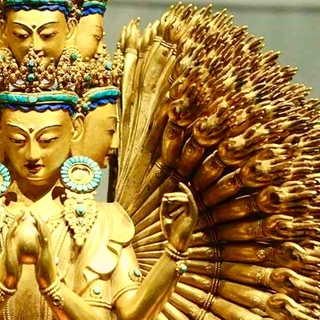
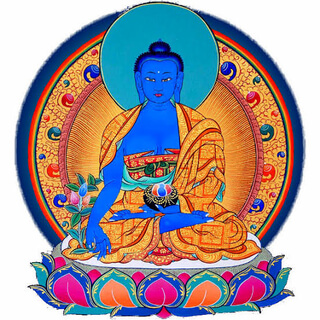
There's this huge thunker of white Tara,
This painting of white Tara hanging above the stage.
And I'm like,
Oh,
There she is.
And there is a resonance.
And so His Holiness,
I felt I did,
I was,
Something moved.
And so His Holiness gave a teaching,
I think it was the commentary on Lama Atisha's Lamp to the Path of Enlightenment was the text that he gave a commentary on.
Lama Atisha had been I think one of the abbots of Nalanda Monastery,
Ancient monastery in India.
He was a incredible practitioner because he,
He went to Indonesia to study with a monk called Sir Lingpa,
Who was famous for having the most compassion in the world.
And he spent 10 years training in Indonesia,
Before he came back to Nalanda.
And then at the invitation of the Tibetan king,
He went to spread Buddhism in Tibet.
So quite an extraordinary and he wrote this kind of,
It's like a prose,
It's like a poetic treatise on core aspects of the Buddha's teachings that he felt would be appropriate for Tibetan people.
And he kind of with his knowledge,
He composed a long treatise written in verse.
And so the Dalai Lama gave his commentary on that.
Now,
In those days,
People don't,
I think if you're looking at the 90 year old Dalai Lama,
People won't realize that he would give a three hour lecture in the morning and a four hour lecture in the afternoon.
And he did that for four days.
There'd be a little tea break,
There'd be a lunch break,
But he,
His knowledge,
And intellect.
He Yeah,
So I think people,
People are familiar with his biography will will understand that he passed all of his exams with the Geshe's in Tibet,
Before escaping to India,
And he excelled.
So he'd done all his studies as a young,
Young monk,
Even while he was the king of Tibet.
And he'd excelled in his exams,
Got his Geshe degree.
And so,
For me,
You know,
To be honest,
At the moment,
It was a bit tedious and a bit boring.
It was like,
Because I'm coming from a meditation tradition,
And we're not not that academically interested.
So one of the things that the Gelugpa tradition seems to specialize in,
Is going through all of the different schools of teachings,
And they'll they'll even they'll explain what the wrong views are.
And then they'll explain how they understand the right view.
And the reason they do this is they believe that you need to know what's wrong,
In order to recognize what's right,
Or what is skillful,
Or what isn't skillful,
What's logical,
What isn't logical.
So he would give a lot of commentaries on these ancient schools of Buddhism in India,
And what were actually wrong views in those schools,
And then what he considered to be the right view,
Based on Nagarjuna's Majamika teachings.
And what I noticed,
Was when the Dalai Lama made a comment about how he understands this verse,
And what he understands to be accurate,
It was always,
It always gelled with what I'd heard from my forest teacher masters.
It was like,
When he was talking about how he understands this verse,
After the long explanation,
And covering ways to look at what's wrong,
What's then,
When he says,
When he says the pithy thing,
Condensed it to what his understanding is,
It always resonated.
So,
Okay.
And it sounded similar to something that Lumpo Chah,
Or Ajahn Anand would say.
And so I noticed that.
Okay,
So yeah.
And then the day came,
The day came for the White Tara empowerment,
And I read the prayer that you had to say,
The vows that you had to say,
Before taking the empowerment.
And the last verse said,
This was apparently the Dalai Lama's favorite verse,
The last verse says,
As long as beings remain,
As long as space remains,
Until then may I too remain,
To dispel the miseries of the world.
And I'm like,
Oh,
I don't know about that.
And there was this Bhikkhuni,
Bhikkhuni Chodron was next to me on the stage.
And I said to her,
Do you have to have the,
Do you have to say the,
The full prayer in order to get the empowerment?
And she looked at me,
She's like,
Yeah,
I think you do,
She said.
And I'm like,
Oh,
But I can't,
There's no way I can commit to that.
So what I did was,
The way the phrasing was,
It didn't actually say that you had to vow to be a Buddha,
The word was,
In order to benefit all sentient beings,
I vow to attain enlightenment.
And I'm like,
I can say that.
And,
But I'm going to fold under this last verse,
I'm not going to say that.
And then I remember,
I remember saying to White Tara,
Okay,
This is the extent of my,
The extent of my aspiration,
The extent of my altruism.
I'm willing to attain enlightenment in order to benefit all sentient beings,
But I'm not staying until samsara ends.
No,
Sorry.
And so I,
I followed through.
And I did those vows.
Now,
Later on,
When I was discussing some of these things with Than Ajahn Anand,
When I'd returned to Thailand,
He said,
He said a way that Theravadans could relate to these practices.
So,
So Ajahn Anand does have certain abilities.
And I showed him a statue of White Tara.
And he,
He,
He saw that she had breasts.
And it's actually against the monk's rules to touch things that belong to women or touch.
And so he actually,
Like,
Put it down on the table.
He's like,
Oh,
She has breasts,
Actually.
Yeah.
And he says to the bodhisattvas,
He says,
Are you sure?
Are you sure she's a high-level bodhisattva?
Anyway,
He checked her out in his meditation and he came,
He said to me the next day,
She is,
She is a full,
High,
High-level bodhisattva with full barami.
She's really beautiful.
And he checked her out.
And then,
So that was interesting.
And she does,
She does have that form.
Of course,
Tushita Devas don't have genitals.
They're not affected by sexual lust.
It's a form.
Tara takes that form to encourage both men and women practitioners to just,
Just so that women can feel inspired that there are female forms.
But he explained that one could,
As a Theravadan practitioner,
Relate to celestial bodhisattvas as a form of Devanusati.
And if we understood that they live in Tushita heaven.
So the Vajrayanas might not agree with that.
They might say,
No,
No,
No,
The pure lands are not Tushita heaven.
They might say that.
And they can say what they like.
But my teacher said,
You can relate to the celestial bodhisattvas as Tushita Devas.
And you can rejoice in their wholesome qualities.
Now,
I found this very,
Very helpful.
Because I mentioned the,
Some of the experience I'd had in Thailand was it's a bit dry.
You know,
There's the,
All of the rules and all of the kind of,
All of you have to do this,
You have to do this,
You have to do this,
You can't do this,
You can't do that,
You can't do that.
The fault finding,
The competitiveness,
The machismo,
Which,
You know,
It has its place.
It helps us keep high standards.
It helps us practice hard.
I'm not saying it's all bad.
It's a lot of it is good.
At the same time,
Like I said,
You need a little bit of nourishment,
You need a little bit of love.
Somehow,
You need to find a way to nourish your own practice.
And so I found Deva Nusati and some mantra practice to be extremely helpful.
It just gave that little bit of extra nourishment,
A little bit of tenderness.
And I kind of felt that the practice met me halfway.
That when I did the mantra,
And the visualization,
That something also came.
And I felt nourished and uplifted.
But it was also a bit like a tuning fork.
It's like if you're,
If you're imagining a being that stayed in samsara for a long time to develop beautiful qualities,
To help as many beings as possible,
Their foremost qualities are loving kindness and compassion.
They're not judgmental,
They're not self righteous,
They're not contemptuous,
They're not macho,
They're tender,
They have tender loving concern.
And they're staying in samsara,
Because they care for you like a mother.
Now for some people,
People like me,
To think of something like that,
An influence like that,
If you believe it actually exists,
And this is one of the things that the Lord Buddha does say about Deva Nusati,
That it is a practice for people who have a strong faith faculty,
You actually have to believe they exist for it to work.
Now,
If you do believe they exist,
And thinking about them uplifts your mind,
It's like a tuning fork,
Something to resonate with something to aspire for.
But then you also receive,
I felt that I received some blessing as well.
And when I asked my Ajahn back in Thailand,
He said that was the case.
And this is one of the benefits of Deva Nusati.
It does actually say in the suttas that one of the benefits of Deva Nusati is that when you think of Devas with appreciation,
You become endeared to them.
They develop affection for you.
As you care for and appreciate the high level Devas with a lot of metta,
They become aware of you,
And they care for you.
And I actually felt I could actually feel something happening.
So when I came back to Thailand,
And I asked Ajahn Anand,
If I could do one night a week,
Where I could do a puja at my kuti,
Where I was focusing on Deva Nusati and mantra,
He gave his permission.
And this really,
This really helped me.
I think it helped me survive as a Theravada bhikkhu.
And so a lot of people will have opinions,
You know,
We all have opinions.
Theravada monks are like this,
Mahayana monks are like this,
Vajrayana monks are like this,
Theravada monks should be like this,
Vajrayana monks should be like this,
This monk should do this,
This monk shouldn't do that.
This is the real teaching.
This isn't the real teaching.
We all have opinions.
The other thing we all have is personal karma.
And what we what we have to do is navigate that.
And we have to find a way to make our practice work for us.
And so what was interesting for me,
Was I went to America,
And my Theravadan teacher,
Super strict forest monk,
The guy that discovered Daodam,
And established several monasteries on Popasana,
He tells me,
We're going to attend the Dalai Lama's teachings,
Achalo.
And I'm taking you with me.
So that's how it started.
And then,
So I spent that time in California.
And I did find it a helpful change.
At the time,
It was very busy,
There was a lot of work.
And,
You know,
But in a way,
It was just it was good to make the good karma.
And it was good.
I remember getting so fed up with my fault finding mind at one point in California,
Because there was like,
Morning work periods,
Afternoon work periods,
Was one of those times when there was,
I think the county was requiring that certain number of buildings got upgraded by a certain amount of time.
So we had to like renovate things.
And the monks were doing a lot of the work themselves and going to the hardware store and going to the dump and dropping off the trash,
You know,
And it was just one of those periods of time where there was a lot of work and everybody had to get in there and help.
But I remember getting so frustrated with my fault finding mind of this isn't why I became a monk,
This is what monks should be doing,
Blah,
Blah,
Blah,
Blah,
Blah.
And I got so frustrated with it.
It's like,
Look,
I can't stand this level of misery.
I have to do something about this.
So I said to myself,
You need to focus on what is good here.
You need to do that.
Because I was the guest monk as well.
So I used to have to answer emails,
Meet guests,
Take them to their dwellings,
Then go back to the building project.
And it was a lot of work.
And I wanted to meditate.
But then there's a word that I learned in California that Australians don't say much.
Australians tend to be a little bit cynical,
Maybe a little bit.
But there's,
You know,
Californians back in those days,
They were they were I don't know what they're like now.
But back in those days,
They were kind of positive.
And so a word that you would often hear in California was great.
That's great.
How are you?
I'm great.
Well,
That's great.
And so I kind of took that as my mantra,
That I was,
I was going to find things that were great.
And I was going to say that they were great.
And it actually really helped.
It actually really helped.
I had to stretch my capacity and allow for some things in conditioned experience to be relatively great,
All things considered in that moment.
So I started saying that I was great,
And things were great.
And,
And I'll be going back to Thailand.
Thank you very much.
But,
Yeah,
It helps sometimes when you sometimes you need to see the degree to which your own fault finding mind makes you miserable,
That you have that that was helpful to me,
Because that made me get determined to cultivate mudita is like,
I have to focus on what is good.
I mean,
These people aren't evil.
They're not doing anything wrong.
What are they doing?
They're building a monastery.
And later on,
Of course,
When infrastructure was more developed,
And things had got past certain challenges,
Then there was less work,
And there was more time to meditate.
And,
But sometimes we'll,
You know,
We'll have to chip in and work a bit work hard.
So that is also a part of forest monks life.
And that was the case,
Even in Ajahn Chah.
Ajahn Chah used to make the monks mix concrete sometimes late into the evening,
When they were making roads and building an ordination hall.
But even Ajahn Chah,
Ajahn Anand while training with Ajahn Chah did several all night concrete mixing.
So it's a,
It's a part of the Ajahn Sumedho talks about making a road at what Tamsangpet back when he was a junior monk with Ajahn Chah.
So yeah,
There are periods of time where we work hard.
It's one of the ways that we are frugal with the lay people's offerings is that we offer our own labor,
Then they cost less money.
So all things considered,
My time in America was helpful,
Even though there were some painful parts.
It turns out that Dalai Lama returned for a second time.
And this time he came to the San Francisco Bay Area,
And we went again.
And this time he gave a commentary on the Heart Sutra.
And this is interesting in,
In the Theravada,
We have the Anattalakana Sutra,
Where we contemplate the not-self aspect of the five khandas.
And in the Prajnaparamita Sutra,
The condensed version,
It's looking at the sunyata,
Emptiness nature of the,
Of everything.
So it's an interesting complement.
Again,
When I came back to Thailand,
And I discussed these things with Ajahn Anand,
He was saying the way he understands it is,
When you,
When you see one of the three characteristics,
Maybe it's Anicca,
Then there's a letting go.
When you experience Anatta,
You see that it's not-self.
And then what the mind experiences is emptiness.
Emptiness of grasping at permanence.
Emptiness of grasping at things as being a self.
So an insight into one of those three characteristics becomes seeing the three characteristics.
Seeing the three characteristics clearly becomes experiencing emptiness.
And Tarnajan Anand said,
This is a description of that.
This is,
The Heart Sutra is a description of the result of the practice.
An affirmation of,
And there is actually a meditation,
A meditation subject.
Is it Upamanusati,
Michi,
Emily?
What's the contemplation of the goal of emptiness of purity?
Yeah,
Contemplation of Nibbana.
I think,
I think it's called Upamanusati,
Where if one has had some insight into emptiness,
One recollects that insight,
Contemplates the ultimate nature,
Empty nature of phenomenon.
So that was a,
That's just a nice complement to our Theravadan studies.
And,
But what I think people might not,
There's a couple of things I want to mention about the Dalai Lama.
For people who look at him now as a 90-year-old,
I don't think people can quite recognize what a rock star he was in the late 90s and early 2000s.
The Dalai Lama,
Whenever he went around the world,
There were 10 or 15 or 20,
000 people attending his teachings,
And he went everywhere.
So this was extraordinary to see the,
The Barami.
So I,
One of the reasons I believe that he is a Bodhisattva,
Is because everywhere he went,
He was,
Even though he had lost his country,
He was received like a head of state.
He had a special security detail.
I remember it being quite funny because the Matrix movie had come out and we'd watched the Matrix on New Year's Eve.
And there were these guys that were like protecting the Dalai Lama that looked like agents.
They had the black suits and the black glasses and they had this,
It's like the Dalai Lama was talking about how to get out of the Matrix,
But there was agents on the left,
On the left and the right hand side of him.
That's what it looked like to me anyway.
But anyway,
I digress.
So even though,
My point,
The point I'm making here is the Dalai Lama is a very interesting example of a being that is still in our world,
That I believe really is a high-level Bodhisattva.
Because Ajahn Anand once said,
To be a truly high-level Bodhisattva,
Meaning like if you're on the 10th Bodhisattva Bhoomi,
To be the real thing,
Everywhere you go you would have to be received like a king and you would have to receive enormous offerings and you would have to be very,
Very famous.
And then Ajahn Anand said about the Dalai Lama,
And that's why I think the Dalai Lama is the real thing.
So if you forget schools,
Forget Theravada,
Vajrayana,
Mahayana,
Look at a being who has been cultivating the Ten Parami for eons and then this is what you're going to see.
Recently when I was in Dharamsala,
I went to the Dalai Lama archive and there's a museum that contains honorary doctorates,
Honorary citizenships,
Keys to the city,
The Congressional Medal,
The Nobel Peace Prize.
There is a museum that holds his accolades from all over the world.
Christian colleges have given him honorary doctorates,
Hindu societies have given him honorary doctorates,
The best museum,
The best universities in the world have given him honorary degrees in respect of his knowledge and understanding of spiritual matters.
He spoke to Christians about how to understand Gospels in England and there was this photo after photo of the Dalai Lama with another university cap,
Another honorary citizenship,
Another key to another city,
Another medal,
Another award.
Now what's interesting is he didn't want or ask for any of these.
He got so many of them they had to build a museum to contain them.
So what is that?
Things don't come without preconditions.
And so I,
But for myself,
And this is I guess my good fortune,
I didn't,
My experience of the Dalai Lama,
You need to understand,
Is that I was sitting five meters from him meditating.
So my experience of the Dalai Lama is as a meditator who is sitting with a monk because the events that I attended were his Buddha's teachings and his Buddha's ceremonies.
And I was four,
Five,
Six,
Sometimes two meters from him,
Two,
Three,
Four,
Five days.
And so I think you'll appreciate that as someone who's meditated many thousands of hours and when you're sitting there meditating,
Certain level of sensitivity,
I could feel the extent,
To some degree,
Of this bhikkhu's loving-kindness,
Or this bhikkhu's understanding of emptiness,
Which manifests as coolness.
And I think I might to maybe show a few pictures now.
If you bring up the picture of the Dalai Lama as the,
Doing the ceremony,
That first one,
JC.
No,
No,
No,
The one with him with the bell.
No,
No,
No.
The very first one,
Remember the one you said,
Which one is,
Where to put this one?
I said put it first.
Yeah,
This one.
So this is the Dalai Lama preparing for a ceremony and probably visualizing a mandala.
And there were occasions where I,
This was my view of the Dalai Lama.
I was sitting on the stage and he was two or three meters away and they would let us come onto the stage and meditate in his presence while he was doing his preparations.
I think you can show that one,
JC.
There's the one with my face is behind His Holiness.
Yeah,
This one.
So on this occasion in Sydney,
I was two meters from the Dalai Lama and he was preparing to give an initiation.
And I could feel waves of rapture exploding off of his being and going through my being while he was bringing in the blessings and clearing obstacles or whatever he was doing.
So my,
That what I'm trying to stress here is my understanding or my appreciation for the Dalai Lama comes from having felt his metta,
Comes from having felt his blessings.
And when I,
When I talked to the people who attended his teachings,
Whether that be 3,
000,
5,
000,
7,
000,
10,
000,
You can show the crowd picture,
JC.
Yes,
So these people came for a blessing,
The Dalai Lama.
This was in Washington DC many years later.
I would ask people and every single person felt blessed.
Every single person feels when they attend these events that the Dalai Lama blessed them.
And so he seemed to have this ability that no matter how large the space and no matter how big the crowd,
That he could embrace each and every one with his loving kindness.
And everybody,
That that space for that period of time becomes like a Pure Land or like Tushita Heaven,
Because everyone is just smiling and so happy.
So,
Okay.
When,
You can close the pictures,
JC.
We'll go back to them again.
So some interesting things started happening.
I went back to Thailand and I was much happier with my little bit of Deva Nusati supplement and my Sangha Nusati,
Including the Dalai Lama as one of my Ajahns and one of,
One of my teachers that,
Who recollecting his beautiful qualities gave me joy and inspiration,
Encouragement.
And so I,
When I went to India on a pilgrimage,
My very first pilgrimage to the Four Holy Sites,
And I stayed in Bhog Gaya for an extra month,
This is after my sixth panca,
It turned out that the Dalai Lama passed through.
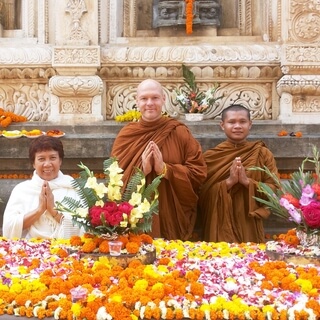
And he was giving,
I was staying at the Wat Thai,
And the Dalai Lama actually visited the Wat Thai.
So you can bring up that picture,
JC.
It's the one with the very young looking Ajahn Achalo,
Not yet Ajahn Achalo,
Very young looking Than Achalo,
This one.
So the Dalai Lama came to the Wat Thai during the month that I was staying there in my,
After my sixth panca.
And I just,
I remember saying to him,
I attended your teachings in America,
Nice to see you again,
Your holiness.
And so some kind of karma kept ripening.
And so I stayed with Than Ajahn Anand.
You can close the photo again,
JC.
I stayed with Than Ajahn Anand for my sixth and my seventh panca.
And I benefited.
Around about my sixth panca,
Something changed in my practice.
I would say the general level of challenge and frustration was replaced with a fairly consistent sense of well-being.
And the level of kind of lust,
Maybe the power of the lust,
Just things kind of cooled down.
This is like,
I'm about 36 or 7 years into the training.
The lust cooled down,
The level of contentment became a consistent thing.
Well-being became something resilient.
And it's not to say there weren't still struggles and challenges.
We all have our karma.
But it is,
I also just mentioned this to people,
That sometimes the results are coming.
They don't come as fast as we might like.
And that was what Ajahn Anand had said to me.
It's one of the things I mentioned in last week's sharing,
Was that,
When will it ever get better,
Anandpour?
Anandpour said,
In five years,
It'll be a little bit better.
In seven years,
It'll be even better.
And that was the case,
That after seven years of just sticking to it,
The level,
The coarseness of the kilesas became more refined,
And the resilience of the well-being became more established.
So,
But then an interesting thing happened.
I was spending my,
Ajahn Anand,
After,
After building his Apostle Hall,
It's a tradition to spend six months away from your monastery,
If you build an Apostle Hall.
It's a tradition in Thailand,
Because they believe that it creates so much merit,
That your karmic debtors will come after you to take their revenge.
And so,
You go and stay in a different monastery,
If you're an abbot,
And wait for things to calm down before you come back.
So,
Realistically,
Probably your karmic debtors will,
Can find you wherever you went.
But for whatever reason,
That is the,
That is the tradition.
And it probably is based on,
These things tend to be based on some anecdotal evidence.
There probably is something to it.
But anyway,
Tan Ajahn had invited me.
He'd spent his panca that year,
In a,
One of his branch monasteries with Tan Ajahn Thong.
That was my seventh panca,
And I,
And he invited me to spend that with him.
There were just six bhikkhus there.
I was one of them.
A very interesting thing happened.
I was meditating diligently,
And I had a dream where the Dalai Lama came into my dream,
And started drawing a sketch of a particular deity.
And he told me that he,
He was recommending that I get a certain initiation,
And do a certain practice.
Now,
This was confusing to me.
But,
And I guess it just suggests,
Obviously I'd made some connection attending the teachings in America,
Seeing him again in India.
And this,
This did,
This did affect my mind.
I'm like,
If the Dalai Lama is telling me I should get something.
And so I,
I thought about this.
I went,
After my seventh panca,
I went back to Wat Nalachad.
I was the guest monk.
Ajahn Yanadamu was the abbot in my eighth panca.
And I made a,
Because I'd been kind of critical in my mind,
In my speech a bit with Ajahn Jayasaro,
When I,
When I wanted more love.
I decided to make it my practice during my eighth panca,
Not to say anything critical of the abbot at all.
That I'm going to offer a year of service,
And I'm not going to be one of those monks that criticizes the abbot.
I'm going to be one of the monks that goes to be helpful,
And doesn't criticize the abbot.
I made that my practice.
And so I was the guest monk.
That's when I started teaching guided meditations actually,
To the Anagarikas and the novices.
That's when I started my teaching career.
By that stage I'd been practicing for ten years,
If you include the Anagarika and novice period.
So after ten years,
I started teaching.
The first people I taught were eight precepts for cows,
Anagarikas and novices at Wat Passing through Bangkok,
At the place where the monks stay,
There were two nuns who used to be Theravadan nuns,
Who'd become Tibetan nuns,
Who were staying in the same place on the lower floor.
And they,
One of them,
Sister Jyotika,
She's based in Spain now.
She had been at Amaravati.
She had been training the Dalai Lama's new ordainees in keeping precepts.
And I told them about my dream.
And she said,
Well you should write a letter to the Dalai Lama and see what he says.
So I did write a letter to the Dalai Lama,
And I got a response from him.
So I have a signed letter from the Dalai Lama,
Where the Dalai Lama says,
You,
You should come to Sara Monastery,
When he's giving a teaching,
A few months later.
And he said,
You should also go to Drepung Monastery.
Now the places where the Tibetan settlements are in southern India,
They say,
He said a few things.
He says,
You don't need to change traditions.
You don't need to consider this.
But you should seek out a teacher.
And he said,
You can just consider this to be adding additional practices.
So that,
That was helpful.
What's very interesting is I,
When I paid respects to Arjun Anand before coming to India,
After my eighth panca,
Arjun Anand gave me a very special gift.
Arjun,
The Dalai,
Arjun Chah had made two sets of amulets,
I believe.
He'd made 108 of one that was made of copper,
And he'd made 108 of one that was made of silver.
And he'd seen the effect that it had had on people.
In Thailand,
There's a lot of greed for special amulets.
And so he decided never to do it again.
I'm not going to make amulets.
But Arjun Anand gave me,
At the airport,
An amulet of Arjun Chah,
One of 108.
And I believe that his,
It was his way of saying,
Don't you forget where you come from.
Remember Arjun Chah.
So obviously,
I still have that amulet today.
And I'm grateful.
And it's a beautiful gesture of my teacher,
Isn't it?
To,
To give me that special thing and just say,
You know,
Don't forget where you come from,
Which I have not.
Very grateful.
And so I went to the,
I went to these teachings,
The Dalai Lama was giving a,
What it was,
Was a monk,
Was a monk called Asanga,
Was believed to have gone to Tushita heaven and received teachings from Maitreya,
And had come down and written a treatise on the teachings he'd received from Maitreya in Tushita heaven.
So the Dalai Lama was giving a commentary on Asanga's teachings on the Bodhisattva Bhumis.
And if I remember correctly,
It was a 10-day teaching.
So I went there.
Now,
To go to where the Tibetan settlements are in southern India,
There's one in Byalakupai in Karnataka,
And there's another one in a place called Mungot,
You needed to get special permission from the government.
And so I'd got permission to go to Sarah,
Sarah J and Sarah May,
Where the teachings were being given.
But I hadn't got permission to get to go to,
To Mungot.
I thought,
No,
No,
No,
I'm just just going to one place.
I don't,
I don't want to go all over the place.
And so it turned out that while I was at Sarah Monastery,
My,
A friend from America and my brother traveled with me in India during that time and helped me to get there.
Dr.
Kabat-Zinnick,
Thank you.
And so when we were at Sarah Monastery with 15,
000 monks attended,
Again,
This is where you see,
Okay,
This is a bodhisattva who's been building merit for a long time.
This might be what it looks like.
There are 15,
000 monks present listening to these teachings.
This is not something that doesn't happen without causes.
And there were some Western monks there,
They allowed me to stay in their place and made some good friends.
Anyway,
During the time that the Dalai Lama was there,
Oh yes,
And the,
And his Hajan Anand had given me some relics to offer to the Dalai Lama.
And the Dalai Lama was so busy that he didn't have time for appointments,
But I was allowed to go at the end of the line of people who wanted to make offerings to him while he was moving between meetings,
Because he was meeting with the abbots and the senior geshes,
Etc.
It was a sangha gathering.
And I remember I got to,
Just in front of the Dalai Lama,
With my white scarf and my relics.
And I looked up and I saw silver and gold rays coming from his face.
No body,
No robe,
And just a face that was shining like the sun.
And I,
Whoa,
And then I took my one step forward and he was back in his normal form.
I offered him the relics and I,
And he tried,
He blessed them and he gave them back to me,
Said,
No,
No,
No,
They're for you.
And he said,
Thank you.
And then he marched off.
And there was this really cool thing,
I think it's cool anyway,
There was this huge table full of offerings that people wanted blessed by the Dalai Lama.
So as he walked quickly away to his next meeting,
He blew on the offerings.
He just did this.
And blessed a whole table of offerings with one out breath.
And I'm like,
Whoa,
That's cool.
And,
You know,
It's not the kind of thing you see every day.
And it's the kind of thing that meditation monks like.
And so when I got back to Thailand,
I asked an Arjan Anand about that.
But Arjan Anand said,
Yes,
The Dalai Lama knew that you'd come a long way.
He knew that you brought a special gift.
He didn't have time to talk to you.
So he used his powers to help you see some of the extent of his merits.
He said he always has silver and gold rays emanating from him.
That's not something that you just saw in that moment.
That is something that is always happening.
The silver is the sealer and the purity,
The gold is the merit,
And the metta.
And he always has that.
So he helped you to see that as his acknowledgement,
Because there wasn't time to talk.
And so anyway,
While I was there,
It was announced that the particular deity that the Dalai Lama had said I would benefit from having the initiation was going to be happening in the monastery in Drepung,
The place where I hadn't got the permit,
But the place where the Dalai Lama had said in the letter,
You should go to Sarah and to Ganden and Drepung.
I didn't have the permit.
I was in India.
What was I going to do?
So I talked to a Tibetan monk and he says,
You can go,
You can go,
But you just have to be careful not to get caught.
And I was like,
Oh God,
I don't really want to spend time in an Indian jail.
So what am I going to do?
And they do these divinations.
There was a,
There was a chanting master who,
Who I asked with the help of one of the Western monks to blow.
And I think they're little balls of dough and they blow on them or something and they do a divination.
And I got a divination and the divination said I'd be okay.
So I traveled this 10 hour drive with this other Tibetan monk and I had to go and stay in the guest house and just basically hide because,
And then go and attend the ceremony and then come back to the guest house and not get caught by the police.
But I did do it.
And so I do have,
I think I've said this before.
I do have certain quality,
Qualities of courageousness and determination.
And it's also my nature to lament and cry and say it's too hard the whole time.
So I have these two things.
I'm courageous,
I'm determined and I lament.
So I was scared that I'd get caught,
But I didn't get caught.
And then I'm not going to mention that which particular deity it was,
That you're supposed to keep some of these practices secretive or discreet.
But what I noticed was I would say before that time that I was sensitive and sweet and kind,
Which is nice,
But somewhat lacking in toughness.
And I think a spiritual practitioner needs both of these things.
You need your sweetness,
Your sensitivity and capacity to empathize.
You need that.
You also need to be tough.
And so after doing,
I think I did 300,
000 of this mantra of this particular deity,
Which was associated more with power.
And I can say that it helped my practice.
I became,
I would say,
More balanced.
The sweetness,
The sensitivity,
The tenderness is still there.
And so is toughness.
So don't pick a fight with me.
So I think,
You know,
Something there is elementally,
There are,
There are things,
You know,
That a meditation master or a vajra master can see that a particular disciple might benefit from a particular extra element in their practice.
And I did.
And so that had come in the form of a dream.
I had followed that prompting.
And I'd received the empowerment,
Did the mantra.
And I had a dream when I was staying at Sarah Monastery.
After I'd had the dream,
After I'd had the empowerment,
I dreamt of Ajahn Anand.
And Ajahn Anand gave me a hug.
And then I knew it was time to go back to my Ajahn in Thailand.
But as I'd mentioned,
Ajahn Anand,
He allowed me to do my one night a week Mahayana puja.
As I said,
I'm content,
Happy.
I would say I have an 85% Theravadan practice.
But that supplement,
A little bit of Devanusati,
A little bit of mantra,
Get that little bit of extra compassion and tenderness by thinking of the peaceful deities,
A little bit more toughness by recollecting a powerful deity.
I believe it was a factor in why I'm still here 30 years into this.
And I'm grateful.
And this connection with the Dalai Lama seemed to keep manifesting.
That was my good fortune,
Was His Holiness started going to Australia with more frequency.
And so I would time a visit with my parents with when the Dalai Lama was coming to Australia.
And I think I mentioned once before,
One of the times when I believe that I experienced the Dalai Lama's psychic powers,
Was when I attended a teaching of his in the Rod Laver Tennis Arena in Melbourne.
I think by this stage,
I'm 10,
10 pounces.
Yeah,
I'm an Ajahn now.
And for whatever reason,
I was the only Theravada monk that turned up and I was in the front row on the stage.
They have the senior Tibetan monks on one side and the representatives of other traditions on the other side.
And a microphone came in front of me.
And this guy asked me,
Can you chant the Mangala Sutta?
And I said,
I can,
But I'm not going to.
And he says,
Yes,
You are.
The Dalai Lama said somebody has to chant the Mangala Sutta.
And so the Dalai Lama came out.
And I think there's about 6000 people here attending.
And the Dalai Lama gave his introduction.
And then he says,
Okay,
Now who's chanting the Mangala Sutta?
Because he would have monks chant the Sutta in a historical accuracy.
So the Theravadans went first and then the Mahayanas would chant the Heart Sutra and then the Vajrayanas would chant the Tibetan version of the Heart Sutra.
Sometimes he would get the Vietnamese or the Koreans to do it as well.
But he would ask the Theravadans to chant the Mangala Sutta.
So he said,
Okay,
You and he looked at me.
And there's like 7000 people and there's another microphone and then the cameras turn on me.
And I'm like,
You don't you don't understand.
I used to get a shaking,
Nervous voice if I had to talk to more than 20 people.
It really was not.
I was a delicate flower born in this lifetime.
It really was not within my capacity to chant this alone in front of 7000 people.
And I'm like,
Well,
What am I going to do?
Am I going to let down the team and embarrass myself?
You know,
Or am I going to try and embarrass myself?
Because what I wanted to say was,
This is too hard.
I can't do this.
I'm like,
Come on,
Don't be pathetic.
So I thought,
I'm going to try.
And if I if my voice shakes ridiculously,
And I make a mess,
And I can't get through it,
At least I tried.
Right.
So I set that intention out of respect for you,
Out of loving respect for you,
I'm going to try.
So I started doing the Namo Tassa.
And the Dalai Lama joined in.
Not more.
We're doing it together.
And then I started to do Asewana Jabalanang.
Now,
You know what,
That part of me that felt nervous,
That perception of a self that felt like it couldn't do it,
It just disappeared.
It wasn't there.
What was there was the syllable that I needed to do next from Asewana to the very young at the end.
I got through it,
Strong,
Loud,
Clear voice.
And I'm like,
I got through it.
I'm like,
And he said,
Thank you.
And I'm like,
Oh,
Thank you.
And I believe that he could see that I was nervous,
And that I actually couldn't do it.
And I believe what he did was he used his power to push aside the nervousness and increase my samadhi and my confidence just to get through it.
And then I got through it.
And it's like,
Then I realized,
Okay,
Now this is a real master with real nuance in terms of reading a mind,
Knowing a person's abilities,
And being able to support them so that they can do because it's win-win.
For him,
A representative of the Theravada is there supporting him.
For me,
I get through it without embarrassing myself.
And people came up to me afterwards and says,
What was it like chanting Pali for the Dalai Lama?
And I'm like,
I don't know,
I wasn't there.
Which is a very interesting insight into not self in and of itself.
And yeah,
So that was an interesting experience.
Now,
A subsequent time,
I did this.
And then I had friends in future meetings,
I think it was at the Olympic Dome in Sydney.
And then once again,
The Sydney Entertainment Centre,
Third time.
What was interesting about the third time is I was beginning to feel maybe a little bit cocky,
A little bit confident,
I can do this,
The Dalai Lama is going to help.
On the third occasion,
When he when I was asked to lead the Mangala Sutta at the opening of the teachings,
He didn't help me.
I remember getting a couple of syllables into it.
And I heard that familiar.
Oh,
No.
And I felt my mouth going dry.
And I,
And I,
I think I recognized what he was doing was,
He helped me the first two times.
But on the third time,
It's like,
No,
You got to do this,
You,
You've got to learn to walk.
And so he,
I remember the Oh,
No,
Help.
And the there was a company that was started a charity that was started in Australia called the Dalai Lama in Australia.
And they were started for the express purpose of sponsoring Dalai Lama to visit.
And from the various teachings I attended,
Around the world,
They did the best job of making these gatherings really,
Really nourishing on many levels.
So,
So they would,
They asked me to lead guided meditations before the guided meditation before the teaching for people who wanted to come and meditate,
They would have question and answer sessions at lunchtimes with representatives from each tradition.
And they would have panel discussions after the teachings with representatives from each each tradition.
So they did a really job,
Really good job of making it a sangha gathering and an inter,
Inter sangha harmony.
And so I think I attended the Dalai Lama's teachings in Australia,
I think at seven times,
And chanted the Mangala Sutta on many occasions.
And so it's this,
Anyway,
This karmic connection.
I'm assuming I've probably been an Indian monk before.
And I'm assuming I've probably been a Tibetan monk before that would be that would be what would make sense to me in terms of the evidence would seem to support some karmic connection there.
And so most recently,
I was invited.
Funny enough,
I was invited to participate in a group from Thailand that was attending a long life prayer for His Holiness's 90th birthday.
And so I happily went.
And then the day I arrived,
I was asked,
Would you mind reading the long life prayer for the Dalai Lama in English?
This was a bit weird,
Because it's like,
What it was this this prayer ceremony was for the Southeast Asian Buddhists.
And there were 1400 attendees,
Vietnam,
Cambodia,
Laos,
Thailand,
Burma.
And I'm like,
There were like three white people.
And they're asking me to say this on behalf of the Southeast Asians.
Like,
And I think part of it was the organizers knew they'd asked me to attend various conferences and things.
And they knew that I'd get through it and that I wouldn't let them down.
And I could do it.
But it was just interesting that I was there,
Sitting five meters from the Dalai Lama and sitting right next to the first elected Prime Minister in the Tibetan government in exile.
And they gave me the speech,
Which was translated from Tibetan to English.
And I read that out.
And yeah,
So I got to press his hand against my forehead and bow at his feet.
High Level Bodhisattva,
One of my Ajahns,
Who's been an important supplement to my Theravadan practice.
I think we can show you some pictures now.
They see.
So this was in Sydney back in 2014,
I believe.
On the stage,
He would come out and he would shake the hands of the monks who represented the other traditions.
And he actually pressed his head against my head on this occasion,
Which is apparently a big honor.
And I could sense emptiness.
He gave a blessing,
An empowerment.
And for whatever karmic reason,
I was two meters from him as he prepared for his this.
I don't usually share this picture because in the picture,
I look like I'm higher than the Dalai Lama.
So I've never kind of shared it.
You're seeing this for the first time.
But yeah,
So as I mentioned,
My experience,
This almost looks like he's paying respects to me.
And if he did,
My head would explode.
So I don't share that picture very often.
But I just share it with you to explain that part of the reason the way I experience and relate to the Dalai Lama is having meditated next to him when he was meditating.
So I love and respect and relate to him as a meditation master,
Having felt the extent of his metta and blessings to the degree that I can.
This was at a conference in Delhi.
I think this was in 2016,
I think.
And Ajahn Kevali,
Also attended.
And a lot of Thai monks.
It was an inter-lineage dialogue.
I was offering him some vitamin C.
His Holiness had a flu on this occasion.
And there was a break.
And I offered him some vitamin C.
So this was in Washington,
DC.
The Dalai Lama gave a teaching on the 37 Bodhipakya Dhammas in Washington,
DC.
And that was another 10-day occasion.
You can see that's my,
I don't know if you see this,
This is my signature ball patch at the end,
At the back.
That's how you know it's me.
Yes,
Again in Washington,
DC.
And that's where that picture of that huge crowd was.
They get to glimpse the accumulated merit,
The beings that feel a karmic affinity and connection with this monk.
It's quite extraordinary.
Yeah.
That's right,
2011.
Trying to follow along with the Tibetan chanting.
So the Vajra Master,
The Meditation Master,
The altruistic,
Compassionate Dalai Lama,
Now 90 years old.
So I guess it's my karmic connections,
My whatever combination of karmas I have manifesting in this lifetime.
Wherever I travel in the world,
I usually bring two photographs with me.
I bring a little statue of the Buddha,
And I have a picture of Ajahn Anand,
And a picture of the Dalai Lama.
So that's if I go to England,
Or America,
Or India.
I don't do that in China,
For obvious reasons.
Just Ajahn Anand,
Just a picture of Ajahn Anand in China.
And it has been my good fortune to have these great bhikkhus as my teachers,
And I love and respect them.
And yes,
I am happy as a Theravadan bhikkhu,
And also happy to have my Mahayana supplement,
And my practice of Devanusati.
Share this information,
Understanding that some people may be critical.
Some people will think,
This isn't what Theravada monks should be doing,
Blah blah blah.
People are welcome to their opinions.
I share this information because it will be helpful to some of you.
And for those of you for whom it was helpful,
Sadhu,
I rejoice.
And for those of you who it was not,
Please put aside what isn't helpful.
And I'll end this sharing,
Part two of the spiritual biography of Ajahn Ajla,
The influence that the Dalai Lama had in my life and practice.
May all be well.
I hope something I said was useful.
Sadhu,
Sadhu,
Sadhu.
Thank you so much,
Prajna.
Beautiful sharing.
Interesting and beautiful.
Very creative and helpful in the past.
It's nice to recollect these occasions as well.
And sometimes I've,
I've like just wondered,
Like I've come to these teachings and I'm sitting on the stage and the Dalai Lama comes out and shakes my hand or presses his head against my head.
And I'm chanting the Mangala Sutta and I'm just kind of like,
How did I get here?
It's like,
It's just baffling.
And what you,
What you can't see is the past previous causes of which there must be.
And yeah,
Again,
Like recently,
Why is it me reading this speech?
And it's like,
Well,
Karmic affinity merits ripening opportunities to make a virtuous karma.
So I guess it's some good fortune.
So we dedicate this to you.