So you'll want your mat up against the wall,
Maybe between one and five inches away from the wall.
You'll want to have maybe some blankets on your mat,
Maybe an additional blanket and a couple blocks.
So we'll be laying down for most of the practice.
And again,
If you don't have a wall,
You can do this practice seated.
So let's just begin in any seat,
Just sort of tuning in.
You can sit in any position.
You can sit cross-legged in a position on a block or a blanket.
And we'll be here for just a few moments.
You might close your eyes and find a soft gaze down in front of you.
And just start to notice how you feel.
Notice your body,
Any areas of tightness or tension.
Notice any sense of energy or pulsing in your body.
You might also notice your breath and the quality of your breath.
Is it smooth or choppy,
Shallow or deep?
Just notice what's going on right now,
Body,
Your breath,
And your mind.
And begin to gently deepen your breath.
Just take a few breaths here.
Inhale and exhale through your nose.
And just notice how that feels.
And then gently open your eyes.
And we're going to come into just a few rounds of Cat-Cow to get into our spine a little bit,
Get a little bit of movement going,
And then we'll come into our first pose.
So come into Table Pose first,
Hands and knees.
Lengthen through your spine.
And then on your inhale,
Draw your heart forward,
Arch into your cow.
Exhale,
Draw your belly in,
Look to your knees for Cat.
Move with your breath.
Inhale,
Cow.
Exhale,
Cat.
Breathing in and out through your nose.
And then return to Neutral Table.
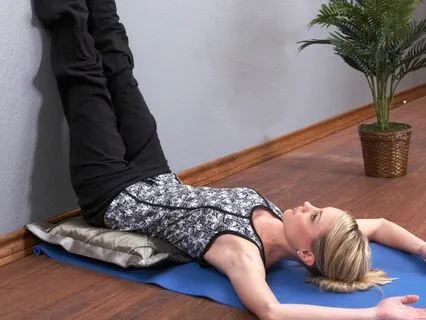
So we're going to move into laying down on the mat with our legs up the wall to get into our first position.
You might want a blanket handy,
Maybe just sort of off to one side of your mat.
And then instead of starting at the middle of your mat,
Start by sitting just sort of off to one side,
Doesn't matter which side you're on,
With your back towards your ball.
You can just sort of sit with your legs off to the side.
And then you're going to have your hips as close to the wall as feels comfortable.
And then lay down on your side and roll onto your back,
Bringing your legs up the wall.
And that should make it a little easier to have your hips as close to the wall as feels comfortable to you.
So if your hamstrings are really tight,
You might want to move your hips away from the wall a several inches.
And just notice how your hips feel here.
If you would like extra height under your hips,
You might take that blanket,
Bring it close to one side of your hips,
Bend your knees,
Feet flat on the wall,
Push into the wall to lift your hips,
And then use your hands to slide the blanket under your hips and then lower your hips back down.
So this provides a little height under the hips.
And if you have any low back issues,
Sometimes that feels better.
So notice how it feels.
And at any time,
Feel free to remove the blanket.
So our first pose is going to be wall butterfly.
From here,
Bring your feet together,
Bend your knees out,
And let your feet slide down the wall.
If you need to,
You can have your hands sort of supporting your thighs if it feels like your knees are going down too far,
Or you can always put blocks angling under the thighs.
So for this one,
I usually don't like the blanket under my hips,
So I'm going to move that out.
But find what feels good to you.
Find the position that feels comfortable where your legs are relaxed and your feet,
At least one part of your feet are probably touching.
Your heels might separate.
Maybe the outer edges of your pinky toes are touching or some of the balls of your feet are touching.
And as we hold here,
Usually we have a little bit of release into the hips and the feet will just sort of automatically slide down the wall a little bit.
It might do it in little movements,
Like maybe a centimeter or so.
You might just notice that release and the feet are just starting to slide down the wall.
If you find that's too much and your legs just sort of went too far,
Use your hands,
Keeping your upper arms on the mat or blanket,
And you can just use your hands to support the knees.
Always make sure your knees feel okay.
And I should have cued to have the blocks closer.
At least mine aren't close enough.
So having the blocks close,
You can also angle the blocks to support your thighs.
And sometimes that is a nice support option.
And if you feel that you need to adjust your hips further or closer to the wall,
Do so.
And we'll be here for a few moments.
So the arms,
If you're not using your hands to hold the legs,
Can just be out to the side.
And see if you can relax into gravity here.
Let your legs and feet be soft.
You might notice the heels separate away from each other as your feet slide down the wall.
Try to really relax into your hips,
Into your legs.
Relax your feet and ankles.
And invite your back to relax.
Notice if you're holding any tension in your back.
And you might notice one foot come down a little more than the other.
That's okay.
And close your eyes.
And of course,
If you don't have a wall,
You'll just be seated,
Maybe on a blanket with your legs in the butterfly position,
Maybe holding onto your feet or using props to support your arms.
Here in wall yin,
We can really soften and relax and have gravity help us go deeper into the pose.
So we want to relax here.
Notice if any tension starts to build in your low back or hips or legs.
Breathe into that area.
You can also have a blanket under your head if you prefer.
I'm going to do that.
It's a little easier for me to talk.
We'll be here for a few more moments.
Take a nice full inhale.
And a soft sigh of an exhale.
Let it go.
And then bring your hands to your outer knees and slowly help the knees come in as you slide your feet up the wall,
Straightening your legs up the wall,
And just relax with your legs up the wall.
Notice sensation.
And of course,
If you're seated,
You can come into windshield wipers or whatever counter pose feels good to you.
So you might point and flex through your feet here,
Getting a little movement into the legs and muscles of the calves and ankles.
And then we're going to come into our next pose.
So our next pose is wall squat.
So I really like this because it's a lot more accessible than squatting on your mat.
So bend your knees,
Widen your feet,
Feet flat on the wall,
And then let your feet come down a little bit more and wider until you feel that your feet are lightly pressing against the wall.
And you feel that stretch in your hips like a melasinous squat,
Similar to maybe like a happy baby sensation or position as well,
Except your feet are flat on the wall.
And this would be a similar position if you were like on your mat on your feet.
So we can just keep the arms by our side,
Relaxing the shoulders and arms.
Relax your back,
Relax your hips,
Relax your legs.
And again,
You might notice that the sensation as you relax,
The sensation of stretch might dissipate.
And then you can just gently,
Very slightly,
Quarter inch or a centimeter,
Bring your feet down a little bit or adjust your heels in or out slightly until you feel that sense of stretch in your hips again.
And then invite your body to really relax into this shape.
Notice if there's any tension building in your shoulders or upper back and relax your shoulders and upper back.
Soften into your arms,
Relax your mid back,
Invite your lower back to relax and release,
Invite your hips to release and relax.
Keep your legs soft,
Feet on the wall.
And again,
If you feel that there's been a release and sensation,
You might slide the feet down a little more or adjust the feet out a little wider,
Maybe toes in,
Toes out,
Heels in,
Heels out very slightly until again you feel that sensation of stretch in your hips.
So it should feel like you're just gently pressing your feet into the wall,
Very slightly.
Breathe here.
And again,
Notice where your body starts to hold tension.
You can send your breath into those areas,
Encouraging the body to relax and release.
So another option while we're laying here is to get into the head and neck a little bit.
So you can just slowly turn your head to the right and just stay here for a few breaths,
Noticing any stretch on the side of your neck.
Let your neck relax and release.
And again,
This is just an option for the head and neck.
Soften into your shoulders,
Relax your arms,
And then slowly bring your head back to neutral if you had your head turned one way,
Pause,
And then slowly allow your head to turn the other direction.
Relax your neck.
Let your head be heavy.
Soften into your shoulders and upper back.
Relax and soften your arms.
Remember,
This is your practice,
So always listen to your body,
Listen to your breath,
And find variations as you need to.
And then slowly bring your head back to neutral if you had it turned one direction,
Pause here,
And then begin to gently deepen your breath.
Take a nice full inhale and a soft sigh of an exhale,
Let it go.
And then maybe using your hands to gently bring your knees back in slowly as you bring your feet up the wall.
Groaning is totally appropriate here.
Notice sensation.
Maybe that temporary and momentary feeling of vulnerability and fragility,
That is the yin echo.
Notice your hips,
Notice your legs as you bring your legs back up the wall,
And pause.
And again,
If you would like to point and flex through your feet,
You could add a little bending of the knees as you do that,
Or let the feet slide on the wall,
Up and down,
Whatever feels good.
So from legs up the wall,
We're going to move into wall straddle.
Make sure your blocks are handy.
Maybe that blanket is handy if you need it.
So wall straddle is like making a V with your legs.
If you have tight hamstrings,
You might need to have your hips a couple more inches away from the wall.
If your hamstrings are more lengthened,
You might want your hips right up against the wall.
That might feel better for you.
So adjust your position of your hips to the wall.
And then with your hands on your outer legs,
Outer thighs,
Slowly invite your legs to go out wide in a V shape.
So again,
We're going to let gravity deepen the intensity.
So sometimes coming into this position,
It's like,
Ooh,
That's too much.
So you can use your hands to support your thighs,
But that sometimes takes some effort.
So what I like is to take the blocks and angle them so the blocks are sort of on one point and either the long side or the short side of the block is right up against the thigh.
And then you can use your hands to hold the blocks as you let your legs relax onto the blocks.
So your hands are just supporting the blocks,
But there's not as much effort in your arms and hands.
And then you can just relax into this shape.
So find your position,
Your variation.
And again,
Once we've been here a little while,
Gravity is going to do its thing.
And you might feel the legs go a little wider,
The feet sliding down the wall a little more.
If it feels appropriate,
You can relax into that release.
Or just move your blocks,
If you're using blocks,
Move them micro movements,
Half a centimeter,
Quarter inch,
Out a little wider so that you can allow your legs to go deeper,
But you're in control so that you know you're not gonna go past what's comfortable for you.
And it's just an option to use your blocks to support the legs.
Some people just like to relax completely into the stretch.
So listen to what feels best to you.
Relax your feet and legs,
Relax into your hips.
You might notice one leg feels different than the other.
Try to keep your legs really relaxed here.
So in yin,
We're getting into the joints and the fascia.
And those sensations we feel that are,
What I like to say is like I aged a decade coming out of the pose.
That yin echo means we got into the joints the way we wanted.
Notice if you're building tension anywhere in your body.
And send your breath there,
Inviting that area to relax and release.
And you can always support the legs with your hands and the blocks.
So you feel comfortable,
You're not going too far,
Too deep.
And if you wanna go deeper,
Just move the blocks slightly out wider and you can relax into that deepening.
Inviting your muscles where you feel the most tightness to begin to soften a little bit more,
Releasing long held tension,
Letting go.
We hold a lot of tension and tightness in our bodies.
So begin to gently deepen your breath,
Take a nice full inhale and sigh it out,
Let it go.
And then slowly using your hands or maybe the blocks initially to help,
Push your legs back up to legs up the wall.
Set your blocks aside within reach still and pause with your legs up the wall.
Notice sensation,
Notice that yin echo.
Again,
If you'd like a little movement,
Flexing the feet,
Bending the knees and then straightening the legs and pointing through the feet,
Whatever would feel good.
Noticing that sensation.
So if your hips are really close to the wall,
You may want to scoot slightly away from the wall for the next pose.
For this next one,
Which is figure four hip stretch using the wall,
You'll want to have your hips maybe anywhere from two to six inches away from the wall.
If your hips are really tight,
You might want to have your hips further away from the wall.
So we're going to start whichever side feels easier to you and cross that ankle over the opposite thigh.
That ankle will stay active,
Toes sort of going up slightly and then bend your other knee.
So the other leg,
The foot is on the wall,
Either the sole of the foot or the heel.
So as you bend that knee,
You're going to feel the stretch in the outer hip of the leg that's got the ankle over the thigh.
So this variation I really like because you can really relax without having to hold behind the other thigh with your hands.
And you can control the level of stretch by sliding that foot that's on the wall down the wall,
Deepening that stretch in the outer hip.
Also,
If you had had your hips on a blanket,
You might want to remove the blanket for this pose.
So you can adjust the deepening of this stretch by the position of that foot on the wall and how much you bend that other leg and how close your hips are to the wall.
Arms are relaxed,
Make sure your knees feel okay,
Make sure your ankle that's crossed over the thigh is neutral so you're not sickling the ankle.
Ankle should just be neutral.
You can relax the foot a little bit,
Just keep the ankle neutral.
And notice that stretch in your outer hip.
You can send your breath into that area,
Encouraging that area to relax and release,
Releasing long-held tension,
Tightness,
Even trauma.
We hold onto so much in our bodies.
It's just our body's natural way of protecting itself.
But after a while,
It's like,
Okay,
That's enough.
Time to let it go.
And it's like layers,
That's why we call it a practice.
It's not one and done.
It's sometimes years of practice to really release long-held trauma.
But often,
Sometimes in one practice,
You can have a major release.
That does happen.
And it's also very common to experience tears when you have an emotional release,
Especially in certain poses,
Getting into the hips.
It's very common to just find yourself getting emotional,
Crying.
Just know that that's a good sign that you're releasing.
If it feels like it's too much,
You can always back out of the pose.
To assist the release,
Just breathe into it and use those soft sighs of an exhale to help release.
Notice what you're feeling.
We'll be here for a few more breaths.
And then begin to gently deepen your breath.
And then slowly on your next exhale,
Start to straighten your leg that has the foot on the wall.
And then uncross that ankle,
Bring that other leg back up,
Legs up the wall.
Notice sensation.
One side might feel different than the other.
And the other side is our counter pose.
So now cross your other ankle over the opposite thigh,
Keeping the ankle neutral.
Start to bend your other leg.
Foot can stay on the wall,
Either the sole of the foot or your heel.
So if you flex the foot on the wall,
You'll deepen the stretch.
And if you slide the foot down more on the wall,
You'll deepen the stretch.
So since we started with our more comfortable side,
You might notice that you want to just sort of push your hips maybe slightly away from the wall for this side,
Or not have your foot on the wall go as deep.
So find your variation.
And we'll hold here.
Again,
Try to relax that leg that's got the ankle over the thigh.
Both legs are really relaxed.
Just the position of the legs and the foot on the wall,
Bending your knee more or less to deepen or lessen the stretch.
Relax into your back.
And as you relax into your back,
You might find you're able to lower the foot on the wall slightly.
Relax into your shoulders and arms.
Notice where you feel the sensation of stretch in that outer hip.
You can send your breath to the area of your outer hip,
Encouraging that area to relax and release.
And just notice if you find any tightening in the back or anywhere else.
And breathe into those areas as well,
Encouraging softness,
Letting your back relax.
You might be able to slide that foot down the wall a little bit more.
Notice sensation,
Maybe scanning your body.
Notice if there's any areas of your body you're starting to hold tension.
Breathe into those areas,
Encouraging your body to relax and release,
Letting go.
Long-held tension,
Tightness,
Even trauma.
Thank your body for protecting you,
For creating this tension as a way of protection.
But now it's time to release,
Time to let it go.
Begin to deepen your breath.
Take a nice full inhale and sigh it out.
Let it go.
Slowly sliding that left or whatever foot is on the wall and then uncross that ankle.
Ooh,
Feel that.
Bringing that leg back up the wall.
Notice sensation.
So we have one more pose.
It's actually a two-sided pose,
Or one on one side,
One on the other.
And then it will be Shavasana time.
So we'll be coming into some wall twists.
Won't be holding quite as long as the other poses.
So from here,
With your hips just about the same distance from the wall as you just were,
Have your blocks handy on either side of you.
Bend your knees towards your chest and slide your feet down the wall.
So it's like you're drawing your knees towards your chest,
But your feet are still on the wall.
And then take your knees over to the left and maybe place a block under your lower legs or feet to have a little bit of support there.
Or you can let your feet go all the way over and maybe have a block between the knees.
So find what feels best to you.
Arms out to the side and gaze over your right shoulder.
So one or both feet might feel like they're still at the wall.
Knees are bent.
And again,
You might have a blanket or a block under the bottom knee or a block between the knees or a blanket between the knees,
Whatever feels best.
And just gaze softly to your right and then relax your feet and legs.
Relax into your hips.
Relax and release your lower back.
Relax your mid back and upper back.
Soften into your shoulders and arms.
Relax your neck and breathe here.
Head comfortably supported,
Maybe on a low blanket if you prefer.
Watching your breath.
If you notice any tightness building anywhere in your body,
Send your breath into that area,
Encouraging that part of your body to relax and release.
We'll be here for a few more breaths.
Begin to gently deepen your breath.
And then on your next inhale,
Just bring your head to neutral.
Remove any props from between your knees.
And then bring the top knee up and then the other so your feet are on the wall again,
Knees bent towards your chest.
Pause.
And then allow your legs to go over to the right,
Feet sliding along the wall.
Again,
Maybe using a blanket or block either under your legs,
Under the bottom leg,
Or a blanket or block in between the knees.
Arms by your side and gaze maybe softly to your left.
Relax your feet and ankles.
Relax and soften into your legs.
Relax and release your hips.
Relax your lower back.
Release your middle back.
Relax and soften into your upper back and shoulders.
Let your arms be heavy and soft.
Make sure your neck is comfortable,
Head supported.
And breathe here.
Just watch your breath.
Again,
Encouraging relaxation and softness.
Anytime you notice there's a tension or tightness,
It's like you're just releasing and relaxing into gravity.
Even soften into your hands and fingers.
We'll be here for a few more breaths.
And then begin to gently deepen your breath.
On an inhale,
Bring your head to neutral.
Remove any props from between your knees.
And thoughtfully bring your knees back up onto your back again,
Straightening your legs up the wall.
And pause.
Notice sensation.
And then options for Shavasana,
If you're really loving legs up the wall,
You could stay here for your Shavasana.
This can be a wonderful Shavasana.
If,
However,
You're done with the wall,
Slowly roll over to one side.
And with as little movement or coming up as possible,
Rearrange yourself onto your back for your Shavasana.
Make sure you feel comfortable,
Warm enough,
Cool enough,
Whatever you need.
And as you settle in for your final resting pose,
Invite your whole body to sink into the support beneath you.
Releasing into gravity,
Let your feet and ankles be soft and heavy.
Let your legs be heavy and soft.
Notice your hips,
And any sensation or energy moving through your hips.
And invite your hips to relax and release,
Sinking towards the earth.
Envision space between each vertebrae.
Relax and release your low back.
Release and relax your middle back.
Soften into your upper back and shoulders.
Let the softening continue down into your arms and hands and finger.
Let your head be heavy.
Soften your throat.
And relax your jaw.
Soften all the muscles in your face.
Especially around your eyes.
And let go.
Thank you.
Namaste.