Welcome.
Thanks for joining me.
This is a part two of the Gentle Yoga series.
Hopefully you've done some warmup prior to this.
And we're gonna continue moving all the way onto your belly.
So coming onto your belly,
Preparing for Sphinx Pose.
Your forearms are gonna be parallel.
Arms are bent with your elbows just about under your shoulders.
The low back is relaxed.
And you're gonna want to feel like you're lengthening through your spine.
So shoulders are away from the ears.
Your upper back,
Those rhomboids in between the shoulder blades are gonna be active here.
As if you're trying to draw your heart forward.
And draw your belly button towards the spine,
Away from your mat.
Your gaze might be down towards the front of your mat or in between your thumbs.
Breathe normally here.
And you might press gently into the tops of the feet under the toes.
You might use a soft,
Ujjayi breath here.
And if shoulders are uncomfortable or this position is too much for you,
Find a variation.
You might need to move the arms slightly forward so the elbows are in front of the shoulders slightly.
If it's too much in the low back,
This might feel better.
Just let your breath be normal here.
Or a soft ujjayi,
That soft ocean breath.
Soft ocean breath.
Take another couple breaths here.
And then on your next exhale,
Widen your elbows out,
Stack your hands on top of each other and rest your forehead on the back of your hands.
Release all effort and breathe normally here.
This is makrasana,
Sometimes called crocodile pose.
Notice the belly as you breathe here,
Feeling the belly press into the mat with each inhale.
Really soften the body.
This is also a great pose for relieving anxiety and stress.
It really helps the parasympathetic nervous system come back into balance.
Take one more breath here.
And then on an inhale when you're ready,
Bring your hands under your shoulders.
And press yourself back up into table pose.
Pause here,
Notice sensation.
You might notice sensation in the back and spine.
And imagine you're lengthening the spine.
Tailbone reaching back,
Crown of your head reaching forward.
Pressing gently into the mat as if you're trying to broaden the upper back towards the sky or ceiling.
And from here,
Either coming into puppy pose,
Staying on your knees,
Reaching your hands forward so the upper body is nice and long,
Reaching your hips back,
Keeping the hips over the knees,
Or a downward facing dog.
Tucking the toes and lifting your hips up and back into adho mukha svanasana,
Downward facing dog.
Listen to your body,
Listen to your breath.
There's lots of variations for down dog.
You can also do down dog with hands on a chair or a wall.
You might find some movement here,
Maybe pedaling out the feet.
Just notice how it feels in your body.
Maybe find a little movement with the hips side to side,
Getting into some side stretches here.
Whatever would feel good.
Take one more breath here,
And a full exhale.
And then from wherever you are,
Thoughtfully make your way into the mat.
And from wherever you are,
Thoughtfully make your way into a forward fold.
So as you come into a forward fold,
You might need to have your hands on blocks or a chair.
You want to keep your spine nice and long.
So it's totally fine to bend the knees a little bit,
Or a lot,
Whatever your hamstrings need.
Weight is a little more into the balls of the feet.
The spine is nice and long.
It's more important to keep the spine long,
Rather than the legs straight.
Eventually,
Your legs will be able to straighten more as the hamstrings get a little more lengthened and flexible.
So make sure your breath is nice and even here.
And notice how it feels in the back of the legs.
Couple more breaths here.
And then on your next inhale,
Come up halfway.
So your hands might be on the shins below the knees,
Or you might have the blocks on the high setting with your hands on the blocks,
Or your hands might be on a chair.
Spine is long,
Shoulders away from the ears,
Belly is engaged,
Draw the belly in.
So your back is nice and long,
Just about parallel to the floor,
Or your heart might be lifted a little bit more.
Then start to shift your gaze,
Looking maybe 10 feet in front of your toes.
Start to lift your head a little bit,
Lifting the heart,
Almost as if there's a little bit of an arch in your upper back.
And then bend your knees,
Bring your hands to the thighs,
Look forward,
This is easy chair.
From here,
Reach the arms forward,
And on an inhale,
Passing through regular chair,
Come all the way up to standing,
Urdhva hastasana,
Or upward arms.
As you exhale,
Slowly lower the hands to your heart,
Pausing here,
Samasthiti,
Or tadasana,
Mountain pose.
Release your hands by your side,
And maybe lift the toes,
Spreading the toes,
And then lower the toes back down.
Really connect your feet to the surface beneath you,
Connecting energetically with the earth.
You can imagine energy going down like roots,
Tree roots deep into the earth.
And gently pressing your feet down into your mat,
Feel the legs activate.
Spine is nice and tall,
Shoulders away from the ears,
Heart opens,
As if there's a hand on your upper back,
Gently lifting your heart.
Crown of the head reaching up towards the sky,
Arms are straight without tension,
Just a little bit of action there in the arms.
Palms might be forward or towards your thighs.
You can either find a point to have a soft gaze,
Or you could close your eyes if you feel stable here.
Mountain pose is a wonderful pose to find stability,
Strength,
And just sort of come back to feeling your energy grounding.
If your eyes are closed,
Gently open the eyes,
And we're going to take a wide stance on the mat.
Feet are parallel,
And maybe about two and a half feet wide,
Or whatever feels comfortable to you.
You can have your hands,
Wherever they feel comfortable,
Maybe on your hips.
And we're going to come into a little movement here.
As you exhale,
Bend your right knee just a little bit.
Make sure the knee is tracking in line with your toes.
Inhale,
Straighten that leg,
And exhale,
Bend your left knee.
Again,
Make sure the knee is tracking in line with the toes.
Not a big knee bend here,
Just a little bit,
So you're feeling a little action there in the foot,
The leg.
Inhale,
Straighten the leg,
And two more times on each side.
Exhale,
Bend the right knee.
Inhale,
Straighten the right leg.
Exhale,
Bend your left knee.
Inhale,
Straighten it.
You can also have your arms by your side.
Exhale,
Bend your right knee.
Inhale,
Straighten.
Exhale,
Bend your left knee.
Inhale,
Straighten.
Release your arms by your side,
And from here,
We're going to come into Warrior II.
So turn your right foot away from you,
Maybe towards the short end of your mat,
And bend your right knee.
Go ahead and take a look at your left foot.
It can either be parallel,
The outer edge might be parallel to the back side of your mat,
Or the left heel might go back a little bit.
Your front heel might be in line with the back heel,
Or maybe your arch of the back foot.
Bring your hands to your outer hips.
Your hips should be at a slight angle here.
So if you're looking towards the front of your mat,
And your hands are on your outer hips,
Your right hand with the straight fingers might be pointing towards the left corner of your mat.
So your hips are at about a 45-degree angle.
Extend your arms about shoulder height or lower,
And your arms are going to be sort of in line with your feet.
Bring your gaze to the front hand or fingertips,
Maybe choosing a point,
Maybe your fingers or a point just off the tips of your fingers.
Virabhadrasana II,
Warrior II.
So press gently into your feet here.
If your arms get tired,
You can lower them down,
Shake them out,
Bring them back up,
Whatever feels good to you.
And then from here,
Take an inhale,
Straighten the front leg,
Bring your arms out and up,
Hands might touch,
And then exhale,
Lower the arms again,
Re-bend the front knee,
And come back into Warrior II.
Again,
Inhale,
Straightening the front knee,
Arms come up,
Hands might touch or fingers touch,
And exhale,
Open the arms once more,
Re-bend the front knee,
Warrior II.
Once more,
Inhale,
Straighten the front leg,
Hands come up,
Fingers touch,
Exhale,
Slowly lower the arms once more,
And hold here in Warrior II,
Re-bending that front leg.
Warrior poses are great for finding strength,
Resilience,
Finding your inner warrior.
Take a couple more breaths here.
Always listen to your body,
Listen to your breath.
If you need to come out of a pose sooner,
Please do so.
On your next inhale,
Straighten the right leg,
Lower your arms,
Turn the right foot parallel to the left,
And heel-toe,
Heel-toe,
Bring your feet back into a Tadasana.
Feet are about hip distance apart,
Parallel,
Pause here in Tadasana and notice sensation.
When you're ready,
Take another wide stance on your mat,
Feet are parallel,
And turn your left toes towards the short end of your mat,
Bend your left knee.
Adjust your right foot so that you feel stable.
Arms extend out,
Shoulder height or lower,
Coming into Warrior II on this side.
Again,
Make sure your legs are active here,
Pressing into your feet,
Pressing into the front foot,
Especially the front big toe,
And pressing into the outer edge of the back foot.
You might feel the legs start to activate here.
Gaze softly over the left fingertips.
Warrior II,
Finding your inner strength,
Appreciating your inner strength.
And then again,
Inhale,
Straightening the front leg,
Bringing the arms up,
Fingertips might touch,
Arms might bend or stay straight.
Exhale,
Slowly coming back to Warrior II.
Re-bend that front knee.
Inhale,
Maybe palms up,
Coming up,
Fingers touch,
Front leg straightens.
Exhale,
Slowly re-bend the front knee,
Lowering the arms back into Warrior II.
Inhale,
Once more,
Arms come up,
Straightening the front leg.
Exhale,
Slowly lower the arms back,
Shoulder height or lower,
Warrior II.
Hold here for a couple breaths,
Gazing over the front fingertips.
You might look back at the back arm and make sure it's about the same height as the front arm.
Sometimes the front arm tends to get a little higher and the back arm a little lower.
Breathe here.
And then inhale,
Straightening that front leg.
Turn the left toes in.
Lower your arms and heel-toe,
Heel-toe,
Bring your feet back into a Tadasana.
Pause here in Mountain Pose.
Notice sensation.
And then coming back onto your mat,
Come into a Table Pose,
Hands and knees.
And from here,
Either Child's Pose or another Downward-Facing Dog.
Listen to what your body wants.
Find the variation that works best to you.
If you're in Down Dog,
The spine is nice and long.
Legs might be straight or bent.
Grounding through the knuckles of the hands and fingers.
Let the head relax,
Ears just in line with the upper arms,
Reaching your hips up and back.
And whenever you feel ready,
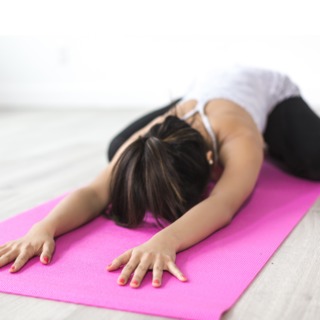
Lower down onto the knees and find Child's Pose.
Always support the head in Child's Pose.
If it doesn't quite make it to the mat,
You can support the head with your hands or a prop,
Like a block or blanket.
Notice your breath.
Soften shoulders.
And then gently make your way back up to a comfortable seat.
You can either stay in a seated position for a few moments with the eyes closed,
Being aware of how you feel,
Or if you like,
Maybe coming into a Shavasana.
Taking time here for as much time as you need.
This completes our practice for today.
Feel free to continue your practice with another yoga series or continue on your day.
Thank you for joining me today.
Namaste.