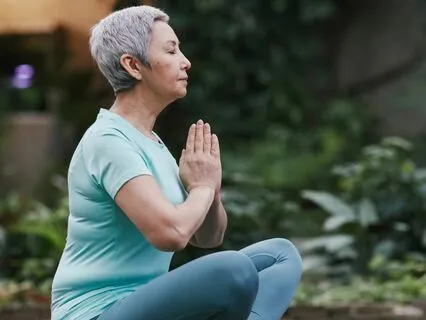
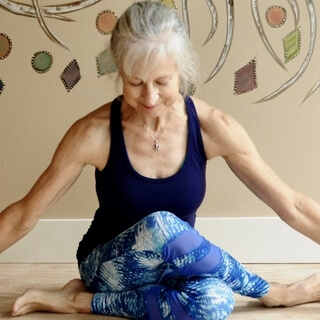
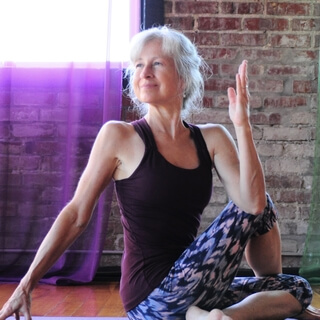
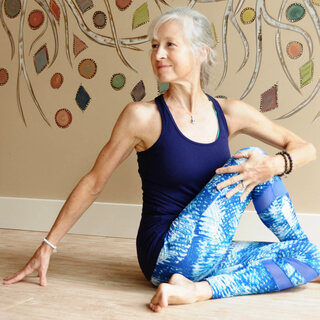
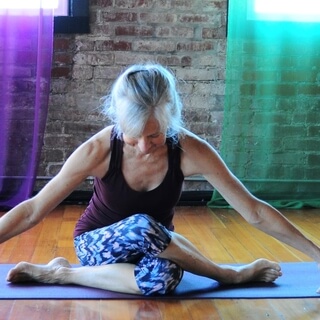
So let's begin in a seat.
You might sit on a blanket or another prop so that you can invite that nice tall spine.
And we'll just begin to take a little bit of an assessment so that we know how we feel now compared to how we're going to feel after our practice.
So you can either close your eyes or find a soft gaze down in front of you and just begin to tune into your body.
Notice areas you're feeling tightness,
Tension,
Or even discomfort.
See if you can invite a sense of sort of listening and allowing to just experience the sensations as they are without resistance.
If you're not sure you're feeling anything,
You might notice your feet and see if you have any sensations there.
And then bring awareness into your legs and notice any sensation in your legs.
Notice your hips and how your hips feel.
Sometimes when we're holding a lot of tightness and tension,
All we feel is that our body is tight.
The tightness and tension sometimes creates blockages for energy to flow freely.
So if you're not feeling much right now,
That's okay.
Just notice what you are feeling and maybe that you're not feeling much.
That's totally fine.
And let your hips and legs relax and sort of sink into the support beneath you.
Keep your spine nice and tall.
Notice any tension in your back or tightness or whatever else you might be feeling.
Notice your shoulders and arms.
Notice your neck and any tension or tightness in your neck or upper back.
Notice the area around your head and any sensation there.
And then notice your whole body.
Notice the whole body and any sensation in your whole body.
And then if your eyes are closed,
Gently open them.
Take a nice,
Full inhale through your nose and sigh it out,
Let it go.
And then reach your arms out and up only as high as feels appropriate to you and bring your hands down to your heart.
Remember,
Always honor your body,
Your mind,
And your breath and then take an inhale,
Open your arms out wide and lower your right hand down beside you and inhale,
Lengthen through your left side.
Take a little side bend here.
Notice how this feels through your back and arms and shoulders and make sure you don't go too far.
Just coming gently into this side stretch.
You might look up,
You might look straight ahead or you might look down.
Breathe here.
Breathing in and out through your nose whatever way feels best to you.
On your inhale,
Come back up and lower your left hand down.
Reach up through your right arm and as you exhale,
Come into a side,
Bend over to your left.
Again,
Choose your games and notice any differences between left and right.
One side might feel different than the other.
And again,
You might look up straight ahead or you might release your neck and look down.
And then inhale,
Come back up and lower the hands and arms down.
So we're going to move into table pose.
If you have sensitive knees,
You might open up a blanket across your mat creating a little bit more cushion there for knees if you want.
Lengthen through your spine and just notice how this feels.
Just neutral table.
Draw your belly in slightly and lengthen through your spine as you're creating a sense of spaciousness between each vertebrae.
And then move thoughtfully through some cat calves.
Inhale,
Belly to the mat.
Draw your heart forward as you arch into cow.
Exhale,
Draw your belly in.
Look to your knees for cat.
Notice how your spine feels.
Move thoughtfully.
Breathing in and out through your nose.
You might use that ujjayi breath,
That soft ocean breath.
If you're unfamiliar with that,
Sort of like a soft sigh when you go,
But the lips are closed.
There shouldn't be any forcing or strain.
Just a slight constriction so that you can hear the sound of your breath.
And then come back to neutral table.
And we're going to do another assessment for our shoulders and upper back.
Getting into puppy pose.
So you may need a block.
You might have it at the medium setting,
The low setting,
Or even the tall setting if your shoulders are really tight.
So placing the block so it's just about under your nose and then walk your hands slightly forward.
Might have to walk them further forward.
Take your hips just slightly back.
So your hips are just slightly back towards your heels,
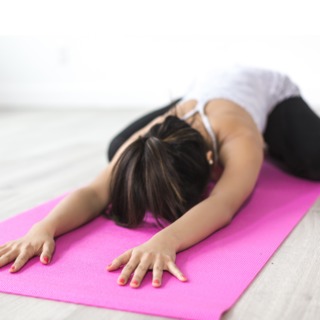
But not as far as child's pose.
Walk your hands further forward,
Keeping your arms fairly straight as much as shoulders allow,
And bring your forehead to the block.
Engage your core and press gently into your hands,
Keeping that engagement in your arms and upper back as you draw your belly in and breathe here in puppy.
If this is too much for shoulders,
Bend your arms and lower the forearms or turn the block up higher to find your variation.
And just notice how this feels.
Some of you may not need a block.
You might be comfortable bringing your forehead to the mat and then thoughtfully bring yourself back up.
Set your block aside.
And then we're going to do another assessment,
Either down dog or a modified down dog.
So if you're a regular down dog,
Just tuck your toes and reach your hips up and back.
Or you can walk your feet forward and have your hands on blocks,
Maybe the tall setting with hips over ankles and your down dog might be here.
So if shoulders or hands don't like a traditional down dog,
Try this variation.
You can always bring the blocks in closer if your shoulders complain.
So you're getting a little bit of an assessment into the upper back and shoulders as well as your hamstrings.
And then bring yourself into a forward fold with your knees bent a little bit.
Keep length in your spine.
Press into the balls of your feet.
Keep your spine long.
So you can also just have your hands on blocks.
The mat or your shins,
But just have your hands helping to support you here.
Weight a little more into the balls of your feet.
Spine is long.
So remember,
It's not about how far you go,
But who you are when you get there.
Notice those hamstrings.
And then thoughtfully come up just halfway,
Lower back down onto one knee and then the other and come to a seat on your mat and just pause.
Notice sensation.
Notice if you feel anything anywhere in your body just from a few of those poses.
So we're going to get into the upper back and shoulders more now.
So we're going to start with our blocks.
And at the end of your mat,
You can place one block on the medium setting to start.
Once we lay down,
You might decide to lower it,
But start with the medium setting.
The other block is going to be on the low setting.
And the blocks are placed a distance away from each other about the space between your hand with the finger spread wide.
So your thumb and little finger would fit right in between the two blocks.
And that's just a guesstimate of where the block should be placed.
So we're going to lay down on the blocks and start to relax into the upper back and shoulders a little bit.
And then lower down onto your forearms and try to have that sense that that edge of the first block is just about at your middle back.
And then one hand behind your head,
Start to lay down on that block.
Reach your other hand for the block for your head and position it so you know it's under your head comfortably.
And then decide if that feels good or if you want to lower that block under your head and make sure that the upper back and shoulders feel comfortable on that middle block.
You might have to lift up a little bit,
Make sure it feels even and that your shoulders are above the block so that your shoulders and arms can sort of drip towards the earth.
And if you feel you're in that good position,
Then just let your knees open up so that your lower legs are supported with that blanket.
And then just relax your arms.
So you might have the palms up,
You might have the arms out a little wider away from you,
Or you could have them in closer.
If you want to get more into the shoulders and upper back,
Some people like to do goalpost arms.
That's a little much for me.
But just listen to what feels good to you.
And as you lay here,
Just invite your body to relax and soften,
Letting your shoulders drip towards the earth,
Letting your knees relax out.
This doesn't feel good in your hips or the leg position here in this butterfly variation.
You can just straighten your legs out.
And at any time,
Feel free to straighten your legs out if you've had enough of this butterfly position with the legs.
So focus on your breath.
And with each exhale,
Invite your body to relax and soften,
Melting into the support beneath you.
Notice where you feel your breath.
Do you notice your belly expand?
Do you notice your chest expand?
Where do you feel your breath?
And with each exhale,
Just invite that softness,
That release into gravity.
So often we're just holding,
Holding on to tension,
Tightness.
Sometimes we just have to let go.
So another option here is to do soft sighs of an exhale,
Letting your jaw be heavy and soft.
With each exhale,
Letting your jaw sort of sink towards the earth.
And then as you inhale,
Gently closing your lips once more,
Taking an inhale through your nose,
And then sighing it out.
So find what feels best to you,
Either breathing in and out through your nose or inhale through your nose,
Exhale,
Sigh it out the mouth,
Keeping your exhale relaxed and easy,
Softening and letting go a little deeper with each exhale.
And we'll be here for a few more breaths.
Take another nice full inhale here,
And exhale,
Sigh it out,
Let it go.
If your legs are still in the butterfly position,
Slowly bring your knees up and just use your feet and push the blanket away,
Straightening your legs out,
And then pause here.
Notice sensation,
And then thoughtfully bend one knee,
Then the other,
Feet flat on your mat.
Take one hand behind your neck,
Support your head as you lift your head,
And then bring your arms down to help support you as you push your way back up to a seat and pause.
Notice sensation.
Notice your upper back and shoulders.
Notice if there's any sense of energy or whatever you might notice,
Maybe pulsing,
Temperature change,
Just maybe an awareness of your upper back and shoulder area.
And then we're going to transition into table pose again.
Have your blocks still handy,
But move them just a little out of the way towards the front of your mat.
So we're going to get into the upper back and shoulders again.
So this one is a nice stretch.
So from table,
Lower down onto your forearms.
And then from here,
You can just keep your fingertips touching.
Move your elbows a couple inches further forward.
Try not to let your hips come in front of your knees.
Keep your hips back,
Just slightly back behind your knees.
And if you have sensitive knees,
You might want a blanket on your mat again.
If you're using a blanket,
It might change the proportion of how your body feels with or without blocks,
But so just experiment.
We're going to try it first without any blocks.
So elbows are a little bit in front of your shoulders,
Hips over knees or slightly back.
And then lift your hands up like in a prayer position and slowly take your forehead to the mat.
And your hands might come up behind your head or your upper back.
So this gets a stretch into the upper back and shoulders and the triceps a little bit.
So make sure your hips are slightly back,
Core is slightly engaged,
Protecting the low back.
And if this feels like your arms are too short,
You may want to use the variation with blocks.
So the other variation is using two blocks on the low setting with an option for one blanket in between the blocks for your head.
You may or may not need the blanket,
But starting with the blanket or towel,
Fold it long ways so that it fits right in between the blocks nicely with about two inches coming forward.
And so then you have a space to rest your forehead on if the mat seems too far away.
So then you might bring your elbows onto those blocks.
Again,
Elbows slightly in front of your shoulders,
Hips over your knees.
And as you take your hips slightly back,
Take your forehead to the mat or the blanket and your hands up behind your head.
They may or may not make it all the way to your upper back.
Core stays engaged and breathe here.
Keep your core slightly engaged and make sure your shoulders feel okay here.
If this is too much for your shoulders,
Remove the blocks and bring your elbows back onto the mat.
And the more you take your hips slightly back and think of pressing your armpits towards the mat,
You can deepen the stretch,
But be mindful,
Listen to your body.
And then slowly make your way up out of that stretch.
Set your blocks aside and we're going to use the two blankets.
So from your blanket or towel opened up from the folded edge,
We're going to roll it.
So the blanket is just about as wide as the mat folded several times.
And I'm going to roll it from the folded edge,
Smoothing out the wrinkles as best as I can.
So that's about the thickness of the width of my hand.
And it's about as wide as my mat or at least almost as wide as your mat is fine.
We're going to place that just about a foot and a half away from the end of your mat.
You might want your other blanket about maybe six,
Seven inches away where that might support your head.
So this is similar to what we did with the blocks,
But it's going to feel a little different.
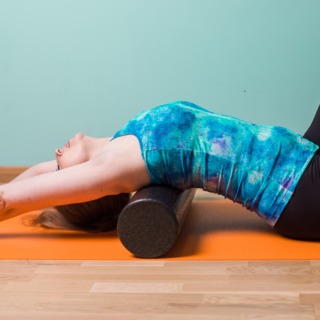
So this gets into the mid back nicely,
As well as the shoulders.
Now,
Once you're here in the pose,
If you are prone to anxiety,
Make sure you have a blanket or other support under your head.
Taking your head back too far before you really feel ready can sort of aggravate anxiety.
So if you feel any sense of anxiousness,
Lift your head,
Put enough support under your head.
But start with it just about at your middle back.
And then once you're laying down,
It should feel like it's at the back of your heart.
Your shoulders and arms are above the blanket.
Shoulders may or may not touch the mat.
It depends on the thickness of your blanket and how open your shoulders are.
And it's going to feel a little tight in the mid and upper back initially.
And then slowly straighten one leg,
Then the other.
And then you can start to relax.
So you can close your eyes,
Arms out to the side,
Legs straight.
So once you straighten your legs,
You're able to relax more here.
If this is uncomfortable,
Feel free to bend your knees.
But then I find there's more tension in the upper back.
So you might just want to place like a bolster or something else under the knee so that you can straighten the legs more.
And then just really relax your whole body,
Releasing and relaxing into gravity.
Let your shoulders and arms be heavy and soft.
Notice the upper back where you might be holding tightness or tension.
And you can send your breath into those areas.
And as you exhale,
Visualize those areas beginning to gently release and soften.
Watching your breath,
Each exhale,
An invitation to relax and release,
To go a little bit deeper.
If you feel you want to adjust the blanket under your head to be lower,
Make sure you're using one hand to sort of support your head.
And then as easily as you can,
Maybe unfold the blanket so you can go a little lower.
But you might be totally fine right where you are.
Continuing to breathe into the area of the upper and mid back,
Relaxing and releasing your shoulders and arms.
As if your back is melting over the blanket.
We'll be here for a few more breaths.
Take one more nice,
Full inhale here.
And sigh it out,
Let it go.
And then thoughtfully bend one knee and then the other.
Bring one hand behind your neck.
Support your head as you lift your head.
And then roll over to one side.
And slowly press your way back up to a seat.
And pause.
Might still feel like you have something on your mid or upper back.
Notice that sensation.
So now we're going to redo our blankets a little bit,
Back into a folded position there.
And we're going to get our tennis ball and get into the upper back and upper trapezius a little bit.
So this can sometimes release tension in the upper back,
Shoulders,
And even into the neck a little bit.
So you may want a blanket under your head and you might want your other blanket just to the right of your mat for your right elbow.
Having your head on the blanket can sometimes feel better,
But if you don't want it,
Just push it aside.
When you have your head on the blanket for this one and the ball is going to be right at the upper trapezius on the right side.
So we want to have the base of our head on the blanket,
But not our neck.
So that the ball has some room and it's not getting stuck by the blanket.
So lay down in constructive rest with the base of your skull just at the edge of your blanket.
So you might have to scoot down a little bit because usually we like to have the blanket a little bit more under our neck.
But it should just feel like it's supporting your head.
And again,
Just an option.
Take the ball,
Lift your right shoulder up and place the ball right on your upper trapezius to the right of your spine,
Slightly above your shoulder blade.
It should feel like it's on soft tissue.
So from here,
You might move that blanket a little closer for your right elbow to be on.
And again,
This is just an option.
Both elbows on the floor or mat or blanket to start.
And then just start a little bit of movement over the ball.
You might move your right arm up and down.
You might lift your left shoulder up off the mat using your left elbow to get a little bit more movement.
You might do a little left to right movement over the ball.
This is like a self massage.
So you're in control of the amount of pressure here.
You can push more onto the ball with your body.
Even pressing into your feet more will help increase the pressure on the ball.
And then you might explore moving that right arm a little more if that feels okay in your shoulder.
If you have any shoulder issues,
Just keep that right arm down.
But experiment,
Find what feels good to you.
You might find a spot that's like a real tight knot,
A trigger point,
And you might just hold in that area,
Really pressing and breathing into that area,
Encouraging the release.
And you might even feel like sort of shoots of energy going into other parts of your body.
That's sometimes a way that these trigger points release.
You're in control.
If it's too much,
Back off the pressure,
Adjust the ball slightly as you need to.
Keep your head down so that the neck is relaxed,
Either head on your mat or the blanket,
Whichever feels best.
And then you might decide to slightly adjust the ball up or down,
Left or right,
Still on soft tissue.
And again,
Find a little bit of movement if you'd like.
This is like a massage.
So find what feels good to you.
Feel free to keep adjusting the ball till you find a good spot.
Or you might just decide to hold in one spot if you found a good spot that feels good to you to just release and just let your body's weight do the work,
Or you can keep moving over the ball,
Whatever feels best.
Breathe into it.
And again,
You might adjust the ball slightly,
Find another area of your upper right trapezius that feels tight,
Place the ball there.
If you have the ball really towards the upper part of the shoulder and it feels like it's slipping away,
You could use your right fingertips to sort of hold it in place.
So listen to your body.
So just a little more on this side,
And then remove the ball.
Just relax,
Pause.
Notice difference between left and right.
And then take the ball and place it under your left upper trapezius.
So again,
To the left of your spine,
Above your shoulder blade on soft tissue.
It should not be on any bones.
And again,
That blanket,
You might put it over to the left of your mat for your left elbow to rest on,
Keeping your head on the other blanket if that feels good.
Just having that space for your neck not to be on the blanket.
And again,
A little bit of movement side to side,
Maybe up and down with that left arm,
Lifting your right shoulder up off of the mat slightly so you can get a little movement.
But you might wanna keep that right elbow on the mat so that you have some,
A little more control of your movement there.
Notice if one side feels different.
Often we have differences in our left to right side.
And again,
Feel free to adjust the ball slightly,
Find a new spot.
You can either keep moving to find a good spot or whatever feels good.
Or you might find that trigger point again and just relax over that spot.
Pressing maybe gently into the ball,
Use your breath,
Encouraging that release.
You could go very slowly or you might move a little bit faster,
Left to right,
Whatever feels good.
Again,
Maybe adjusting the ball slightly,
Find another spot.
And the more you do this,
The deeper you can get into the different layers of all the fascia.
Little bit more on this side,
Find a good spot and then release the ball.
Set it aside,
Pause.
Notice sensation.
And then bend your knees,
Roll over to one side or the other and press yourself back up to a seat.
Set your blankets aside and then come back into the pose you did for your assessment.
Whether you want to do puppy pose or down dog or your variation of down dog,
Come into that pose and notice how you feel now.
And we haven't gotten much into the legs so the legs might still feel a little tight but notice your upper back,
Shoulders,
Notice your mid back,
Notice your low back,
Drawing your belly in to protect your low back.
And then lower your knees down and we're going to get into the hips next.
So let's get our tennis ball,
Come to a seat.
You can also do this laying down if you prefer.
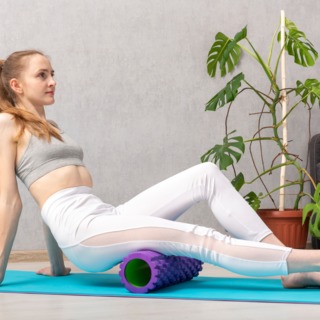
Lift your right hip up and place the tennis ball right at the biggest part of your glute.
Straighten your right leg and bend your left knee.
So you're lifting your left hip up off the mat and your weight is on that right glute.
If this is too much on your hands,
Just lay down and you can do the same thing laying down.
So from here,
Take your left knee across your right thigh.
So you're moving a little bit more to the right on your ball.
Breathe here.
If you need to,
You can adjust the ball.
You could move up or down on the ball slightly by pointing and flexing your right foot.
If you want to go a little more,
Roll a little more over to the right hip,
Taking that left knee over further across your right thigh and breathe here.
This is getting into some of the deep six muscles and the hips and then come off the ball.
Release the ball.
If you're laying down,
Just stay laying down.
If you're seated,
Just be seated unless you want to lay down.
And then we'll do the other side.
So lift your left hip up,
Place the tennis ball right under the thickest part of your left glute.
Left leg is straight.
Right knee is bent.
Lift that right hip up off the mat and take that right knee across your left thigh as you're leaning a little bit more over to the left,
Either just sort of leaning on your hands or lay down if your wrists bother you here.
So again,
Find your variation.
If you want,
You can move a little bit up and down over the ball,
Exploring that,
Or just relax over the ball as much as you can.
Few more breaths here and then rock off the ball.
Set it aside.
Notice those glutes.
Going to do one for the hip flexors.
The more relaxing release is using a blanket,
Rolling it like we did for under our shoulders and upper back,
Placing it across your mat,
And you would just come into table pose and lay on the blanket at your hip crease.
And you can just lay here,
Letting your belly come onto the mat and just relax forehead on your hands,
Letting your hips and legs be heavy and soft.
Take a few more breaths here.
Take one more breath here.
Soft sigh of an exhale,
Let it go.
And then bring yourself up onto your forearms or hands and slowly press your way back up off of whatever props you were using.
Set the rolled blanket aside.
Notice sensation.
So now we're going to get into the legs a little bit.
So bring your blocks with you and have that rolled blanket handy or re-roll it.
So we're going to get into the hamstrings and calves.
So have your blanket rolled about halfway.
Come onto your knees and place the rolled blanket behind your knee crease.
You can have it more or less rolled,
Whatever feels good to you.
Some people like to have it a little thicker.
Knees are about hip distance apart.
You might have to hold the blanket there as you sit your hips back,
Compressing your hamstrings and calves onto the blanket.
So you could stay just like this with your hands supporting you.
Some people can stay upright with hands on thighs.
You can also have your hands on blocks.
So just whatever support you need so that you can let your hips be heavy and let the weight of your hips compress the blanket.
If this is too much,
You might come down onto forearms on your blocks.
I find this is sort of relaxing and you might support your head with your hands,
Sort of like hands in a prayer position,
Forehead to the back of your thumbs.
So breathe here.
If this is still too much,
You might come onto your forearms on your mat and use a block to support your head here,
Sort of like a child's pose.
And this can feel really relaxing and it's great for the low back as well.
So find your variation.
And as we hold here,
You might notice that there's a little bit of a release in the tightness and tension.
And you might be able to come up a little bit.
You might adjust your props slightly.
You might bring the blocks up higher or move your shoulders back a little closer towards your hips.
But again,
It might just be like you want to stay right where you are.
These are just options.
And again,
If you notice another little release,
You might be able to come up slightly more,
Maybe still using your hands to support you,
But letting a little more weight come onto the blanket.
Just a few more breaths here.
If you can come up any more,
Feel free to do so.
Slowly make your way out of this pose.
Lift your hips up off the blanket.
Set the blanket aside.
And once again,
Come back into either your down dog or a forward fold if you're not doing down dog.
And notice your hamstrings as well as the rest of your body.
Notice how this pose feels now.
Nice,
Full breaths.
Keep your spine nice and long.
Whether you're in down dog or a forward fold,
You might have your legs straight or slightly bent.
Find your variation.
Belly drawn in slightly to protect your low back.
And then lower your knees down.
Come to a seat and pause.
Notice how you feel.
It's now time for Shavasana.
So make sure you feel warm enough,
Comfortable enough.
You might cover up with a blanket or use a blanket over your hips.
Maybe putting on socks if your feet are cold.
And as you lay down for your final resting pose,
Invite your feet and legs to relax and release.
Relax your hips.
Notice any sensation or energy in your hip.
And invite your hips to relax and release towards the earth.
Notice your spine,
Visualizing space between each vertebrae.
And relax and release your lower back.
Relax your middle back.
And soften into your upper back and shoulders.
Let your head be heavy and soften your lower belly.
Soften the area around your heart.
And let all the muscles in your face soften and relax.
Soften your eyes.
And let go.