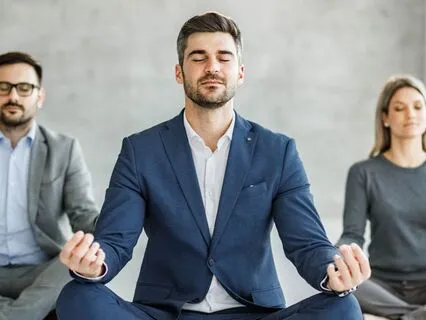
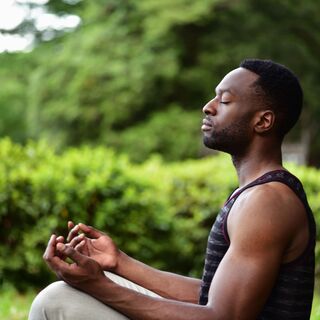
We're talking about calm power leading without overwhelm.
This is about leading with presence,
With leading with calmness and with deep steadiness,
Especially in those times of chaos.
So we're going to explore how to access calm power in this session today with a few practices that I personally enjoy.
And it's all about being able to lead and work in life without pushing,
Proving or burning out.
And this is especially for those conscious leaders of you who know that you want to hold space for others.
You want to help others thrive in whatever work that it is that you do.
And you really are ready to lead with your heart and show up with more grounded clarity in your day.
So if this is you,
Stick around.
So as always,
Let's just take a moment to drop into today's space.
And we're going to do that with a quick wee meditation.
So if it is safe for you to do so,
Close down your eyes.
If your legs are folded,
Unfold them.
And whatever's happening with your hands,
Just let them rest somewhere comfortable.
And start to take a few deep breaths,
Tuning into the breath.
And with each breath,
We invite in more calmness in our mind,
More calmness in our body,
And more calmness in our energetic field.
And we can do this deliberately using the breath,
Using the body as a key.
As we breathe in,
Noticing any places of tension in the body.
And as you breathe out,
Letting go of that tension,
Letting your body physically relax.
If it feels good to do so,
Just let out a gentle sigh as well.
Use your voice as a way to signal to your body and your mind that you are relaxing.
So with each breath,
Noting any tension.
And with each exhalation,
Gently letting go.
And perhaps now you'd like to deepen your breath and make your breath longer and wider.
And if this feels fun for you,
Then now's the time.
So start to slow the breath,
Breathing in slower.
And start to slow the exhalation.
And simultaneously start to think about widening the breath.
So using all of the directions to breathe.
Can you breathe with the upper parts of your lungs?
The lower parts of your lungs.
The left,
The right side,
The back and the front.
Using all of that space that's available for you to breathe with.
Expanding into all of that space in all directions.
And letting go.
And some of you may notice as you let go,
You feel your body almost sinking.
Nicely sinking into the seat.
Into the seat of your pelvis.
And we can feel this groundedness that occurs when we relax the body.
And this is kind of your seat of calm,
So to speak.
Just noticing the physical sensation of calm in your body.
And this is a great reference point for you during your day to know whether you are in a calm place or perhaps you're in a more hyper-excited place.
Tune back into the body.
Does it feel like the feeling that you are having right now?
Grounded,
Seated,
Relaxed,
Steady.
And as we relax the body and we relax the breath or slow the breath.
Notice the effect it has on your mind.
Perhaps now as you have focused your attention on the pattern of breathing in and breathing out.
As you have focused your attention on your breath,
Your mind is a little bit more clear.
And we practice this attention to breath as a way to train the mind to attend to this moment now.
What is important is right now.
And this is a great way to quickly come out of any stress or anxiety that you might be experiencing with thinking about the future or thinking about the past.
Attend to the breath.
So notice the calmness of your body,
The calmness of your mind and the calmness of your energy.
And imagine going through the rest of your day with this kind of grounded presence.
As a leader.
The effect that this would have on everyone that you encounter today.
And when you're ready,
Gently opening your eyes.
Coming back here.
And going about the rest of your day.
And maybe the rest of your day is spent,
Well some of the rest of your day is spent with me for the next 20 minutes.
Thank you for the hearts.
Welcome to those who have joined us.
32 on here today.
Kia ora,
You're with me,
Nick Chung.
I'm a Conscious Leadership Coach and Mentor.
For those leaders of you who want to create a positive change in your workplaces.
And from that,
Create positive ripple effects out into the world.
I'm here live twice a week now.
So you can catch me midday New Zealand time on Wednesdays and this early morning slot on Thursdays.
This is New Zealand time.
I also have a meditation,
Purely just a meditation,
15 minute meditation on Monday evenings.
So for all of those details,
Check out my Insight Timer.
If you're not already following me,
Go ahead and do that.
So calm power,
Leading without overwhelm.
The angle I want to take with this is not only about meditation.
It's about how can you have this access to this constant state of calmness as you go about your day and you lead your people in whatever capacity that may be.
And what does that do in terms of your leadership?
And you might already have an inkling of what that does.
It's set in the description,
Right?
It's about not pushing.
It's about not proving.
And importantly,
It's about not burning out.
So if we can access the state of calmness in most of our day,
And ideally all of our day,
Right?
That's the aim.
Then we're able to still lead powerfully,
But without any of the negative effects that may occur from us taking on this leadership role.
And remembering that leadership,
In conscious leadership anyway,
We talk about leadership not only by the role that you're given,
The title that you're given,
But by the fact that you've chosen to become a leader.
So how do we access this calm power?
Firstly,
I want to talk about a couple of practices that I personally enjoy.
And we'll briefly talk about that.
And then we'll talk about the importance of doing that and how that can affect your leadership.
One of the first things that I love in terms of a really practical way to practice calm power in the midst of chaos,
Is practicing the pause.
Have you heard of that before?
I'm sure some of you have.
So practicing the pause is this,
Especially in chaotic moments,
Is pausing before answering.
Pausing before making big decisions.
Yeah,
And the pausing might be a three second pause.
Okay,
It might be like,
Everything's going crazy,
People are asking so many things,
And I take three seconds or three deep breaths before I answer,
Or before I answer the email,
Before I pick up the phone,
Before I hop into the meeting.
If you need more than that,
The pause is a little bit longer.
Okay,
So it might be taking a walk,
Taking a walk outside,
Clearing your mind,
And then coming back and doing the hard things.
Right?
So practice the pause in whatever way that you can,
Especially if you're finding yourself in states of overwhelm,
States of stress,
Of anxiety,
Or perhaps it's just a kind of a workplace culture that occurs,
Especially in say,
For me,
I used to work in event management.
So there would be times and schedules of events where we would have crunch time.
Right?
There'd be two or three weeks before the actual event and during the event where it'd be really chaotic.
And not because people wanted it to be chaotic,
It's just that a lot of things have to get done in time for that.
Right?
And it didn't matter how much you planned,
It was always the same.
It was this like two week lead up of like chaos.
And so it's those moments where you can practice the pause a lot.
And these pauses,
As I said before,
Don't need to be long.
They can be three seconds.
They can be a break in the toilet,
Whatever it is that you need.
Practicing the pause.
The more that you practice the pause,
The more that you understand that you are in control of your own state.
So what happens when we get into places of overwhelm or stress or anxiety and we start to pick up,
And that's in parenthesis,
Right?
We start to pick up people's energy is that we start to feel that we're not in control of our own state.
And you always are.
You always are in control of your own state.
And the pause gives you that moment to recollect your own energy,
Recollect your own attention.
Remember that everything that we pay attention to gives it energy.
So it gives you a chance to recollect that for yourself,
To have that moment,
To then be able to decide what kind of state you want to carry on with.
So practicing the pause sounds so easy and it is so easy.
It's a very simple practice.
However,
It's really powerful if you do it well and you do it constantly.
So that is one of the easiest ways that you could do straight away now is to start practicing the pause.
Practice the pause,
Especially in moments of chaos.
Practice the pause when you're having a conversation,
Have to get back to an email,
Anything where you're feeling less than calm,
Practice the pause and then go from there.
And this,
As I said,
Allows you to recollect,
To re-empower you.
You are in control of you.
Never forget that.
Next thing that I wanted to talk about was grounding.
I know a lot of you already know this.
So there's several ways you can do it.
You can go outside and stand on the grass literally.
You can stamp your feet.
You can do what we did in terms of the meditation at the start is that feeling us sinking into the seat of our pelvis.
That's a really good way of grounding in the body.
What grounding should do in terms of the body is it should make you feel like you're sitting in a stable position.
So if you feel in your body,
If you're a body nerd like I am and I use my body as a way of cuing,
A powerful cue to know whether I'm in states of stress or calm,
Know that your body should feel relaxed,
Stable and steady.
So whatever way you do that,
Whether you go out into the grass,
Put your feet on the grass,
Whether you stamp your feet,
Whether you take a moment to meditate and sit in your pelvis,
Grounding will allow you to get out of your head and into the heart.
And this really is the heart of what calm power is all about.
It's less about leading from the head and it's more about balancing the head and the heart.
What often happens when people are in that state of burnout is they have been either pushing themselves too hard or they're constantly trying to prove themselves which is then causing them to come into the state of burnout is that they have been operating from the head too much.
There's no balance between head and heart.
When you do this,
There's several spinoffs from this.
One is as a leader you start to model what it is that you expect from other people so then you get other people who are also pushing and trying to prove themselves and burning out and leading from the head.
And where do you think leading from the head comes from?
What part of self?
Can anyone guess?
Remember that anytime that we lead from purely the head we are really leading from the ego.
The ego is all about logic and logic is not a bad thing.
So logic is not a bad thing necessarily unless it's not balanced with the heart.
So the ego resides in the mental space,
The head space.
And so when you start to model a culture of where you're leading from the head without the balance of the heart then you start to get a lot of people around you who also lead from the head and don't balance out the heart.
And what can this look like?
It looks like that really overly competitive workplace that perhaps you are already in.
Because remember what is the basis of the ego?
What is the primal paratus?
Is that the right word of the ego?
It is to keep itself safe and it is highly individualistic.
So we tend to in places,
In cultures where we have learned to lead from the head and not balance with the heart we tend to find cultures that are highly individualistic and thinking about me,
Me,
Me,
Me,
Me.
And what is that?
Competitiveness.
So let me just have a quick look because I saw a few things pop up in terms of questions.
Don't certain industries attract more ego?
Absolutely,
They absolutely do.
Why do they attract that?
Why do certain industries attract more egotistical people?
Because they've created a culture or an expectation that is mainly logical.
And remember that where logic resides,
The ego resides.
The ego resides within the mind.
The soul or the spirit or the higher self or whatever it is you want to call it resides in the heart.
Which is why when we talk about conscious leadership we're talking about the balance between head and heart space.
We're talking about leading with both.
So yes,
Certain industries do attract more egotistical people because their whole basis is about logic.
However,
That doesn't have to be the case and I think that there can be a change with leaders like you who are going to start modelling even in industries that tend to attract more egotistical people this balance between the heart and the head.
So how can we balance?
How can we find that balance with ourselves?
Especially in cultures that maybe attract more egotistical people more logical based places.
And this brings us to one of my favourite practices and perhaps some of your favourite practices which is meditation.
You're here on Insight Timer.
I'm sure that you're amazing meditators.
So meditation allows you to ground.
It's one of the most amazing practices for that.
It allows you to practice nervous system regulation.
That is calmness.
And it allows you to clear mental noise.
But with the right meditations you're also starting to activate the heart space.
Moving from head to heart.
Moving from ego to soul or to spirit or to higher self or whatever the word is that you like to use.
And when we practice meditation we're starting to learn how to use both our head and heart to lead.
Remember that the more that we engage in certain states so whether that's the state of logic or the state of heart the more that we're likely to lead with that.
We're forming a habit.
We're creatures of habit.
So the more that you practice meditation and choose meditations that are actually going to help you come into heart space more.
There are a lot of meditations.
I've got a load on my Insight Timer that talk about heart space.
So you can check that out.
The more that you practice heart based meditations the more that you're going to balance the logical part of yourself which I think most of us lead with because we're born in a culture which really values logic.
The more that we're going to balance our logical self with our heart self or our ego with our soul.
So meditation,
If you're not already doing this if you're not already doing this as a daily practice I really strongly invite you to do so now.
Find a few people that you love to listen to find a few meditations that work for you and they don't need to be really really long.
So just for example this morning we did a five minute meditation and it already brought you back down from the head and down into your body and into your heart.
Really really easy.
Along with that idea of bringing yourself out of your head and into your heart you can use things like journaling.
I say this with just a little bit of a caveat because sometimes journaling can help you get out of your head and sometimes it makes you get more in your head.
So find a journaling practice that can offer you space to reflect and regather but not replay and get too heady about it.
What I love actually the combination that works best for me is meditating then journaling.
Because from the meditation I've dropped into heart space then my journaling is more about what's expressing out through my heart rather than journaling and then just staying up here in my head.
The other practice that works well with this and is what I guess I call a meditation of its own sort is walking in nature.
Go outside.
Get in amongst the trees or the beach or something.
It has to be in spaces of nature.
It doesn't have to be but it works better.
Go and walk without music with no distractions and practice mindful walking.
What mindful walking is is really being in the moment.
Maybe you instead of counting the breath like you do in meditation you're going to count your steps.
You're going to become highly aware of each step that you take.
Or maybe you're going to become highly aware of what you are seeing in front of you or what you're hearing.
I especially love doing this in the bush in New Zealand because we have beautiful birds that have amazing songs.
And so I love to activate my hearing and I'll use it.
I'll mindfully walk and try to just listen intently listen.
Put 100% of my attention on listening to what songs are being sung.
So you can use this one and this is one of my favourite ways to meditate or to ground or to bring myself from head space into heart space because I start to not only move from head to heart but also start to connect in with something that is bigger than me.
I start to actually understand my connection with all things.
When I'm with nature I understand I am nature.
And so in that practice not only am I moving from egological based which is individualistic but into heart based that is about connection and about collective thinking.
So I've given you quite a few tools here for you to choose from and as a practitioner you need to if you're serious about doing this if you're serious about leading with calmness then please make sure that you are dedicating yourself to a daily practice of any of those things that we've just discussed.
And remember that building calmness is like building a muscle.
It's a practice state of being and the more that you practice it the more it becomes your habit.
Let me look at these.
Being in the head more is due to lack of safety and needing to survive?
Not necessarily.
It can be especially if we feel threatened but being in the head is also due to not knowing how to connect with the heart or prizing logic over feeling.
So it's also a cultural thing.
I said this earlier.
He said don't certain industries attract more egotistic people?
So we have cultures of which we really value logic and so it's a practice.
So sometimes being in the head is about safety and needing to survive.
Sometimes it's a habit.
Nature was created by God for our benefit.
It absolutely was.
Yes.
And so we should connect more to that.
So building calmness remember is a muscle.
It's not something that comes all the time and especially we need to remember that when we're in states of chaos in our leadership or we're dealing with maybe change in our workplaces or just challenging times in our workplaces and so the more that we practice it in our own time the more that this is going to become the habit that we embody all of the time.
And I've given you certain ways and especially the first one practice the pause ways to reconnect to that calmness while you're in amongst all of the chaos of your work.
And so when we learn to access this calm grounded presence and power we're really accessing that energy or that frequency of spirit of heart and coming out of the ego.
So this place,
This place of calm naturally that comes from the heart naturally wants to empower all people and it thinks collectively not individually because remember where are we accessing?
We're accessing the heart which is the space of spirit or soul.
And so from this place of spirit or soul that is activated from the heart that is allowing you to be calm,
You don't need to push or to prove yourself as a leader and you then can avoid this common trap of what is becoming more common in the workplace is a lot of stress,
Anxiety and burnout.
You can avoid that.
How do we get these places of burnout,
Stress,
All of those things?
It's when we remain in the ego.
The ego is always thinking about individual outcomes rather than collective outcomes.
It's thinking about proving itself.
It's thinking about pushing itself being better,
Being better,
Being better because I'm not good enough.
And so if we step out of that for a second we actually relieve ourselves from all of that pressure of the ego.
And imagine that as a leader embodying that and having that be the model of what your culture could be in your workplace.
How would that change things for you and your people?
I think that'd be really,
Really awesome.
Okay.
I've done enough talking for today but I do have some reflection questions for you.
I'd love to leave you with some questions to reflect on and help your own personal development here.
So the first one is,
How can I be more calm today?
How can I lead with more calm?
What could I do?
What daily practices do I need in place to practice calm?
Please write these down or journal and journal on them.
Take some time today.
Only five minutes.
You just need five minutes to think about these things,
To ponder,
Reflect on what you're doing.
The next question is,
In what situations in my work is calmness more important than ever?
And then the follow-up question to that is,
How can I prepare myself for those situations?
So we can sometimes predict if we've got semi-predictable workplaces.
Like I said,
I used to work in event management and there always used to be two weeks right before an event which was super stressful,
Super chaotic.
So if you can,
Reflect on that and go,
I know when things are going to get a bit more chaotic and calmness is going to be needed more than ever.
Or maybe there's a certain person you know that you're going to have a meeting with that you're going to have to be calm with.
How can I prepare myself for this?
How can I practice this?
How can I practice calmness before I get into that situation?
So please write those down.
Take some time today to spend five minutes just reflecting on those.
And I highly recommend,
If you haven't already,
To start having a practice that grounds you,
That allows you to return to calmness and in that return to this heart space.
Start to activate that heart space.
And I had so many options for you during today's talk.
So you can choose the one that works best for you.
I like changing my habits.
Is change good for calm?
As people don't like change,
As they don't like the being and the unknown.
What are your thoughts on this?
Yes,
I see what you're saying.
You're saying that you like to change your habits and is change good for calm as people don't?
This is the thing.
I see what you're saying because you're saying that people don't like the unknown so therefore you're not making them calm.
Is that what you're saying?
Give me a thumbs up or a thing if I've got that right.
And you're right.
People don't like the unknown.
Why don't they like the unknown?
Yes,
I am right.
Why don't they like the unknown?
Because they've got their ego leading.
Their ego says,
I'm unsafe unless I know what's going to happen.
However,
If you're a leader,
And remember that leaders have a really important role of being able to change culture by being the role model of what they want to see.
That's the first thing.
If you can change your habits in a calm manner,
Then you are saying to someone,
It is safe to be able to change and it is safe for change to happen because it can happen in calmness.
Because what we do is we often associate change with like this chaos.
There's so much change.
It's so stressful.
I feel anxious about changing.
Am I right?
And so if we only have that model of change,
That it's scary,
That it's challenging for us,
Then of course we're going to react in ways where we're like,
We don't like it and it's going to cause more anxiety.
You are the role model first and foremost.
So if you can model change in this really calm way and frame it in such a way that it's exciting,
That it's helping you to improve,
To reach your potential,
And you know your audience best so you know who you're working with,
Figure out what motivates them and then bring change to their table like that.
But your energy in terms of how you're changing and making that more calm is going to help seed that kind of culture in your workplace.
Have I answered your question?
Let me know.
Yes,
Thank you.
Wonderful.
Great question.
I love that question.
That was such a good one.
Multilayers.
I actually probably could do a whole live on everything that you've just said.
Alright everyone.
Thank you for your time.
We've spent a little bit more time than usual today.
If you're not already following me,
Come and follow me.
Nick Chung on Insight Timer.
I have so many meditations for you to hop into.
I've got my good past talks recorded and live on there.
If I do use them again,
Please know that I just take out your names.
So don't be afraid of asking more questions.
I would love for you to come and follow me and please,
If you really loved today,
Come and join me again.
I do these lives twice a week now.
So Wednesdays midday in New Zealand time.
All in New Zealand time.
This time today,
Whatever time that is for you.
And I also lead just a meditation itself on Monday evenings New Zealand time.
If anything today felt really fun for you and you'd love to make me a donation,
I would deeply appreciate that.
That means that I can spend more time giving these free offerings to you and I absolutely love doing them.
So I want to do more and you can support me by popping a little donation for me.
And I hope that this has been incredibly useful for you because I hate wasting people's time.
So I hope that something useful has come from today.
Please go ahead and do all those reflection questions that are incredibly important if you're serious about personal development and self reflection.
Go ahead and do that.
And please come and join me again on another live.
I would love to see you there.
Next week we're going to talk about shedding old identities so you can become a better leader.
That's on Wednesday midday,
My time.
Not sure what time that is for you.
So you can come and check us out there and join me there.
And we also have another one coming up on this time Thursday.
Go and check out my events on my Insight Timer to check out what works out for you.
Alright everyone,
I appreciate you all.
I love the work that you're doing in the world.
Thank you for turning up for today and helping yourself become better so that you can become a better leader for your people.
This is what it's all about right?
Let's improve ourselves so that we can make a better world through our workplaces and I'm stoked that you're doing the work.
I thank you for you doing the work.
Have a beautiful rest of your day everyone.
Ciao for now.
Bye.