All right,
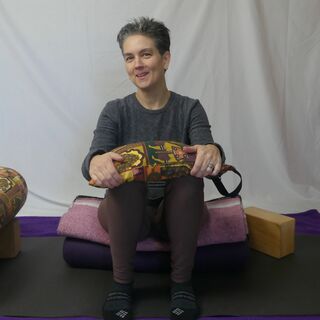
I want you to take a seat and you're going to get a hold of a couple tennis or tuna balls sitting on a blanket or a bolster.
This class is going to go for a lengthy amount of time,
So I want you to find that any time you need to have some fluids,
Hydration,
You're going to take a break if you're going to stay for the whole 90 minutes.
But in this moment,
I want you to get a hold of the two tennis or tuna balls,
Lift up through the upper realms of the collarbones,
And kind of visualize that those stretch across,
Okay?
Bring the balls till they're at the sides,
The basin of this jugular area,
You're going to feel where the sternum is,
And you're going to place the balls right to the sides and then start with some tapping.
We call this tapotement.
So you might close your eyes,
You might do some oohs and aahs to feel that wave of stimulation in the body's cleaning system,
The lymphatics.
So we start with a little bit of alternating pressure,
And then tapping out to the corners of the chest,
Almost to feel where there's a connection to the shoulder,
But I want you to tap to the center and then back out across.
So you can feel you go into the middle,
And then you tap out to the sides.
You don't hit the shoulders,
And then start to smooth out the area.
You're going to push into the chest.
So it's below collarbones,
It's right between the rib,
And then you can kind of feel this territory here that's,
You know,
A little bit tender maybe.
So push outwards with the ball,
Make sure it goes out to your lymph station,
Right,
Towards the armpit.
Go out to that area,
Push it out.
Any congestion,
Chest congestion,
Fluid in this area,
We're working on flushing that out,
And then go back to tapping.
It's kind of hard to talk well when you're doing this one,
Tapping,
Pushing,
Vocal cords get a little bit tripped up.
Okay,
So then as you push out the next time,
Okay,
Feeling where your chin rises up,
Okay,
I want you to just put the balls down,
Let your right ear lean over to the shoulder,
And just feeling that circulation in the left side of the neck.
And of course,
You might move the jaw all the way towards that right shoulder.
Just feel that sweeping motion and enjoy the range of movement of your neck.
So tipping to the side and then moving the chin towards the shoulder.
Come back center,
But keep it moving.
So lift up at the sternum,
High,
High up,
And then tipping your head to the left side,
Feeling that right side of the neck.
Relax your throat.
And then maybe letting your head just swivel,
Right?
You can feel the swiveling from your neck,
Moving your jaw towards the shoulder,
Right,
Towards your left shoulder.
So feeling the difference from one side and now into the second side,
The movement across.
This area is important to get some integration in the beginning because the sensations that we feel in the practice can be sometimes alarming.
So we want the nervous system to kind of go into reset mode,
The circulation up into the facial muscles,
The neck area.
And then as you come back into center,
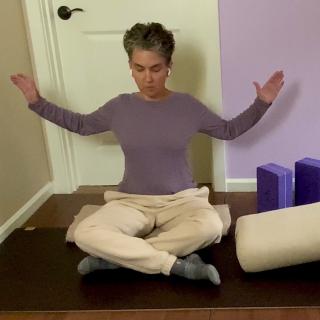
Take a hold of your belt or scarf,
Bring it overhead,
Take a reach,
Feel if you can stretch the hands out as far out as possible,
And then open through the chest,
Moving the belt back behind you.
Now,
Some of us,
This might be too far for our shoulders,
Not necessarily just the joints,
But the muscles.
So you might feel when you move the arms back,
I'm in a cross-legged position,
You could be kneeling,
You could be sitting on a pillow.
So you might need to change that position with the legs right now.
So you're comfortable in the knees,
But as you motion the belt back,
You're going to now swoop back,
Turn the palms to face forward,
Hold your belt or scarf straight behind you,
And then moving that belt down towards the ground,
And shift the shoulders out to the sides and squeeze the blades to the spine.
And this spine,
Your spine,
Is a huge focus for circulation,
Coordination in our body.
And you can let your head tilt side to side here as you continue that circulation in the chest.
Okay,
Now release,
Place the belt off to the side,
Twist to your right,
Bring your left hand to the right knee,
Take a rotation through back muscles,
Massaging the organs,
Moving over towards the liver,
And then twisting to that left side,
Moving in towards the stomach,
Pancreas,
Spleen.
Each side,
Really important,
Right?
Not just liver,
But on that second side,
All those muscles,
All those organs kind of push together,
Feeling that squeeze from the pose.
Simple seated twist.
All right,
Come back center,
Take the balls.
I want you to do a little tapotement from the inner ankle.
So I bring the soles of my feet together,
And I tap from the base layer of my inner calf.
Okay,
And I tap all the way up,
I bypass the knee,
And then go up to the inner thigh.
Okay,
And kind of find where it's that space in the inner thigh that is moving along right with your tapping,
Feels like it responds,
And then come a little bit higher,
Not quite up to the top of the thigh,
But right where you can feel the brink of the quad muscle right on the corner there and then go back to these lymphatic zones,
The lymph nodes in here,
Back here we go,
And then we go back to the chest one more time.
Okay,
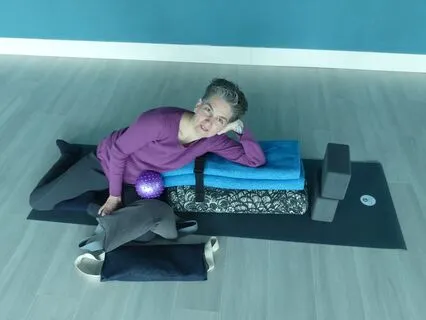
So now let's start to make our way back onto our bolster ramp.
Okay,
So balls are going to go under this time,
So when we lie back,
We're going to place the balls right at the piriformis,
The deep glute.
So I think of these as deep buttock muscles,
But when I lie back,
I place my whole back energy onto this bolster with a blanket under it,
Right?
So I have a blanket,
You might have a pillow or a book that holds the bolster to some height,
And then as I scoot my feet towards my seat,
So knees pointing up in the beginning,
I'm going to push into the feet and then roll the balls under to kind of a little below the eyebrows of the buttocks.
Okay,
So when I settle onto the balls,
I do want to commit to putting all the weight I have there on them.
So I can begin to bring circulation into my hips.
Okay,
So take a block or two,
You can use blocks under the thighs,
You can go minus the blocks,
But as I add my blocks to the upper outer side of my thigh,
I bring the soles of my feet together and the knees sway out to the sides,
And that worked out magically.
My body is set on the blocks,
It doesn't always work out that easy,
But you might find with the knees motioning out,
Yeah,
Be a little curious.
Do your feet slide down?
Do they get higher up towards the groins?
What allows you to feel like this is a basin,
Right?
The pelvic basin.
So you want to swoop into that blood flow into the groins and the leg pits,
And then make sure the balls are felt.
You can feel that they're there,
But they're not hurting,
Right?
It's not like you're receiving discomfort,
It's setting in some heat into the glutes,
Into the buttock muscles.
Let your chest spread open via the arms way out to the sides.
Clear your side yard and open the chest and receive your breath.
Reclining cobbler's pose,
Spine long,
Glutes strong,
You can feel their response to a little bit of tender pressure into them,
And the knees sway open.
If you notice more weight on one thigh than the other,
Like you can feel the reaction of the block into that thigh,
That gives you some insight into your hips,
Okay?
So you want to find balance.
So for me,
I feel more weight on my right,
So I'm just going to see if I can slide the blocks and kind of push the skin on the thigh with the block support outwards,
So I just settle into the basin of the pelvis.
If you don't use blocks,
It will be a deeper stretch that doesn't always mean better.
You want to focus on endurance for this class,
Like think of a session that's like brief and then you add some time,
You know,
Really working on that lymphatic circulation in the body,
That cleanup crew is going to work vigorously in the next bit of time.
So sense the diaphragm motion down to the lower belly,
The abdomen lifts,
And as you exhale,
The belly draws back towards the spine.
Just feel the alternating motion of in and out breath.
And now way back in the space behind the heart,
Feel that that space right behind the heart centers,
And then as we reach down to the blocks,
We're going to point the knees up,
You're going to slide the blocks off to the side,
And just let your hips move side to side,
Like you're wagging your tail.
You want to have a really good motion here,
Wag,
The tail back side to side.
So what happens is the balls kind of start to go out to the side,
Right?
They don't stay here,
They're going to start to glide to the side.
Okay,
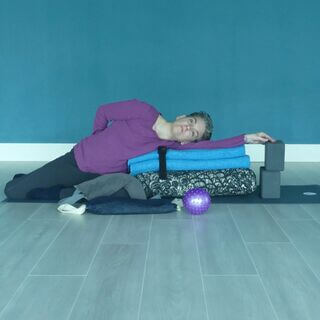
So now let's lean to the left and come around to a sleeping sage pose.
We're getting our nice ritual of restoratives in the beginning today to kind of soothe the body and the nervous system before we kind of dig in with the MFR work.
So I've got my bolster still up on the blanket on a ramp,
And I'm going to add my ball to each to that left side of my lower thigh right above the knee.
So right here lives the iliotibial segment here,
Just above my knee.
So I'm not pushing the ball on my ligament,
Right?
I'm just above it,
Right?
So I'm just above the knee,
Right into this area.
If you squeeze it with your fingers,
Like you try to tug in there and pull it apart,
And you might not feel like it's so tight until you roll on it,
Right?
You know,
When you use a roller on the IT band,
It's quite,
It's quite,
It sparks up a lot.
So when we're here,
I want you to settle the balls right there.
So use one or two,
You can choose.
Some of us will think that two is not enough pressure,
Doesn't hurt enough,
But just trust,
Trust the process.
My left foot touches the right thigh.
I'm going into a twist to the left,
Reach my hands besides the bolster on the floor,
Stretch the waist up to the bolster,
And then let your head turn to the right and let your arms span open.
Elbows relaxed down.
You can always straighten the left leg on this one with the balls,
Right still to the IT band,
It might feel pretty good.
Okay.
So if you have the pressure right on the IT band,
Right now,
You're going to let your body weight relax into the bolster and feel the twist and the spinal spaces opening up.
Okay,
On the left side,
You're going to notice the heart beating.
See if you can find an ability to slow your breath so the heart doesn't beat faster.
Squeezing in towards the spleen on that left side.
Okay,
On the right side,
You're going to notice the heart beating.
See if you can find an ability to slow your breath so the heart doesn't beat faster.
Hands slide down besides the bolster,
Palms on floor,
Push to come up,
And then we're going to slide the left leg back on down to the right leg and then turn so you're facing straight to the knees a little bit,
Feel the chest rise.
If you feel like all you got in you right now is to hug your bolster and rest down on it like this,
You can always take a bolster hug.
Have you hugged your bolster today,
Right?
So this might be the moment for that a little bit of this a little bit of that range of motion through the waist.
Okay,
And sense that arch through spine,
Through the heart space.
Do a little bit of curling cat,
Come back to table,
Curling cat,
Chin to chest around the back.
Stretch the hips back and move your hips side to side.
Make a little bit of circular motion.
So you move your hips to one side and then you bring the waist towards the bolster and then towards the other side and around.
So I always like the visual as if my navel had like a light and I was trying to make circles,
Right,
With that spotlight on the ground.
So I'm just circling,
Go the other direction,
Circling,
Circulation station.
That goes along with your hydration station in class,
Huh?
Your circulation station.
Okay,
Come back,
Sway center,
Two balls,
IT band down on your right side.
Here we go.
So lean into the bolster with your right hip next to it.
Place the balls to that right lower leg,
Right?
So when I lean to the right side here,
I've got the balls here on my IT band.
So they're right next to each other.
My leg lies down into the balls and it's promoting that circulation.
This will be key for those of you that have a foam roller when we roll into this area.
So see if you can let your leg just rest into them.
Sometimes when we feel a prop,
We hover over it.
We use some of our tension cycles to not let go.
So feel if you can surrender the weight into the balls and yeah,
Don't twist too much,
Right?
You want to get your hip right up against the bolster.
So move up.
Okay,
Now I trapped the balls.
They're there.
They're now in my IT band.
I can't,
They won't go away.
So take a twist.
Caution on the lumbars here.
So I want you to do all your turning from the thoracics.
I want you to feel like the lumbar area has the arch that it deserves here.
So those,
The lumbar doesn't have a big degree of rotation,
Right?
So what I want to have is my belly resting on the bolster.
Belly is connected above the belly,
Right into the thoracics.
If you were to touch where your belly is behind,
It's the lumbar than above.
So when I rest down,
I really like to feel when I'm in the soothing restorative twist that my chest opens.
I really feel the breath across the rib cage,
Expanding into the back.
Let the weight of the heart relax down.
Everything in you has some weight to it.
So just let go and receive the pose.
Now hands besides your bolster come up.
Let's take the balls to the side here.
Then you're going to move your bolster to the base,
Right down to the foot of your mat.
And let's go ahead and unroll blanket or towel so it's at the lowest setting that's comfortable for you.
I'm going to have a little bit of lift for my head,
Not my neck.
And then when we lie back,
You're going to need the balls.
And you definitely want to have a belt or a scarf with you this time.
So have something nearby.
And I want us to kind of get the balance of circulation in our glutes and into our hamstrings and calves on this one,
Okay?
So when we lie back,
We're going to let the knees just windshield wiper side to side.
And if you've got anything in the side yard that's going to,
You're going to bump into,
Move it aside.
And then feeling as you kind of fling the knees,
Right?
Think movement,
Casual,
Just not anything too controlled so that you can feel for yourself where your hips move,
Right?
They're kind of in this stuck station,
Right at the glute zone.
And that area can only feel like it's in a box,
Right?
Think about where the glutes are stationed,
Right?
To support the pelvis and the movement of the legs,
Right?
They're controlling that.
So when we come back in center,
Hug your knees into your chest,
Hug the backs of the thighs,
And then draw the knees side to side,
Feeling that weight into the back of the pelvis,
And even the lower back.
Okay.
All right,
Now,
We're going to bring the right ankle to the left knee.
We're gonna let that right knee move away.
Okay,
You can use your right hand to press into the right thigh to position it to stretch the inner thigh and the hip.
Okay,
Hug the knees into your chest,
Figure four,
Or thread the needle,
Pull the back of that left thigh,
Deeply sense the inner right thigh.
Lower the left foot,
Push the right thigh gently with the right hand so that you can immerse that circulation to the inner right leg.
Right foot steps down on the bolster,
Left foot lifts and crosses to the right knee.
Gently press with the left hand on that left inner thigh,
Moving it out.
Any sensation into perhaps just inner thigh,
Right?
Knees draw to the chest,
Hold the back of the right thigh,
Squeeze.
What's getting the motion,
Right?
The squeeze,
The squoze feel is likely the left leg.
Could be different patterns of pressure through the inner thigh,
The leg pits,
The lymph drain.
It's pretty serious on this one.
This is a serious cleanse class.
Okay,
Lower the right foot,
Press that left inner leg.
Okay,
Now we're going to do a little tester,
Right,
To start working on that glute massage on the left side.
So we're going to be rolling,
Doing some deeper tissue work.
So with my left knee out,
I'm going to take a hold of two balls,
Okay?
And you can use a roller on this one.
I'll show the roller in about 30 seconds.
So we're going to lean the knees to the right,
And you're going to slide the ball.
Actually,
You're going to roll them under to that left glute zone.
Now I say when the balls are right next to each other like this,
They're not like turning like this.
Most of us might think that if they turn inwards,
Horizontally,
You're going to get more glute work.
Well,
What we're doing here is we're on that fascial kind of brink here onto the border.
And then when I lean my left knee to that side,
I'm going to pick up my weight onto the balls.
I'm basically mounting them.
And then I just let my hips move side to side,
Wag my tail.
Okay,
Left foot can lower down to the bolster now.
And then start to feel where the sensation is rolling through.
Pressure plus movement is key.
You want to get the right amount of pressure,
Which is kind of all of it,
Right?
You want to surrender your weight into it.
But then how do you get the rolling to happen so you have this perfect blend that gives you some results?
So what I find,
I feel my upper back relaxing here,
My blanket under my head.
When I sway my hips side to side,
I might slow it down a little bit as I track my hips to the right because the balls are on the left.
And then I kind of swing over into the ball and you don't want to kick the balls out.
That's the challenge here,
Is that you don't want to get too wild and crazy that there go the balls,
Right?
And then you go bam onto the ground,
Right?
No,
We don't want that.
So feeling how you're going to be a good massage therapist,
It takes practice,
Okay?
And you know what,
That lower ball might go away,
Right,
If you kind of get into it.
So you have to kind of keep monitoring where is that support that I'm rolling into.
If you've got a roller,
You can exchange it.
Instead of the balls,
You will lean on the left elbow and just guide the roller under that left glute zone and you're going to cross fiber.
So you're going to go up and down the muscle pathway.
And so this one's a little different because you're not going across horizontally as much as you're swiping up and down on the glute.
I think they're both pretty good.
They're a little different in what they're doing with the skin tissue.
They're slightly different,
Right?
A little different.
So I think they're both,
Maybe if you have a roller and the balls,
You might use them both during this set today.
See how it goes.
Remember to hydrate.
This is probably the time when you start to notice.
It doesn't take much rolling to feel the massage,
The fluid motion into these areas.
It has to go from somewhere,
So you have to add it into your body.
It doesn't come from outer space,
Or maybe it does.
Okay,
Now get to the other side when you're ready.
If you're like getting kind of interested in this roller,
You can always slide down the roller a little lower to your IT band here.
And I sometimes like to do IT band with my opposite foot from the left side.
I push it down and I just try to really go straight in there.
Yes,
You can sit on your rear,
But it won't get your IT band now if I'm on my rear.
So I've got to lift up and mount onto the roller.
You can use the balls as well,
But they're incredibly intense,
Or maybe for me they are.
If I use the ball,
I would just say,
Place them just right across from each other lengthwise,
Right?
And you would just press onto the balls and you'd straighten the leg out,
Right?
And bend the leg.
So straighten the leg and bend and just breathe.
To me,
This is a little better for stimulating that release into the IT band,
But the roller you're going to be gliding up and down.
Okay,
Let's take a counter pose in between these two sides.
So let's lie back.
Okay,
Hug your knees into your chest,
Hold them in,
Take a counter pose,
Get a belt,
A scarf,
Anything.
We've only done one side here.
So belt goes under your left foot,
Right foot rests on the bolster of the floor and swing the left leg to the right side.
Get a nice sweep through the hip muscles.
These are all muscles in the lateral rotation series on our body.
Side band.
An interesting flow in the body,
Right?
In the sides.
And the left arm could swing back and up.
Don't deny the body some opportunity to get a little bit more range of motion.
If it feels too much reach,
You can always just make that movement with the left leg a little bit bent.
You can just bend into it,
Guide it to the right.
Perfect.
Now bring the knee towards the chest,
Reach the belt with both hands or the scarf and bring both feet up into it and push your feet out into,
I would say,
A semi-wide stance.
The stance of a semi,
I don't know if that's the right description,
But you want to have a stance outward so you feel each kind of outer corner of the glute,
Right?
So I don't really feel my lower back pushing right now when my feet go wide.
I'm going to feel that glute area right here.
I'm going to feel the piriformis,
Those bones are pushing down,
Not up into the lumbar when my feet go wide.
Because if you were doing a wide stance standing,
That area would arch and you'll definitely be strengthening into the hips.
Now if you want to go a little bit further out with the feet,
Hold onto the belt.
Hold,
Hold,
Hold,
Hold,
And slide the feet together.
Perfect.
Bend the knees,
Take the belt off,
And then here we go to the right side.
So two balls.
Start with the balls if you can.
If you want to just go with the roller,
That's up to you.
But I've got the two balls to the right side.
What I like to do is sometimes I'll just roll them under and then go right into the movement.
Sometimes I'll put them next to the hip and I'll just swerve my knees to the other side and then kind of mount up onto them.
It just depends if my back is in the same place.
It doesn't hurt me to push into my feet and lift up my hips and roll the ball under the balls,
But sometimes the back is a little bit,
You know,
Sensitive.
Okay,
But consider that you're rolling tissues that stream down from that conscious lower back zone.
So you're kind of taking the energy away from the back and moving it into these fine muscles you have to help you walk and organize movement into the pelvis.
So give them some massage,
Right?
Massaging the glutes.
Okay,
Now there are some people that might do the rolling with the ball,
One ball.
So if you want it more intense,
You just use one,
Right?
Just one to the glute medius,
Right?
So you can have it towards the border.
I like to just,
In some way you're rolling across,
You know,
Medius,
Maximus,
Minimus,
You're just gliding,
Right?
So you don't have to have them exactly like this.
In fact,
Some of you might already be up on your roller,
But this is what I was taught.
Okay,
So I sometimes have that burned in my memory.
But if you have a different wave of teaching it,
I always welcome anybody to connect in the group in the chat and let me know.
But when you're gliding across,
Maybe come back to that figure four for a moment,
Maybe ankle to knee,
Kind of feel how that curves into the glute.
Yeah,
All these muscles,
These pathways are so interesting,
How they,
You connect the dots.
And then when you push into the ball,
It's like,
Oh,
I can feel the connective tissue,
I can feel layer one,
Layer two,
All the way in,
Right?
And then you swipe across.
Get on the roller.
Those of you that haven't started with your roller and have it,
Get on it.
Okay,
So I've got the roller now to my left,
Oh sorry,
To my right.
So I'm going to sit onto it.
And there's no graceful way that you have to do this.
But you could have your hand pushing down,
You could have your elbow down.
But just with this glide into the glutes.
And if you want,
You can go a little lower sooner.
Okay.
And I would say the IT band is just above the side of the knee,
It's not in the middle.
Some of us kind of somehow feel it's really challenging to get that far down,
I think.
So you might stay with the glute,
We'll get a little closer into it a little while.
So you don't feel like you have to get there now.
But if you want to find some IT band awareness again,
Before we move on to the next stage,
You can always come down off the roller,
Take one or two balls to that side,
Like we did earlier when we were doing that side,
That sleeping sage pose,
Lean into it and straighten the leg and bend.
So you want to have the weight on the balls.
So if you've got knee inflammation,
Recovering from knee injury or surgery,
Don't put the ball on the knee at all,
Right?
Go to the muscles above to the side,
Not the inside,
The side of it,
Just lean into the ball,
You could just be like this,
Have one or two balls to the IT band.
And that area gets a,
You know,
It gets kind of hypertoned when there's an injury or inflammation.
It compensates,
Right?
So you might want to get a little bit of love in there.
Right?
Love equals rolling,
Rubbing into the tissues.
Okay,
Now let's go ahead and take that crossover.
So we're on our back.
Once again,
We take the belt or scarf in our right foot,
And we reach it over to the left side.
Doesn't have to be perfect prop stuff.
But take your belt to the right foot,
Cross it over to the left side.
Whoo,
Yeah,
You can feel that sweep,
That energetic pull,
We're going full body,
Right,
We're going to start to lower all the way to our calves.
Be present,
Right here and now with the side of the leg.
Breathe.
It only helps.
Back in center,
Feet straight up into the belt,
Pull with resistance,
Wake up the calves.
Okay.
And then you might slide the belt so it's right at the balls of the feet,
Pulling with both hands to kind of exert that fluid motion back towards you.
Towards the groins,
Pelvis,
Bend the knees,
Slide the belt off your feet,
And then take some time to casually roll up to sitting.
Okay,
So I go easy to the side.
I let my hands bring me on up.
And then I'm going to start to work towards my calves.
Okay,
Let's begin.
So you can sit just simply.
I would like to encourage you to use a block on this one today.
So if you don't have a block,
You might use a hardcover book.
You could also use a bolster to put the ball on as well.
But we're going to need a block and maybe a roller and then a ball.
But in the beginning,
If you have a couple balls,
Start to tap into these calf zones.
Now you might notice this is a part of the calves we don't.
I know Mary Alice is like,
This is the part that I really like.
Yay.
Okay.
Feel tapping.
Okay,
Feel like there's a resounding kind of an echo here in the calves,
An outside object entering.
Okay,
Go when the knees are out in this pointy direction,
Go high up to the calf.
And you don't want to hit the bones or you're not hitting your knee at all.
No knee.
Knee hitting here.
Okay.
Okay,
Go up and so kind of find right where you're at the rim and the side of the tibia just on the side.
So the tibia is going to be the bone right here,
All the way down tibia.
So I'm on the side,
I'm on the inside.
Okay.
All right.
Now,
Balls down and just use your thumbs to press into these tissues.
Kind of feel how you can grip with your thumbs and slide and pull.
Okay.
Yeah.
And it's kind of it's,
It's smushable,
Isn't it?
It's squishy.
It's not a huge terrain of squishiness,
Is it?
But this area is thus where that fluid retention starts to drop down and then kind of holds in here.
It can be to the knee for some of us,
Inflammation,
But most of us have some sort of retention down here.
So it's tight.
Okay.
So we're working deeply on that lymphatic,
That venous return when we start with the calf work,
And then we'll flow.
You'll see how we go with the circulation back to the heart.
So take a block or a hardcover book,
And you're going to place a ball.
I just turn the block horizontal and place the ball on the block and then your calf on top of the ball.
Okay.
So lean back.
If you need to kind of reset your space to be a little bit more cozy,
It's up to you.
But I want you to lean back a little bit into your hands or your elbows and just go side to side.
Feel if you can kind of roll on the ball.
So you motion your knee out and then down and in.
Okay.
You know,
It's an interesting movement with the muscles is to find is it's not like you're going to turn your,
Your leg around.
You know,
We're not,
We don't have that kind of ability in the joints here.
We're not owls.
So when you motion,
Feel for that calf pushing the tissue off to the side.
It's kind of sticky,
Right?
Calf can be a little bit glommed up in there.
Boggy tissue.
Okay.
Boggy no more.
All right.
So now you can start to go up and down the calf,
Which we call strip the calf.
So we turn the block lengthwise and I lean back.
I tend to take my opposite leg to lifting and put the bottom of the foot on the ground.
And then I have an easier ability to kind of push off the left foot and then glide down the right calf.
I go up and down the calf with the ball by pushing into it and gliding up.
And this is when we start to get this interesting interoception,
The sensing in the body that we don't have with like choreography with movement.
It's a little different.
It's pretty deep awareness into your muscles,
Into the fluid motion in these areas.
So feel that glide.
Okay.
Is there an area that's,
I find when I go up and down the calf,
It's somewhat even more than when I go side to side.
That to me is pretty,
Pretty never ending.
Um,
Bogginess.
Okay.
Now we're going to go to the best of all the peroneals.
Okay.
So you're going to the fibula area of the,
Of the lower leg.
So the side of the lower leg below the knee to the side is a fibula.
So you're going to grasp a hold of the ankle on that right foot and just above,
Uh,
Just below the knee with the right hand.
And I want you to glide across.
So yeah,
Your leg might not bend quite like this.
Some days it just feels a little bit stuck for me today.
It's a little,
A little stiff.
So I'm going to push into the ball and just glide the weight of my leg,
All the muscles there.
So here we're really working with that fluid retention.
We're draining out.
So as we push,
It's going to feel pretty nervy,
Nerve rich.
So we're doing,
We're working with massage,
Right?
This is a lot of massage work here.
Self massage education.
Okay.
So now is there an area where you feel when you go a little lower,
Where the nerves are slightly more sensitive?
Okay.
See if you can do saw like motion.
So holding the leg,
Help it along all for the love of yourself.
Who else is going to do this?
This work is pretty,
Pretty good.
Okay.
Now the place we never are rolling is on a knee,
Kneecap or anything,
And we're not rolling on the tibia,
Right?
The top,
The front of the leg.
So when we come out of this one,
Okay,
I want you to come out of it.
And I would just say,
Come into this with both legs extending in front,
And then just shake it out.
Do a little bit of a leg tantrum here.
Feel not looking.
Okay.
Breathe,
Take a seated,
Lift with the heart.
Just let your feet relax.
Okay.
And then let's come to the second side.
So if you need to do a little bit of calf rub in between sides to kind of acknowledge the difference from one side to the next,
Just pinching the calf might feel,
It's good luck.
Pinching your calf.
Take a block across horizontal and a calf on top,
Another calf,
And then going side to side.
Yeah.
It's interesting how you feel like cerebrally,
Right?
When you do some of this rolling stuff,
The restoratives are good,
But it's nice to balance it out in this class.
So right now we're kind of heavy in that rolling part.
So breathe,
Hydrate,
Take a walking break if you need to around your room.
See if you can just take the time to be patient with your body,
Kind of letting go of this tension,
Right?
And you're going to be in the tension while you're flushing it out.
So if I was to feel my right calf compared to my left in those few seconds,
It does feel different energetically.
So let your body take a few moments here going cross fiber across the back of that lower left leg.
Can you use two balls?
Well,
Yes,
You can.
Like you could have the two balls in the tote and that feels really good.
So if you have two nut balls and they come in the tote or the sock,
You can put tennis balls in a sock and do calf massage as well.
Okay.
It's a little easier,
Like the sensation's a little softer if you have two balls versus one.
But so we're kind of going into the deep work right now,
Just with the one ball.
Part of the class is deep tissue.
Then we turn the block lengthwise,
Straight up and down.
So I have a little bit more terrain to flush out the calf.
I lean back and I just go all the way up and down on that whole little valley in the calf.
You are drawing down maybe to the Achilles area,
But I would say feel where it's the thickest part.
And if you go,
If you push back and you get all the way down to the base and it's kind of gnarly in there,
I think in the,
The role model textbook for rolling,
They do call some of these kind of the,
The gnarle,
The gnarle zones.
Okay.
It is,
It is part of the textbook,
Right?
They do have chapters on this,
Particularly gnarly areas.
It's a funny word,
Huh?
Okay.
So going up and down.
And then as I turn the block,
Okay.
Now with all this ball stuff,
You feel like,
I'm going to get on my roller.
I'll show you that in just a second here.
So when you cross over,
You hold onto the lower leg and you might lean forward,
Take a little forward fold and feeling for your peroneals here.
In fact,
This is probably your most effective one.
If you've got foot issues,
Plantar fasciitis,
Neuromas,
Structural stuff,
Right?
Postural challenges.
Maybe you have orthotics and you're being talked to about different ways that you're putting pressure on your feet.
So this area is a good one to strum through.
Like you're practicing.
If you're a musician,
You practice playing your instrument.
This would be a really good one to play every day,
The peroneals.
Okay.
And you might notice,
Okay,
I hold and I kind of rock it.
Now,
If you want to use your roller,
You can add that into the game here.
At the end of it,
You can just put your roller under your calves.
This is kind of easy instruction,
Right?
I just have my roller under my calves and I lean back and forth and I just use my hands to press.
I think if you use your hands up on blocks,
That can be really effective too.
Because then I can use that elevation.
Okay.
Then I get a little bit more weight into the calves.
See?
And then you get some bonus core work.
Yeah.
I find just lying into the roller,
Just kind of wiggling my legs side to side,
Like they're having a little bit of a tantrum,
Works really good.
That's so nice.
Okay.
What's nice about it?
It's great therapy,
Right?
For the body,
All the cleaner station,
Right?
The lymph,
You're going to feel it when we come upside down.
So here we go.
Start to come around to hands and knees.
You can use a blanket or a towel.
I'm going to recommend do use something like this and just roll it up.
Roll it really tube tight.
Towel,
Blanket.
You can also use your roller instead of this.
Okay.
You can put your roller back here instead.
Okay.
What I like about the blanket though,
Is you can mash it a little easier unless you have a soft roller.
This is not going to be as mashable.
So you want it to conform to what your body needs,
Right?
Some of us need something that's our hips are going to lean back.
So you're going to lean your hips back into the blanket,
Towel,
And then you can feel it just at the thicker part of the calf.
I like to have my arms reaching my elbows down and then my elbows go out to the sides and my forehead onto the hands.
Okay.
Yes.
If you want more,
You can sit back like I am here in what's called Virasana pose or seated hero pose,
Your traditional meditation pose.
This would be that.
And I would sit back onto the blanket.
Does you feel this?
It's a pretty intense sensation in the area that I was just massaging the calves.
Okay.
Now,
If you're in child's pose variation,
You're reaching your hips back,
You can wiggle your hips side to side.
Okay.
All right.
Now let's stretch out the backs of the legs.
If you're feeling like you don't want to put weight into your hands that deeply,
Don't.
Okay.
You could lean back and stretch a leg at a time behind you.
Stretch your calf this way,
One at a time.
And those of us that want to go both,
Lift up the knees,
Alternate bending your knees,
Pedal out the legs,
Feel from the feet and then that run down to the heel,
And then walk your feet towards your hands,
Your hands towards your feet,
And find yourself in a standing forward fold.
Reach the arms out of the back,
And then just feel how they relate to your existence right now.
I mean,
Your arms are usually down by your sides anyway,
But now you can use those upper extremities to help completely stretch out the backspace.
Okay.
Let your head nod side to side.
Relax your jaw.
Okay.
You might even explore stepping the left foot back a little bit,
Feeling back into the calf,
Then forward,
Step the right foot back just a little bit,
Press down into the heel.
There's all kinds of little interesting blends of movement,
But all that circulation to the face,
The skin cells of the face get all warm.
Whenever you do this,
You always sound congested,
Right?
Because of all that flow to the brain.
It's a good one,
A good drainer.
And then as I bring the knees back to bending feet apart,
I'm going to just simply start to bring my hands up my shins and just slowly roll up.
Try to move up.
And once you go up,
Your shoulders start to lift.
You're going to roll them back and down,
Spine up,
Chest lift,
And then just shake it out in your feet.
Okay.
So now get a ball or get some water right at the same time.
It's a good time to hydrate.
Usually when I come up is when I go down to get my fluids.
So I'm going to start to roll my right foot.
You can roll either foot.
You probably have two options.
So I want you to get the motion at the bottom of the foot to guide those bones to feel like they're separating.
So you just use your weight.
So I like to have the opposite leg just turned out a little bit.
And then I press and roll.
How are we doing?
So as you push,
You can feel like you can lift your heel and then glide through.
Does that make sense?
You can also do the opposite.
But I like the lift of the heel and then glide.
Heel,
Glide.
And then to see if you can do a little bit of movement across.
So just kind of turning.
Okay.
So feeling from the foot,
Press,
Find the roots of the toes a little bit,
Not just the center.
Woo.
That can be dynamic.
Okay.
And then change it to the other side.
Do a little shake out if you need.
That's pretty dynamic when you twist.
Okay.
So glide.
So get a feeling of lifting.
Now you can always take your foot off the ball here and just kind of feel the movement roll through.
I think the idea of staying on the ball is a great one,
But you know what?
You've got to kind of make this entertaining for yourself.
Otherwise you won't come back.
You got to find ways to make this part of your self-care,
Making you feel a little happiness and energy circulation.
Probably feel good from doing this,
At least more connected to yourself.
Okay.
Now one side,
You might notice the bones have a little bit of a different kind of snap crackle.
I do notice that on this one.
My non-dominant leg kind of holds back and probably checks out the scene often when I'm starting to walk,
Huh?
Compensates the opposite leg.
So kind of feel into it.
Give it lots of attention.
Feel through the foot,
Maybe grind it,
Turn a little side to side.
Okay.
Now feeling when you turn,
The next time you come back to push into the ball,
Slide off of it,
Shake it out.
You can do a little bit of big leg shake out or just feeling from the knee down to the foot,
Kind of wiggle.
And then let's come down.
So let's take a reach down to our feet,
Bend the knees.
If you need to hold on to a wall or a chair,
You can do that.
Do so.
And then we'll walk it out.
Hands,
Feet,
Back,
Knees down.
Take a few cat cow,
Curling cat motion.
Feel that curl through the pelvis.
Feel the arch through the ribs and then come back onto your seat.
Okay.
All right.
Let's take a reverse flow to our heart.
So we're going to do Viparita Karani,
Which is reverse action,
Reversing the effects of gravity on heart,
Muscles.
So really nice way to blend kind of the heart of the legs,
The soleus,
Everything reverses down and it's refreshing for our vascular system.
Okay.
So I've got a blanket folded under my head.
Bolster is not necessary,
But I like to feel like I can push off of it sometimes,
But it's completely up to you.
You can have your feet on the floor if you prefer and then take a block.
Okay.
Now lift up the hips and slide the block under the back of your pelvis.
So it's at the second setting or it's at the lowest setting.
It's setting one or setting two,
Or actually setting one or setting two.
Okay.
Setting three is for those that need that height to feel,
Some of us like that a little bit more energy with the higher the hips go.
Okay.
So then let the legs go up either one at a time or both.
But as you feel that hinge at the hips,
The feet with that lift,
They're furthest away from your brain just starts to reverse the flow and the effects of gravity on the heart.
So the blood returns to the heart.
So the heart can relax and the body can focus on other things.
Just think of all the,
Don't even think of all the things it has to do all the time to keep you well or even moving towards wellness.
So if you're challenged,
All of us are challenged in some way if we've lived in our body for a while,
That will be part of existence.
So use this practice to really support your body to heal,
Replenish,
Recover.
So some parts of the practice will feel more essential to you than others.
They'll speak to you more.
So right now we're in the inversion layer,
Giving back to the heart,
To the brain.
Scan the awareness of the shape that reverses back to those areas that I mentioned.
And then bend the legs,
Feel where the motion of the feet flows into your quad.
So once your feet lower to the bolster or the floor,
Push into your feet,
Lift the hips up and slide the block away.
And as your spine glides down and guides to the floor,
Okay,
Keep that pelvic basin down,
Right?
Keep it centered down.
Okay.
Now,
If you have a bolster under your feet,
What I want you to do is push it with your feet over to the right side of your space and you're going to cross the left leg on top of the bolster.
Okay.
Restorative hip crossover.
Okay.
The ball is going to go to the upper left side of your back.
So just roll a ball under the trapezius.
Well,
It's actually basically on the trapezius,
Right?
It doesn't go below it.
It's right against it.
So,
But I roll the ball down from my shoulder between my shoulder and the spine on the upper left side of the back,
Right up here.
Okay.
Now it's not on top.
My hand doesn't reach that far back when I show you,
But it is,
And it's also not below to the rotator cuff zone in here.
I don't want you to have it right in the,
That infraspinatus area.
So if it gets kind of stuck into the bones,
Like all of a sudden it's in a trap,
Go to the trap,
The trapezius.
That's where you want to go.
You want to go where the energy is sort of trapped.
Who doesn't have a trapped trap?
They're not,
They're not in class anymore,
Probably,
Right?
They're just free of all discomfort,
I guess.
So feel the left arm open and keep that ball to the upper left side of the back and shrug the shoulder.
See if you can get that part of the body to,
To have some conversation,
Right?
I mean,
These areas,
There's just a few areas that you feel like you can nearly talk to,
Like hamstrings is one.
Areas that we,
We notice when we stretch our general stretching is,
You know,
Leg up kind of stuff,
Forward fold,
But this upper back area can feel really stuck.
So get a ball there and just shrug the shoulder or just let the left arm open out and breathe.
It doesn't have to be more than that.
If you're getting kind of a little bit of a headache with it,
It's probably really tight tissue,
Dehydrated,
Right?
Get some water,
Get up,
Get plenty of water,
Take a few moments and then return.
You want a good return from your investment in taking class,
Right?
So keep that in mind when you're taking the class,
Right?
What is this for you?
Like this is an investment you're making in practicing.
Me too.
Okay.
Coming together with a practice for you.
So treasure it.
Yeah.
We're together in it right now.
So feeling that sensation,
The upper left side of the back.
Okay.
Anyone feel that?
Okay.
Last thing,
Last person we heard from has been a while.
So if anyone has anything you can always type in,
Okay,
Everybody's welcome to connect.
Okay.
Now I reach back for the ball.
I switched sides,
Knees to chest.
Okay.
As you come to the second side,
You're going to cross the,
Put the bolster on the left side of your mat.
And I want you to swing the right leg over on top of the bolster.
And when you're here,
If you're feeling like,
Oh geez,
This is a lot in my upper back.
And maybe you happen to have a roller.
You can always do a little flushing of the upper back muscles,
Kind of in between sides.
And I recommend this just anytime we're doing upper back,
Because it can be surprising when you're trying to negotiate that rolling.
So now I'm on my back and I've crossed my right leg over to the bolster on the left.
And I'm placing a ball to the upper right side of my back.
And I'm just,
This side I have a little more free glide on the ball.
I notice other side,
I have scar tissue and it's just a little bit more jammed up in there.
Cause that kind of grows over the tissue and adds like a mesh over it.
So it's going to take more grinding to get in there and loosen it up.
And it feels good.
It doesn't hurt,
But it does feel like this side has more glide into it.
Okay.
Now,
If you have the roller and you want to try that,
Take a careful roll up to get it,
Slide it around to your upper back,
Right behind the heart,
And then pushing down into your feet,
Go down and up.
And don't be afraid to go too far up.
Just be careful where your feet are positioned.
You don't want them too high up to your rear.
You might have to slide them down,
Bending the knees and then going up and down the back.
You can kind of feel that the arms open and feel that glide up and down the back.
You can bring your chin closer to your chest,
But I would say be really safe on that movement in your neck and just get that heat into your back.
Anyone feel that?
The heat to the upper back.
Okay.
Now come back to that hip crossover.
If you moved out of it on the roller,
Okay.
Right leg over to the left ball at the upper back,
Upper right side of the back.
Okay.
All right.
Now to me,
This is the really good stuff,
Right?
For me,
This is the stuff I need.
So here we go.
We're going to go both sides of the back with the balls.
Okay.
So you can tell how movement occurs when I have something under the upper back and my arm opens.
I can feel it in the chest as well.
Okay.
So when you take that one ball out,
Okay,
We're going to prep for going through both sides of the trap.
Okay.
So take a little bit of time here for some support.
Bring the balls to the upper chest,
Just below the collarbone and do a little tapping out.
So I go from center and then out center and out on my back.
Okay.
The area opposite this spot is going to be your massage location.
Okay.
All right.
So take a block,
Place it under the back of your pelvis.
I think of it as just pelvis rear.
That's a good spot.
Block is at the lowest setting.
Okay.
Now,
If you've got a blanket under your head,
You want it to be just under the,
The shelf at the back of your skull,
The occiput to just have it up that high,
Pretty high up.
Okay.
This way you have all this space.
You got the neck long.
The ball does not go on the neck.
No ball on the neck.
Okay.
So I'm going to bring the two balls.
Each hand's got a ball and I'm going to roll them.
So they're right on each side of my neck.
Okay.
Then I'm going to lift my chin up and then roll the balls under the upper back.
Okay.
They have a little separation between them,
Which is a spine,
But I want you to have them so they're far enough down that they're not on your neck.
And then when you move your hands away from holding them,
You'll just shrug the shoulders up and down.
You'll bring your elbows out to the side and circle.
It's okay to make it very gentle in the beginning.
Make sure you got space on your side to create the movement.
Arms out and circling.
Breathe.
That's another way to hydrate your body,
Right?
Oxygenation station,
Free refills.
Don't even have to get up and do anything.
You can just move those particulates,
Right?
Arms out.
And then your body's always flushing and moving toxins.
And then now it's all the time.
This class just kind of gets out in hyper mode,
Doesn't it?
All right.
Now I want you to bring the arm up one at a time.
So you're like you're climbing a rope.
Okay.
If you're still confused about this ball thing,
Let me just demo what that's about.
So those of you that have the ball in a good spot,
Keep going.
Arms up,
Arms out,
Shrug the shoulders.
What I find is sometimes I'll put the balls so they're apart in my upper back.
I roll them under.
Okay.
Now if that's a little difficult for you,
You can also just put them on the mat.
Come up,
Put them.
Remember you want a little space.
Just imagine it's that this is about the whole terrain of your trap that you can get into.
So as I lower down,
My hips way forward,
My block is somewhere nearby and my elbows on the ground.
And then I just get the back onto the ball set.
And then I add my block and it works pretty good.
Yep.
That actually is a little better.
It's not as tender.
I have a little lower.
Okay.
But if your neck is tight,
You got some headaches,
Neck stuff,
I would say make sure they're high enough on the back.
Okay.
Now slide the block out or block free.
Okay.
Hips down.
Okay.
Now you can feel that you can drag your weight down the ball as you're lowering down,
The balls go up the back and then you push into your feet and you go up.
Hold the back of your head if possible.
And then slowly feel like you go inches.
You might find that your stay on a knot in the traps like you're just right on the knot.
So see if you can just jostle those tissues.
You go uptown and downtown from the knots in the traps.
And you might let your head relax back onto the blanket again,
Still holding your head just a little bit up and down.
Breathe.
It only helps.
I think you've heard that before.
They were just helping each other along.
Okay.
Now when you come around,
Roll to a side,
Save yourself here,
Come around to hands,
Knees,
Get a block.
Now you don't have to use two blocks.
You might use two on this.
I like sometimes the bolster under my elbows,
My block between my hands.
Okay.
And then I lean back.
Okay.
Oh,
That's funny,
Bethany.
Oh,
So hands push into the block and stretch the chest.
Feel the hands push into the block.
That's key.
But hey,
What I feel is my triceps,
My cross,
My chest and my back a little bit.
Press into the block,
Then start to move the block to your upper back.
Okay.
Now come back up.
Okay.
Let's take a little side stage.
So pull the bolster into the center.
So if you don't have a bolster,
Use a thick pillow or a couch cushion.
You're going to lean the right hip up to the bolster right next to it on floor.
Pull a blanket or a towel in so it's at a,
It's,
It's horizontal.
It's straight out.
You don't want to have it lengthwise.
And then as you lean in,
I would put a block on the other side of your blanket or a,
A wall,
A wall you could reach to,
Or a chair if you don't have a block.
And I'm going to wad up my blanket.
Actually,
I've changed my mind.
I want a little bit more height.
So it's not higher than your pillow or bolster.
That's the rule.
And as you lean in to that bolster,
The legs can be in a fetal position.
They can stretch back.
Left arm can extend over,
Head relaxes down.
All right.
So feeling in this lengthy practice,
This is a long one.
This is like workshop series type of timing.
So really acknowledge your effort to still be here.
Okay.
And working into the final spinal here.
Let the weight of your head rest on the blanket,
Left arm stretches overhead.
Breathe.
Feeling the range of motion,
Especially now in the neck.
Okay.
And some of you know,
We do usually end with craniosacral in the last quite several months,
We've been doing craniosacral at the end.
So when you do lie down,
You want your head to relax.
Even if this upper arm doesn't want to go overhead,
And it's too much on your shoulder,
You can have it rest on your hip.
Just let the weight of your head lean to the right.
Right arm is on the floor between the bolster and the blanket.
It's not on the bolster like up on it with the elbow,
The elbows on the floor.
So carefully switch sides,
I recommend feeling the sensation of your ribs from one side to the next.
So when I shift my pelvis in center,
I stretch open my ribcage,
Head back on the blanket,
Careful here,
Walk the feet to the side and stretch the back of the head.