Today I'd like to share with you a simple breathing exercise that has changed everything for me.
Even years after burning out my nervous system was always switched on.
Even on quiet days I felt tense and restless,
My mind wouldn't stop and I lived in that tired but wired state.
What I came to understand is that we can rewire our nervous system.
We can guide the body back to the green zone,
A natural state of rest,
Recovery and safety.
We can do this by slowing down our breathing.
But there's a catch.
Often when people try to breathe slowly they begin to take bigger audible breaths and this actually upsets the balance of gases in the blood and can actually keep the nervous system on edge.
So yes the way in is through the breath but not just slower breathing.
The breath needs to be light,
Quiet and gentle.
When we breathe like this the body naturally releases chemicals that slow the heart,
Calm the mind and help us to feel safe and warm.
And what's really exciting is this,
With regular use that calm becomes easier to reach,
Stronger and it lasts for longer.
So if you'd like to give it a go let's try this together now.
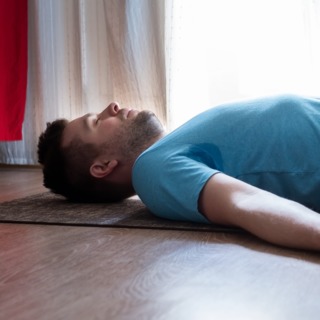
Finding a comfortable position either seated or lying down,
Bringing a little length into the middle of the body so that you feel open and supported.
And gently closing the mouth,
Breathing through your nose for the rest of the recording.
We're aiming for a breath that is soft,
Light and quiet.
The first step is breathing with the diaphragm.
So when you're ready just bringing your attention to the area around the bottom of your rib cage,
Around the sides of the lower ribs and noticing the movement there as you breathe.
You might place the palms of your hands around the sides of the lower ribs to help you feel this and then just let your shoulders soften down.
Simply noticing how your breathing is already happening,
How as the body breathes in there's a subtle expansion around the lower ribs and as you breathe out a gentle return.
The diaphragm is our main breathing muscle,
Shaped like a dome and resting at the base of the rib cage.
As you breathe in it's flattening and widening,
Pressing the lower ribs outwards.
And as you breathe out it's rising back up into its dome shape,
The lower ribs easing back in.
So just allowing your belly to stay soft,
The movement should be subtle and the breath is quiet and light.
Now once we've found the breath at the diaphragm,
The next step is to breathe slowly and gently and this is what really helps to heal the nervous system.
We'll use the sound of bells to guide the pace.
So the rhythm we're going to use is about five and a half breaths per minute and this is an optimal speed for calming and resetting the nervous system.
If it feels too fast or too slow for you then simply allowing your body to settle into a pace that feels natural for you.
So let's start the bells now and when you're ready gently breathing in and gently breathing out.
Breathing softly and quietly,
Breathing gently and smoothly.
Breathing in through the nose and breathing out through the nose.
Feeling the breath in the belly and down in the lower ribs.
Gently breathing in through the nose gentle expansion on the in-breath,
Gentle deflation on the out-breath.
Gently breathing in and gently breathing out.
Feeling the calming rhythm of the breath.
Adjusting the size of the breaths so you have just enough air.
If you start to feel dizzy or light-headed then just making your breaths smaller and lighter.
Taking a break at any time if you need to.
You can pause the recording at any time.
So we're gently breathing in and gently breathing out.
It's as if there's a balloon in the middle of the body.
Gently inflating on the in-breath,
Slowly deflating on the out-breath.
Breathing softly,
Gently,
Quietly with the bells.
On each out-breath,
Allowing the body to relax.
Letting the mouth and the jaw soften.
Letting the shoulders drop down away from the ears.
Releasing any gripping in the hands.
Allowing the belly to relax.
Belly soft like jelly.
Letting the pelvis melt down into the surface beneath you.
Releasing the buttocks and the pelvic floor.
Feeling the legs soften,
Heavy and supported.
On each out-breath,
Allowing the whole body to relax.
So we're gently breathing in and gently breathing out.
The breath is quiet and gentle.
No big breaths.
So we're just finding the sweet spot where we have just enough air.
There's no straining or forcing.
Just finding a gentle air hunger.
When we breathe less air,
We actually get more oxygen to the brain.
More blood flow to our muscles and our heart.
We reset our breath to be lighter and quieter.
So we're gently breathing in and gently breathing out.
Noticing any positive feedback from your body.
Perhaps feeling a calmness or warmth.
Maybe more saliva in the mouth.
Perhaps the mind is slowing down.
Or there's a gentle sense of clarity.
So we're gently breathing in and gently breathing out.
Breathing in through the nose.
Breathing out through the nose.
Noticing how much calmer you feel.
Knowing that this is healing your body.
Know the recording continues for the next 10 minutes with the sounds of the bells.
You can stay with this rhythm for as long as you wish.
Enjoy.