This is a simple,
Science-backed breathing technique to help you noticeably reduce pain within minutes.
It's an approach that works for pain anywhere in the body and is suitable for both temporary and chronic pain.
I'll briefly cover the science of how it works and then I'll guide you through the breathing exercise so that you can learn how to do it and get some pain relief by the end of this recording.
If you're returning to this track,
You can skip straight to the breathing exercise using the timecode in the description.
So what is this breathing technique and how does it work to reduce pain?
Well,
Research conducted in 2019 showed that paced breathing can significantly reduce pain.
The study involved healthy volunteers who were exposed to different breathing patterns and heat pain stimuli,
And the findings were quite enlightening.
When participants breathed at a slower pace,
The pain they felt was less intense.
And even more interesting,
The pain-reducing effects were more pronounced when the exhalation was longer than the inhalation.
And it turns out that by controlling our breathing,
We can help to shift our nervous system from fight or flight to rest and digest mode.
And in the brain this has the effect of turning down the dial on how intensely we experience pain.
So as we do this breathing exercise together,
We'll focus on slow paced breathing,
Specifically aiming for six breaths per minute.
We'll also pay special attention to making your exhalation longer than your inhalation.
We'll be breathing in for four seconds and then out for six seconds.
We can then make further adaptations to how we breathe to make the technique even more effective and I'll explain how those work later in the recording.
Okay then,
Let's get to the breathing exercise.
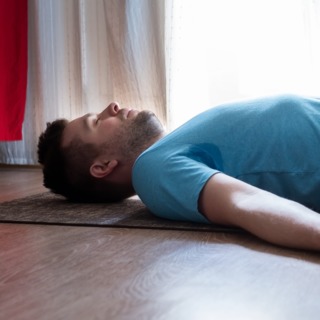
So beginning by choosing to sit in either a comfortable upright posture or lying on your back with your feet flat on the floor and your knees rising up towards the ceiling.
Breathing through your nose if possible,
But if you can't breathe through your nose don't worry,
Just breathe through pursed lips instead.
We'll be breathing in for four seconds and then out for six seconds and we'll use breathing bells to help you keep time.
So let's start those now and then gently beginning to bring your breathing in sync with the timer.
Gently breathing in and gently breathing out.
It might take a few breaths to get in time with the bells,
So just going gently and taking your time.
Your breathing should be soft,
Quiet and gentle,
Avoiding taking any big breaths as this can make your pain worse.
So gently breathing in and out,
Feeling the calming rhythm of your breathing and then slowly beginning to bring your attention to the area of your upper belly,
Just below the rib cage.
If you like you can rest the palm of one of your hands on your belly to help you feel your breathing or bring both hands to rest around the sides of your lower two ribs and then just letting your shoulders relax back down,
Beginning to feel the gentle expansion of your breathing on the in-breath and the gentle deflation on the out-breath.
So it's as if there was a balloon in the center of the body which is gently inflating on the in-breath and slowly deflating.
Gently breathing in and gently breathing out,
Just breathing softly,
Gently and quietly with the bells.
The diaphragm is a dome-shaped muscle that attaches to the bottom of the rib cage.
It's our primary breathing muscle and as the body breathes in it flattens down,
Pushing on the digestive organs beneath it and it also gently pushes the lower two ribs out to the sides.
And as we breathe out the diaphragm returns to its normal dome-like shape and the belly and the lower ribs move back in again.
So perhaps just noticing that natural expansion out to the front and to the sides as the body breathes in and a gentle sense of collapse as the body breathes out.
There's no need to push or pull the breath,
It's enough just to bring your awareness here and the movement of the breath will be quite subtle and gentle.
Breathing diaphragmatically in this way has been shown to reduce back,
Neck and shoulder pain and so this is an additional benefit of breathing in this way.
Taking a break at any time if you need to,
You can pause the recording at any time and then come back to it.
Gently breathing in and gently breathing out.
Feeling the subtle movement of the breath around the region of the diaphragm.
Sometimes tension in the body can also contribute to pain so as we breathe let's just begin to bring some relaxation into the body.
Allowing the mouth and the jaw to relax.
Letting the shoulders soften down away from your ears.
Releasing any gripping in the hands.
Allowing your belly to relax.
Letting your pelvis soften down into the surface beneath you.
Unclenching the buttocks and the pelvic floor and allowing the legs to soften and then coming back to the breath.
Gently breathing in,
Gently breathing out and letting your breathing be really light and gentle.
Breathing so that you have just enough air and as you continue this pattern you might start to feel a sensation of mild air hunger.
A feeling like you don't have quite enough air.
Like you'd like to take a deeper breath and this happens when you start breathing about 10% less air than you would normally do.
It's actually a really good sign.
It means that you're retaining more carbon dioxide and that can help to improve circulation and reduce your pain further.
If the air hunger feels too strong then just making the breaths a little bit larger.
Playing with this idea of air hunger just if it feels right for you otherwise dropping it.
So we're breathing slowly,
Gently and diaphragmatically and noticing if there's any positive feedback from your body.
Noticing any changes to your perception of pain.
Perhaps noticing if you feel calmer or warmer or if there's saliva in your mouth.
Perhaps your mind has slowed down or you feel more clarity.
These can all be signs that this breathing exercise is bringing you both short and long-term benefits.
Gently breathing in and gently breathing out and then just going for another two minutes now without any guidance later and now letting go of any control of your breathing.
Just allowing your breathing to return to its normal rhythm and depth.
Opening your eyes if they've been closed.
Thank you so much for breathing with me today and I wish you all the best.
Thank you.