A warm welcome to this guided coherent breathing exercise.
It's been optimized to help you
improve your heart rate variability and used regularly it can help you to access calm on
demand,
Improve your resilience to stress and even enhance your cognitive function and sleep.
In this version we'll be breathing at a rate of six breaths per minute,
Breathing in for four and breathing out for six.
It's really important that you breathe
gently and quietly so please avoid taking any big or loud breaths as this will cause you to
over-breathe and that can actually negatively impact your HRV in the long term.
Okay then
let's get to the breathing exercise.
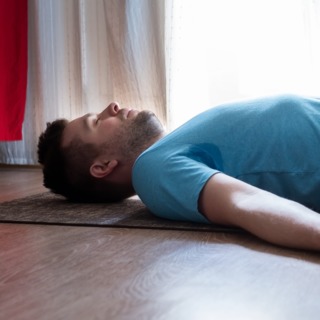
So choosing to either sit in a comfortable upright posture
or lying on your back with your feet flat on the floor and your knees rising up towards the
ceiling.
We'll use breathing bells to help you keep time so let's start those now.
And then when you're ready
gently breathing in
and gently breathing out.
Breathing in through the nose,
Breathing out through the nose,
Breathing softly and quietly,
Breathing gently and smoothly.
Avoiding any big loud breaths,
Breathing light as a feather.
So gently breathing in
and gently breathing out.
Feeling the calming rhythm of your breathing.
Feeling the breath in the belly
and down in the lower ribs.
So it's as if there was a balloon in the center of the body
which is gently inflating on the in-breath and slowly deflating on the out-breath.
And slowly deflating on the out-breath.
Gently breathing in
and gently breathing out.
Just breathing softly gently and quietly with the bells.
Gently breathing in
and gently breathing out.
There's no need to push or pull the breath.
It's enough just to bring your awareness here
and the movement of the breath will be quite subtle and gentle.
Taking a break at any time if you need to.
You can pause the recording at any time and then come back to it.
Gently breathing in
and gently breathing out.
Feeling the subtle movement of the breath
around the region of the diaphragm.
As we breathe,
Let's just begin to bring some relaxation into the body.
Allowing the mouth and the jaw to relax.
Letting the shoulders soften down away from your ears.
Releasing any gripping in the hands and the feet.
Releasing any gripping in the hands.
Allowing your belly to relax.
Letting your pelvis soften down into the surface beneath you.
Unclenching the buttocks and the pelvic floor.
Allowing the legs to soften.
Gently breathing in.
Gently breathing out.
Letting your breathing be really light and gentle.
Breathing so that you have just enough air.
And noticing if there's any positive feedback from your body.
Perhaps noticing if you feel calmer or warmer.
Or if there's saliva in your mouth.
Perhaps your mind has slowed down or you feel more clarity.
Or if you're feeling a little bit more relaxed.
Perhaps your mind has slowed down or you feel more clarity.
These can all be signs that this breathing exercise is bringing you
both short and long-term benefits.
Gently breathing in.
And gently breathing out.
Breathing in through the nose.
Breathing out through the nose.
Breathing softly and quietly.
Breathing gently and smoothly.
So gently breathing in.
And gently breathing out.
Feeling the breath in the belly.
And down in the lower ribs.
Feeling the calming rhythm of your breathing.
And this recording now continues for the next 10 minutes just with the bells.
Enjoy.
Do
Do
Do
Do
Do
Do
Do
Do
Do
Do
Do
Do