Welcome to this guided Bottego breathing exercise in which we'll be breathing light,
Slow and deep.
This is a science-backed breathing exercise which when practiced regularly can reduce symptoms of anxiety,
Brain fog,
Long COVID and a whole host of chronic health conditions.
Breath work is really powerful and so it's always important to read the safety instructions which you can find in the description along with the disclaimer.
In this recording we'll be bringing together the three most important elements of healing breath work.
We breathe light,
Breathing softly and quietly through the nose and this subtly increases levels of carbon dioxide in the body which actually improves oxygen delivery to the brain.
Gently you'll feel a mild air hunger,
A feeling like you aren't getting quite enough air but at the same time that should be comfortable.
We also breathe slow,
Breathing in and out for five and a half seconds.
This stimulates the vagus nerve and activates the calming parasympathetic branch of the nervous system.
And we breathe deep.
Now this doesn't mean taking big deep breaths but rather it means breathing diaphragmatically,
Focusing our awareness around the sides of the lower two ribs as they gently move out to the sides on the in-breath and then move back in again on the out-breath.
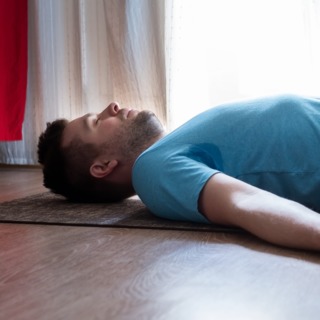
The recommended posture for this exercise is lying on your back with your feet flat on the floor and your knees pointing upwards.
If you find it helpful you can place your hands on either side of the lower two ribs to help you feel the movement of the diaphragm as you breathe.
I'll guide you with both my voice and also some bell sounds and that means that you can keep your eyes closed if you wish.
Okay then,
So let's begin.
And when you're ready,
Gently breathing in and gently breathing out.
Breathing in through the nose and breathing out through the nose.
Breathing softly and quietly.
Breathing gently and smoothly.
Feeling the breath down in the belly and around the lower two ribs.
Gently breathing in and gently breathing out.
Lower ribs expanding out to the sides and lower ribs moving back inwards.
Good,
You're doing really well.
Taking a break at any time if you need to.
Adjusting the size of the breath so that you have just enough air so that you feel a gentle air hunger.
Feeling about 10% less air than you would normally do.
If the air hunger is too strong,
Then making the breaths bigger.
Adapting to your body and adapting the exercise accordingly.
Relaxing as you breathe in,
Relaxing as you breathe out.
The jaw is relaxing,
The shoulders are relaxing,
The arms are relaxing,
The belly is relaxing,
The buttocks are relaxing,
The whole body is relaxing.
Gently breathing in,
Gently breathing out.
Breathing in through the nose,
Breathing out through the nose.
Feeling the breath in the belly and down in the lower ribs.
Breathing on your own now for the next two minutes.
And now letting go of any control of the breath and just allowing your breathing to return to its normal rhythm and depth.
Noticing if there's any positive feedback from the body,
Perhaps noticing if you feel calmer or warmer or if there's saliva in the mouth.
Perhaps your mind has slowed down or you feel more clarity.
And I'd just like to thank you for going through this exercise with me today.
If you found it helpful,
Then perhaps coming back for another listen in the future.
But for now,
Thank you once again for listening and I wish you all the best.
Thank you.