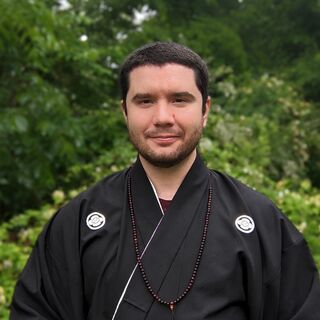
Hello everybody and welcome to another quick examination of a Buddhist character in history.
I'm Silas Day.
Today we will be taking a look at a character by the name of Vasubandhu who helped to develop Yogacara or Yogacara Buddhism.
I hope you're enjoying these short little lectures to help increase your understanding and knowledge of all of the various characters,
Schools,
And pieces of literature throughout Buddhism itself.
Vasubandhu,
Who lived during the fourth or fifth century CE,
So 400 or 500,
Was an influential Indian Buddhist philosopher and scholar.
Along with his half-brother Asanga,
Vasubandhu played a significant role in the development of the Yogacara or the Yogacara school of thought,
One of the two main philosophical systems within Mahayana Buddhism,
The other being Madhyamaka.
He was born in a Brahmin family in the region of Gandahara.
Vasubandhu was initially a scholar of the Sravastavada school of Buddhism,
Which is the kind of ancestor to Mahayana Buddhism.
However,
After being influenced by his half-brother Asanga and the teachings of Mahayana Buddhism,
He converted to the newer version of Mahayana tradition and became a devout practitioner and scholar.
Vasubandhu is particularly renowned for his contributions to the Yogacara school of thought,
Which focuses on the nature of consciousness and its role in shaping our experiences.
He authored several key texts,
Including the verses on the treasury of the Abhidhamma,
The 20 verses,
And the 30 verses,
Which have served as a foundational work for the study of Buddhist psychology and epistemology within the Mahayana world.
One of the central concepts of Vasubandhu's teaching was the idea of the storehouse consciousness.
This is a subtle foundational level consciousness that contains the seeds of all past experiences and karmic impressions.
The storehouse consciousness,
According to Vasubandhu,
Is the basis for the manifestation of our individual experiences,
Which arise from the interaction between our karmic seeds and the external world.
Vasubandhu's teaching also emphasized the importance of understanding the three natures of phenomena.
These are the imaginary nature,
The dependent nature,
And the absolute nature.
This tripartite framework helps practitioners to distinguish between the illusory,
Conceptual nature of things,
And the ultimate reality that transcends duality and conceptual constructs.
The impact of Vasubandhu's work on the development of Buddhist thought is immense.
His contributions to the Yogacara school have deeply influenced various traditions,
Including Tibetan Buddhism,
East Asian Buddhism,
And the later emergence of the Vajrayana tradition.
Furthermore,
His insights on consciousness and the nature of reality continue to inspire contemporary scholarship in both Western and Eastern philosophical traditions.
In conclusion to this short introduction,
Vasubandhu's life and teachings have left an incredible mark on the evolution of Buddhist philosophy.
His emphasis on the understanding of consciousness and the three natures of phenomena have provided practitioners with valuable tools for deepening their insights into the nature of the mind and of reality,
As well as how it presents itself to us.
Thank you for joining me in this exploration of Vasubandhu's life and work.
May we all continue to cultivate wisdom and compassion guided by the teachings of great masters who have walked the path before us.
I'm Silas Day,
And I hope you're enjoying these short Buddhist lectures.