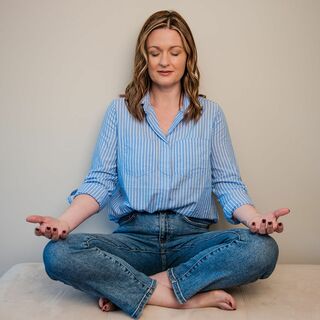
Day 3 Setting an Intention and Making Meditation a Habit It's much easier to make something a habit when you have a goal in mind.
This course was brought to you for a reason,
Right now,
At this specific point in your life.
What has you curious about meditation?
Is there something in your life you want to change?
Perhaps you've been wanting to experience more peace,
And you heard meditation can help.
Maybe you want to learn how to feel your intuition,
And you felt drawn to a meditation.
Choose an intention for your meditation practice that will help you later measure your progress.
My intention is usually to deepen my relationship with myself.
How can I get to know myself better so I can be the unique expression of me in this world?
Many habits we form unconsciously,
Because our brain tells us that our body likes the feeling when we do blank.
For example,
I have a habit of biting my lip,
Because at some point it helped me calm my anxiety.
I don't have as much anxiety anymore,
But I still find myself biting my lip from time to time,
Because it's a deeply ingrained unconscious habit.
We can teach ourselves how to create new habits by working with our brain to create good feelings in tandem with the new habit.
I like to loosely follow James Clear's formula from his book Atomic Habits.
Here's what that looks like in three easy steps.
1.
Attach your meditation to an already existing habit.
Meditating first thing in the morning is best,
But any time you can make it work is better than never.
Let's say you have a habit of making coffee every morning after you get up.
Choose to meditate before you have your coffee,
And eventually your brain will know that after you get up,
But before you have your coffee,
You meditate.
2.
Make it easy.
Do not try and cram it in before school drop-off if mornings are hectic in your house.
Do not try and make everyone in the house silent before you can meditate.
And don't wait until you've created a perfect meditation spot in your house.
Make it easy so it gets done.
3.
Make it attractive by rewarding yourself with something after you've meditated.
Like perhaps you wait to drink your coffee until your meditation is over.
That way,
Your brain gives you the feel-good hormones as a reward.
It's said that it takes us 21 days to create a habit.
Use structures that will support you to make meditation a practice for 21 days,
And you'll have a habit in no time.
Once it becomes a habit,
You won't have to effort to make it happen.
Your body will naturally follow the cues each day that lead you to your meditation practice.
Today,
Let's try a meditation that can help you feel grounded in your body.
I invite you to close your eyes,
Or soften your gaze,
And take a long,
Slow,
Deep breath in through your nose.
And let the air exit your body with ease as you relinquish your inhale.
On your next breath in,
Fill your lungs and your abdomen with the life-giving oxygen.
And as you release it,
So too release the burden of tension your muscles have been so diligently carrying.
Shift your attention to any area of your body that feels tense and bearing more than its share of weight.
Perhaps it's your shoulders.
Maybe it's your neck.
Maybe there's tension in your hips.
Wherever you find it,
Breathe into it.
Breathe oxygen into those areas,
Creating spaciousness for blood to flow.
And as you exhale,
Relax your body into peace and calm.
Repeat as many times as feels right for your body.
When you are ready,
Slowly open your eyes and ease back into your day.
I will see you tomorrow for day 4.