Day one.
The science behind meditation and how it impacts your brain.
The limbic system is among the oldest parts of the brain.
Within it is the amygdala,
Two almond-shaped structures that help us to detect danger.
If in the future you encounter a similar danger from the past,
It's your amygdala that alerts your brain of an impending threat.
Your pleasure center is ironically located within your limbic system,
Too,
Which means if the amygdala believes you're in danger,
It's rather tricky to access pleasure.
One condition that affects your amygdala is anxiety,
And chronic anxiety means your amygdala is in a constant state of alerting you to possible dangers,
Making it unlikely you're spending a lot of time exploring pleasure.
What's further is brain-related illness that involves the amygdala includes autism and Alzheimer's.
Studies have shown that after only eight weeks of meditation,
The brain's fight-or-flight center,
The amygdala,
Shrinks.
And the prefrontal cortex,
Which regulates higher-order brain function,
Such as awareness and decision-making,
Actually gets thicker.
By practicing meditations,
The connection between the amygdala and the rest of the brain actually gets weaker,
And the areas associated with attention and concentration get stronger.
In other words,
Our more primal responses to stress seem to be superseded by the more thoughtful ones.
In a time when anxiety is being normalized and we live in an era referred to as the fear era,
Meditation is a likely key to our survival.
Anxiety is not only keeping us from accessing our wisdom,
It's actually killing us.
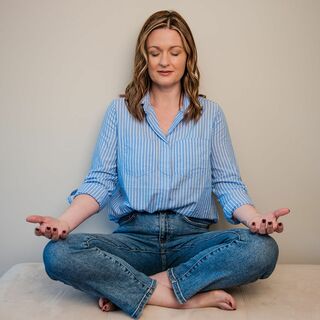
Let's practice a one-minute mindfulness meditation now by focusing our attention on the breath.
Start by closing your eyes or softening your gaze if that feels better for you.
Take a deep breath in through your nose,
Seeing if you can expand your chest and draw it into your belly.
Let go of the breath,
Letting it naturally flow back out of your nose and into the space around you.
Try that again,
A long deep breath in through your nose,
And see if you can take in even more air this time,
Until you can't take in any more.
Until the space in your body is full,
Pause and then release.
As you exhale,
See if you can push a little more air out at the end of your natural exhale.
Can you empty your body of all of the air?
Repeat this two more times,
Inhaling,
Filling your body with oxygen,
Every nook and cranny taking in all the air you can,
And letting go,
Exhaling,
Pushing all the air out.
Even when you think there is no more air to be pushed out,
Try pushing out just a tiny bit more.
Deep breath in,
Soft,
Smooth exhale out.
When you are ready,
You can slowly open your eyes and ease back into your day.
You've just completed day one.