So mindful movement practice.
So find yourself a space where you have a little bit of room around you and if you can take shoes off and socks off and you could do this practice either standing or you could sit down.
So just to go through the different postures,
If you are sitting then if you're sitting away from the back of the chair with your legs both firmly planted on the floor and you're back with a little bit of energy in it so that it's sitting upright but not forced or tense.
So shoulders relaxed and down and a sense of dignity to the posture.
If you're standing then stand with your feet about 4 or 5 inches apart or perhaps a hip width apart firmly on the floor pointing forward and for the moment have your hands resting down by your sides.
So I'm going to be doing this practice from a standing position and if you are sitting then it's very easy to adapt the postures that I do to the sitting posture.
Let's begin by standing then and feeling the ground beneath you.
So if you can and you want to then close your eyes and come to notice that the feet are making connection with the floor.
There is a feeling of pressure.
There's a feeling of some gentle movement in order to keep the body upright.
Have your neck and your chin just tucked slightly in your neck aligned.
Shoulders down.
Coming to breathing.
So feeling the body breathing.
If it's possible for you then feeling the breathing taking place right down into the abdomen.
We're standing then in this posture feeling the body breathing firmly grounded.
First movement that we're going to do is very small movement.
So what I'd like you to do is take one wrist and support it by your other hand so that your hand is underneath your wrist and the hand is supported by that other wrist.
So if you're starting with your left hand have your right hand supporting your wrist.
What we're going to do is just gently rotating the wrist.
Just moving it in a circular motion.
Very gentle,
Very small movements.
Beginning to feel and notice the movements required in the hand.
Perhaps the muscles that are working.
The movement of the fingers.
You can make this movement as large or as small as you want to make it.
You could start off quite small.
Very small movements.
Staying with the experience of the hand moving.
Or you could increase it to a larger rotation.
Whatever you choose,
Seeing if you can stay as much as possible with the experience unfolding.
And take a moment to notice whether your shoulders have got tight or the rest of your body is reacting to this movement and just see if you can let go of any unnecessary tension that might have built up.
And when you're already changing the movement,
Turning the circle the other way.
So moving your hand in the opposite direction.
And noticing what that feels like.
Again adapting that movement to be larger or smaller depending on how you're feeling.
What's possible for you.
And now letting the arm gently down,
Releasing both hands and letting them just come to rest.
And if your eyes are closed,
Then seeing what it's like.
Noticing how your body is feeling.
How the arms,
The hands are feeling.
And also noticing what's happened to breathing.
And now let's do the same movement on the other hand.
So taking the right hand,
Placing the left hand to support it and moving the right wrist.
Moving the hand around in a circular motion.
Very slowly.
Remembering this is not exercise,
It's not activity,
It's mindful movement.
It's using the body as another way of connecting with the present moment.
And changing the direction,
Moving the hand in the opposite way.
Noticing how the fingers trace through the air.
And noticing if you are experiencing some difficulty here,
Some tension or some emotion that's cropping up.
And then returning to the movement.
And now coming to rest,
Letting arms drop down by sides.
Tuning in to how the body's feeling.
And adjusting the posture,
Maybe tucking that chin in again.
Shoulders relaxed.
And once again returning to breathing.
In this next movement we're going to move our arms out to the side and back in again.
Almost like the wings of a bird opening out and then closing.
And like all the movements,
We can choose how we want to do this movement.
We can make it a small movement or we can make it a larger movement.
Just depends on how your body's feeling.
So listen to your body and what it needs.
So let's start on an in-breath by moving our hands both to the sides,
Our arms,
Our elbows,
Both coming out like the birds wings opening.
And on an out-breath,
Bringing them back so they're slightly crossed over each other and it's almost as if we're giving ourselves a hug.
And then on an in-breath,
Out we go again,
Out to the side,
Stretching.
And then when we come back again on an out-breath,
We're crossing the arms over the opposite way.
So let's continue with that movement.
Really,
The rhythm is very much in tune with the breathing.
We all breathe differently,
Different rates.
So just using your breath to guide you here and noticing sensations as you're moving the arms.
You can do smaller movements or you can do bigger movements.
And you can also make the movement slightly higher in the body or lower.
We're going to do a couple more and then come to rest.
Maybe just shaking the arms out a little bit.
And then once again coming to standing,
Tucking the chin in.
Perhaps making sure that the knees aren't locked.
Standing tall.
Coming to breathing.
And checking in again,
What's happening in the body right now.
Have sensations changed?
Has the temperature of the body changed with the movement?
And how are you feeling?
What emotions are around?
Okay,
So let's do some shoulder rolls.
So let's start by bringing the shoulders up towards the head.
Let's bring the shoulders up towards the top of the head.
We're going to stretch there.
And then moving them back as if you're drawing the shoulder blades together.
And then down.
And when you get down to the bottom then let's move them towards each other at the front of the body and then back up.
So you're creating a circular movement.
And you can use the breathing to help.
So perhaps on one half of the circle breathing in and the other half of the circle breathing out.
And the arms and the hands remain relatively passive in all of this.
The movement comes from the shoulders.
And just like the other exercises that we've done,
You can go at any speed,
Any rate and any degree of movement.
The important thing is about being with the body as it moves.
Noticing how the body is moving.
Just like any other practice when the mind goes off,
Gets distracted,
You notice,
Ah,
It's gone off.
And then brewing it back to the movement.
So let's change direction.
Letting the body moving.
And then dropping shoulders.
Maybe again shaking out a little bit.
And having a bit of a sigh out.
And tuning in again.
What do you notice now?
Sensations tingling pulsing.
If we continue with the neck now,
We're going to move our neck very gently.
This first movement is really about moving the chin and the head to look to the side.
So if we take the focus down onto the chin and then gently moving the chin and the head towards the left so that we're looking towards the left hand side.
And bringing the head back towards the central position.
And then again with our focus on our chin,
Taking the head to the side,
The right hand side.
And bringing the head back and just doing that again on both sides in your own time.
And returning to our standing posture,
Releasing tension that might have built up.
We're going to now move both of our arms out towards the side on an in-breath.
So on an in-breath now,
Moving the arms out to the side to the point where they're parallel to the ground as best you can and holding that position,
Stretching and noticing the sensations right from the fingertips through the arms to the shoulders.
The effort that's required to do this movement.
And perhaps also noticing the rest of the body,
Whether the breath has suddenly become,
It's been held in some way,
Just seeing if you can breathe.
Releasing any tension that's in the body that's not involved in this movement.
And seeing if you can stay with the stretch as much as it's possible for you.
You can always drop the arms down when you need to.
But just seeing if you can find a sort of soft edge of a stretch.
If you've reached a hard edge and you're pushing through and trying to compete with yourself,
Then noticing that and maybe pulling back.
Seeing if you can maintain the stretch enough to get sensation and feeling that sensation change perhaps in your arms as you're doing this,
In your shoulders.
And now on an out-breath,
Just releasing the arms back down to the sides very slowly,
Staying with the movement.
And now releasing some tension,
Shaking the arms,
Maybe moving the shoulders a little bit.
And once again we come to stillness and we're tuning in to the effects of that movement.
And if it's possible for you now,
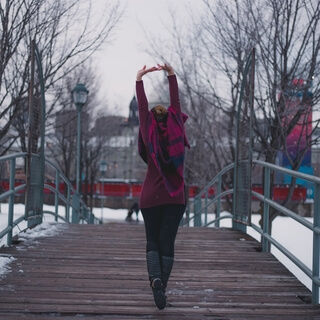
We're going to continue that stretch but we're going to move the arms up over the head.
So on an in-breath,
Breathing in and moving the arms out to the side,
Continuing the movement up.
So the arms are above the body.
If you can,
If you want to,
You can clasp the thumbs together and then stretching up.
Maintaining breathing and stretching up towards the ceiling,
Towards the sky.
Just feeling the stretch through your whole body.
Through the legs,
The hips,
The torso,
The shoulders,
The hands.
Always the possibility of coming down,
Resting the arms if needs be,
Listening to the body.
And on an out-breath now,
Let's bring the arms down.
We'll do this very slowly.
Breathing out,
Maybe even pausing for a sec while we breathe in and then continuing on an out-breath.
Staying in touch with the arms all the way down.
Feeling the movement and then letting the arms relax down.
Coming to breathing again.
And now really being with the body as we stand in this final posture.
So noticing now sensations from the top of the head,
Through the face,
Down through the neck,
The shoulders,
The arms right down through to the fingers,
And the chest,
And the stomach,
And the back.
And then down through the pelvis and the hips,
Through the legs,
Right down to the feet on the floor.
So really feeling the body grounded,
Supported,
And still.