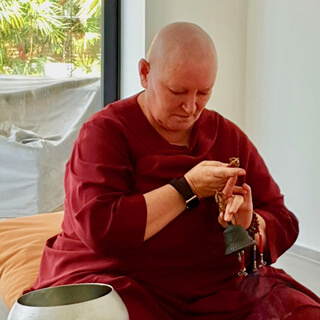
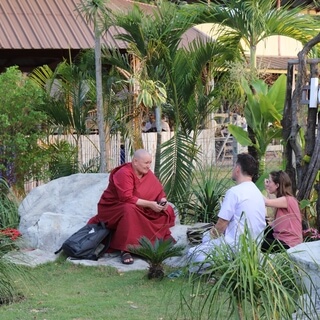
Welcome to our Sunday talk.
Today,
I want to talk about the seventh of the 10 Parami,
About Satya Parami.
Satya can be translated to truthfulness,
Sincerity,
Straightforwardness,
Many words we can use,
Honesty without deception.
So these are all important parts of satya,
Of truthfulness.
Well,
It is a very important Parami.
The Buddha-to-be,
The Bodhisattva,
It is said that he never broke this Parami.
Satya Parami was never broken.
All the others might have been transgressed or broken in the time when he was still a Bodhisattva,
So Buddha-to-be.
But Satya Parami was never broken by him,
So he had a very powerful truthfulness that is really important on our path.
Again,
I have to explain all the Paramis we practice,
All of them are a development of our mind.
We develop our mind to a higher level,
To a higher state with each of those Paramis.
So from a normal worldly mind,
We go further and further to a higher level of mind,
Where the utmost,
The highest level is the mind of a Buddha.
So very important.
Truthfulness is one of the most important there.
If we don't speak the truth,
We have a wrong speech,
Then of course we reduce this Parami.
We reduce our truthfulness.
Wrong speech,
We have in Buddhism,
We speak about four kinds of wrong speech.
And that is of course lying,
What we know is also for the Western people,
A very well-known precept also in Christianity and I think in other religions,
So speaking the truth.
But it goes beyond that.
So it's not speaking lies,
But it's also trying to avoid any kind of harsh speech,
Try to avoid to speak in a way that hurts others.
Even if it is the truth,
We try to say it in a manner that it doesn't hurt the other person or the person in front of us.
We try to be aware of the right time to speak,
The right circumstance to speak to the person that is in front of us.
So there are many things that work together with having the right speech in this direction.
Then the third kind of wrong speech is divisive speech that we try to create disharmony or divide people with the way we are speaking.
Or even if we don't have this intention still trying to be aware of that,
What I speak there,
Does it divide people?
Does it lead to people not going to be friends again?
It's also a very important part of the monks' vinayas,
The monks' rules.
It's like one of the worst things a monk can do is to speak in a way that they separate the Sangha,
That some monks cannot be together with other monks anymore or nuns the same.
Because through the things that someone has said,
They are enemies.
So this is a really very severe offense.
And you wouldn't be a monk anymore if you do that or a nun,
Because it's really one of the four worst offenses that a monk or a nun can do.
So divisive speech is really not good.
And then the fourth wrong speech would be a frivolous speech.
And I like the Pali name of frivolous speech.
It's called sampapalabha.
And the word itself already says palabha,
A lot of rubbish being spoken.
So we should also try to avoid that.
And that is very important,
Especially also when you are in a retreat.
If you have ever done a longer retreat,
An intensive retreat,
Then it is recommended to keep silent in such a time.
Try not to speak except to your teacher if there are questions about the meditation or the Dhamma.
And talking about the Dhamma is not reducing your energy or doing anything harm to you.
But if you speak about nonsense or any kind of worldly things that are not really important,
It will reduce your energy.
I know from myself,
I have been to silent retreats for years.
And as soon as you get out of this silent retreat and you start to open your mouth and talk,
It is like the whole energy level that you build up inside yourself is reducing.
And especially if you talk some worldly nonsense talks,
Even if you don't lie,
But just things that are really of no importance at all,
Like social sampapalabha.
You should really try to avoid that.
If you can't avoid it,
If you're in a social gathering and you can't avoid to talk about this and that,
Then at least watch your heart,
Watch your mind,
How it's changing.
If there is a change in the energy level,
If there's a change in your focus,
You will feel it,
Kind of feel that there's something going on.
Then try to stay away or just be aware,
Be with the breath or whatever.
So even that kind of speech can be really not very beneficial for yourself and others.
Then you as a lay person,
What is maybe important to tell you is there are five aspects of truthfulness that we should consider.
The first is truthfulness in regards to one's own responsibilities.
If you're a husband or you're a wife,
You have the responsibility of a husband and a wife.
If you're a parent,
A father,
A mother over there,
You should try to keep yourself to these responsibilities.
If you are a son,
A daughter,
Try to keep your responsibilities up that you have towards your parents.
That's also truthfulness.
Being clear,
Being aware of this kind of responsibilities we have in our life and try to follow it appropriately.
That's important to having proper conduct towards those beings that we have responsibilities to.
The second aspect would be truthfulness in regards of our work,
The work we have to do.
It's also a responsibility I have to do my job and really trying to be responsible with it.
If there are hindrances,
The work is not easy to do,
Then do the best you can to fulfill these responsibilities and make the best out of this work.
Try to get around the hindrances,
Try to solve them,
Do your work as good as you can and to your full ability.
This is also an important thing,
Not to neglect it,
But fulfill this responsibility.
The third kind of truthfulness is in regards of our speech.
Of course,
Not to tell lies,
Not to have harsh speech,
No divisive speech,
No sampapalapa,
As I said before.
But in deep,
It also means do what you say.
So if you speak about something,
Then really act like that.
And also try to speak or have a speech that is in line with your heart.
So the heart thinks different,
But you speak in another way that is not really truthful.
So look if they are in line.
Then the fourth truthfulness is in regards of people,
The people that are there with you right now.
Those that are in your surrounding,
The person that stands in front of you.
Try to use your truthfulness then to be truthful to them.
Try to be in a way as if they are your real friend.
You are a real friend to them.
Speak in this kind of attitude.
Even if they are not friends,
Even if it's just a stranger coming and asking you for the way.
It happens to me sometimes here in Thailand that maybe some others who have been to Thailand have experienced that too.
You ask a person,
Where is this and that place?
I need to go there.
And they always,
They look at you and they show you the way,
But sometimes they don't know it at all.
But it is the kind of,
They lose their face.
If they tell you they don't know,
They would never say they don't know.
So they would show you a way,
Even if they don't know the right way.
And then it's of course troublesome.
So I'm already used to ask three people because then it's more like you really get to the right place.
So this kind is not useful.
So really try to be honest,
Even if this is not a friend,
But try to speak in a way as if it is a friend.
It's very,
Very wholesome for yourself if you really try to develop a mind like that and try to develop your speech like that.
So more happiness arises for the others,
For ourselves.
If we have this kind of sincerity.
Then the fifth kind of truthfulness is in regards to our goodness,
To goodness.
Trying to really practice what is wholesome,
What is good in every way.
Trying not to depart from that path.
So even if the way,
Another way is easier,
The one where we tell a lie or we are not sincere,
We still try to go the way of goodness and try to be a good human being.
Even if no one sees it,
That's also a thing.
Sometimes people only want to be good,
Do good,
Speak good if someone is seeing it.
But it shouldn't be like that.
We should try to keep our goodness also if no one is seeing that or knows about it.
So that's the five aspects of a Satya of truthfulness.
Then of course it's also very important to be self-honest,
Honest about yourself.
Look at yourself in the way you are,
You act,
You do things,
You speak,
Whatever.
Watch yourself and be honest about that.
Because often when things in life confront our present situation,
Then we have a tendency to not be truthful,
But to sort the things out the way that we are not to be blamed if something is going wrong.
Others are blamed.
Things are blamed,
People are blamed.
And that's not really truthful.
We should really look at the present situation in a correct way and then be honest about the situation.
Try not to put it in a way that others are to blame for whatever is going wrong.
How do we do that?
How do we develop that right speech?
Most teachers will tell you most important is mindfulness.
If you have right mindfulness,
Then usually our speech is also going in the right direction.
If we have mindfulness,
We will see things as they really are and not with this filter of our concepts and of wanting to put things in the way that we like to judge it.
We don't judge it.
We don't put these concepts in,
But really see things as they really are.
That there is more honesty in our daily life.
We should put aside selfish concepts.
We should try to benefit others with the way that we speak or act in life and not just ourselves.
That's also falling under truthfulness.
Then being honest about ourselves means also that we leave room for new understandings,
For new things that we might not know yet,
But keep it open.
Often we think we are the only ones who know the truth.
We know everything.
We are perfected in that,
But it's not like that.
It's not truthfulness.
Leave room for new understanding.
That's also sattva.
We have to be especially aware if the facts fit too neatly into our world view because our world view is also an illusion.
We have to always keep in the back of our heads that this is also an illusion.
So if things always have to fit in perfectly in the way we see things and we think they have to be,
Then be a bit mistrustful and check that out.
Then honesty is also not there to protect our ego and our self-interests or confirm our biases we have.
So there also be bit mistrustful when it is like that.
Be open to truth,
Be open to new views of things.
That's good.
And also to sometimes say,
Okay,
I don't know.
You don't know it.
So what's the problem?
If you don't know it,
Then you don't know it.
Truthfulness is not there to share up our ego.
Then yeah,
Truthfulness is nothing we perfect now.
It's a lifelong practice,
Lifelong practice to be open to truth,
Including about ourselves.
Then yeah,
Acting without deception.
Again,
That is this good heart inside you,
The mind of renunciation,
Being open and not deceiving others with the way we speak.
You know that's very much this dishonesty is very much a practice in politics,
In advertising,
Where you put everything like in a way,
Okay,
It's most beautiful.
It's the best.
I am the best,
Whatever.
You know politicians,
How they are and how they have no shame to speak lies or people who want to sell you something.
I mean,
Sure,
There must be people who sell things.
That's a good thing to do.
There's no problem.
But maybe sometimes it's better to be just truthful,
Not try to persuade others to buy the thing and tell them all kinds of untruthful things,
Just that they buy it.
Because it's maybe sometimes even better if you don't say much,
But you just say the things as they are and if they buy it,
Then they do it.
And if not,
Then it's okay,
Let it go.
I mean,
It's easier to say than to do that probably for people who have that job.
But I always think it's better to speak the truth,
Even if you have an occupation like that.
Yeah.
Then one more important thing,
Of course,
Is in regards of our meditation practice is to see the difference between worldly truth and absolute truth.
Worldly truth,
Of course,
Is for us the things that we name in daily life.
You say this is a man,
This is a woman,
This is blue,
This is red,
This is good,
This is bad,
Whatever.
This is the way we name things.
And for that,
We always use our perception.
We have perception,
We have our certain draws where we put things in.
And so we say,
Okay,
This is this,
This is that.
That's a worldly kind of truth.
Even science is a worldly kind of truth.
And this kind of truth doesn't lead us to the cessation of suffering,
To overcome suffering.
And then there is an ultimate or absolute truth.
And this absolute truth that needs wisdom.
Wisdom is the most important to go deeper and to understand the absolute truth of things.
So under that absolute truth,
It's like,
For example,
The three characteristics of existence.
They fall under this absolute truth.
Seeing that things are changing,
They are impermanent,
Everything.
You're sitting there right now and you sit there quietly in meditation,
But still there's change going on all the time that you see that inside your body cells are dying,
New cells are born,
There's change,
There's the breath coming and going.
If it doesn't,
You will die within a few minutes.
Then there is heartbeat going on.
So there's the blood flow going on.
There's always changing.
Things we feel we experience while just quietly sitting there.
Feelings,
Weight analysis,
Always changing.
That we see absolutely everything in life is changing.
That's an absolute truth.
Seeing that this body,
Mind are suffering,
But they are not really satisfying because they change,
Because we can't keep them in a certain way that is pleasant to us.
There's always change going on.
There is suffering.
So we see the second of these characteristics.
And the third is the non-self or the understanding that we have no full control over body and mind.
These are absolute truths.
And also Nibbāna is an absolute truth.
The four noble truths are absolute truths.
Seeing that there is suffering,
Seeing the cause for the suffering.
Why suffering there?
Because there is attachment.
We cling,
We hold on to things.
Seeing the truth of the cessation of suffering,
Suffering can also see.
And seeing the truth of the cause for the cessation of suffering or the eightfold path.
These are absolute truths.
Then eightfold path,
A very important part of the eightfold path is right speech.
It's the third of the eightfold path.
If that factor is not there,
If truthfulness is not there in the eightfold path,
The whole eightfold path will collapse.
So these are absolute truths in life.
So yeah,
That's about speech,
Truthfulness.
Maybe one more thing I want to add.
Here in Thailand,
We have a famous temple,
Which I also support with my social projects.
And that's called Tamka Bog.
This temple,
People can do withdrawal from drugs,
From alcohol,
From all kinds of addictions.
So any person who has a problem with addiction can go there.
And as many Westerners,
Thais,
Who do one withdrawal in that place.
And the most important part of their whole withdrawal system is truthfulness,
Satya.
The people have to make,
In the beginning,
When they come there,
They have to make an oath of truth,
Like that they will never touch that drug,
Alcohol,
Whatever they are addicted to anymore.
And only then the whole withdrawal therapy will start.
And they say that this place has 70% of success with withdrawals,
So a very,
Very high success rate.
So you see how important it is there.
And as I've heard,
Also the alcoholic and anonymic,
Alcoholic,
So how you call them,
AA groups,
They also use truthfulness to support their whole therapy.
So even their truthfulness is very important.
Yeah,
So I hope this short talk on truthfulness was a little bit useful for you.
I got some input for your daily life for working with truthfulness in your daily life.
And I wish you having a nice Sunday and hope to see you again soon.