Yeah,
Good afternoon.
Ah,
Good morning.
You have morning,
I have afternoon.
Welcome to this Vesak Day talk.
Yeah,
I want to speak a little bit about this,
The significance of this day in Thailand,
But it's also in all Buddhist countries and all Buddhist lineage that this is one of the most important days.
It's actually the most important holiday in Buddhism.
It's the day,
The full moon day of the month's Vaisak and the month's Vaisak is the fourth month in the year.
And on that full moon day Buddha was born.
In Thailand they say it's 2564 years ago.
So we have the year 2564 in Thailand.
And in that year,
That Vaisak day Buddha was born.
So he was born as a prince.
His father was king,
King Sotodana.
His mother was Queen Mahamaya.
And he was the first born son.
They called him Siddhartha.
It happened in Kapilavastu that is on the border to India nowadays as in Nepal.
But in that time there was no Nepal.
So it was India.
It was a small kingdom.
And yeah,
He was the first born prince.
When he was born,
The king invited 12 astrologers,
The most famous astrologers in that time to the palace.
He invited this astrologers to make a kind of a birth chart for the newborn prince.
And all these astrologers said that this prince will be either emperor or he will be a Buddha.
And only one of them,
The youngest of those astrologers,
His name was Kondanya.
He said this will be a Buddha.
This boy will be a Buddha in future.
And then the king was very concerned because of course the king wants to have a king.
He wants his prince to be a king in future.
So he decided to keep all kind of suffering away from his son.
So he had three palaces built for his son for Siddhartha because in India at that time they had only three seasons.
So for each season of the year,
He had a whole own palace.
And the prince was always surrounded by beautiful,
Healthy,
Strong people.
He only had the best food,
Clothes,
And singing,
Dancing,
And all kind of pleasures that a human being could have.
So that was really a luxurious,
Very pleasant life.
And when he was 16,
He was married to a princess,
Princess Yasodhara.
That was an arranged marriage because it's normal in that time.
I think still nowadays in India and in Nepal.
And then,
Yeah,
When the prince was already 29,
It was the first time he left the palace.
He left the palace and went out to see the normal people outside.
He did it without telling his parents.
He decided that and went out with his servant,
Janda was his name.
And they went out and then the Buddha saw the first time a Sikh person.
He saw a Sikh person and he asked his servant,
Janda,
What is that?
He had never seen something like that.
And Janda said,
This is a Sikh person.
And he asked,
Can that happen to all beings,
To all humans?
And he said,
Yes,
Everyone is going to get Sikh once in their lifetime or more often.
And then he was very concerned.
So he went on and then he saw the first time an old man walking with his crutch.
And he asked Janda,
What is that?
And Janda said,
Okay,
This is an old man.
And then he told him,
Old age happens to all of us.
He was even more concerned than as a Siddhartha.
And then finally he also saw a corpse,
Like people,
Family carrying a corpse to the river,
Crying,
Weeping and being sad.
And he saw this corpse.
He wouldn't move.
He wouldn't,
There's nothing going on.
And he asked,
What's going on there?
He said,
That is death.
It's a death person.
It's a corpse and death also happens to all.
And he asked,
Yeah,
Even to me,
Yes.
Even to a prince,
A king,
Even to my wife,
Yes,
To everyone.
And he was really shaken by that.
And then when he went back to the palace,
He saw an ascetic sitting under a tree very peacefully and calm.
And he asked,
He asked Janda again,
What is that?
And he said,
This is an ascetic.
He tries to overcome suffering.
And when he,
When Siddhartha arrived at the palace,
He got the news that his wife had given birth to their first child.
So they were already married 13 years,
But he didn't have a child yet.
So it was the first born and it was a son.
Then Siddhartha gave a name to that son.
He called him Rahula and Rahula means a fetter,
A chain.
And then he reflected,
Siddhartha reflected,
If I'm going to see this child now and have him in my arms,
I would never get away from the palace anymore because I will be so attached to my newborn son that won't be possible.
And then he decided in that night that he will leave the palace to find the way to overcome suffering,
To overcome sickness,
Old age,
Death,
And birth.
And he left the palace.
He left the palace and he gave away all his jewels and cut his hair and all his nice clothes.
And he wore some baggers of rags.
He gave the beggar the beautiful princely clothes.
And then he walked and tried to find a teacher,
A teacher that could help him to find a way out of suffering.
So he met his first teacher.
This teacher was teaching the jhanas to the fourth level of jhana,
First four absorption levels.
And he practiced with him.
And within a short time,
He reached all four jhanas and was very good established in that deep kind of concentration.
But he saw that this is not yet the end of suffering.
I'm still suffering here.
So he left that teacher and searched for a new one.
And he found a second teacher who even taught jhanas to the eighth level of jhana.
And again,
Within a short time,
He realized the eighth jhana and went even further.
So his second teacher asked him to be the new master in that ashram,
But he refused because he saw he hasn't overcome suffering yet.
He's still suffering.
And the teacher said,
I have nothing more to give you.
So he left the second teacher and he tried other methods.
So it was very common at that time to do this ascetic kind of practices,
Austere,
Skepticism,
Like he wouldn't eat,
He wouldn't sleep,
He would stand on one leg and really like punish the body to overcome suffering.
He did that.
And all the time that he was searching for this truth,
I have to tell you also there was one of these astrologers that have been with him that were saying that he would be a Buddha or emperor in future.
The one that said he will 100% be a Buddha,
His name was Kondanya.
And this astrologer followed the prince all the time while he was practicing because he knew this will be a Buddha in future.
And I want to learn this knowledge from him.
So he and four other ascetics were with him in this time when they really practice this asceticism.
And Buddha did it so extremely that he was really almost dying.
They say he could put the finger in his stomach,
On his stomach and he could feel the backbone.
So he was so thin.
And then he was sitting there and had not reached anything yet,
Almost dying.
He was fainting several times already because he practiced so tough.
And then while sitting there under a tree,
He heard a music teacher with his students,
Which is pupil passing by on a boat at the river that was beyond that tree.
And they passed by,
They wrote by and the teacher told his students,
If you want to play the Sita well,
Then it's very important that you tighten the strings of the Sita in a perfect way.
If the strings are too loose,
There is no good sound.
If the strings are too tight,
Then they will rip.
If you tight them too much,
They will break.
So it must be the perfect middle way and then there's good tone coming and you can play nice music.
So when the Buddha heard that,
He reflected on his own practice and he thought,
Okay,
That's what is wrong with my practice.
If I go on like that,
I will,
The body will break.
I will die.
And of course,
If I do it the way I did before I became an ascetic as a prince,
Then it's indulgement in all kinds of central pleasures.
And that also doesn't lead to the cessation of suffering.
So if I try to avoid both of these paths and I find this middle way,
That should be the way to overcome suffering.
So he had this understanding and he decided I have to go to eat something because I need strength to go on that path.
And then on that day,
There was a young woman coming to that tree where the Buddha sat and she was the daughter of a rich farmer in that area.
And when she,
A year before when she was still a maiden,
She went to that tree and she asked the spirit in the tree,
Please help me that I get a good husband and that I will give him a son.
And now that time she had given,
She had a good husband and she had given birth to a son.
So she wanted to offer something to the spirit in the tree.
And that was a very special offering because she took the cream of the milk from thousand cows and the first rice that was harvested in that year.
And she boiled it in that cream and she added honey,
Pure honey and boiled it so long that they could make little balls of it,
Like little sweet balls.
It was a very nourishing meal,
Of course,
And very special.
So she offered that to the Buddha because she thought,
Ah,
This is the spirit of the tree and the Buddha received it.
She offered it on a golden bowl.
So yeah,
The Buddha received it and he ate and it's really sad that he ate 45 pieces,
You could say spoonfuls,
But it's like in that time they made little balls of rice.
So he ate 45 of them.
And then he went with that golden bowl to the river and he made a determination,
Very strong determination.
He said,
If I reach enlightenment now,
Then this bowl should swim or float against the stream of the river.
And he threw the bowl into the river and really the bowl turned around and floated against the stream of the river.
That's how it is said.
And then the Buddha went on to Bodh Gaya,
Very close.
Nowadays,
If you go to a pilgrimage,
Not far from Bodh Gaya,
You can find a place where there's also the tree where the Buddha ate this meal and also the big farmhouse of that family where the girl gave this food to the Buddha.
Yeah.
So the Buddha went across the Gaya and to that Bodhi tree.
He sat down,
Made a determination.
Even if my blood dries away my bones are only dust.
I will not stand up anymore.
I will sit here until I reach complete enlightenment.
And then he sat there and he remembered that as a child,
Only three or four years old,
He had the first experience of Jhana,
The first Jhana.
And he didn't know he was meditating.
It was the royal blowing ceremony.
And they set him under in the shade of a tree.
And while sitting there,
He relaxed and gently went into first Jhana.
He remembered that state.
So he sat there,
Relaxed and went to first Jhana and then the knowledge started to arise.
So it's said in the first watch of that night,
He received the knowledge of past lives.
So he could remember his,
All his past lives.
And then also the past lives of all sentient beings.
So that was the knowledge he had in the first watch of the night.
In the second watch,
He had the knowledge of the laws of karma.
So he could see cause and effect and karma,
How is it going on.
Very deep.
And then in the third watch of that night,
He got the understanding of how to overcome all attachment,
Like how to reach complete freedom from all suffering.
And of course,
When something very special like that is happening,
Then we usually say there is also an obstacle,
Hindrance coming,
Something that tries to avoid the good thing from happening.
This is not just for the Buddha.
It happens to all of us in a certain way.
So if you decide really to do something good,
And mostly also obstacles are coming,
And then you have to show the strength to overcome them and not to give in.
So with Buddha,
It is said that Mara was appearing.
Mara could be translated with the devil.
So yeah,
He came and he sent his daughters,
They say,
Three daughters,
Very beautiful.
Their name is Raga,
Rati and Arati,
Actually the translation for central lust and desire and also,
Yeah,
Just kind of defilements that lead to greed.
So these three daughters were half naked dancing in front of him trying to tempt the Buddha.
But he wouldn't let them tempt him.
He stayed completely relaxed.
And so they disappeared.
And then Mara sent his army of demons and really frightening beings coming and with weapons,
Shootings,
Burning arrows at the Buddha.
And the Buddha stayed relaxed.
And it's said he gave metta and transformed all these burning arrows into pink lotuses.
They floated back to them.
So he wasn't impressed by that.
He stayed cool,
Equanimous.
We have to understand now,
Of course,
This is all kind of like a tale and whatever,
But the meaning is symbolic for things that we experience in our meditation.
So if you practice meditation,
You will surely also have to do with hindrances.
So the daughters of Mara desire.
It's the hindrance desire,
Central lust,
All these kinds of things.
They can come up when you practice trying to avoid that you move on,
But you get attached to that very nice central feelings that arise or whatever.
And you think,
Oh,
That's it.
I reached something and you stuck.
You don't go further.
You don't reach the real goal.
So that is this first appearance of Mara,
Mara's daughters.
The second is with this demons and frightening army and whatever.
This is another hindrance and that is anger,
But also fear.
And this can also come up.
Everyone has to do with it more or less.
It can be very little,
But it can also be very strong sometimes in meditation that we experience fear or aversion,
Anger against the things we hear or people who disturb our meditation or whatever,
Or fear from things that we have never experienced before and we might experience in our practice.
And then we get frightened because we're not sure what is that.
So these hindrances,
They come for all of us and they were there with the Buddha,
But he stayed equanimous,
Went through it.
And then this symbolic thing with transforming all the burning arrows into pink lotus flowers,
Which flew to the back.
That is the symbolic meaning of meta,
How meta helps us to overcome fear and anger and aversion.
There is the best medicine to apply to overcome that.
So it's very important.
And pink is also usually what we say the color of meta.
Yeah.
So that's what happened in that night.
And then the Buddha really,
After overcoming the hindrances,
He reached complete enlightenment.
He stayed a while there at the Bodhi tree.
He was doing,
He sat there seven days.
They say he was walking there.
You can see,
Still see this path where the Buddha walked,
These steps where he walked up and down near the Bodhi tree.
He did walking meditation seven days.
He was standing seven days,
Standing meditation for seven days,
Gazing at the Bodhi tree in like gratefulness because he gave him the shade to practice there.
And after,
And then after that,
The first thing the Buddha said when he came out of that enlightenment in that night,
The first thing he said is what I also wrote in the last newsletter.
I think you got that.
If not,
I'm going to repeat it here.
He said,
You are a house builder.
You are seen.
You are not going to fool me anymore.
Your rafters are broken.
You cannot build a house with me anymore.
This house builder is the mind,
The mind that always builds up things,
This me,
Mine,
Self and creates for us this understanding that there is a self and does not,
That doesn't help us to overcome suffering.
So he could understand that in deep,
All these concepts that were leading to suffering.
Yeah.
And that is what happened in that night.
And then he thought,
Okay,
I can teach that.
This knowledge,
No one will understand it.
It's impossible.
But luckily then there was Indra,
The king of the devas,
The highest of the angels,
You could call it,
And Sahambhati that was the highest of the Brahma beings,
Of the gods.
And they both came and asked him,
Begged him,
Please give the teaching.
There are some beings who don't have so much dust in their eyes.
They will understand it.
Please give the teaching.
So he decided,
Okay,
I will do that.
And he contemplated on whom should I give the teaching because it was important that those beings would understand.
And then he thought of these five ascetics who were practicing with him for many years.
And he could see with his inner eye,
With his divine eye,
That they were dwelling anywhere in Varanasi on the Ganges river.
And he walked there to give him this teaching.
That was when he set this wheel of Dharma in motion and he taught the first time the Four Noble Truths.
And Kundanya,
The one I talked before,
The astrologer who was with him all the time,
Was the first one who reached the first level of enlightenment,
Who understood that in that teaching.
So then the Sangha was born.
Yeah.
And then the third thing that happened on the Vesakte,
Not to forget that,
That was Buddha's death or his entering of Parinibbana,
The final Nibbana.
And that happened when he was 80 years old in Kusinara,
Also part of India.
And he died there under a salar tree,
Entered Parinibbana.
So this was the third event.
It all happened on his birthday,
You could say,
On the full Monday in the fourth month of the year.
Yeah.
So that's Vesakte.
And here in Thailand,
Yeah,
We normally we celebrate that.
All the people around the temple are coming with lotuses and candles and incense.
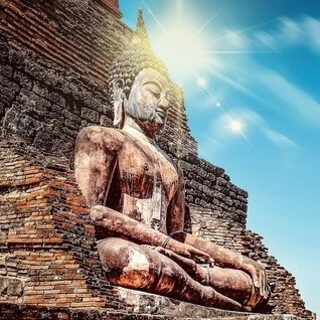
And we walk around the main Buddha statue,
Circumvulate it three times and we chant.
Today,
Unfortunately,
There will not be much,
It's only the monks and me.
There are not many people because they locked the temple.
They are all very concerned about the virus right now.
So unfortunately,
Not much celebration.
I think that's in all temples in Thailand.
Right now,
They are very careful.
So it's very sad actually,
Because it's very special for the Thai people to come and make merit and do something on that day.
And for you,
I hope you can have a bit more practice today.
Also keep in your mind that especially on that day,
Keeping critical principles or just making one determination.
Like today,
I'm not gonna drink alcohol.
Even if you never drink alcohol,
Make a determination today and do it.
Because all the good things you can do today and all the determinations you can go through with today will multiply.
They say a million times.
So even if you never do it,
But if you don't make a determination,
It's just as it is.
But if you make a determination and you don't do it,
You don't steal,
You don't kill anyone or you don't drink alcohol today or whatever,
Then the merit multiplies.
So it is a good day to do that today.
So yeah,
Maybe do that or do anything that is wholesome to help your meditation with it.
And I wish you a nice race update.