Yeah.
Good morning.
Nice to have you here for the Sunday Dharma talk on equanimity today.
So I want to talk a little bit about the last of our perfections,
The last of our paramis.
The in the Buddhist practice is the most sublime emotion.
It's the ground for wisdom and also so some people think equanimity is like something like dry neutrality.
It's kind of careless,
Carelessness towards others,
But that is not the case.
That's not at all.
What is very important to always say again and again,
Equanimity always has as a base morality,
Etic principles.
And carelessness doesn't have that.
So if we are careless,
We just say,
Okay,
I can do what I want,
Because it doesn't matter.
Even if I do harm others,
I don't care.
So that doesn't have this base of morality or etic principles.
So equanimity always has a kind of a radiance of warmth.
And it includes meta,
Loving kindness.
It includes compassion and sympathetic joy,
Being happy with others,
Good things they do or get.
So these three are included in equanimity.
But equanimity is kind of this way how we observe,
You know,
We observe the situation.
And if we can't do anything,
We continue to observe until there is this possibility to do something about it,
To help others,
And then we will immediately do that.
So we observe and see a bigger picture of the situation.
In India,
It is also sometimes translated as seeing with patience.
Or we could say seeing with an understanding.
So,
For example,
When we know not to take offensive words personally,
We are less likely to react to what was said.
Instead,
We stay equanimous.
We are not reacting.
One approach to developing equanimity is cultivating the qualities of mind that support equanimity.
That's very important.
There are seven kinds of mental qualities that support it that will help us to gain more equanimity in our lives.
And these are the first one is integrity as a having a moral base having more principles.
Because whenever we know we have a pure mind,
We are not here to harm anyone,
Others or ourselves,
Then we get a kind of confidence.
And it's even in one place in the teachings,
The Buddha said someone with more integrity can be in any congregation in any social gathering.
It doesn't matter what it is or where it is,
With what people it is with confidence,
Because you know,
You are not harming anyone.
So this gives you a very strong confidence.
So this is very important.
Then the second support for equanimity is faith.
And faith is very important.
Like when you practice meditation,
And you have faith in your own ability to practice,
Then this will be very supportive.
Because whatever hindrances are coming,
You will continue to do it because you know,
You can practice and hindrances will come,
There is no way you do practice of meditation and you don't have experience with hindrances,
Whatever it is,
It might be tiredness,
It might be restlessness,
Or doubts or just greed or anger,
They come all these five hindrances will appear.
But if there is faith,
Then it's easy to overcome this hindrances,
And therefore also develop equanimity.
So faith is very important.
Then,
Of course,
The third support is a well developed mind,
Which in this case means a mind that is focused,
You have concentration and also mindfulness.
The mind is well developed like that,
Then it is easy to practice with strength and with balance.
You have mental stability.
And if the mind is stable like that,
Then the eight local dhammas,
So this eight worldly dhammas are also sometimes called worldly winds will not be able to destroy your equanimity.
So this is very important as well.
Then the fifth support for equanimity is understanding or wisdom.
Wisdom is essential in learning to accept the present moment as it is,
Without having the mind resisting in it.
So there's no resistance in the present situation.
And of course,
That is very important if,
As long as we are still resisting in what is already there,
We just increase our suffering,
Resistance,
And not accepting the thing that is already there.
The present situation will increase suffering.
There's no way out.
So having equanimity,
Accepting it,
And then still doing the best we can to deal with this situation or to try to make it however better.
Yes.
But what is already there?
What else should you do?
You should accept it as it is.
That's how it is.
And that will take a lot of this suffering out of the present situation.
So accepting the present moment is very important.
And that means also wisdom will also tell us to accept other people.
Sometimes people doing actions that are not agreeable,
We don't agree with their actions,
But still we are aware that this is a conditioned thing.
There's cause and effect.
And that's why they are maybe acting like this right now.
And it's good to tell them what you think it is,
Is not correct or so,
But it should not destroy your relationship with others.
So we still separate the action of a person with the person,
Her or himself.
And the same is with yourself.
Sometimes you do things that are not good or non-agreeable or say things.
And then it's not that we are totally angry with ourselves and unforgiving with ourselves.
That doesn't bring much good.
So we can also accept that there are conditions and under certain conditions,
Certain things are happening.
So we can also accept that and then still change or make the best out of it.
So that is wisdom that tells us this and helps us to have more equanimity also in the face of such things.
Then there's also one very famous sentence when we try to practice meditation and develop equanimity.
And that is,
You are responsible for your own life.
So there is always cause and effect.
So when you experience suffering right now,
It is because of some past karma,
Some past deeds.
And if you're suffering right now,
It is not my responsibility.
It's not me that creates this suffering and I can't change that.
But as it's not changing through my own wishes now,
I might wish that you're happy,
But still you are in this suffering.
So it's not my responsibility.
So I don't blame myself because you are suffering.
But then that doesn't say we are careless.
We still try to do what we can to guide a being out of suffering,
Of course.
So that is also giving us some understanding,
Having this equanimity that this present situation is as it is.
And it is not because of me.
Then one of the most powerful ways to use wisdom is to be aware when equanimity is absent.
So if we are aware that equanimity is not there in our present situation,
Then we will see what's the result.
Usually suffering is arising.
So seeing that and looking at that suffering will also help us to get more equanimity into our lives.
Seeing what is absent will help us to learn how to find balance again.
Then the sixth support is insight.
Seeing the true nature of things.
I talk often also in the meditations about it,
Like seeing the three characteristics of life.
But mainly seeing impermanence will help us to gain more equanimity.
If we are in the process of practicing a more intensive retreat,
Then usually you could go through 16 steps of insight knowledge,
Or vipassana,
Jnana,
How we call them.
Well,
Going to all 16 is very successful.
But yeah,
It's not always happening.
But we can see some of them.
And then one,
The 11th of this insight knowledge is what we call sankhā upeka,
Jnana upeka,
As you hear.
So we have a strong equanimity towards all sankhāras,
All conditioned things.
So this is a very strong insight,
Having this total equanimity towards everything.
And why do we have that?
Why do we come to such a point in our experience?
And that is through seeing impermanence.
We go through insight knowledge that shows us very clear that everything we experience is changing.
Nothing remains the same.
It's all changing.
It's arising and ceasing.
And finally,
When it's very strong,
This insight,
Then it's just ceasing,
You just see everything just vanishes,
Just goes away,
Just ceases every,
Every part of a second.
And the first reaction in our mind,
The natural reaction is,
Of course,
Oh,
You get frightened,
I can be really frightening,
Because you can't hold on to anything.
And when you continue watching,
Not giving up,
It's very important to have a good vipassana teacher then that tells you continue,
Just do it and watch.
Then you will slowly go through that knowledge and pass on to a knowledge that is much higher.
And then there is total peace in your mind.
And this is very,
Very strong equanimity.
So this is what we call Sangha Upakanya,
Strong equanimity that arises through the insight of impermanence,
That we can't hold on to anything.
So equanimity arises to letting go,
Not trying to hold on to things that anyway have to change.
And as I mentioned it now,
This is just experiencing it in a very,
Very powerful and strong way when you do a longer,
So called vipassana retreat,
Then you will experience that.
But actually,
All these things we experience in such a retreat are naturally there all the time.
In your life,
You can experience it too,
But it's maybe not that clear and not that sharp,
The insight into it,
Because we,
In our normal life,
We always distract ourselves with all kind of stuff.
And that's why the insight can't be that powerful and strong.
Although it can happen,
Sometimes under very,
As under certain circumstances that are very powerful,
Something very traumatic is happening,
Then it could also happen.
Yeah,
So that's the insight part.
And the final one,
Yeah,
Is freedom.
The final support of equanimity is freedom.
So freedom that comes from letting go,
From not reacting anymore,
Not being reactive to whatever happens.
Whatever arises,
Whatever circumstances,
Whatever things you are confronted with,
That the mind is not reactive anymore,
But it can observe it.
So that if you can do that,
Or if you can do it just once,
And you are really aware of it,
Then you will see how much freedom that brings.
And once you see that,
Then of course,
You will apply it more often.
Whenever there are situations that usually lead to conflict or to suffering,
That you're trying not to act or react.
And then there is freedom,
It's space.
And the whole Buddhist practice is actually on that.
We try to expand these times of freedom more and more so that all our life slowly becomes more alive of freedom from having to react to certain things that happen.
Yeah,
Then there are two forms of equanimity.
One form of equanimity is coming from observing rather outer things,
We observe what is going on.
And the second form is from inner balance.
They both come together when we practice mindfulness.
Mindfulness both come together,
The outer observing,
But also the observing of our inner balance or not balance.
Then,
Yeah,
Upekka is,
Of course,
Is a part of the,
What we call Brahma Viharas,
Or the four divine states of mind.
The first one is loving kindness,
Metta.
The second is karuna or compassion.
The third is mudita or sympathetic joy,
Altruistic joy.
And the fourth is upekka,
Equanimity.
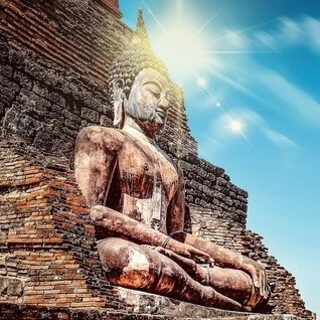
Maybe you have seen a state of a Brahma,
As it is stated,
We have here also in the temple,
And it looks a little bit like the Buddha sitting there,
But it has four faces,
Maybe you have a sort of face into all four directions.
So this is the symbol for this,
For Brahma Viharas.
And one of them is,
Of course,
Is upekka.
So again,
It's associated with this willingness to help,
But you observe the situation.
If there is a possibility to help,
You immediately do it.
So this compassion,
This loving kindness is there,
This sympathetic joy is there,
And this openness to help.
But you still observe,
If there's nothing you can do,
You just observe.
So this is upekka.
If I can't do anything,
Then I have to be with upekka or with equanimity.
Then the upekka can also be seen as kind of what we call supervision nowadays,
A modern word,
More or less used in psychology or whatever,
The supervision.
You have an overview over the things that happen.
You could see it like a man that sits on a chariot and holds the reign of the horses in his hands.
This man,
He's observing.
He's observing,
Do the horses run the same tempo as they are running even?
He's observing the road so that everything goes well.
And if everything goes well,
He's just holding the reins and observes.
He's not acting.
He doesn't have to act.
He just observes.
And it doesn't say he's careless and just dreams or whatever,
But he's observant.
He watches the horses.
He watches the road.
And when there is necessity to act,
To do something,
Then he's doing it.
But if there is none,
If they run even if all the factors come together in the right way,
Then he doesn't have to act.
So this is also a bit of a comparison to equanimity or upekka when we speak about supervision.
Then equanimity is also very important in absorption practice.
When you practice jhana or deep concentration meditation,
Then equanimity is absolutely necessary.
It's not working without it.
And in this case,
The power of equanimity is this.
It has this characteristic of stability,
Of indelibility.
It's there and nothing can bring it out of balance.
It cannot be disturbed by any kind of sense,
Impressions or inner feelings.
It's just stable there.
And finally,
Upekka or equanimity is a parami.
That's why I talk about it today as the tenth parami.
And also what we call in Bali Bojanga,
A factor of enlightenment.
So it's a part of this enlightenment factor which has to come together to reach liberation and freedom.
And in this case,
Its function is having this equanimity serenity,
The ability to remain normal.
Whatever is there,
Whatever situation is there,
Whatever the circumstances in life are,
You stay,
You remain serene and normal.
That's the function of upekka in parami and the bhojangas.
Then I have to speak a little bit about upekka and the eight worldly dhammas or the loka dhammas.
To practice upekka is to be unwavering or to stay neutral in the face of the eight worldly dhammas,
Which are loss and gain,
Good repute or ill repute,
Praise and blame,
Sorrow and happiness.
These are the eight worldly dhammas or sometimes also called the eight worldly winds.
So equanimity keeps you stable,
Whatever is there.
If they praise you or if they blame you,
Equanimity doesn't allow you to get out of balance,
Get very happy about praise or very unhappy about blame.
It can always change.
Then the Buddha said it's amidst those eight worldly dhammas,
Amidst loss and gain,
Good repute,
Ill repute,
Praise and blame,
Sorrow and happiness.
You remain like a strong big tree.
And these worldly dhammas are like eight worldly winds that blow.
But the tree that it's not unrooted to it,
It's staying stable,
Whatever is coming to it.
So it's a very good comparison to equanimity by the Buddha.
Equanimity has close and far enemies like everything else.
So the far enemy of upekka is greed and also resentment or anger.
Far enemy because they are very different.
It's obvious that they are not equanimous.
When you are angry or there's a very strong desire,
You know you are not in equanimity.
And there is a near enemy and that is indifference and apathy.
And they close enemies because they seem to be very similar to equanimity.
It seems there is equanimity when you are indifferent,
But they are very far from it as well.
Because as I said before,
Indifference doesn't have these moral principles or there is just like you don't care.
Whereas equanimity still has this radiance of warmth and the wish to help other beings,
But with equanimity.
And then finally,
I want to read something for you that I find very useful.
And it is Bhikkhu Bodhi who wrote that part about upekka or equanimity.
He says,
The real meaning of upekka is equanimity,
Not indifference in the sense of unconcern.
For others,
As a spiritual virtue,
Upekka means stability in the face of the fluctuations of worldly fortune.
It is evenness of mind,
Unshakable freedom of mind,
Unshakable freedom of mind,
A state of inner balance that cannot be upset by gain and loss,
Honor and dishonor,
Praise and blame,
Pleasure and pain.
So the lokadamas.
Upekka is freedom from all points of self-reference.
It is indifference only to the demands of the ego-self with its graving for pleasure and position,
Not to the well-being of one's fellow human beings.
True equanimity is the pinnacle of the four social attitudes that the Buddhist text calls the divine abbots or the brahma-viharas,
Boundless,
Lovingkindness,
Metta,
Compassion,
Karuna,
Altruistic joy,
Mudita,
And equanimity,
Upekka.
So the last does not override and negate the preceding tree,
But rather perfects and consummates them.
I think this is very beautifully said and it contains all this knowledge about upekka.
So yeah,
It's very important and I really want to finish this talk about upekka now and really wish you a lot of upekka in the situations that you're in right now,
With COVID or whatever,
Or with seeing how the environment is destroyed and global warming or whatever,
Or kind of political troubles in this world.
I wish for all of you to keep upekka,
Like an equanimous mind,
Because it will give you more power of mind.
And if you have more power,
Then you're also able to help others and be more useful for this world.
So I wish that from my heart and I hope you have a nice day and I hope to see you again soon.
Bye.